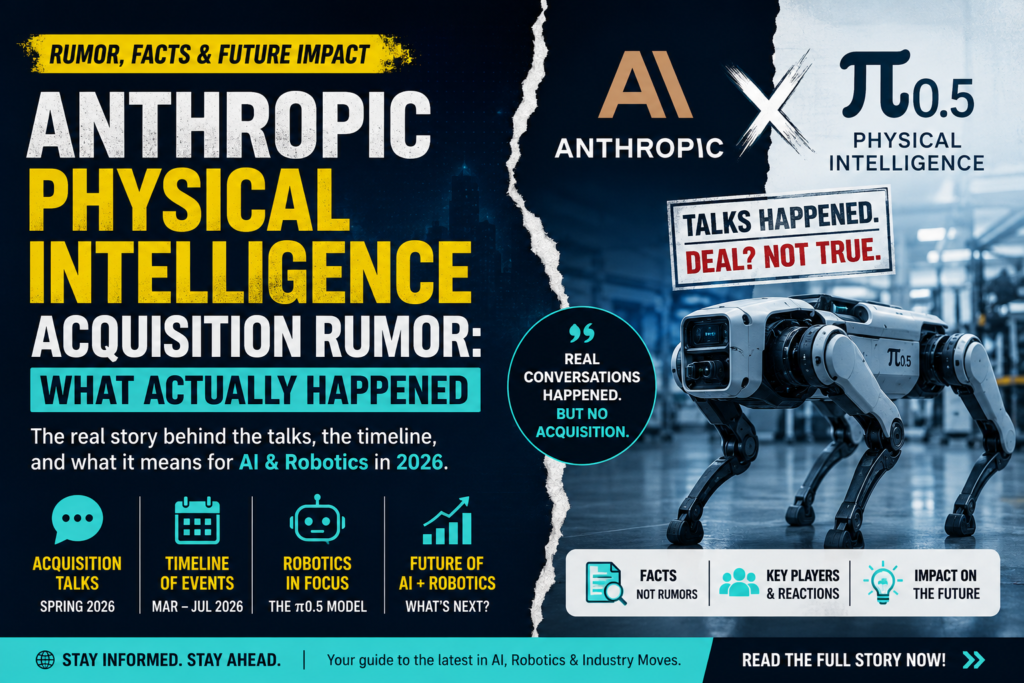
A weekend rumor claiming Anthropic had acquired robotics startup Physical Intelligence turned out to be only half wrong — the two companies really did hold acquisition talks this spring, even though no deal was ever announced. The Anthropic Physical Intelligence acquisition story exploded across AI Twitter in July 2026 after blogger Robert Scoble posted about it, and even a denial from Physical Intelligence’s CEO wasn’t enough to kill the speculation.
If you’re trying to understand what’s real, what’s rumor, and why any of this matters for the future of AI and robotics, this breakdown covers everything confirmed so far.
What Sparked the Anthropic Physical Intelligence Acquisition Rumor
The rumor began over a weekend in July 2026, when tech blogger Robert Scoble posted on X claiming Anthropic had bought robotics startup Physical Intelligence outright. The post spread fast, partly because it landed in an environment where AI acquisitions have become routine. Anthropic and OpenAI have each been on aggressive buying sprees throughout 2026, snapping up developer tooling companies, AI services shops, and product-testing startups to turn raw model capability into enterprise revenue.
Against that backdrop, a claim about the Anthropic Physical Intelligence acquisition didn’t seem far-fetched at all. What made it stand out wasn’t the plausibility — it was the specificity, and the fact that it named a company with real weight behind it.
The Bigger Acquisition Backdrop
To understand why this particular rumor landed so hard, it helps to look at the sheer volume of AI dealmaking happening in 2026. Anthropic has made four known acquisitions this year alone, while OpenAI has been considerably more aggressive, acquiring at least 17 companies since 2023. Both labs are using acquisitions the same way: converting raw model capability into enterprise-ready products faster than they could by building everything in-house.
Both companies are also racing toward the public markets at the same time. Anthropic confidentially filed for an IPO on June 1, 2026, and OpenAI followed roughly a week later — setting up what could become two of the largest U.S. stock market debuts in history. Against that kind of high-stakes, high-velocity backdrop, a rumor about either lab making a bold acquisition move didn’t need much to catch fire. It fit the pattern investors and reporters had already been watching all year.
Why the Rumor Felt Credible
Three things gave the story legs:
- Physical Intelligence was co-founded by Lachy Groom, an investor-operator whose profile in Silicon Valley has risen sharply in recent years
- The startup has raised more than $1 billion, and was reportedly in talks this spring for another $1 billion round at an $11 billion valuation
- Its π0.5 model is considered one of the more widely used “robot brains” in robotics research today
None of that proves an acquisition happened. But it explains why the claim traveled so quickly through AI circles — the target company was already a known, high-value name.
Timeline: How the Story Unfolded
Understanding the Anthropic Physical Intelligence acquisition story requires separating what happened when. Here’s the sequence, based on reporting from The Information and TechCrunch:
- Spring 2026 — Anthropic and Physical Intelligence reportedly hold acquisition talks, according to The Information. No deal is announced publicly.
- Spring 2026 — Physical Intelligence is separately reported to be in talks for a new $1 billion funding round at an $11 billion valuation, suggesting the company was pursuing independent growth in parallel with any acquisition conversations.
- June 1, 2026 — Anthropic confidentially files for an IPO.
- Early June 2026 — OpenAI follows with its own confidential IPO filing roughly a week later.
- Late May 2026 — Sam Altman makes “OpenAI Robotics” official, announcing the division is hiring and outlining plans for infrastructure robots in the near term.
- June 2026 — Anthropic publishes the second phase of Project Fetch, reporting that a newer Claude model completed robot-dog programming tasks roughly 20 times faster than the best human-plus-Claude team from the prior year.
- Weekend, mid-July 2026 — Tech blogger Robert Scoble posts on X claiming Anthropic acquired Physical Intelligence outright. The claim spreads rapidly across AI Twitter.
- Following Monday — Physical Intelligence CEO Karol Hausman reportedly tells employees internally, via a Slack message featuring a GIF, that the reports aren’t true. Groom does not respond to TechCrunch’s request for comment.
Laid out this way, the pattern is clear: real conversations happened months before the rumor went viral, and the public version of the story compressed “talks” into “acquisition” — a small but important distortion that still captured something true about Anthropic’s ambitions.
Who Is Physical Intelligence?
Physical Intelligence is a San Francisco-based robotics startup founded roughly two years ago by Lachy Groom, along with former Google researchers and professors from Stanford and Berkeley. The company builds general-purpose “robot brains” — AI models designed to let robots figure out physical tasks they weren’t explicitly trained to do.
Founders and Funding
Groom’s background as a Stripe veteran-turned-investor gave Physical Intelligence early credibility with top-tier venture firms. Its investor base includes Khosla Ventures and Thrive Capital — names that also appear prominently in OpenAI’s own cap table. Founders Fund, another major OpenAI investor, was reportedly involved in Physical Intelligence’s most recent funding round earlier this year.
That overlapping investor base is not a minor detail. It becomes central to understanding why any Anthropic Physical Intelligence acquisition would be legally and politically complicated, which we’ll get to shortly.
The π0.5 Robot Brain
What is π0.5? It’s Physical Intelligence’s flagship robotics model, designed to help robots complete tasks they were never explicitly taught. Rather than programming a robot for one narrow function, π0.5 aims to give machines the kind of adaptable, generalized understanding of the physical world that today’s large language models bring to text.
That generalization is exactly what makes Physical Intelligence attractive to a company like Anthropic, whose own models are built almost entirely on text, code, and digital reasoning rather than physical embodiment.
Did Anthropic Really Hold Acquisition Talks?
Yes — according to The Information, Anthropic and Physical Intelligence did hold acquisition talks this spring, even though the deal never closed and no formal transaction was confirmed. That single fact is what separates this story from a baseless rumor. Scoble may have gotten the specifics wrong — claiming a completed acquisition rather than an exploratory conversation — but he wasn’t wrong that something had happened between the two companies.
Physical Intelligence’s public response to the rumor didn’t exactly read as an emphatic denial, either. Per The Information’s reporting, CEO Karol Hausman told employees internally via Slack that the reports weren’t true — and reportedly did so with a GIF of a character from “The Office” shaking her head no, rather than a formal statement. Groom himself did not respond to requests for comment sent Monday night following the weekend rumor.
That combination — a confirmed round of talks, paired with a casual internal denial and founder silence — is exactly why the Anthropic Physical Intelligence acquisition conversation refused to die down, even after the initial claim was debunked.
Why Would Anthropic Want to Buy a Robotics Startup?
The short answer: physical-world understanding may be a prerequisite for building superintelligent AI systems, and no amount of internet text can substitute for it. Anthropic has spent 2026 filing for an IPO, closing acquisitions, and racing OpenAI on nearly every front — robotics is arguably the one major capability gap left on the board.
Project Fetch and Anthropic’s Robotics Research
Unlike OpenAI, Anthropic hasn’t built a hardware lab of its own. What it has done instead is run internal research through a group that stress-tests frontier model capabilities for safety purposes. The clearest example is Project Fetch:
- November 2025 — Anthropic staff tested how much Claude could help a non-expert program a robot dog to complete physical tasks
- June 2026 — A second phase of the project found that a newer Claude model completed the same tasks roughly 20 times faster than the best human-plus-Claude team from the year before
That kind of internal capability jump is a strong signal Anthropic sees real strategic value in physical-world reasoning — and that building it from scratch, versus acquiring a team that’s already solved core parts of the problem, is now a live question inside the company.
OpenAI’s Rockier History With Robotics
It’s worth noting that OpenAI’s own path into robotics wasn’t a straight line, and it offers useful context for why Anthropic might prefer to acquire rather than build from scratch. OpenAI built an early robotic hand capable of solving a Rubik’s Cube, then shut its entire robotics group down in 2021. Co-founder Wojciech Zaremba later said the approach at the time was missing pieces needed for real superintelligence — the hardware and simulation techniques simply weren’t mature enough yet.
The team quietly came back together in 2024, building a humanoid robotics lab in San Francisco largely out of public view, before Altman made it official in late May 2026 with the “OpenAI Robotics” announcement. That multi-year detour — shutting a division down, then rebuilding it years later — is exactly the kind of expensive, slow-moving cycle that an acquisition can help a rival avoid. It’s a strong part of the logic behind why Anthropic exploring a deal for an already-functional robotics team like Physical Intelligence’s makes strategic sense, even without a completed transaction.
Buying Expertise vs. Building It
Acquiring an existing robotics team lets a company skip years of foundational research. Physical Intelligence already has a working general-purpose robot model, a research team pulled from Google, Stanford, and Berkeley, and a body of published work in the space. For Anthropic, buying that expertise outright would compress a multi-year R&D timeline into a single transaction — which is likely part of what made the idea worth exploring in the first place, even without a completed deal.
OpenAI’s Complicated Stake in the Deal
Here’s where the story gets genuinely tangled: OpenAI is itself an investor in Physical Intelligence. That means any serious Anthropic Physical Intelligence acquisition attempt wouldn’t just be a straightforward two-party negotiation — it would involve a company effectively helping fund a potential asset for its biggest rival.
Do Early Investors Have a Say?
This raises a real legal question. Strategic investors — particularly ones as sophisticated as OpenAI and its backers — sometimes negotiate for information rights or a right of first refusal over any future sale of the company they’ve invested in. If OpenAI secured either provision when it invested in Physical Intelligence, it could have real leverage over whether Anthropic — or anyone else — is allowed to acquire the startup at all.
That possibility flips the entire narrative. Rather than Anthropic simply outbidding rivals for a hot robotics team, OpenAI — already a shareholder, already close to Groom through the existing investment, and already racing to build its own robotics division — may have the stronger claim to Physical Intelligence than Anthropic does.
TechCrunch reported it asked OpenAI directly about these questions; the company did not respond.
Anthropic vs. OpenAI: Robotics Strategy Compared
The two leading AI labs are approaching physical-world AI from almost opposite directions. Here’s how their robotics strategies stack up heading into their respective IPOs:
| Factor | Anthropic | OpenAI |
|---|---|---|
| Hardware lab | None built to date | Humanoid robotics lab in San Francisco (built quietly since 2024) |
| Public robotics announcement | No formal division announced | “OpenAI Robotics” made official by Sam Altman in late May 2026 |
| Approach so far | Internal research (Project Fetch) testing Claude’s ability to assist robotics tasks | Direct hardware development, hiring for infrastructure and humanoid robots |
| Stake in Physical Intelligence | Reportedly held acquisition talks this spring | Existing investor in the company |
| 2026 acquisition activity | 4 known acquisitions | At least 17 acquisitions since 2023 |
| IPO status | Confidentially filed June 1, 2026 | Confidentially filed one week later |
| Long-term robotics goal | Not publicly stated | Altman has described a “personal robot for everyone” as the eventual goal |
The contrast is telling. OpenAI has been visibly building toward robotics for years, including an early robotic hand that solved a Rubik’s Cube, a full team shutdown in 2021, and a quiet relaunch in 2024 before this year’s public announcement. Anthropic’s approach has stayed almost entirely internal and safety-research-focused — until this spring’s reported talks with Physical Intelligence suggested it might be ready to move faster.
What This Means for the AI Robotics Race
Robotics has quietly become one of the most contested fronts in the AI industry, and the Anthropic Physical Intelligence acquisition talks are a signal that both major labs now see physical-world reasoning as core to their long-term roadmaps — not a side project.
A few takeaways worth tracking:
- Physical-world data is the next frontier. Text and code have largely been mined out as training data sources; robotics offers a new, physically grounded data stream that neither lab can easily substitute for.
- M&A is the fastest path to capability. With both companies racing toward IPOs, buying existing expertise is faster than building internal teams from zero — which is exactly why acquisition talks, even unconfirmed ones, carry real signal.
- Investor entanglement will shape who wins deals. OpenAI’s existing stake in Physical Intelligence shows how tightly the AI funding ecosystem is interconnected — the same VCs and strategic investors often sit across the table from both major labs.
- Public denials aren’t always reliable signals. Physical Intelligence’s casual internal denial, paired with confirmed talks reported elsewhere, shows how much nuance gets lost once a story goes viral.
Frequently Asked Questions
Did Anthropic actually acquire Physical Intelligence? No. There is no confirmed acquisition. Anthropic and Physical Intelligence reportedly held acquisition talks this spring, according to The Information, but no deal was announced or confirmed by either company.
Who founded Physical Intelligence? Physical Intelligence was founded roughly two years ago in San Francisco by Lachy Groom, along with former Google researchers and professors from Stanford and Berkeley.
What is Physical Intelligence’s valuation? The company was reportedly in talks this spring for a new $1 billion funding round at an $11 billion valuation, on top of more than $1 billion already raised.
Is OpenAI involved with Physical Intelligence? Yes. OpenAI is an investor in Physical Intelligence, which complicates any potential acquisition by a rival like Anthropic, since strategic investors sometimes hold rights of first refusal or information rights over future sales.
Does Anthropic have its own robotics division? Not in the way OpenAI does. Anthropic hasn’t built a hardware lab; instead, it has run internal research like Project Fetch, testing how well Claude can assist humans with physical robotics tasks.
What is OpenAI’s robotics strategy? OpenAI quietly rebuilt a robotics team starting in 2024 and made “OpenAI Robotics” official in May 2026, with a near-term focus on robots for infrastructure work and a long-term goal of a personal robot for everyone.
What is Project Fetch? Project Fetch is Anthropic’s internal research initiative testing how well Claude can help non-experts complete physical robotics tasks, such as programming a robot dog. A second phase in June 2026 found a newer Claude model completed the same tasks roughly 20 times faster than the best human-plus-Claude team from the prior year.
Why does robotics matter for AI labs racing toward superintelligence? Many researchers believe physical-world understanding is a prerequisite for building truly general, superintelligent AI systems, since internet text alone can’t teach a model how objects, forces, and physical cause-and-effect actually behave. That’s a core reason both Anthropic and OpenAI are investing in robotics capability now, ahead of their respective IPOs.
The Bottom Line
The Anthropic Physical Intelligence acquisition rumor turned out to be a case of directionally correct information wrapped in an incorrect headline. No acquisition happened — but real talks reportedly did, and that alone confirms robotics has become a genuine strategic priority for Anthropic, not just an area it watches from the sidelines. With OpenAI already invested in Physical Intelligence and building its own hardware lab, and Anthropic reportedly circling the same target, the next chapter of the AI robotics race may be decided as much by cap tables and investor rights as it is by research breakthroughs.
Meta Description: Anthropic held real talks to acquire robotics startup Physical Intelligence this spring — here’s what’s confirmed, denied, and still unclear.
Slug: anthropic-physical-intelligence-acquisition-rumor