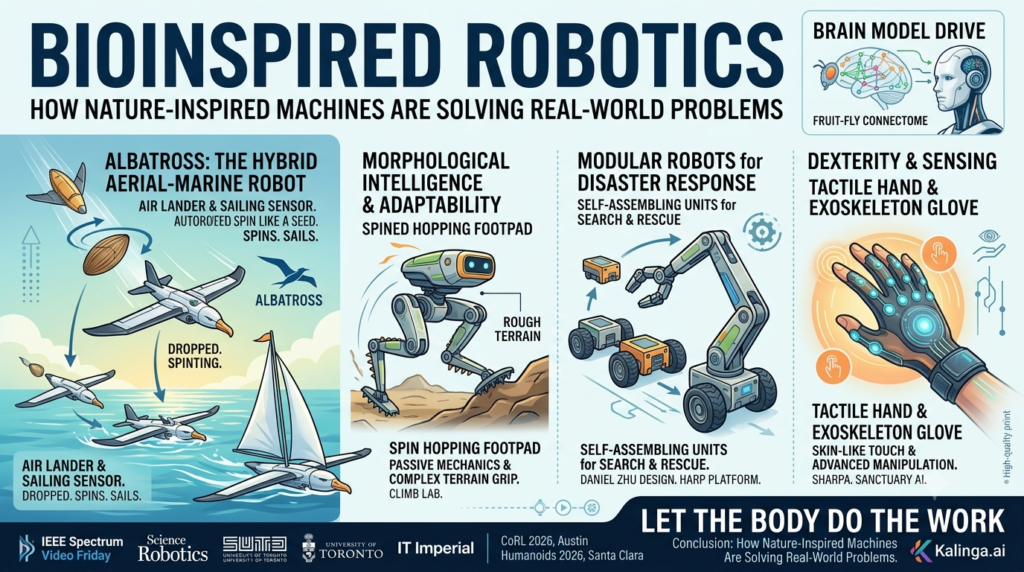
A robot that is dropped from the air, spins down to the water like a falling seed, rights itself after landing, and then sails away on the same wings it fell with sounds like science fiction. It is a real research result published in Science Robotics, and it is a good snapshot of where the field is heading. Bioinspired robotics is the practice of designing robots by borrowing strategies that animals, plants, and nervous systems evolved, and in 2026 it is shifting from lab curiosity to a practical toolkit for disaster response, ocean sensing, and dexterous manipulation.
This guide explains what the field is, why it matters now, and what a single week of robotics news reveals about its direction. It draws on the October 2026 Video Friday roundup from IEEE Spectrum, which featured a self-righting hybrid aerial-marine robot, a spined hopping foot, a high-school-built modular arm, and a humanoid driven by a fruit-fly brain model. Each section below stands on its own, so you can jump to the part you need.
What Is Bioinspired Robotics?
Bioinspired robotics is an engineering discipline that takes a working solution from biology, such as a body shape, a way of moving, or a control strategy, and re-implements it in a machine. The goal is not to copy nature exactly. The goal is to extract the principle that makes the biological solution effective and apply it with metal, plastic, sensors, and software.
Evolution has spent hundreds of millions of years testing designs under real-world constraints: limited energy, unpredictable terrain, damage, and competition. Engineers working in bioinspired robotics treat those results as a library of tested ideas. A gecko’s grip, an insect’s leg, a bird’s wing, and a fly’s visual system have each inspired machines.
Three traits usually define work in this area:
- Function over form. The robot borrows what an animal does, not necessarily what it looks like.
- Passive mechanics first. Clever structures handle tasks that would otherwise require motors and code.
- Robustness in messy environments. Designs are judged outdoors, on rough ground, in wind, or in water, not only on a clean lab floor.
How Do Bioinspired, Biomimetic, and Biohybrid Robots Differ?
Bioinspired robots take a principle from nature, biomimetic robots try to reproduce a specific organism closely, and biohybrid robots combine living tissue with engineered parts. The terms overlap in everyday use, but the distinction helps when you are searching for research or choosing a design approach.
A hopping robot with a spined foot is bioinspired because it borrows a traction idea. A robotic fish built to match a real fish’s fin motion is biomimetic. A machine powered by living muscle cells is biohybrid. Most robots discussed in this article are bioinspired robots in the first sense: they apply a biological idea without trying to be a replica.
Why Does Bioinspired Robotics Matter Now?
Bioinspired robotics matters now because the hardest problems left in robotics, such as unstructured terrain, energy efficiency, and safe physical interaction, are exactly the problems animals already solve well. Factory robots succeeded by controlling the environment. Robots that must leave the factory cannot count on that control.
Three pressures are pushing the field forward at the same time. First, disaster response and environmental monitoring need machines that work where roads, bridges, and power have failed. Second, battery limits make energy efficiency a design requirement rather than a nice-to-have. Third, the rise of physical AI, meaning AI models that act through bodies, has renewed interest in what a good body looks like.
The last point is easy to miss. A smarter controller does not fix a clumsy body. Researchers increasingly argue that better bodies make learning easier, and bioinspired robotics supplies the design vocabulary for those bodies.
Case Study: ALBATROSS, the Hybrid Aerial-Marine Robot
ALBATROSS, short for Airborne Lander with Buoyant AuToROtating Sailing Sensor, is a hybrid aerial-marine robot from the AIR Lab at the Singapore University of Technology and Design that can be released from the air, descend without a parachute, right itself on the water, and sail using its own wings. The work was published in Science Robotics and featured by IEEE Spectrum on 2 October 2026.
How Does ALBATROSS Work?
ALBATROSS uses one set of rigid wings for three jobs: spinning descent, post-landing recovery, and sailing. After release, it autorotates, the self-spinning descent familiar from falling seeds and helicopter rotors, which slows its fall without a parachute. Once it lands on water, it passively rolls upright without a dedicated righting motor. It then repurposes the same wings as sails and navigates using the wind, with minimal actuation.
The robot is also a clear example of a hybrid aerial-marine robot done with restraint. Rather than bolting together a drone, a boat, and a parachute, the team let a single structure carry the whole mission.
Why Does ALBATROSS Matter for Ocean Sensing?
It matters because it points toward cheap, fast-to-deploy platforms that can then stay at sea using wind instead of batteries. The researchers describe their interest in combining rapid aerial deployment with persistent, energy-efficient marine sensing. A sensor that can be dropped into a remote patch of ocean, then drift and sail for a long time, could support environmental monitoring, storm tracking, and coastal surveys.
For anyone studying the field, ALBATROSS is a clean teaching example. The design philosophy is visible in the hardware: reduce parts, reuse structure, and let physics do the work.
What Is Morphological Intelligence?
Morphological intelligence is the idea that a robot’s physical shape and materials can perform part of the “thinking” and control, reducing what software and motors must do. It is also called morphological computation in research circles. The concept explains why the field keeps returning to simple, passive mechanisms.
Consider how an animal’s leg springs back after a step. The tendon stores and releases energy without the brain issuing a command for every instant. Engineers aim for the same effect with compliant joints, flexible feet, tuned masses, and shaped wings.
ALBATROSS shows morphological intelligence in the air and on the water. The wing geometry creates the spinning descent, the weight distribution creates self-righting, and the same geometry catches the wind. Fewer actuators mean fewer failure points, lower weight, and less energy use.
The practical payoff is reliability. A machine whose body does the heavy lifting degrades gracefully, because the physics keeps working even when a sensor drifts or a control loop glitches.
Hopping Robots and Terrain-Adaptive Feet
A compliant, spined footpad can help a hopping robot land and grip on uneven or slippery ground by self-aligning with the surface and digging in. The CLIMB Lab at the University of Toronto presented exactly this design: a planar foot on a compliant spherical joint, with embedded spines for traction.
The compliant joint lets the foot tilt to match the ground at impact, so the robot does not need to compute the perfect landing angle. The spines add grip on surfaces where a smooth sole would slide. The combination echoes how many animals cope with rough terrain, using flexible joints for alignment and small hooks or claws for purchase, though the lab frames it as a terrain-adaptability improvement rather than a copy of a particular species.
Hopping is attractive because it can cross gaps and obstacles that wheels cannot, and it can be energy efficient when springs recycle energy between jumps. The foot is often the weak link, since a hopper only works if every landing is survivable. Better feet make better hoppers, which is why a small design like this one is a meaningful step forward.
Modular Robots for Disaster Response
Modular robots for disaster response split a machine into smaller units that travel separately and then combine into something stronger on arrival. This approach tackles a real contradiction in rescue robotics: small robots fit through rubble but cannot move heavy debris, while large arms are strong but cannot get in.
How Does a Self-Assembling Robot Arm Work?
A self-assembling arm travels as separate wheeled modules and docks into a single arm at the destination. A Canadian high school student, Daniel Zhu, built a low-cost version with disaster response in mind. His design uses three wheeled modules that move independently and then connect with a spring-lock docking mechanism.
The project matters beyond its novelty. It shows that a meaningful idea in modular robots for disaster response does not require a million-dollar lab. A student with a clear problem statement and an elegant mechanical trick produced a concept that professional teams would recognize. Biology offers a parallel: colonies of ants link their bodies into bridges and rafts, then disperse again.
What Is HARP?
HARP, the Heterogeneous Aerial Robotic modules Platform from the General Robotics Lab, is a system in which independently deployable aerial robots physically reconfigure to combine their capabilities. In many robot teams, each member’s role is fixed for the whole mission. HARP aims to let the team change its physical makeup in the field, so complementary abilities can be merged when a task demands it.
Taken together, the arm and HARP show a trend. Instead of one big universal machine, researchers are building teams of simple parts that assemble on demand. That is a natural fit for biology-led design, because swarms, colonies, and flocks are among nature’s most successful strategies.
What Happens When a Fruit-Fly Brain Model Drives a Humanoid?
A team at IT Imperial connected a published connectome of a male fruit fly, called MaleCNS, to a Unitree G1 humanoid, creating a closed loop from camera input to neural model to robot movement. The robot’s stereo camera supplies images, which are converted into a form suited to the fly’s visual system. A computational model of the reconstructed nervous system processes the signal, and the output is decoded into motor commands.
This experiment sits at the far end of the field: it borrows not a body or a gait but a wiring diagram. It is worth being precise about what it shows. It demonstrates that a biological network can be wired into a real-time robot loop. It does not demonstrate that the robot behaves like a fly, or that a fly’s circuitry is a good controller for a humanoid body.
Still, connectomics gives researchers a new kind of design reference. As more complete maps of nervous systems become available, expect more attempts to test which biological circuits transfer usefully to machines and which do not.
Tactile Hands and the Race for Dexterity
Dexterity is the next frontier for bioinspired robotics, because human and animal hands combine touch sensing with fine motor control in a way robots still struggle to match. The same Video Friday roundup highlighted several dexterity efforts, showing how crowded the area has become.
At the IROS conference, the company Sharpa unveiled three products: D01, a tactile-sensing robot built for dexterous manipulation; W02, an ultracompact tactile hand; and AE01, a haptic exoskeleton data glove used to capture human demonstrations. Sanctuary AI published an explainer on how robotic hands and physical AI work together. Boston Dynamics argued that its commercial track record with Spot and Stretch positions its Atlas humanoid to win the humanoid race, a claim that remains to be tested.
The common thread is touch. Vision alone cannot tell a robot how hard it is squeezing a fragile object. Tactile sensing, inspired by skin and nerve endings, closes that gap. Teleoperation gloves like AE01 matter because they let humans demonstrate skilled manipulation that machine learning systems can then imitate.
Bioinspired vs Conventional Robot Design: A Comparison
Bioinspired design trades the predictability of conventional engineering for adaptability, efficiency, and graceful failure. The table below summarizes the practical differences.
| Criterion | Conventional robot design | Bioinspired approach |
|---|---|---|
| Design starting point | Task specification and standard components | A biological solution to a similar problem |
| Handling of rough terrain | Sensors and software compensate | Compliant structures adapt passively |
| Energy use | Often high, motor-driven | Often lower, uses stored and recycled energy |
| Part count | Separate systems per function | Shared structures serve multiple functions |
| Failure behavior | Abrupt when a subsystem fails | More graceful, physics keeps helping |
| Best-fit environment | Controlled, predictable | Unstructured, changing |
| Main drawback | Brittle outside its design conditions | Harder to model, tune, and verify |
Neither approach wins everywhere. A warehouse robot on a flat floor does not need a bioinspired foot. A robot crossing a debris field does.
Which Bioinspired Robots Were in This Week’s Roundup?
The October 2026 Video Friday roundup featured at least six projects that illustrate different layers of bio-inspired design: body, foot, team, brain, and hand. The table maps each to its core idea.
| Robot or project | Group | Core idea | Intended use |
|---|---|---|---|
| ALBATROSS | Singapore University of Technology and Design | One set of wings for autorotation, self-righting, and sailing | Rapid deployment and long-duration ocean sensing |
| Spined hopping footpad | CLIMB Lab, University of Toronto | Self-aligning compliant foot with traction spines | Hopping on uneven or slippery terrain |
| HARP | General Robotics Lab | Aerial modules that physically reconfigure | Adaptable field operations |
| Self-assembling arm | Daniel Zhu | Wheeled modules that dock into one arm | Low-cost disaster response |
| Fruit-fly-driven humanoid | IT Imperial | Connectome-based neural model controlling a robot | Brain-to-robot research |
| Tactile hand and glove | Sharpa | Touch sensing for manipulation and demonstration capture | Dexterous manipulation |
What Are the Limits of Bioinspired Robotics?
The main limits are modeling difficulty, scalability, and the gap between a convincing demo and a dependable product. Biological systems are complex, and borrowing one feature without the rest can produce surprises. A passive design that works in a tank may behave differently in a storm.
Hype is a related risk. The roundup’s own editor voiced fatigue with humanoid publicity stunts, a useful reminder that a viral video is not a deployment. When you read about a new robot, ask three questions: what problem does it solve better than a conventional machine, under what conditions was it tested, and what happens when it fails?
Verification is also harder. Conventional controllers can be analyzed with established tools. Compliant, passive mechanisms often require physical testing across many conditions before anyone trusts them in the field. That slows adoption, but it does not diminish the value of the approach.
Why Bioinspired Robotics Matters in India
For India, bioinspired robotics is relevant because the country faces frequent floods, cyclones, and coastal hazards where light, low-cost, adaptable machines can help. The roundup included a story about drone pilots in Nepal who mapped flood damage, supported search teams, and delivered supplies after the floods of 26 August 2026. Community-led drone response of this kind is a model other flood-prone regions can learn from, including river basins and coastal districts across eastern India.
Three opportunities stand out for Indian students and builders:
- Low-cost modular design. The self-assembling arm shows that a disaster-response concept can start with modest hardware and a sharp idea.
- Coastal and ocean sensing. Wind-powered, self-righting platforms in the spirit of ALBATROSS could be relevant to a long coastline.
- Open skills pathway. Robotics, embedded systems, and AI control are accessible through coursework, competitions, and open-source tools.
India’s talent pipeline in AI and electronics is large. Pairing that talent with the design thinking behind this field could produce solutions tuned to local conditions rather than imported ones.
How Can You Follow Bioinspired Robotics Developments?
The fastest way to follow the field is to track a few conferences, a few journals, and a weekly roundup. Upcoming events listed in the same roundup include CoRL 2026, scheduled for 9 to 12 November 2026 in Austin, and Humanoids 2026, scheduled for 6 to 9 December 2026 in Santa Clara, California. Journals such as Science Robotics regularly publish peer-reviewed work in this area, and IEEE Spectrum’s Video Friday offers a weekly digest of new videos.
A practical routine looks like this:
- Read one weekly roundup to spot new projects.
- Open the linked paper or lab page for any project that interests you.
- Note the biological principle, the environment tested, and the stated limitation.
- Revisit the lab a few months later to see whether the work progressed.
Frequently Asked Questions About Bioinspired Robotics
What is bioinspired robotics in simple terms?
It is building robots that use ideas borrowed from living things, such as how they move, sense, or organize, to work better in real environments. The robot need not look like an animal. It only needs to use the useful principle.
What are examples of bioinspired robots?
Examples include ALBATROSS, a self-righting sailing robot; hopping robots with compliant spined feet; modular robots that dock into larger arms; and tactile robotic hands. Each borrows a different principle, from autorotating descent to touch sensing.
How is bioinspired robotics different from AI?
Bioinspired robotics focuses mainly on the robot’s body and mechanics, while AI focuses on software that perceives and decides. The two increasingly work together, since a well-designed body makes it easier for an AI controller to learn useful behavior.
What is the biggest challenge in bioinspired robotics?
The biggest challenge is turning a promising prototype into a reliable, repeatable system outside the lab. Biological designs are hard to model fully, and passive mechanisms need extensive physical testing before field use.
Can students work on bioinspired robotics projects?
Yes, and the self-assembling arm built by a high school student is a clear example. Start with a specific problem, pick one biological principle, and build a small mechanical prototype before adding software.
Conclusion: Let the Body Do the Work
The common message across ALBATROSS, the spined foot, modular arms, and tactile hands is simple: good bodies make hard problems easier. This approach offers a disciplined way to find those bodies by learning from solutions that nature has already tested.
The field is still young, and many of its best results remain prototypes. But the direction is clear. Expect more passive mechanisms, more reconfigurable teams, more touch sensing, and more careful borrowing from biology. For students, founders, and engineers, now is a good time to learn the principles.
Want more explainers on AI, robotics, and emerging technology written for learners in India? Explore the latest guides and workshops on Kalinga.ai.