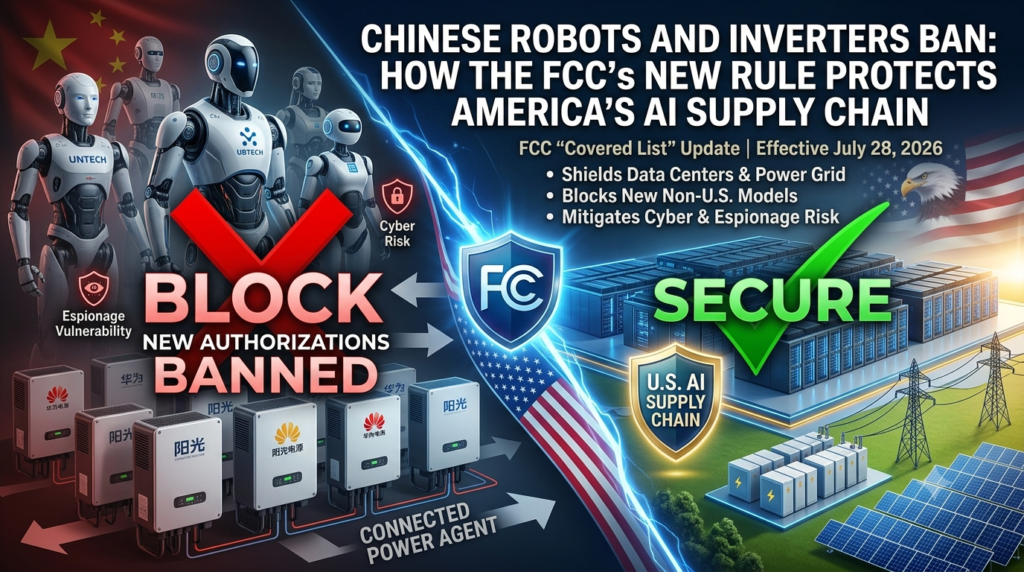
Chinese Robots Ban is now official: on July 28, 2026, the Federal Communications Commission added foreign-made humanoid robots, quadruped robots, and connected power inverters to its national security “Covered List,” blocking new models from receiving the authorization they need to be imported, marketed, or sold in the United States. The move is designed to shield the physical backbone of America’s AI buildout — data centers, power grids, and robotics supply chains — from Chinese cyber and espionage risk.
If you build, invest in, or write about AI infrastructure, this decision affects you more than it might first appear. It is not just a robotics story or a trade story. It is a signal that Washington now treats AI infrastructure hardware — the inverters that power data centers and the robots that will eventually work inside them — with the same urgency it once reserved for telecom equipment and semiconductors.
What Is the Chinese Robots and Inverters Ban?
The Chinese robots and inverters ban is an FCC action that adds two new categories of foreign-made equipment — “advanced robotic devices” (humanoids and quadrupeds) and connected power inverters — to the agency’s Covered List. Equipment on this list cannot receive the FCC authorization that almost every electronic device needs before it can legally be imported, marketed, or sold in the U.S., effectively closing the door to new models while leaving previously approved devices on the market untouched.
The FCC announced the update on July 28, 2026, following national security determinations from a White House-convened interagency panel that identified the two device categories as national security risks. Notably, the FCC’s rule text does not name China explicitly, even though every signal — from congressional statements to industry context — points squarely at Chinese manufacturers. Chinese Robots Ban
Why This Matters for the US AI Supply Chain
AI data centers depend on two things that rarely make headlines: the electricity that keeps GPUs running and, increasingly, the robots that will maintain and build the physical infrastructure around them. Power inverters sit at the center of that electrical chain. They are the devices responsible for connecting renewable energy sources and battery storage to the grid and to data center equipment. If a hostile actor could remotely disable or manipulate thousands of inverters at once, the impact would ripple straight into the data centers powering frontier AI models.
Robots introduce a parallel risk. Humanoid and quadruped machines are mobile sensor platforms — cameras, microphones, and network radios on legs — that could, in theory, be repurposed for surveillance or remote control if compromised. That is precisely the concern regulators cited when placing the devices on the Covered List.
The FCC Covered List: How the Chinese Robots and Inverters Ban Actually Works
The Covered List is not a new tool. The FCC has used it since 2021, when it was first deployed against Huawei, ZTE, and Hikvision. Since then, the list’s scope has widened well beyond telecom gear.
Timeline of Covered List expansions:
- March 2021 — Huawei, ZTE, and Hangzhou Hikvision Digital Technology added over telecom espionage concerns
- December 2025 — Foreign-made drones added to the list
- March 2026 — Consumer internet routers added over supply-chain security concerns
- July 28, 2026 — Advanced robotic devices (humanoids, quadrupeds) and connected power inverters added, forming the current Chinese robots and inverters ban
Under the Secure and Trusted Communications Networks Act, the FCC cannot add categories to the Covered List on its own initiative. It acts only at the direction of national security authorities, implementing their formal determinations through its device authorization process rather than initiating restrictions independently.
Question: Does the Chinese Robots and Inverters Ban Apply to Devices You Already Own?
No. The Chinese robots and inverters ban is forward-looking only. It blocks new device models from receiving FCC authorization going forward — it does not recall or restrict robots and inverters that individuals, universities, or companies have already purchased and deployed. Retailers can also continue selling previously authorized inventory. The practical effect grows over time: as manufacturers release newer models, those models are frozen out of the U.S. market while older, already-approved units remain legally available.
Question: Does the Ban Apply Only to China?
Technically, no — and this detail matters for anyone drafting content or analysis on the topic. The FCC’s rule text restricts foreign-produced robots and inverters regardless of country of origin, rather than naming China directly. In practice, however, the policy intent and the market reality point at one country. China dominates global manufacturing in both categories, and the national security determinations were driven by Chinese-linked incidents and vulnerabilities.
Why Regulators Targeted Robots and Inverters Specifically
The Inverter Risk: A Grid-Level Vulnerability
Power inverters convert and route electricity between solar panels, batteries, the grid, and data center equipment. Because modern inverters are network-connected for monitoring and firmware updates, they are also remotely accessible — which is exactly what worries national security officials. The interagency panel’s determination warned that inverter connectivity introduces vulnerabilities that could let foreign firms exfiltrate data, remotely disable devices, or exploit them through malware, and that the risk compounds as inverter-based resources spread further across the U.S. grid.
China’s dominance in this market amplifies the concern. Sungrow Power Supply and Huawei — the latter already under heavy U.S. sanctions — are among the world’s largest inverter manufacturers, and Chinese suppliers have been steadily gaining share in Western markets by undercutting on price. European regulators had already begun tightening scrutiny of Chinese inverters before the FCC’s move, driven by similar concerns about disruption and malware installation.
The Robotics Risk: Documented, Not Hypothetical
Unlike some national security actions that rest primarily on precautionary reasoning, the robotics side of this ban points to specific, already-disclosed vulnerabilities. Security researchers had identified backdoors in Unitree robotics hardware deployed at several U.S. research institutions, and a separate Bluetooth-based exploit — capable of spreading from one compromised robot to nearby units without any user action — had already been disclosed publicly before regulators acted. Some Unitree quadrupeds had reportedly seen limited use in U.S. Marine Corps operations, a detail that reportedly added urgency to the congressional push behind the rule.
The scale of Chinese manufacturing in this category is part of what makes the risk feel urgent to U.S. regulators. Unitree has grown from a lab curiosity into a company preparing for a public listing, and its quadrupeds have already seen limited use by U.S. defense-adjacent organizations — a detail that has reportedly drawn Pentagon attention. UBTech Robotics, the Shenzhen-headquartered, Hong Kong-listed rival, posted roughly ¥2 billion yuan (about $295 million) in revenue over a comparable recent period, underscoring how quickly Chinese humanoid manufacturers have moved from prototypes to commercial-scale production. A 2025 report from the International Federation of Robotics identified humanoid robots as a central pillar of China’s national robotics strategy, built around scalable supply chains and early deployment in service industries ahead of broader manufacturing rollout.
That combination — rapid commercial scaling plus documented, unpatched vulnerabilities — is what separates this action from a purely precautionary trade restriction. Regulators were not weighing a hypothetical; they were responding to hardware already found to be exploitable in real institutional deployments.
Key concerns cited in the national security determination:
- Advanced robots collect continuous environmental and behavioral data that could be exploited for surveillance
- Networked robots could theoretically be remotely commandeered by a hostile actor
- Vulnerabilities in one unit could propagate to other connected devices on the same network
- Foreign manufacturers could gain persistent access to sensitive U.S. environments (labs, defense-adjacent sites, corporate facilities) through embedded connectivity
Chinese Robots and Inverters Ban vs. Previous China Tech Restrictions
| Feature | 2021 Huawei/ZTE Telecom Ban | Dec 2025 Drone Ban | Mar 2026 Router Ban | Jul 2026 Robots & Inverters Ban |
|---|---|---|---|---|
| Legal mechanism | FCC Covered List | FCC Covered List | FCC Covered List | FCC Covered List |
| Primary target | Telecom network equipment | Consumer/commercial drones | Consumer internet routers | Humanoid/quadruped robots, connected power inverters |
| Retroactive? | No — new authorizations only | No — new authorizations only | No — new authorizations only | No — new authorizations only |
| Names China explicitly? | Yes | Largely, yes | Largely, yes | No — applies “regardless of nationality of origin” |
| Primary stated risk | Espionage via network infrastructure | Aerial surveillance | Home network compromise | Grid disruption + physical/data surveillance |
| Exemption path | Case-by-case FCC review | Case-by-case FCC review | Case-by-case FCC review | New “Conditional Approval” process via DoW/DHS |
The Conditional Approval Process: A Narrow Path Back to the Market
One new feature distinguishes this action from earlier Covered List expansions: a formal “Conditional Approval” mechanism. Manufacturers of robots or inverters that would otherwise be blocked can seek an exemption if either the Department of War (for robotic devices) or the Department of Homeland Security (for power inverters) determines that a specific device or class of devices does not pose an unacceptable national security risk.
This creates a narrow, agency-controlled path back into the U.S. market — but it shifts the burden of proof onto manufacturers rather than leaving compliance to standard FCC engineering review, which is a meaningfully higher bar than the process used for most consumer electronics.
Political and Industry Reaction to the Chinese Robots and Inverters Ban
Reaction split along familiar lines. FCC Chairman Brendan Carr framed the decision as both a security and economic measure, tying it to the administration’s broader push to reshore critical manufacturing. Representative John Moolenaar, chair of the House Select Committee on China, publicly welcomed the move and has separately pushed legislation that would subject Chinese robots to formal national security review, calling for Congress to codify the policy into law.
Beijing’s embassy in Washington did not immediately respond to requests for comment following the announcement, according to multiple outlets that covered the story.
Industry response has been more mixed. Supporters argue the rule creates breathing room for U.S. robotics and inverter manufacturers to scale before Chinese competitors, who have already achieved significant cost advantages, lock in permanent market dominance. Critics counter that the ban could slow near-term deployment of advanced automation at a moment when the AI buildout desperately needs more physical infrastructure — including the humanoid robots increasingly floated as a solution to data center construction and maintenance labor shortages.
The Reshoring Angle: Economic Security as National Security
Administration officials have been explicit that this policy is not purely defensive. It is also an industrial policy tool. An unnamed administration official framed the rule around the need for independent, secure domestic supply chains in critical and emerging technology categories, tying the action to a broader agenda of reindustrializing U.S. manufacturing rather than treating it as a narrow cybersecurity fix.
That framing matters because it changes how the policy should be read. A pure security rule would likely focus only on network authentication, encryption standards, or firmware verification. A rule built around “economic security is national security” instead uses the same legal mechanism — the Covered List — to accomplish an industrial goal: creating breathing room for nascent U.S. humanoid robotics companies and domestic inverter manufacturers to compete against Chinese rivals that have already achieved substantial cost advantages through years of state-supported scale.
Global Context: The US Isn’t Acting Alone
Europe had already begun tightening its own scrutiny of Chinese-made inverters before the FCC’s July 2026 action, driven by comparable concerns about remote disruption and malware risk in grid-connected equipment. That earlier European movement is part of what prompted U.S. regulators to accelerate their own inverter review. The pattern suggests this is not an isolated American policy experiment but part of a wider, coordinated shift among Western regulators toward treating networked energy and robotics hardware as critical infrastructure requiring the same scrutiny long applied to telecom equipment.
What This Means If You Work in AI, Robotics, or Energy Infrastructure
- Data center operators and developers relying on foreign-made inverters should audit their supply chains now, since new-model imports will face growing restrictions even though currently installed equipment is unaffected.
- Robotics companies and integrators evaluating Chinese humanoid or quadruped platforms should factor in the Conditional Approval bottleneck before committing to new-model procurement.
- US-based robotics and inverter manufacturers gain a meaningful, if temporary, competitive shelter — a dynamic worth tracking for anyone covering the robotics investment landscape.
- Policy and compliance teams should watch for parallel legislative action, since Representative Moolenaar’s push to codify similar restrictions into federal law suggests the Covered List action may be the floor, not the ceiling, of upcoming China tech restrictions.
- Content and market analysts should treat this as part of a pattern, not an isolated event — the FCC has now used the same staged, agency-driven mechanism four times in roughly 16 months, expanding steadily from telecom into drones, routers, and now physical AI hardware.
Frequently Asked Questions
What products does the Chinese robots and inverters ban cover? It covers new foreign-made “advanced robotic devices” — defined as mobile robots including humanoids and quadrupeds — and new foreign-made connected power inverters used in solar, battery, and data center systems.
When did the Chinese robots and inverters ban take effect? The FCC announced and released the measure on July 28, 2026, following national security determinations from a White House-convened interagency panel.
Does the ban affect robots or inverters already installed in the US? No. It only blocks new models from receiving the FCC authorization required for future import, marketing, or sale. Already-approved and already-purchased equipment is unaffected.
Can a Chinese manufacturer still sell robots or inverters in the US after this ban? Only through the new Conditional Approval process, in which the Department of War (for robots) or the Department of Homeland Security (for inverters) must determine that a specific product does not pose an unacceptable national security risk.
Why did regulators link robots and inverters to AI infrastructure specifically? Because both device categories sit inside the physical layer that supports AI data centers — inverters manage the power feeding compute clusters, while robots are increasingly proposed for data center construction, maintenance, and security, making both categories relevant to safeguarding the broader AI supply chain.
Key Takeaway
The Chinese robots and inverters ban extends a security framework the FCC has used since 2021 into an entirely new domain: the physical hardware powering and eventually staffing America’s AI infrastructure. It won’t unplug a single robot or inverter already running today, but it draws a hard line around what gets approved tomorrow — and it signals that Washington now views AI infrastructure security as inseparable from broader supply chain and national security policy. For anyone tracking AI infrastructure, energy security, or U.S.–China tech policy, this is a rule worth watching closely as the Conditional Approval process and any follow-on legislation take shape.