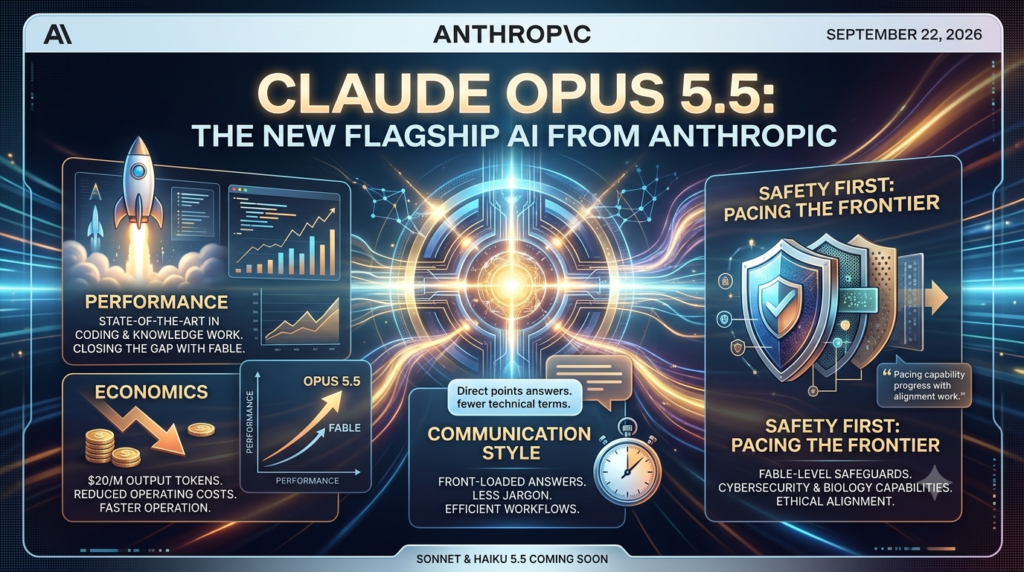
Anthropic released Claude Opus 5.5 on September 22, 2026, and the short answer is this: it’s a faster, cheaper, and more capable version of the company’s top-tier AI model, one that Anthropic says sets a new state-of-the-art in coding and knowledge work performance. If you’re deciding whether to upgrade, switch providers, or simply understand what’s changed, this guide breaks down everything you need to know about pricing, performance, and safety. TechCrunch
Claude Opus 5.5 isn’t just an incremental patch. It arrives with a lower price tag, a notably different communication style, and, perhaps most interestingly, a release philosophy shaped by Anthropic’s public commitment to slow down capability gains in favor of alignment work. Let’s unpack what that actually means in practice.
What Is Claude Opus 5.5?
Claude Opus 5.5 is the newest release in Anthropic’s three-tier Claude model lineup, which also includes Sonnet (a mid-tier model) and Haiku (the fastest, most affordable tier). Opus is the most capable and expensive tier in that lineup, designed for the heaviest reasoning, coding, and knowledge-work tasks. TechCrunch
What makes this release notable is where it lands competitively. According to Anthropic, the release outpaces the larger Fable model on many benchmarks and succeeded at several informal tasks that Fable was unable to complete. In other words, Claude Opus 5.5, a smaller, cheaper model in Anthropic’s lineup, is now matching or beating a model one tier above it in real-world usage. That’s an unusual dynamic in the AI industry, where bigger and newer models almost always cost more. TechCrunch
Definition + Expansion: Claude Opus 5.5 is best understood as a “refresh” release rather than a brand-new model generation. It builds on the architecture and training approach of its predecessor, Opus 5, but applies newer optimization techniques to squeeze out better performance at a lower compute cost, which is exactly why the price dropped alongside the performance gains.
Claude Opus 5.5 vs. Claude Opus 5: What Changed
The launch comes just two months after the release of Opus 5 on July 24, making this one of Anthropic’s fastest turnaround cycles for a flagship model update. Two months is a tight window, and it signals how aggressively Anthropic is iterating on its top-tier model even while publicly discussing the need for caution.
Performance and Benchmarks
The headline change with Claude Opus 5.5 is raw capability. Anthropic has positioned it as the strongest model the company has tested so far, with particular strength in coding tasks and knowledge-work benchmarks. For teams that rely on AI for software development, technical writing, or research synthesis, this matters because Claude Opus 5.5 is reportedly closing, or in some cases surpassing, the gap with Anthropic’s own higher tier, Fable.
A New Communication Style
One of the more subtle but genuinely useful upgrades in Claude Opus 5.5 is how it communicates. The new version makes significant changes to how Opus communicates, using less jargon and putting important information at the start of its messages more often.
Question → Direct Answer: Why does this matter for everyday users? Because it means less time scrolling through preamble to find the actual answer. For professionals using Claude Opus 5.5 in fast-moving workflows, customer support, coding assistance, content drafting, front-loaded, jargon-light responses translate directly into time saved.
Claude Opus 5.5 Pricing: How Much Cheaper Is It?
Cost is often the deciding factor for teams choosing between AI models, and this is where Claude Opus 5.5 makes its clearest statement. Output tokens are charged at $20 per million tokens for Opus 5.5, compared to $25 for the previous model, with other pricing metrics seeing similar reductions. The model is also faster to run, reflecting an overall drop in the compute required to serve it.
Here’s how the two generations compare side by side:
| Feature | Claude Opus 5 | Claude Opus 5.5 |
| Output token price | $25 / million tokens | $20 / million tokens |
| Relative speed | Baseline | Faster |
| Coding/knowledge-work benchmarks | Strong | State-of-the-art (per Anthropic) |
| Communication style | Standard | Less jargon, front-loaded answers |
| Release date | July 24, 2026 | September 22, 2026 |
| Safety tier | Standard Opus safeguards | Fable-level safeguards |
This combination, better performance and a lower price, is a relatively rare pairing in AI releases, where capability gains usually come with a cost premium. For businesses and developers already budgeting around Claude Opus 5, the drop to $20 per million output tokens on Claude Opus 5.5 represents a meaningful reduction in operating costs at scale, especially for high-volume coding or content pipelines.
Claude Opus 5.5 vs. Fable: How Do the Two Models Compare?
Anthropic’s model lineup also includes Fable, a higher tier positioned above Opus. The interesting twist with this release is competitive overlap: Claude Opus 5.5 is reportedly outperforming Fable on several benchmarks despite sitting in a lower, cheaper tier.
This matters practically for two reasons:
- Cost efficiency, if Claude Opus 5.5 can match or beat Fable-level output on many tasks, users get Fable-adjacent quality without paying Fable-tier prices.
- Access, Fable carries additional usage restrictions (more on that below), so a capable Opus-tier alternative gives more users practical access to near-frontier performance.
That said, “many benchmarks” isn’t “all benchmarks,” so task-specific testing is still worthwhile before assuming Claude Opus 5.5 is a full substitute for Fable in every use case.
Safety First: Why Anthropic Is “Pacing the Frontier”
This release didn’t happen in a vacuum. Opus 5.5 is Anthropic’s first model release since CEO Dario Amodei publicly embraced calls to pace the frontier, deliberately slowing down capability progress to match the pace of alignment work. Amodei explained the reasoning directly: fully addressing AI risks requires more prudence, not just investment in risk prevention, but pacing the rate of capability advancement so that risk-prevention work has time to keep up.
That context reframes how to read the Claude Opus 5.5 release. It’s not just a performance and pricing update, it’s also a signal about how Anthropic intends to balance speed and caution going forward.
What Safeguards Apply to Opus 5.5?
Because of its elevated capabilities, Claude Opus 5.5 doesn’t ship under the standard Opus safety framework. Anthropic says Opus 5.5 is comparable to Mythos in its biology and cybersecurity capabilities, so it’s released under the same safeguards as the company’s Fable model. Those safeguards limit how much the model can be used to discover exploits in compiled programs or assist with developing recognizable biological weapons, among other restricted tasks.
Definition + Expansion: These are known internally as capability-tier safeguards, restrictions that scale with how dangerous a model’s raw abilities could be if misused, independent of the model’s marketing tier. It’s a reminder that “cheaper and faster” doesn’t mean “less carefully governed.”
On the testing side, Opus 5.5’s safety training followed a broadly similar process to its predecessors, including alignment testing and pre-release evaluation by outside organizations like METR and Frontier Design. Anthropic has also indicated that more advanced training and evaluation systems, including improved security and monitoring, are already being prepared for future models.
Who Should Use Claude Opus 5.5?
Given the mix of performance gains, lower pricing, and safety-tier restrictions, Claude Opus 5.5 suits a fairly specific set of users well:
- Software development teams running high-volume coding tasks who benefit directly from the state-of-the-art coding benchmarks and the reduced per-token cost.
- Content and research teams producing large volumes of knowledge-work output, where faster response times and jargon-light communication reduce editing overhead.
- Startups and cost-sensitive businesses looking for Fable-adjacent performance without paying for the highest-tier model.
- Enterprises with compliance needs, since the Fable-level safeguards mean Opus 5.5 already operates under stricter oversight for sensitive-capability areas like cybersecurity and biology-adjacent queries.
- Developers building agentic or automation workflows, who benefit from both the speed improvements and the more concise, front-loaded response style.
How to Access Claude Opus 5.5
Claude Opus 5.5 is available through Anthropic’s standard access points: the Claude API, Claude.ai, and Claude Platform, alongside Anthropic’s other current models. Anthropic has also said that Sonnet 5.5 and Haiku 5.5, the next tiers in the lineup, will follow “in the coming weeks,” with similar performance improvements expected across the board. Teams currently on Opus 5 can generally switch to Claude Opus 5.5 without workflow changes, though it’s worth re-testing safety-sensitive use cases given the new Fable-level restrictions.
Frequently Asked Questions
Is Claude Opus 5.5 cheaper than Claude Opus 5?
Yes. Output tokens dropped from $25 to $20 per million tokens, with proportional reductions across other pricing metrics.
Is Claude Opus 5.5 faster than the previous model?
Yes, Anthropic attributes the speed increase to a reduction in the compute required to serve the model.
Does Claude Opus 5.5 outperform Fable?
On many benchmarks, yes, according to Anthropic, though Fable remains a separate, higher tier overall.
Why does Claude Opus 5.5 have Fable-level safety restrictions?
Because its biology and cybersecurity capabilities are considered comparable to Mythos-tier models, triggering the same safeguards applied to Fable.
When will Sonnet 5.5 and Haiku 5.5 be released?
Anthropic has indicated both are coming in the following weeks after the Opus 5.5 launch, with similar performance gains expected.
The Bottom Line
Claude Opus 5.5 represents an unusual combination in the AI market: a cheaper, faster model that also claims state-of-the-art performance, released deliberately within a slower, more cautious safety framework. For technical teams, the practical takeaway is straightforward: Claude Opus 5.5 offers a strong reason to upgrade from Opus 5, provided your use cases are compatible with the added Fable-level restrictions on sensitive capability areas. As Sonnet 5.5 and Haiku 5.5 roll out in the coming weeks, expect the same pattern, better performance, lower prices, tighter safeguards, to define Anthropic’s release cadence going forward.