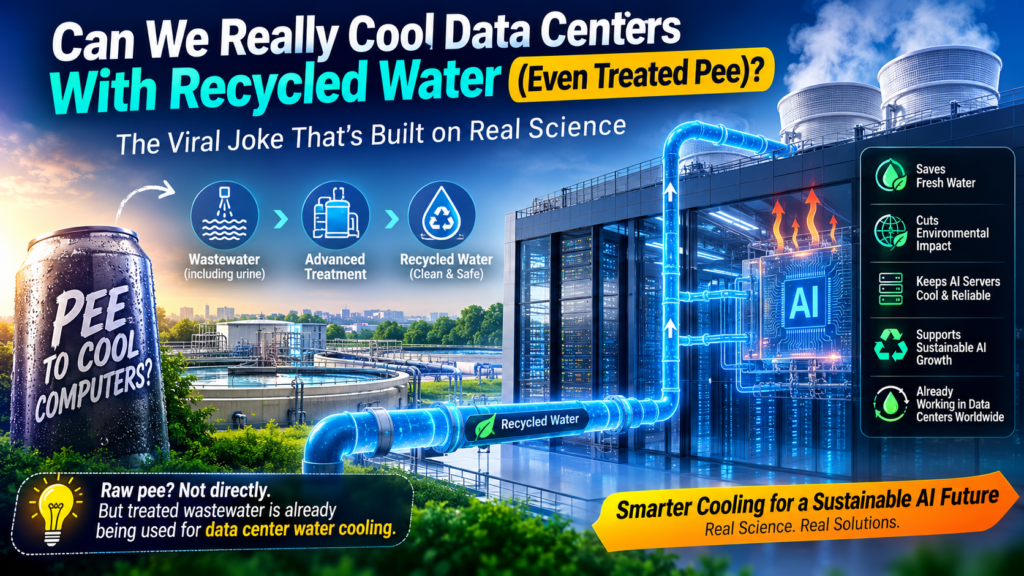
Picture a stadium full of people cracking beer cans and singing about peeing on computers to save the planet, that’s exactly what Liquid Death and former NFL star Jason Kelce did in a viral 2026 marketing campaign. It sounds like pure comedy, but here’s the direct answer: you cannot pour raw human urine into a server room, yet data center water cooling already relies on treated wastewater, including the kind that starts as sewage and urine, through a process called water reuse or recycled water. The joke, it turns out, is built on real engineering that’s already running in facilities across the world.
For students and young professionals in Odisha tracking India’s booming AI infrastructure buildout, this isn’t just a quirky internet story. It’s a preview of the water-versus-AI tension that every data center hub, from Virginia to Hyderabad, will eventually have to solve, and data center water cooling is quickly becoming one of the defining infrastructure questions of the AI era.
Why Do AI Data Centers Need So Much Water in the First Place?
Data center water cooling is the set of engineering methods used to stop servers from overheating, and it exists because AI workloads generate enormous, continuous heat. A typical hyperscale AI data center runs thousands of GPUs (graphics processing units, the chips that power AI models) at full tilt around the clock, and without constant cooling, those chips would fail within minutes. Water is one of the most efficient ways to move that heat away from hardware, which is why the AI boom has turned water into as scarce and contested a resource as electricity.
Question: Why does water cool servers better than air alone? Water absorbs and carries away heat far more efficiently than air, which is why most large data centers pair air handling with water-based systems, especially evaporative cooling towers. In evaporative cooling, hot air is passed through water so the water evaporates and pulls heat out of the system, the same principle your body uses when you sweat. This is efficient, but it also means the water used in this process largely doesn’t come back; it evaporates into the atmosphere, which is why AI data center water usage has become such a sensitive topic for local communities.
This is precisely the tension the Liquid Death and Kelce campaign was poking fun at: AI data centers are consuming enormous volumes of water even as many regions face drought stress and rising utility bills. As AI adoption accelerates worldwide, data center water cooling decisions made today will shape water availability for entire regions over the next decade.
How Big Is the Problem, Really?
It helps to picture what “cooling a data center” actually means at industrial scale. A single hyperscale AI campus can use as much water in a day as a small city, because every rack of GPUs generates heat that has to go somewhere. Multiply that across the hundreds of new AI facilities being planned globally, and it becomes clear why data center water cooling has moved from an engineering footnote to a boardroom and policy issue almost overnight.
The Viral Campaign That Accidentally Got the Science Right
In the ad, Kelce jokes that people should contribute their urine so that Liquid Death and Garage Beer can help “cool these data centers,” and a crowd sings about saving humanity by peeing on computers. It’s absurd on its face, nobody is literally plumbing toilets into server rooms. But according to Michael Obradovitch, vice president of Data Center Global Accounts at the water-management company Ecolab, the underlying idea isn’t as far-fetched as it sounds, because a meaningful share of data center water cooling already comes from alternative, non-potable water sources rather than fresh drinking water.
One of those alternative sources is recycled water, made by treating wastewater and sewage, which, as it happens, does contain human urine among many other things. So while nobody is pouring pee directly into cooling towers, treated sewage water genuinely is part of how some data centers already manage their water footprint. In other words, the punchline of the ad and the actual practice of data center water cooling aren’t as far apart as they first appear, the industry just gets there through a treatment plant instead of a beer can.
Can You Actually Pour Urine Into a Cooling Tower? Here’s the Direct Answer
Question: What would happen if a data center tried to use raw, untreated urine for cooling? It would be a maintenance disaster, not a sustainability win. Bruno Pigott, executive director of the WateReuse Association and a former acting assistant administrator for water at the U.S. Environmental Protection Agency (EPA), explained that urine contains salts, urea, bacteria, and organic matter that would leave mineral deposits and require constant cleaning of cooling equipment. Running raw urine through an evaporative cooling system, where hot air passes through water, would also create serious odor and hygiene problems at scale.
There is precedent for turning urine into usable water: astronauts recycle their own urine into drinking water in space, since they can’t carry unlimited supplies on long missions. But that kind of small-scale, closed-loop recycling isn’t efficient or feasible at the scale of millions of gallons a day that a hyperscale data center needs. That’s why real-world data center cooling technology doesn’t collect urine directly, it relies on municipal wastewater treatment systems that combine urine, sewage, and other wastewater into one recyclable stream, which is then routed into cooling towers as part of standard data center water cooling operations.
Definition: Evaporative Cooling
Evaporative cooling is a method of removing heat by passing hot air through water so the water evaporates and carries the heat away with it. It’s the same basic principle as sweat cooling human skin, scaled up to industrial cooling towers. Because so much of the water involved evaporates into the atmosphere rather than being returned to the local supply, evaporative cooling is one of the biggest single reasons data center water cooling consumes such large volumes of fresh water in the first place.
What Is Recycled Water, and How Does It Actually Cool a Data Center?
Recycled water is wastewater, including sewage, greywater, and industrial runoff, that has been treated through processes like membrane bioreactors, reverse osmosis, and ultraviolet disinfection until it’s clean enough for industrial or, in some cases, even drinking use. Once treated to an appropriate standard, this water can be piped into a data center’s cooling towers instead of drawing fresh potable water from local reservoirs and aquifers.
Dr. Greta Zornes, practice leader for water reuse at the engineering firm CDM Smith, has worked in this field for more than two decades and notes that recycled water has been used for industrial cooling for decades, data centers are simply the newest and fastest-growing customer. Zornes says she now spends much of her working time specifically on recycled water projects tied to data centers, reflecting how quickly demand has shifted in this direction.
Question: Why don’t all data centers just switch to recycled water? Because the necessary treatment infrastructure often doesn’t exist where new data centers are being built. Zornes points out that a facility needs to be located near a wastewater treatment plant that’s large enough to supply the volume of water a data center requires, and many AI data centers are being built in rural areas where local treatment plants simply aren’t sized for that kind of industrial demand. Building out that infrastructure takes real time and capital, which is currently one of the biggest bottlenecks in scaling water reuse in the AI industry and, by extension, in scaling sustainable data center water cooling more broadly.
Definition: Water Reuse
Water reuse (sometimes called water reclamation) is the practice of treating used water, from sinks, showers, toilets, and industrial processes, to a quality standard suitable for another purpose, such as irrigation, industrial cooling, or even drinking. It has been standard practice in industries like agriculture and manufacturing for decades. Applying water reuse to data center water cooling is simply the newest, fastest-growing use case for a technology that already has a long track record of safety and reliability.
Data Center Cooling Methods Compared
| Cooling Approach | Water Source | Efficiency for Heat Removal | Environmental Trade-off |
| Potable water evaporative cooling | Fresh drinking-quality municipal water | High | Strains local drinking water supply |
| Recycled/reclaimed water cooling | Treated wastewater and sewage | High (comparable once treated) | Requires nearby treatment infrastructure |
| Air-based (chiller/fan) cooling | Minimal to no water | Lower per-watt efficiency at scale | Higher electricity use, less water stress |
| Closed-loop liquid cooling | Small volume, continuously reused | Very high for dense AI hardware | High upfront hardware cost |
This comparison shows why recycled water for data centers is gaining traction: it delivers similar cooling performance to potable water while easing pressure on drinking-water supplies, provided the treatment infrastructure is in place. When operators weigh data center water cooling strategies, they’re rarely choosing just one method, most large facilities blend two or more approaches depending on climate, hardware density, and local water availability.
Loudoun County, Virginia: A Real-World Test Case
Loudoun County, outside Washington, D.C., is home to more than 250 data centers, with plans for roughly two dozen more, making it one of the densest data center water cooling hubs in the world. According to Loudoun Water, the local utility, data centers in the county collectively used about 200 million gallons of recycled water per day as of 2025, but that impressive figure still only covered 43% of total daily data center water demand in the region. The remaining 57%, or roughly 260 million gallons a day, still came from potable drinking water supplies.
This single data point captures the entire debate: recycled water is already doing real work at massive scale, but it isn’t yet enough on its own to fully offset the thirst of AI infrastructure. Even the most water-reuse-friendly region in the United States still leans heavily on fresh water for data center water cooling, which shows just how much infrastructure investment is still needed before recycled water can become the default rather than the exception.
What’s Slowing Down Water Reuse in the AI Industry?
Scaling recycled water for data centers isn’t just a technology problem, it’s an infrastructure and policy problem. Based on reporting from industry experts, the main barriers include:
- Treatment plant capacity, many data centers are built in areas where local wastewater plants are too small to supply industrial-scale recycled water.
- Infrastructure lead time, building new treatment and pipeline infrastructure takes years, even when funding is available.
- Upfront capital costs, recycled water systems require significant investment before any water savings are realized.
- Policy incentives, supportive legislation, like proposed U.S. tax credits for water reuse infrastructure, is still being debated rather than broadly enacted.
- Public trust and awareness, many communities are unaware that recycled water, including treated sewage, is already safely used in cooling and even drinking water systems.
Some AI companies are starting to invest directly in solving the infrastructure gap. Meta, for instance, has committed at least $270 million toward wastewater infrastructure projects near its data center communities, spending that Obradovitch believes could help position data centers as genuine anchors for local water infrastructure development rather than just consumers of it.
On the policy front, Pigott has been advocating for legislation that would offer a 30% tax credit to help industries scale recycled water infrastructure faster, arguing it would meaningfully accelerate adoption of data center cooling technology built around water reuse.
Why This Matters for Odisha and India’s Data Center Push
India, and Odisha specifically, is increasingly positioning itself as a hub for AI infrastructure and cloud investment, which means the same AI data center water usage questions playing out in Virginia will eventually arrive here too. Odisha already faces seasonal water stress in several districts, so any large-scale data center development in the region should be planned alongside serious water reuse and treatment infrastructure from day one, not retrofitted later.
For students and young professionals building careers in AI, sustainability engineering, or infrastructure policy, this is a genuinely emerging field. Understanding data center water cooling, water treatment technology, and environmental compliance isn’t just useful trivia, it’s becoming a real, hireable skill set as India’s own AI data center footprint expands.
What Odisha’s AI Ecosystem Can Learn From Loudoun County
Odisha’s push to attract AI investment, cloud infrastructure, and data-driven industries gives it a rare opportunity to plan data center water cooling correctly from the start, rather than retrofitting solutions after facilities are already built, as many U.S. regions are now being forced to do. Pairing new data center approvals with mandatory water reuse assessments, encouraging closed-loop liquid cooling for high-density AI hardware, and investing early in wastewater treatment capacity near proposed sites could help the state avoid the exact bottlenecks Loudoun County and other established hubs are now working to fix. That kind of forward planning also creates new categories of technical jobs, from water treatment engineering to sustainability compliance, that are directly relevant to students currently training in AI and infrastructure fields.
Public Opinion Is Already Shifting
The reason a joke about peeing on computers went viral in the first place is that people are genuinely anxious about AI’s environmental footprint. A recent Gallup poll found that about seven out of ten Americans oppose having data centers built in their local communities, and broader public sentiment toward AI products has been showing signs of backlash. Pigott’s own reaction to the campaign was that any conversation, however crude, that raises public awareness about water use is ultimately useful, because it opens the door to educating people about water reuse work that’s already happening quietly in the background.
That’s really the bigger lesson buried inside a beer commercial: data center water cooling is no longer a niche engineering detail. It’s becoming a mainstream conversation about how AI growth intersects with basic resources like clean water, and communities everywhere, including in India, are going to keep asking harder questions about it.
FAQ: Data Center Water Cooling and Recycled Water
Can urine really be used to cool data centers? Not directly. Raw urine contains salts, urea, and organic matter that would damage cooling equipment and require constant cleaning. However, treated wastewater, which includes urine as one component of sewage, is already used as recycled water in some data center cooling systems after going through proper treatment processes.
What is recycled water in the context of data centers? Recycled water is wastewater, including sewage and greywater, that has been treated using methods like membrane bioreactors, reverse osmosis, and ultraviolet disinfection until it’s clean enough for industrial use, such as cooling towers, or in some cases, even drinking water.
How much water do AI data centers actually use? It varies widely by facility and cooling method, but the scale can be enormous. In Loudoun County, Virginia alone, data centers used roughly 460 million gallons of water per day in 2025, with only 43% of that coming from recycled sources and the rest from potable drinking water supplies.
Why can’t every data center just switch to recycled water immediately? Because recycled water requires nearby wastewater treatment infrastructure large enough to handle industrial-scale demand, and many new data centers are built in rural areas where that infrastructure doesn’t yet exist or isn’t big enough.
Is evaporative cooling the only method data centers use? No. Data centers also use air-based chiller systems and closed-loop liquid cooling, which reuses a small volume of water continuously rather than relying on evaporation. Each method has different trade-offs between water use, electricity use, and cost.
Why did the Liquid Death and Jason Kelce pee campaign go viral? Because it tapped into real public anxiety about AI’s environmental footprint. Polling shows a majority of Americans are uneasy about data centers in their communities, and the campaign’s crude humor made a genuinely serious water-use issue easy to talk about.
Curious how AI infrastructure, sustainability, and engineering careers are converging in India? Explore more AI industry breakdowns and training resources on Kalinga.ai as we track how these global trends will shape Odisha’s own tech ecosystem.