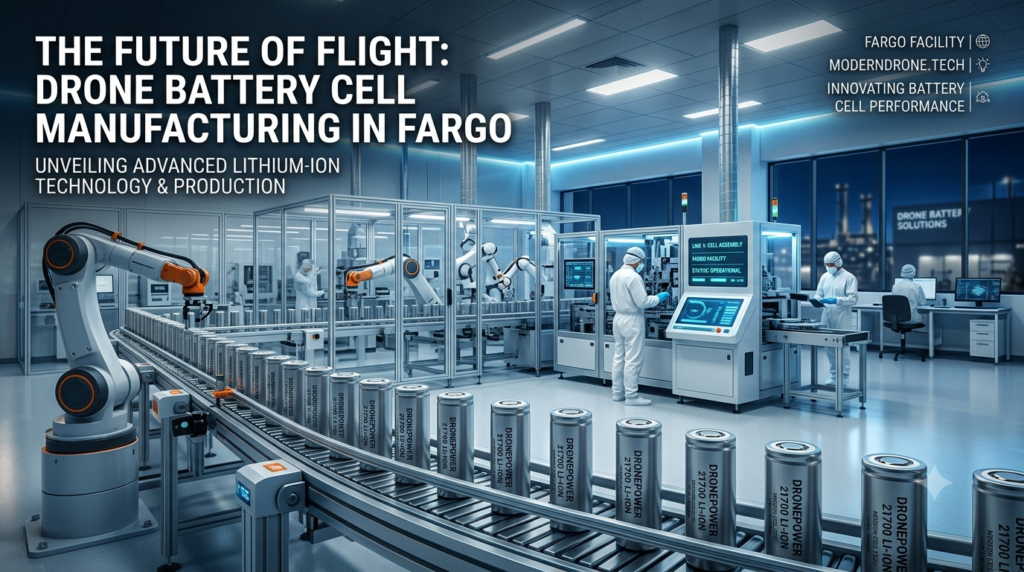
Drone battery cell manufacturing in the United States is moving from construction to production, with Badland Batteries shifting its Fargo, North Dakota plant toward large-scale output of NDAA-compliant lithium-ion cells for drones and defense systems. The plant will make lithium-ion cells designed for drones, unmanned aerial systems, and other defense applications. A domestic cell source changes the security, compliance, and supply picture for anyone who buys or builds unmanned aircraft. dronelife
A drone can have the best airframe, camera, and flight controller on the market and still be grounded by a battery that is hard to source, restricted by procurement rules, or impossible to trace. For years the battery has been the quiet bottleneck of the drone industry. This guide explains what the Fargo facility is, how cell production works, why it matters, and which questions buyers should ask before relying on a new domestic supplier.
Key Takeaways
- What happened: The latest phase supports the transition from factory construction to large-scale battery cell production in Fargo. dronelife
- Who is behind it: Badland Batteries is the off-the-shelf battery brand of Packet Digital, a Fargo-based engineering and manufacturing company focused on UAS batteries.
- What it makes: Lithium-ion cells for drones, unmanned aerial systems, and defense applications, with design support for multiple chemistries.
- Why it matters: Drone battery cell manufacturing inside the U.S. reduces dependence on imported cells and supports NDAA-compliant sourcing.
- What to watch: Independent performance data, production volumes, and pricing have not been published in the sources I reviewed.
What Is Drone Battery Cell Manufacturing?
Drone battery cell manufacturing is the process of producing the individual electrochemical cells that store and release energy, which are later wired together with electronics and housing to form a drone battery pack. It starts with raw materials and ends with a tested, sealed cell. Assembling a finished pack from cells someone else made is a different job.
This distinction is easy to miss because “drone battery” can mean several things. A buyer who sees “U.S.-made battery” on a product page may be looking at a pack assembled in America from cells made elsewhere. A cell plant moves the manufacturing one level deeper into the supply chain.
Cell vs. Pack: Why the Difference Matters
A cell is the basic energy-storing unit. A pack is a group of cells, plus a battery management system (BMS), connectors, wiring, and a protective enclosure. Packs are what operators plug into their aircraft.
| Component | What it is | Who typically makes it |
|---|---|---|
| Cell | Single energy-storing unit (e.g., a lithium-ion pouch cell) | Cell manufacturer |
| Battery management system | Electronics that monitor voltage, temperature, and safety | Pack designer |
| Pack | Cells + BMS + connectors + enclosure | Pack assembler |
Cell chemistry and construction set the ceiling for energy density, discharge capability, and cycle life. A pack designer can optimize around a cell’s limits, but cannot exceed them. That is why control over the cell is valuable.
The Three Stages of Drone Battery Cell Manufacturing
Badland Batteries describes its process in three broad stages, and each stage of drone battery cell manufacturing affects the final performance of the cell:
- Electrode manufacturing. Active materials are mixed and coated onto thin metal foils to form the positive and negative electrodes. Coating consistency strongly influences cell uniformity.
- Cell assembly. The prepared components are combined into a cell structure. In this stage, the prepared components of the battery cell are combined. packetdigital
- Cell finishing. Finishing includes roll pressing, formation, degassing, aging, and a final quality check. Formation is the controlled first charging that conditions the cell, and aging reveals cells that fail to hold performance. packetdigital
Quality problems compound across these stages, which is why in-house testing and traceability are central selling points for domestic plants.
What Did Badland Batteries Announce in Fargo?
Badland Batteries announced that its Fargo cell plant is progressing from factory construction into large-scale production of NDAA-compliant lithium-ion cells for drones and defense systems. The company said the facility represents a long-term investment in American manufacturing and workforce development. This is the core news behind the DroneLife report published on October 13, 2026. dronelife
The plant is a purpose-built drone battery cell manufacturing site, not a general-purpose electronics line. Company materials describe cells engineered for unmanned systems, with packs built from those cells at a nearby Packet Digital facility.
The Company Behind the Plant
Packet Digital was founded in Fargo and initially focused on power-saving computer chips. Over time it moved into UAS batteries and later created Badland Batteries as its off-the-shelf battery brand. Company history points to a Navy contract as the project that set the battery manufacturing buildout in motion. DroneLife’s coverage of the Fargo plant also tags a U.S. Navy drone battery contract. Packet Digital’s Navy work falls under the Logistics UAS Family of Advanced Batteries program. packetdigital
Badland Batteries Fargo: Facilities at a Glance
| Facility | Size | Role |
|---|---|---|
| Pack assembly and test facility | 25,000 sq ft | Battery and circuit board assembly, plus testing |
| Cell manufacturing campus | 80,000 sq ft | R&D building and primary site for cell production |
The company says the cell campus is the first battery factory in North Dakota and the first in the U.S. to make cells specifically for drones and unmanned systems. That is a company claim, and buyers should treat “first” statements as marketing until verified independently. packetdigital
A Badland representative also described a differentiator in a local agriculture news interview: once finished, the company expects to be the only U.S. business able to design batteries, build cells from raw materials, and assemble drone batteries in one place. If accurate, that vertical integration is the strategic point of the whole project. rrfn
Why Does Drone Battery Cell Manufacturing Matter for Supply Chain Security?
Drone battery cell manufacturing matters because the cell is the least visible and most import-dependent part of a drone’s power system. Company materials state that the drone battery supply chain relies heavily on Chinese-made cells. That creates three kinds of risk: packetdigital
- Availability risk. Trade restrictions, tariffs, or shipping disruptions can interrupt cell supply, even if packs are assembled domestically.
- Compliance risk. Government buyers increasingly require components that meet sourcing rules, and a pack’s origin may not cover its cells.
- Traceability risk. If you cannot verify where a cell was made and tested, you cannot easily trace failures back to their source.
A domestic drone battery supply chain addresses these risks by shortening the distance between design, material processing, and final testing. A plant that controls chemistry, cell construction, and pack design in one location can respond faster to defects and customer needs than one buying cells on the open market.
There is also a performance angle. Drone applications such as long-endurance inspection, logistics, and tactical missions are often battery-limited, so a supplier that can tune cells to the mission has an edge over one choosing from catalog cells.
What Does “NDAA-Compliant” Mean for Drone Batteries?
NDAA-compliant generally means a product’s components meet sourcing restrictions written into recent National Defense Authorization Acts, which limit certain foreign-made components in equipment purchased by the U.S. government. The details vary by program, contract, and component category, so “NDAA-compliant” is not a single universal certificate.
For drone batteries, the practical takeaways are:
- Compliance can depend on where cells, not just packs, are produced.
- Contract language matters. A buyer should confirm which clause applies to the specific purchase.
- A domestic cell plant makes compliance easier to document, because the manufacturing chain is shorter and more traceable.
Badland Batteries positions itself as a full-scale, NDAA-compliant cell and pack engineering hub. Drone battery cell manufacturing in Fargo is the foundation of that positioning, because compliance claims are strongest when the company controls the cell itself. As always, procurement teams should verify claims against their own contract requirements and not rely on marketing language. commercialuavnews
Lithium-Ion Pouch Cells and Multiple Chemistries
Lithium-ion pouch cells are flexible-format cells that use a soft laminated casing instead of a rigid metal can, which makes them lighter and easier to shape into packs. Badland says that once its cell plant is complete, all of its packs will be powered by U.S.-made high-performance lithium-ion pouch cells. commercialuavnews
Pouch cells are popular in aviation-weight-sensitive applications for a few reasons:
- Weight efficiency. Less casing means more of the cell’s mass is active material.
- Form flexibility. Pouches can be sized and stacked to fit airframe constraints.
- Thermal behavior. Flat shapes can dissipate heat well, though pack design still matters.
The trade-offs are real. Pouch cells need careful mechanical support, and swelling or damage can create safety risks if packs are poorly designed. That makes the pack engineering and BMS as important as the cell.
DroneLife reports the facility is designed to support multiple lithium-ion chemistries. Chemistry flexibility matters because drone missions differ: some need maximum flight time, others need high discharge for heavy lift or fast maneuvering. A plant that can adapt its chemistry can serve both without redesigning its whole factory. The economics of drone battery cell manufacturing reward this flexibility, since tooling is expensive and volumes in any single niche are modest compared with automotive batteries. dronelife
Imported vs. Domestic Drone Battery Cell Manufacturing
The main difference between imported and domestic cells is control and traceability, not necessarily raw performance. The table below summarizes general tendencies buyers should weigh. These are not measured results for any specific product.
| Factor | Imported cells (typical) | Domestic cells (e.g., Fargo plant) |
|---|---|---|
| Sourcing transparency | Varies; often limited visibility into origin | Easier to document if the plant controls the process |
| NDAA-related compliance | Depends on country of origin | Easier to demonstrate for U.S.-made cells |
| Customization | Usually catalog-based | Potentially tailored to the platform |
| Supply risk | Exposed to trade and shipping disruptions | Reduced exposure to import disruptions |
| Track record | Long production history | New; performance data still accumulating |
| Cost | Often lower at scale | Often higher initially; depends on volume |
| Quality feedback loop | Remote | Local engineering and testing |
The final two rows are the honest counterweight. Established cell makers have decades of production experience and enormous scale. A new plant has to earn trust through data, which is why independent testing and customer references matter.
Who Benefits From Domestic Drone Battery Cell Manufacturing?
Not every drone user needs a domestic cell, but several groups gain meaningfully:
- Defense and government buyers who need documented sourcing and traceable components.
- Drone OEMs that want a dependable, single-vendor path from cell to pack for their platforms.
- Commercial operators in inspection, public safety, and logistics who value consistent supply and support.
- Regional workforce and manufacturing in North Dakota, where the company has emphasized workforce development.
- Integrators building custom systems that need packs tuned to a specific airframe or mission profile.
Hobbyists and low-cost consumer drone makers are less likely to benefit in the near term, since price sensitivity favors high-volume imported cells.
Risks and Open Questions
Drone battery cell manufacturing is capital-intensive and technically demanding, and a new plant faces a steep ramp. Responsible coverage should note what is not yet known:
- Production volume. The sources I reviewed do not publish output figures or capacity targets.
- Performance data. Energy density, cycle life, and discharge specs for the new cells are not detailed in the coverage I could access.
- Pricing. Domestic cells often cost more than imported ones, and pricing for Badland’s cells has not been published there.
- Yield and quality. Early production lines commonly experience scrap and tuning periods before reaching stable quality.
- Independent validation. Third-party testing and field data will be the real proof.
None of this undermines the project’s strategic logic. It simply means buyers should request test reports and references before standardizing on any new cell supply.
Frequently Asked Questions
What is Badland Batteries?
Badland Batteries is the off-the-shelf battery brand of Packet Digital, a Fargo, North Dakota company. It designs and manufactures U.S.-made batteries for drones and UAS platforms. commercialuavnews
Where is the cell plant located?
It is in Fargo, North Dakota. The campus is an 80,000-square-foot facility that houses research and development and primary cell production.
Is drone battery cell manufacturing new to the U.S.?
Battery cell manufacturing is not new, but dedicated production for drones and unmanned systems is rare. The company says its Fargo plant is the first in the U.S. built specifically for that purpose, which is a claim worth verifying independently.
What kinds of batteries will the plant produce?
Lithium-ion cells for drones, unmanned aerial systems, and defense applications. Badland also sells packs, including 12S and 6S lithium-ion packs for commercial drones. dronelife
Are the cells NDAA-compliant?
The company describes them as NDAA-compliant. Because requirements vary by contract, buyers should confirm compliance against their own procurement terms.
Why does domestic cell production matter more than domestic pack assembly?
Because the cell is where most of the origin risk lives. A pack assembled in the U.S. from imported cells may still carry sourcing and traceability concerns.
Will this make drone batteries cheaper?
Probably not at first. New domestic production usually costs more per unit than established imports. The value case rests on security, compliance, and customization.
Who should pay attention to this plant?
Defense buyers, drone OEMs, integrators, and commercial operators with supply-chain or compliance requirements.
A Practical Checklist for Evaluating a Drone Battery Supplier
Use these questions when a supplier claims U.S.-made or NDAA-compliant batteries:
- Are the cells made in-house, or only the packs assembled here? Ask directly.
- Can you document the cell’s origin and test history? Traceability should be part of the offering.
- Which chemistries are available? Match chemistry to mission: endurance versus high discharge.
- What independent test data exists? Request third-party reports or customer references.
- How does the BMS handle protection and fleet monitoring? Pack electronics are as important as the cell.
- What are lead times and volume commitments? A new plant’s ramp can affect delivery schedules.
- Does the compliance claim match your contract? Verify against your specific procurement language.
Applying this checklist protects you whether you buy from Badland Batteries or any other supplier.
Bottom Line
The Fargo plant is a meaningful step toward a domestic drone battery supply chain. It puts cell production, pack design, and testing under one roof, aimed at the drones and defense markets that care most about sourcing and traceability. Drone battery cell manufacturing on this scale is still early, and the performance proof will come from independent testing, production data, and customer experience over the coming months.
For operators and buyers, the practical move is to watch for published specifications, ask hard questions about traceability, and treat “first” and “only” claims as hypotheses to confirm. If the plant delivers on its promise, drone battery cell manufacturing in North Dakota could become a reference point for how the U.S. rebuilds a critical piece of its unmanned systems supply chain.