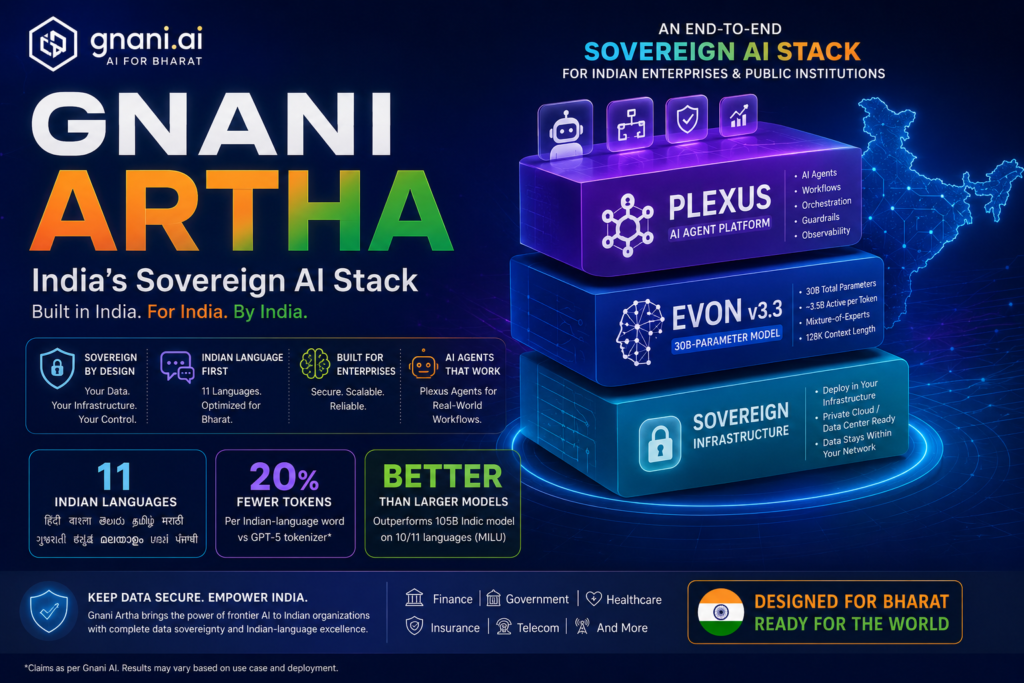
What Is Gnani Artha?
What if an Indian bank, government department, hospital, or telecom company could deploy a powerful AI system without sending sensitive organisational data outside its own infrastructure?
That is the idea behind Gnani Artha, a sovereign AI stack launched by Bengaluru-based voice AI company Gnani AI on August 28, 2026. The stack combines Evon v3.3, a 30-billion-parameter open-weights language model trained across 11 Indian languages, with Plexus, an agentic AI platform designed to connect AI capabilities with enterprise and institutional workflows. (Press Information Bureau)
The launch took place in New Delhi, where Vice President of India C. P. Radhakrishnan unveiled the technology at Uprashtrapati Bhavan. He said the combination demonstrated that Indian engineers can build frontier technologies rather than simply consume them. (Press Information Bureau)
The bigger story, however, is not simply another Indian large language model.
Gnani Artha is positioned as an attempt to bring together three things enterprises increasingly want: data control, Indian-language capability, and AI agents that can actually perform work.
Definition: What is sovereign AI?
Sovereign AI refers to AI infrastructure that gives an organisation or country greater control over its data, models, computing environment, and AI operations.
For an enterprise, that can mean running a model inside its own data centre or private cloud environment rather than sending sensitive prompts and documents to an external AI service. Gnani AI says its Artha stack is designed for deployment within an organisation’s own infrastructure, including private data centres or virtual private cloud environments. (Gnani AI)
That distinction matters because AI is increasingly being connected to internal databases, customer records, financial documents, employee information and government systems.
The more deeply AI is integrated into those workflows, the more important questions around where data goes, who controls the model, and how AI actions are audited become.
Why Did Gnani AI Launch Gnani Artha Now?
Why is sovereign AI becoming important for Indian enterprises?
Because organisations increasingly want the benefits of generative AI without giving up control over sensitive information or becoming completely dependent on external AI infrastructure.
Traditional generative AI services typically involve sending a prompt, document, image, or other input to a cloud-based model and receiving an output. That architecture can be highly convenient, but organisations operating in regulated or sensitive environments may prefer more control over deployment.
Gnani AI is targeting precisely this requirement with Gnani Artha.
The company describes the stack as an end-to-end sovereign AI platform for Indian enterprises and public institutions. Its design combines the model layer represented by Evon with the workflow and agent layer represented by Plexus. (Gnani AI)
The distinction is useful:
- Evon v3.3 provides language understanding, reasoning and generation.
- Plexus connects AI intelligence to real-world workflows.
- Self-hosted deployment is intended to keep organisational data within the customer’s infrastructure.
- Open weights give developers more control over the model than a purely closed API.
- Indian-language optimisation aims to make AI processing more efficient for Indic languages.
This makes Gnani Artha different from simply releasing another chatbot.
It is being positioned as infrastructure for organisations that want to build their own AI-powered systems.
What Is Evon v3.3?
What is Evon v3.3?
Evon v3.3 is Gnani AI’s 30-billion-parameter open-weights language model, designed specifically for English and 10 Indian languages, including Hindi, Bengali, Telugu, Tamil, Marathi, Gujarati, Kannada, Malayalam, Odia and Punjabi. The model is based on a hybrid Mamba-Transformer mixture-of-experts architecture. (Hugging Face)
A parameter is a numerical value learned during model training that helps a neural network recognise patterns and generate outputs. More parameters can increase a model’s capacity, but parameter count alone does not determine how useful or efficient a model will be.
Evon v3.3 uses a Mixture-of-Experts (MoE) architecture. Instead of activating all 30 billion parameters for every token, approximately 3.5 billion parameters are active per token, according to Gnani AI’s model documentation. (Hugging Face)
That is important from an efficiency perspective.
Think of an MoE model as a large team of specialists. The entire team may have 30 billion parameters, but a particular task does not necessarily require everyone to work on it. The system can route different pieces of computation to selected experts.
For enterprises, the attraction is straightforward: a model can have substantial overall capacity while attempting to limit the amount of computation required for each piece of input.
Evon v3.3 at a glance
| Feature | Evon v3.3 |
| Total parameters | 30 billion |
| Active parameters per token | ~3.5 billion |
| Architecture | Hybrid Mamba-Transformer MoE |
| Languages | 11, including English and 10 Indic languages |
| Context length | Up to 128K tokens |
| Weight licence | Apache 2.0 |
| Deployment | Self-hosted / own infrastructure |
| Primary focus | Indic-language understanding, reasoning and enterprise AI |
The model is available on Hugging Face under the Apache 2.0 licence, with Gnani AI making the weights available by request. (Hugging Face)
That open-weights approach is significant because developers can inspect, deploy and integrate the model rather than interacting only through a proprietary hosted endpoint.
How Strong Is Evon v3.3 on Indian Languages?
Does Evon v3.3 actually compete with larger models?
According to Gnani AI’s published benchmark results, yes , particularly on Indian-language evaluation.
The company reports that Evon v3.3 outperforms a 105-billion-parameter Indic model on 10 of 11 languages in MILU, an Indian-language benchmark covering academic and professional subjects. It also reports that the 30-billion-parameter Evon model leads a similarly sized Sarvam model across all 11 languages. (Hugging Face)
The important caveat is that these are company-reported benchmark comparisons. Benchmark performance does not automatically mean that a model will outperform another system in every real-world enterprise workload.
Still, the results highlight an important shift.
AI performance is not only about building the largest possible model. A smaller model that is specifically trained and optimised for a particular language environment can sometimes be more useful for that environment.
Gnani’s published MILU results show Evon v3.3 scoring particularly strongly across languages such as Kannada, Bengali, Hindi, Telugu and Gujarati, while also supporting Odia and other Indic languages. (Hugging Face)
For India, this matters because English-centric AI systems can face additional computational and linguistic challenges when processing Indian scripts.
Why Tokenisation Could Be Evon v3.3’s Biggest Advantage
Why does tokenisation matter for Indian-language AI?
Because AI models do not process words exactly as humans see them. They break text into smaller units called tokens, and the number of tokens required to represent a sentence can affect computational cost and context efficiency.
Gnani AI says it rebuilt Evon’s tokenizer specifically for Indian scripts and that the model uses roughly 20% fewer tokens per Indian-language word than the GPT-5 family tokenizer. The company also claims it requires less than half the tokens used by byte-level tokenisers associated with models such as DeepSeek, Llama and Qwen for comparable Indian-language text. (Gnani AI)
That claim deserves attention because token efficiency can become an important economic issue at scale.
Imagine an organisation processing millions of Indian-language customer messages. If its AI system requires fewer tokens to represent the same information, there is potentially less computation involved in processing those requests.
In simple terms:
Fewer tokens → potentially less computation → potentially lower processing costs.
That does not automatically mean a 20% reduction in an organisation’s total AI bill. Actual costs depend on hardware, inference software, model configuration, workload, electricity, networking and deployment architecture.
But improving token efficiency at the model level can make a meaningful difference for large-scale Indian-language workloads.
Gnani AI says Evon v3.3 was trained on more than two trillion tokens of Indic data and uses a vocabulary rebuilt for Indian scripts. (Gnani AI)
This is where the idea of an Indian-language AI stack becomes more interesting than simply translating an English-first model.
What Is Plexus and Why Does It Matter?
What does Plexus add to Gnani Artha?
Plexus is Gnani AI’s agentic AI workforce platform, designed to turn model intelligence into governed workflows and actions.
An AI agent is different from a conventional chatbot. A chatbot generally responds to a user request, while an agent can be designed to plan steps, call tools, retrieve information, interact with software and complete a defined task.
Gnani AI describes Plexus as a platform where individual agents can be composed into workflows around specific outcomes, with orchestration, guardrails, observability and audit logging. (Gnani AI)
That could make the system more relevant to enterprises than a standalone language model.
Definition: What is agentic AI?
Agentic AI refers to AI systems designed to pursue a goal through multiple steps rather than simply producing one response.
For example, instead of asking an AI to summarise a customer complaint, an agent could potentially retrieve the customer’s account information, classify the complaint, check relevant policies, create a ticket and route the case to the appropriate team.
The important word is workflow.
The model provides intelligence, but the agent platform determines how that intelligence interacts with enterprise systems.
How Could Gnani Artha Be Used?
Where could Gnani Artha be useful?
The strongest opportunities are likely to be environments where organisations have large amounts of sensitive information and need support for Indian languages.
Potential applications include:
- Banking and financial services: multilingual customer support, document processing and internal knowledge systems.
- Government: citizen-facing assistants, document workflows and multilingual information services.
- Healthcare: administrative workflows, subject to appropriate safety controls and human oversight.
- Telecom: customer service and multilingual voice or text interactions.
- Insurance: policy-document analysis and claims workflows.
- Enterprise operations: internal search, knowledge retrieval and workflow automation.
- Public-sector institutions: AI systems deployed inside controlled infrastructure.
Gnani AI already lists BFSI, insurance, healthcare and telecom among the enterprise domains it targets across its broader AI stack. (Gnani AI)
However, deployment in high-stakes sectors should not be confused with automatic readiness for high-stakes decision-making.
The Evon v3.3 model card explicitly cautions against using the model for high-stakes legal, medical or financial decisions without appropriate evaluation and human oversight. (Hugging Face)
That distinction is crucial.
A sovereign model can improve data control without automatically solving AI reliability, bias, security or safety.
Gnani Artha vs Conventional Cloud AI
The easiest way to understand the positioning of Gnani Artha is to compare it with a conventional hosted AI approach.
| Factor | Conventional Hosted AI | Gnani Artha Approach |
| Model access | Usually through an external API | Open-weights model plus platform |
| Data environment | Provider-controlled cloud infrastructure | Designed for customer’s own infrastructure |
| Model customisation | Depends on provider | Greater control over self-hosted model |
| Indian-language focus | Varies by model | Specifically designed around Indic languages |
| AI agents | Often separate from model provider | Plexus provides an integrated agent layer |
| Data sovereignty | Depends on provider and contract | Designed around infrastructure-level control |
| Deployment | Cloud/API oriented | Data centre or private infrastructure |
| Licensing | Varies | Evon weights listed under Apache 2.0 |
This does not make one approach universally better.
Hosted AI can offer convenience, rapid deployment and access to very large frontier models. Self-hosted AI can offer greater control but requires organisations to manage infrastructure, security, model updates, monitoring and operational complexity.
The real choice is therefore not simply “Indian AI versus foreign AI.”
It is increasingly about which deployment model fits a particular organisation’s risk, cost, performance and data requirements.
Why Data Sovereignty Matters for India
Why is data sovereignty particularly important for public institutions?
Government departments and large enterprises can process information that is commercially sensitive, personally identifiable or operationally critical.
Sending such information through external AI infrastructure can introduce governance questions around storage, access, retention, jurisdiction and compliance.
A sovereign deployment model attempts to address part of that challenge by allowing the organisation to keep the AI workload inside infrastructure it controls.
Gnani AI says Gnani Artha is designed so that customer data does not leave the customer’s network when deployed within its infrastructure. (Gnani AI)
That could be particularly relevant as Indian organisations move from experimenting with AI chatbots to embedding AI directly into internal workflows.
There is another strategic dimension.
If enterprises depend entirely on a small number of overseas model providers, they may have limited influence over model availability, pricing, product changes and deployment policies.
A domestic open-weights ecosystem can provide another option.
That does not eliminate international AI models. Instead, it gives Indian organisations more choice.
The Economics of Indian-Language AI
AI adoption can become expensive when organisations process huge quantities of text, audio or documents.
Indian-language workloads add another layer because different scripts and language structures can be represented inefficiently by tokenisers designed primarily around other languages.
Gnani’s approach is to attack that problem at the model level.
Its published specifications highlight roughly 3.5 billion active parameters per token, a rebuilt vocabulary for Indian scripts and approximately 20% fewer tokens per Indian word compared with the GPT-5 family tokenizer, according to the company. (Gnani AI)
The company also reports a first-token latency of 302 milliseconds on a short prompt and generation speeds of around 257 tokens per second under its stated testing conditions. (Gnani AI)
These numbers should be treated as vendor-reported performance rather than universal production guarantees.
Real-world performance depends heavily on hardware and workload.
Still, the direction is clear: Gnani AI is treating efficiency as a core feature rather than an afterthought.
For a startup or enterprise processing millions of requests, that distinction could matter as much as raw benchmark scores.
What Makes Gnani Artha Different From Just Releasing an LLM?
Is Evon v3.3 alone the main product?
Not exactly.
The more ambitious part of Gnani Artha is the combination of model + deployment + agents.
A language model can answer questions, generate text and reason over information. But an enterprise usually needs more than that.
It needs AI to interact with:
- Databases
- Internal documents
- Customer-management systems
- Business applications
- Authentication systems
- Approval workflows
- Monitoring and audit systems
Plexus is intended to sit at that operational layer.
Gnani AI describes its agents as identity-bearing units that can be combined into workflows and governed through orchestration, guardrails, observability and audit logging. (Gnani AI)
That approach moves the conversation from “Which LLM should we use?” to “Which business processes can AI safely operate?”
That is a much bigger question.
What Does the Launch Mean for India’s AI Ecosystem?
Does Gnani Artha prove that India has built a frontier AI competitor?
It is too early to make that broad conclusion.
What the launch does demonstrate is that India’s AI ecosystem is increasingly producing models and infrastructure designed around Indian languages, deployment requirements and local enterprise use cases.
The government’s Press Information Bureau described Gnani Artha as a sovereign AI stack comprising Evon 3.3 and Plexus, and highlighted the broader goal of strengthening India’s technological self-reliance. (Press Information Bureau)
The launch also comes as India attempts to develop domestic AI capabilities through initiatives such as the IndiaAI Mission.
For students and young AI professionals, the important takeaway is that India’s AI opportunity extends well beyond building the next general-purpose chatbot.
There is growing demand for:
- Indic-language NLP
- Speech AI
- AI infrastructure
- Model optimisation
- AI safety
- Agentic workflows
- Enterprise deployment
- Data engineering
- AI evaluation
- Sovereign cloud and computing
In other words, the future AI job market may involve building the systems around models, not only training models themselves.
What Are the Limitations?
The excitement around Gnani Artha should be balanced with several practical questions.
First, benchmark scores do not necessarily predict performance across every enterprise workload. Companies should test models on their own datasets, languages and business processes.
Second, self-hosting is not automatically simple. Organisations need suitable GPUs or other infrastructure, model-serving software, security controls, monitoring and skilled teams.
Third, open weights provide flexibility but also shift responsibility toward the organisation deploying the model.
Fourth, agentic AI introduces additional risks. An agent capable of taking actions can potentially create more serious consequences than a chatbot that merely generates text.
That is why guardrails, permissions, audit logs and human oversight matter.
Gnani’s own model documentation recommends safety evaluation on target languages and domains and warns against deploying the model for high-stakes decisions without appropriate safeguards. (Hugging Face)
So, the strongest interpretation of Gnani Artha is not that it makes AI risk disappear.
It is that it gives organisations another architectural option for managing those risks while retaining more control over their AI infrastructure.
What Should Students and Young Professionals Learn From Gnani Artha?
What skills are becoming more valuable as sovereign and agentic AI grow?
The biggest lesson is that AI is becoming a systems discipline.
Knowing how to write prompts is useful, but organisations deploying AI at scale need people who understand how models interact with data, applications and infrastructure.
For someone starting an AI career, useful areas include:
- Learn the fundamentals of LLMs and transformers.
- Understand tokenisation and why it affects inference cost.
- Learn how RAG (Retrieval-Augmented Generation) connects models to private knowledge.
- Explore AI agents and tool calling.
- Learn basic model serving with tools such as vLLM.
- Understand cloud and on-premise deployment.
- Study AI evaluation rather than relying only on benchmark leaderboards.
- Learn about AI safety, permissions and governance.
- Explore Indian-language NLP and speech technologies.
The rise of models such as Evon v3.3 also shows why language-specific AI is an important research area.
For India, building AI that works well in Hindi, Odia, Bengali, Tamil, Telugu and other languages is not merely a translation problem. It involves data, tokenisation, evaluation, speech, cultural context and real-world deployment.
The Bigger Picture: India Wants Control Over the AI Stack
Gnani Artha arrives at an important moment for Indian AI.
The first phase of generative AI adoption was largely about using models created elsewhere. The next phase is increasingly about building models, infrastructure and applications that organisations can control themselves.
Gnani Artha represents one version of that strategy.
Its combination of a 30-billion-parameter open-weights model, Indian-language optimisation, self-hosted deployment and an agentic workflow platform is aimed at organisations that want AI to become part of their operational infrastructure. (Gnani AI)
The company’s benchmark claims still need to be understood in context, and production performance will ultimately matter more than launch-day comparisons.
But the underlying idea is significant.
India may not need every organisation to build its own giant frontier model. It may need capable, efficient and controllable AI systems that solve Indian problems at scale.
That is where Gnani Artha could become particularly interesting.
FAQ: Gnani Artha, Evon v3.3 and Sovereign AI
What is Gnani Artha?
Gnani Artha is a sovereign AI stack from Gnani AI that combines the Evon v3.3 language model with the Plexus agentic AI platform. It is designed for Indian enterprises and public institutions that want AI capabilities with greater control over deployment and data. (Press Information Bureau)
What is Evon v3.3?
Evon v3.3 is a 30-billion-parameter open-weights language model designed for English and 10 Indian languages. It uses a hybrid Mamba-Transformer mixture-of-experts architecture, with approximately 3.5 billion parameters active per token. (Hugging Face)
Which Indian languages does Evon v3.3 support?
Evon v3.3 supports Hindi, Bengali, Telugu, Tamil, Marathi, Gujarati, Kannada, Malayalam, Odia and Punjabi, alongside English, for a total of 11 supported languages. (Hugging Face)
What is Plexus AI?
Plexus is Gnani AI’s agentic AI workforce platform for turning AI intelligence into enterprise workflows. It is designed around agents, orchestration, guardrails, observability and audit logging so AI can be connected to real-world institutional tasks. (Gnani AI)
Is Evon v3.3 open source?
Evon v3.3’s weights are available under the Apache 2.0 licence, with the model listed on Hugging Face by Gnani AI. The company says access to the weights is available by request. (Hugging Face)
Why does Gnani Artha matter for India?
Gnani Artha matters because it combines Indian-language AI, open weights, self-hosted deployment and agentic workflows in a single enterprise-oriented stack. If it performs reliably in production, this combination could give Indian organisations another option for deploying AI while retaining greater control over sensitive data and infrastructure.
Final Takeaway
Gnani Artha is less about launching another chatbot and more about building an AI stack that Indian organisations can control. With Evon v3.3 targeting efficient Indian-language processing and Plexus targeting enterprise AI agents, Gnani AI is betting that the next stage of India’s AI journey will be about deploying intelligence directly into real-world workflows.
For readers interested in how India’s AI ecosystem is evolving, the next question is no longer just which model is smartest? It is which AI systems can be efficient, trustworthy, locally relevant and useful enough to run an organisation?