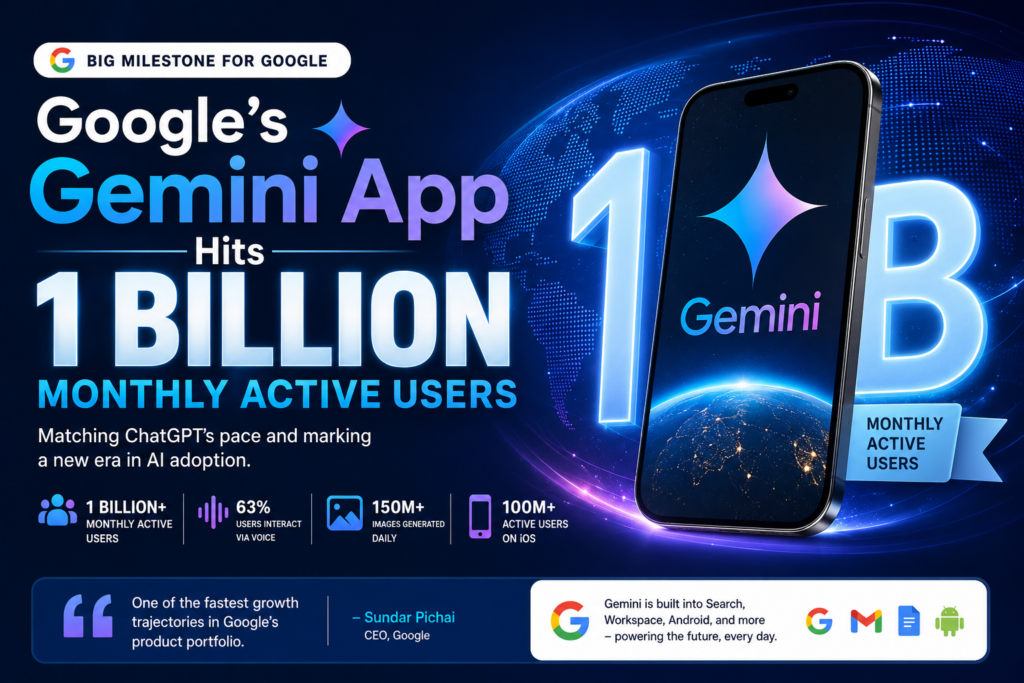
Bhubaneswar, Odisha — August 13, 2026 — Google’s Gemini app has crossed 1 billion monthly active users, CEO Sundar Pichai announced on X on August 11, 2026, marking the 14th Google product to reach the billion-user threshold. Google Gemini 1 billion users
The milestone puts Gemini on par with OpenAI’s ChatGPT, which reported passing 1 billion monthly active users in June 2026, according to Reuters. It also comes just weeks after Google’s Q2 2026 earnings call, where the company reported Gemini had already surpassed 950 million monthly users, with daily active usage tripling over the past year. Google has spent the past year embedding Gemini across Search, Workspace, Android, and its standalone app, and the new figure reflects the fast-growing pull of the standalone Gemini app specifically, separate from Google’s broader AI Mode in Search, which Google says also has more than 1 billion monthly active users on its own.
Key Facts
- Gemini’s standalone app has surpassed 1 billion monthly active users, Pichai said via X on August 11, 2026.
- It is the 14th Google product to reach 1 billion monthly active users, according to Pichai’s post.
- Google reports 63% of Gemini users interact with the assistant using its voice feature.
- Gemini now generates more than 150 million images per day, per Google’s figures.
- The Gemini app has more than 100 million active users on iOS, Google says.
- The announcement follows Google’s Q2 2026 earnings call on July 23, 2026, when the company disclosed Gemini had over 950 million monthly users.
Why It Matters
Gemini’s jump to 1 billion monthly active users signals that Google has closed the gap with OpenAI’s ChatGPT in the race for consumer AI adoption, with both products now crossing the same threshold within a two-month window of each other. For an AI assistant market that has largely been defined by ChatGPT’s early lead, this parity in user scale is a significant shift, and it strengthens Google’s negotiating position with advertisers, developers, and enterprise customers who weigh platform reach when deciding where to build. The scale also gives Google a much larger base from which to collect usage data and refine models such as Gemini 3.5 Flash, which the company has positioned around coding and autonomous agent tasks rather than simple chat. For India’s AI ecosystem, where Android and Google Search already dominate distribution, Gemini’s growth curve is likely to accelerate mainstream exposure to AI tools among students, freelancers, and small businesses who encounter Gemini through products they already use daily.
The Details
Pichai’s announcement, posted on X on August 11, 2026, framed the 1-billion-user mark as one of the fastest growth trajectories among Google’s product portfolio, according to TechCrunch’s report on the post. Google did not specify in the announcement the exact date the app crossed the threshold, only that the milestone had been reached recently.
The comparison to ChatGPT is notable because both companies have now cleared the same user-count bar in quick succession. Reuters reported in June 2026 that OpenAI’s ChatGPT app hit 1 billion monthly active users, a record pace for the product. Gemini’s rise to the same level roughly two months later suggests Google has been closing, rather than widening, the gap in consumer-facing AI adoption, even as OpenAI maintains a head start in raw brand recognition for chatbot products.
Google has pursued a strategy of distributing Gemini widely rather than relying solely on the standalone app. The company’s AI Mode in Search has independently crossed 1 billion monthly active users globally, according to Google, but that figure is tracked separately from the Gemini app number Pichai announced. Gemini is also built into Android, Workspace apps such as Gmail and Docs, and a growing list of Pixel-specific features, giving Google multiple entry points that funnel users toward deeper engagement with the assistant.
On usage patterns, Google disclosed that 63% of Gemini users now interact with the assistant primarily through its voice feature rather than typing, a detail that points to growing comfort with conversational, hands-free AI interactions. The company also said Gemini generates more than 150 million images daily, an indicator of how central image generation has become to everyday use of the app, alongside text-based queries and coding tasks.
International growth also featured in Google’s disclosure, with the company reporting more than 100 million active users on iOS specifically, a notable figure given that Gemini competes with Apple’s own AI ambitions on Apple’s home platform.
The milestone follows closely behind Google’s Q2 2026 earnings call on July 23, 2026, during which the company said Gemini’s monthly user base had already crossed 950 million, with daily active users tripling over the preceding year, according to TechCrunch’s earlier coverage of that call. The jump from roughly 950 million to over 1 billion in the span of a few weeks underscores the pace of Gemini’s recent growth curve.
Google has also continued shipping new models tied to this expansion. Gemini 3.5 Flash, released earlier in 2026, was designed with an emphasis on coding tasks and autonomous AI-agent workflows, according to Google, signaling that the company sees agent-style capabilities, not just conversational chat, as central to Gemini’s next phase of growth.
What Happens Next
The user-count milestone arrives just ahead of Google’s Made by Google event, where the company is expected to unveil additional Gemini-powered features across its Pixel device lineup. Analysts and industry observers are likely to watch whether Google’s user growth translates into comparable revenue or advertising gains, and whether OpenAI responds with its own updated usage figures in the coming weeks. Continued competition between the two companies over model capability, particularly in coding and agentic tasks, is expected to remain a central storyline through the rest of 2026.