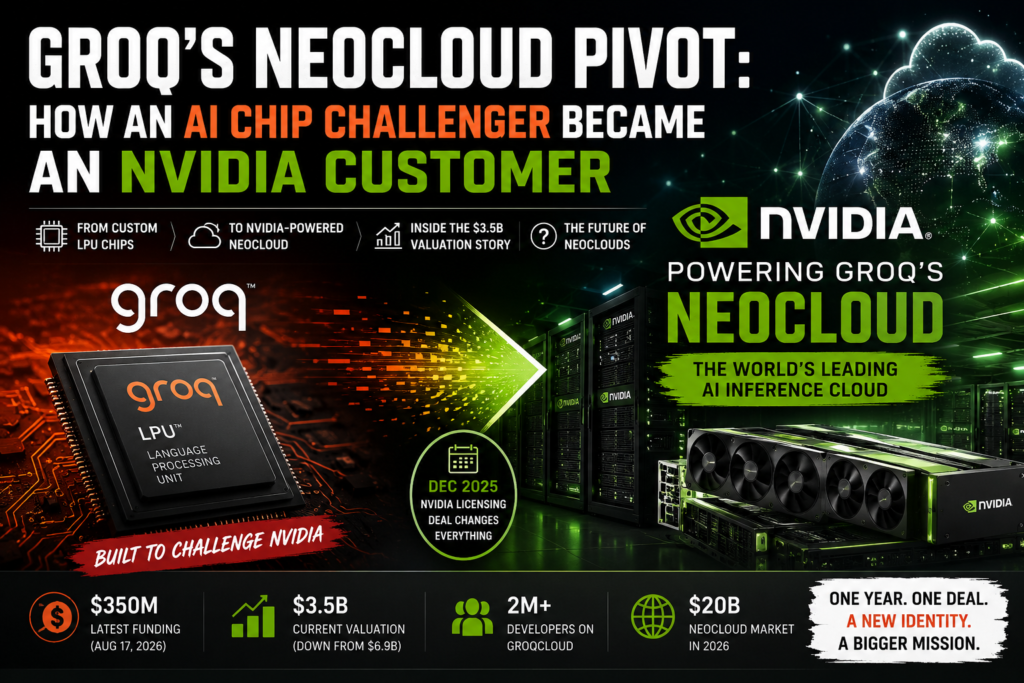
Groq closed a $350 million funding round on August 17, 2026, at a $3.5 billion valuation , roughly half of what the company was worth eleven months earlier. That drop in valuation is not really the story. The story is what Groq has become: a company once built to compete with Nvidia’s GPUs is now, by its own description, building “the world’s leading AI inference cloud” on top of Nvidia’s hardware. This is the Groq neocloud story, and it is one of the clearest case studies available today of how quickly the AI infrastructure market can reorganize around a single dominant supplier.
This guide traces the full arc , from Groq’s founding as a chip challenger to its current identity as a Groq neocloud operator running on Nvidia hardware , and places that transformation inside the broader neocloud market, where CoreWeave, Nebius, Lambda, and a growing list of GPU-as-a-service providers are racing to capture demand that hyperscalers cannot fill fast enough. Along the way, this article examines the mechanics of the Nvidia licensing deal that triggered Groq’s pivot, the economics of running a neocloud business, and the open questions about whether this category of company can ever be reliably profitable.
Background: What Groq Was Built to Do
Definition: What Is a Neocloud?
A neocloud is a specialized cloud computing provider built almost entirely around GPU-accelerated compute for AI training and inference, as opposed to the general-purpose infrastructure offered by hyperscalers like AWS, Microsoft Azure, and Google Cloud. Neoclouds typically lease or buy large fleets of Nvidia GPUs, house them in data centers with dedicated power and cooling, and rent that capacity to AI labs, enterprises, and developers who cannot get sufficient capacity from the hyperscalers or who want a lower-cost, more flexible alternative. CoreWeave, Nebius, Lambda, Crusoe, and now Groq all fall into this category, and analysts project the broader neocloud revenue pool to reach roughly $20 billion in 2026, expanding toward $180 billion by 2030.
Groq was not originally part of this category. Founded in 2016 by Jonathan Ross , one of the creators of Google’s Tensor Processing Unit (TPU) , Groq built its own custom silicon called the LPU, or Language Processing Unit. The LPU used an SRAM-centric, dataflow architecture rather than the general-purpose parallel processing approach behind Nvidia’s GPUs, and Groq claimed the design could run large language models several times faster and at a fraction of the cost of GPU-based inference. By late 2025, Groq said its GroqCloud platform was powering AI applications for more than two million developers, and the company had scaled from a niche hardware startup into one of the most closely watched Nvidia challengers in the inference chip market.
Why this matters now: The Groq neocloud transformation , from chip designer to Nvidia-powered cloud operator, completed inside a single calendar year , is a live illustration of how concentrated Nvidia’s position in AI compute has become , and how even well-funded, technically credible challengers can end up inside Nvidia’s ecosystem rather than outside it.
The Nvidia Deal That Changed Everything
What Actually Happened in December 2025
On December 24, 2025, Groq announced what it called a “non-exclusive licensing agreement” with Nvidia covering Groq’s inference technology. Under the arrangement, founder and CEO Jonathan Ross, president Sunny Madra, and other senior engineers left Groq to join Nvidia, while then-CFO Simon Edwards stepped in as Groq’s new chief executive. CNBC reported the deal’s value at approximately $20 billion in cash, a figure Alex Davis , CEO of investment firm Disruptive, which has backed Groq since its founding , confirmed publicly, even though Nvidia itself declined to comment on deal terms. That price represented roughly 2.9 times Groq’s $6.9 billion valuation from a $750 million financing round completed just three months earlier, in September 2025.
Question: Why didn’t Nvidia just acquire Groq outright? Direct answer: Structuring the transaction as a non-exclusive technology license and a talent transfer , rather than a formal acquisition , allowed Nvidia to absorb Groq’s core intellectual property and engineering team while avoiding the regulatory scrutiny that a full acquisition of a chip competitor would likely trigger. Bernstein analyst Stacy Rasgon described the structure as designed to “keep the fiction of competition alive,” noting that Nvidia has used similar acqui-hire-style arrangements before, including a smaller deal with AI networking startup Enfabrica. Nvidia CEO Jensen Huang framed the deal differently in a note to employees, stating that the company planned to integrate Groq’s low-latency processors into the Nvidia AI factory architecture. At GTC 2026, Huang reportedly said LPU-style decode processing could eventually handle roughly a quarter of the compute inside an AI cluster, underscoring that Nvidia saw genuine technical value in the acquisition, not just a competitor-removal play.
Crucially, Groq’s cloud business , GroqCloud , was excluded from the assets Nvidia licensed. That exclusion is what made everything that followed possible: Groq the company continued to exist as an independent entity, but without its founder, its chip design team, or exclusive rights to the LPU architecture it had spent nearly a decade building.
Inside the Groq Neocloud Pivot: From Chipmaker to Nvidia Customer
The June 2026 Restart
With its engineering core gone and its signature chip technology now licensed to the very company it had been built to challenge, the remaining Groq organization needed a new business model. In June 2026, Groq confirmed a $650 million funding round, explicitly framed as the starting capital for a pivot into operating Nvidia-powered data centers rather than continuing to design and sell its own AI accelerators. This was the first concrete signal that Groq intended to re-staff and rebuild , not as a chip company, but as an infrastructure operator.
That pivot has now been reinforced with the August 2026 round. The new $350 million raise was led by Disruptive, the same investment firm run by Alex Davis, who has personally invested more than half a billion dollars in Groq since 2016 and who now also serves as Groq’s chairman. Nvidia is a planned participant in the round as well , meaning the same company that licensed away Groq’s core chip technology and hired its founder is now also becoming an investor in what remains of Groq, deepening a relationship that already runs through Groq’s data centers, which are built on Nvidia GPUs rather than Groq’s own silicon.
Question → Direct Answer: Is This a Down Round?
Question: Groq’s valuation fell from $6.9 billion to $3.5 billion , doesn’t that make this a down round in the traditional venture sense?
Direct answer: By the conventional definition, yes , the company is now valued at roughly half of its prior mark. However, a Groq spokesperson told TechCrunch the company does not view it that way, characterizing the new $3.5 billion figure as establishing a fresh baseline valuation for what it called the “post-Nvidia-licensing-deal version of Groq” , a materially different business, built around leasing and operating Nvidia infrastructure rather than designing proprietary chips. Whether investors accept that framing is a separate question, but it is worth noting that the entity being valued today genuinely is not the same company that raised $750 million at $6.9 billion in September 2025. That earlier valuation priced in Groq’s LPU architecture, its founding team, and its position as a credible Nvidia challenger , all of which are now gone or diminished.
Scaling Plans
Groq says the new capital will support its build-out of Nvidia-accelerated computing capacity for both training and inference workloads, targeting customers who need “medium and larger sized clusters.” The company has laid out a specific power-capacity target: scaling from 54 megawatts to more than 200 megawatts by 2027. As of the August 2026 raise, Groq operates 13 data centers across North America, Europe, the Middle East, and Asia Pacific, and says it serves more than 6 million developers, enterprises, and AI-native companies , up from roughly 356,000 developers reported before the LPU business existed at scale, and over 2 million as of the Nvidia deal in December 2025.
The Groq Neocloud Business and Its Market
Definition: How Neoclouds Make Money , and Why It’s Risky
Neoclouds generate revenue by leasing GPU capacity to customers under multi-year contracts, often at prices below what hyperscalers charge, while carrying enormous capital expenditure on GPU fleets that depreciate quickly as Nvidia releases new generations of chips (Blackwell Ultra, and now Rubin, in 2026). Because so much of this capacity is financed with debt collateralized by the GPUs themselves, the sector faces what analysts have called a “refinancing wall” , tens of billions of dollars in loans coming due between 2026 and 2028, concentrated among a relatively small circle of correlated lenders. None of the major neoclouds is profitable under GAAP accounting as of mid-2026, and depreciation alone consumes roughly half of revenue at both CoreWeave and Nebius, according to industry analysis published in mid-2026.
Groq’s New Competitive Set
The Groq neocloud business now competes directly against an established group of Nvidia-powered neoclouds:
- CoreWeave , the market-share leader, reporting a $104 billion contracted revenue backlog against a $58.8 billion market capitalization as of August 2026, with major contracts including Meta and Anthropic, alongside continued investor concern over heavy debt reliance.
- Nebius , expecting more than $9 billion in customer prepayments in 2026, with year-over-year revenue growth reported above 450% in some quarters, but negative free cash flow expected to persist through at least 2028.
- Lambda , backed in part by a Microsoft deal and roughly $1.5 billion in funding, with an anticipated IPO.
- IREN, Applied Digital, and Crusoe , smaller but fast-growing players; IREN, for instance, signed a five-year, $3.4 billion cloud contract with Nvidia alongside up to $2.1 billion in direct Nvidia investment.
Nvidia’s fingerprints are on nearly all of them. The chipmaker supplies the GPUs that every neocloud depends on, while simultaneously investing directly in several of these same companies , a structure some analysts describe as circular financing, where Nvidia effectively funds the customers who then buy its chips, recognizing revenue on both ends of the transaction. Groq’s August 2026 round, with Nvidia as a planned participant, fits squarely inside this pattern.
Comparison: Groq Then vs. the Groq Neocloud Business Now
| Dimension | Groq as Chip Challenger (pre-Dec 2025) | Groq as Neocloud (post-pivot, 2026) |
| Core product | Proprietary LPU chips, sold/licensed as an Nvidia alternative | Nvidia GPU-based cloud infrastructure and data center capacity |
| Relationship to Nvidia | Direct competitor in AI inference hardware | Customer, infrastructure operator, and now investee |
| Leadership | Founder/CEO Jonathan Ross, President Sunny Madra | CEO Simon Edwards (former CFO); Ross and Madra now at Nvidia |
| Valuation | $6.9 billion (Sept. 2025 Series E) | $3.5 billion (Aug. 2026 Series A of “new” Groq) |
| Developer base | ~356,000 (2024) to 2 million+ (late 2025) | 6 million+ developers, enterprises, AI-native companies (Aug. 2026) |
| Infrastructure scale | Proprietary LPU clusters | 13 data centers globally; 54MW scaling to 200MW+ by 2027 |
| Primary investor backing this round | Disruptive, BlackRock, Neuberger Berman, Samsung, Cisco, Altimeter, others | Disruptive (lead), with planned Nvidia participation |
What This Means: Implications of the Groq Neocloud Pivot for the Wider Market
The Groq story connects to several larger dynamics playing out across the AI infrastructure sector in 2026, and reading it in isolation understates how significant a signal it is.
First, it demonstrates how thoroughly Nvidia has been able to absorb potential competition without triggering the antitrust exposure of a formal acquisition. Groq was widely regarded as one of the most credible non-GPU inference architectures on the market , a company Jensen Huang himself said could eventually handle a meaningful share of AI cluster compute. Rather than competing against that architecture indefinitely, Nvidia licensed it, hired the team that built it, and left behind a shell company that is now, by necessity, one of Nvidia’s own customers. Whatever independent inference-hardware alternative Groq once represented has effectively been folded into Nvidia’s own roadmap.
Second, Groq’s pivot illustrates just how attractive the neocloud model has become as a fallback business, even for a company that was building something structurally different a year earlier. That attractiveness is driven by real, near-term demand: hyperscalers like Microsoft, Meta, and Google cannot build data center capacity fast enough to meet AI workload growth, since new hyperscaler facilities typically require three to five years of permitting and construction, while neoclouds with existing power agreements can often install GPUs and go live within six to eighteen months. Microsoft alone has committed more than $60 billion to neocloud partnerships, including a $23 billion agreement with UK-based Nscale for 200,000 next-generation GPUs, while Meta has signed a $14.2 billion deal with CoreWeave and a further $3 billion with Nebius. Anthropic, for its part, announced a $50 billion infrastructure partnership with FluidStack. Groq is entering this market at a moment when capital is abundant and demand signals are strong , but also at a moment when skepticism about neocloud economics is rising sharply.
Third, the deal underscores the risk concentration building inside the neocloud sector as a whole. With Nvidia acting simultaneously as chip supplier, infrastructure customer, and direct investor across CoreWeave, Nebius, IREN, and now Groq, the entire category’s fortunes are tightly linked to Nvidia’s own product cycles, pricing decisions, and willingness to keep extending capital. A slowdown in Nvidia’s GPU shipments, a shift in its investment appetite, or a broader correction in AI infrastructure spending would likely hit every neocloud in the sector at once, given how correlated their financing and customer bases have become.
Key takeaways from the Groq neocloud transformation:
- Groq shifted from a proprietary AI chip designer to an Nvidia-dependent cloud infrastructure operator within roughly eight months of losing its founding team to Nvidia.
- The company’s new $3.5 billion valuation is roughly half its September 2025 mark, though Groq disputes the “down round” framing given how different the underlying business now is.
- Nvidia is both the supplier whose GPUs power Groq’s data centers and a planned investor in the new funding round , a dual role common across the neocloud sector.
- Groq plans to nearly quadruple its power capacity, from 54MW to 200MW+, by 2027, while operating 13 data centers across four global regions.
- The broader neocloud sector remains unprofitable under GAAP accounting industry-wide, with heavy debt loads and a looming multi-year refinancing wall cited as key risks by analysts.
- Groq’s pivot mirrors , rather than diverges from , the strategy of established neoclouds like CoreWeave and Nebius, both of which also depend heavily on Nvidia hardware, capital, and customer relationships.
Limitations and Open Questions
Several aspects of Groq’s neocloud pivot remain genuinely uncertain as of August 2026. Groq’s financials are still private, so there is no independently verifiable picture of its revenue, margins, or debt load , claims about its developer base and infrastructure scale currently rest on company statements rather than audited disclosures. It is also unclear whether Groq’s original LPU intellectual property, now licensed to Nvidia, could theoretically still be used by Groq itself to differentiate its cloud offering, or whether the licensing terms foreclose that path entirely; neither company has detailed the exclusivity boundaries publicly. Finally, the sustainability of neocloud economics is an open debate across the entire sector, not just for Groq , whether GPU-as-a-service can generate durable free cash flow once depreciation, debt service, and Nvidia’s next hardware generation are all accounted for is a question none of the established players, including CoreWeave and Nebius, have yet definitively answered.
This analysis draws on Groq’s own public statements, contemporaneous reporting from TechCrunch, CNBC, and Data Center Dynamics on the Nvidia-Groq licensing agreement, and industry data on neocloud sector economics from ABI Research and other infrastructure analysts, cross-referenced for consistency.
FAQ
What is the Groq neocloud business? The Groq neocloud business involves operating data centers filled with Nvidia GPUs and renting that compute capacity to enterprises, AI labs, and developers for AI training and inference , a shift from its original model of designing and selling its own proprietary LPU chips.
Why did Groq stop making its own AI chips? Groq didn’t formally stop, but in December 2025 it licensed its core LPU technology to Nvidia and lost its founder, president, and much of its chip engineering team to Nvidia in the process, leaving the remaining company without the team or exclusive rights needed to keep building LPU hardware as a standalone product line.
How much did Nvidia pay for Groq’s technology? Reports, including from CNBC, put the value of the December 2025 licensing and talent deal at approximately $20 billion, though Nvidia has not officially confirmed a price and has emphasized the deal is a non-exclusive license rather than a full acquisition.
Is Groq’s $3.5 billion valuation lower than before? Yes, in raw terms , it is roughly half of the $6.9 billion valuation Groq achieved in September 2025. Groq maintains this isn’t a like-for-like “down round” comparison, since the business itself changed fundamentally between the two fundraising events.
Who invested in Groq’s $350 million round? The round was led by Disruptive, the investment firm run by Groq chairman Alex Davis, with Nvidia planned to participate as well.
What is a neocloud, and how is it different from AWS or Azure? A neocloud is a cloud provider focused almost exclusively on GPU-accelerated compute for AI workloads, typically built faster and priced more aggressively than hyperscaler offerings, but without the broader general-purpose cloud services (storage, databases, enterprise software integrations) that AWS, Azure, and Google Cloud provide.
Is the neocloud business model profitable? Not yet, industry-wide. As of mid-2026, none of the major neoclouds , including market leader CoreWeave and fast-growing Nebius , are profitable under GAAP accounting, largely because GPU depreciation and debt service consume a large share of revenue even as top-line growth remains strong.
Conclusion
Groq’s journey from Nvidia challenger to Nvidia-dependent neocloud operator, compressed into roughly eight months, is one of the sharpest examples yet of how concentrated power in the AI compute market has become. The company that once promised a faster, cheaper alternative to Nvidia’s GPUs is now, in its own words, building its future on top of them , a pivot that says as much about the state of AI infrastructure competition in 2026 as it does about Groq itself.