IDTechEx-ର ଆକଳନ ଅନୁଯାୟୀ, ୨୦୩୭ ସୁଦ୍ଧା ହ୍ୟୁମାନଏଡ୍ (ମାନବୀୟ ଆକୃତିର) ରୋବଟ୍ ବ୍ୟାଟେରୀ ବଜାର ୮୫୦ ନିୟୁତ ଆମେରିକୀୟ ଡଲାର ଅତିକ୍ରମ କରିବ।
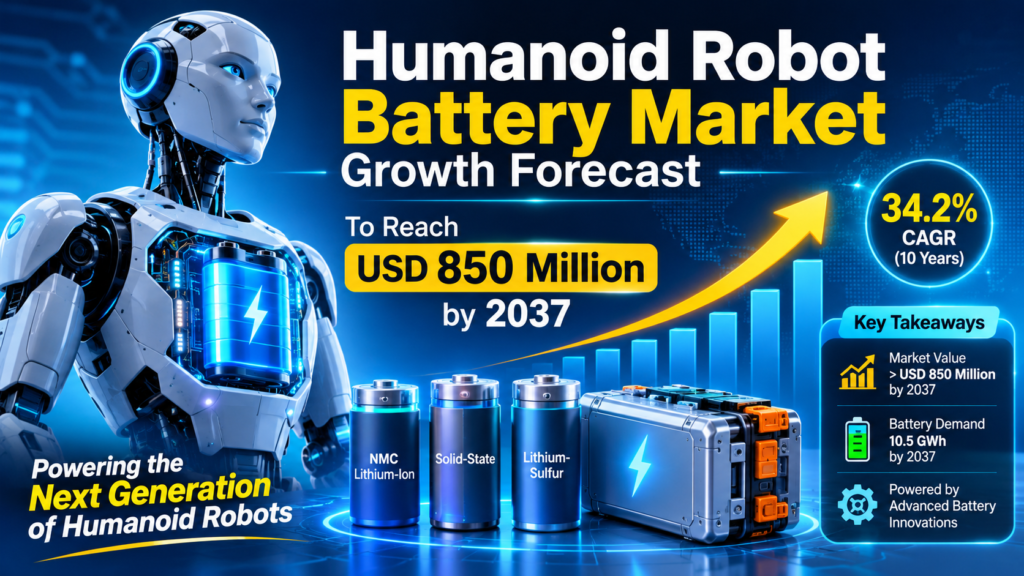
The humanoid robot battery market is forecast to pass USD 850 million by 2037, according to IDTechEx, which projects a ten-year compound annual growth rate of 34.2%. That value sits on top of an expected 10.5 GWh of battery demand by 2037, and on a structural quirk: robots that swap packs need more batteries than there are robots. humanoidsdailyidtechex
Why does a market this small deserve attention? Because batteries decide whether a humanoid is a demo or a coworker. Most humanoids today run for roughly two to four hours, and a Samsung SDI official has said current packs support as little as one to two hours because no robot-dedicated batteries exist yet. The company that closes that gap shapes the whole industry. emsnowkedglobal
Key Takeaways
- Size: IDTechEx expects humanoid battery revenue to exceed USD 850 million by 2037, a 34.2% ten-year CAGR.
- Volume: Demand is forecast at 10.5 GWh by 2037.
- Today’s chemistry: Nickel-manganese-cobalt (NMC) lithium-ion dominates, while lithium iron phosphate (LFP) is seen as too low in energy density.
- Tomorrow’s chemistry: Solid-state and lithium-sulfur are promising, but neither is expected to dominate by 2037.
- Different bets: Agility is betting on nine-minute fast charging, XPENG on solid-state cells.
- Caution: Third-party forecasts disagree by orders of magnitude, so treat any single number as a scenario.
What Is the Humanoid Robot Battery Market?
The humanoid robot battery market is the commercial segment that supplies rechargeable cells, packs and related power systems to bipedal and general-purpose robots built to work in human spaces. It is a component market. Its revenue depends on how many humanoids get built, how large and how many packs each one carries, and which chemistry goes inside.
Definition plus expansion: a humanoid battery pack is more than a cell. It combines cells, a battery management system, thermal control and a housing that fits inside a torso or backpack-style bay. Because the robot must balance and move, weight and shape matter as much as raw capacity.
IDTechEx divides its analysis along three axes. It segments demand by application (industrial, commercial and domestic) and by technology (lithium-ion, solid-state and lithium-sulfur), and it splits lithium-ion by cathode nickel content: NMC622, NMC811 and NMC9.5.5. That structure tells you where the money is expected to move: toward higher-nickel cells first, and toward newer chemistries later. idtechex
Why batteries matter more for humanoids than for most devices
Extra battery weight loads the robot’s own motors and actuators. Industry observers note that added battery mass increases the burden on those systems, which is why energy density is so important. A phone can carry a larger battery without consequence. A walking robot pays for every extra kilogram with more power draw, and that is a feedback loop designers must break. battery-tech
How Big Will the Humanoid Robot Battery Market Be by 2037?
Short answer: IDTechEx says the humanoid robot battery market will exceed USD 850 million by 2037, with 10.5 GWh of annual-scale demand behind it. The firm’s report, Batteries for Humanoid Robots 2027-2037, offers ten-year forecasts in both megawatt-hours and millions of dollars. idtechex
| Metric | IDTechEx Figure |
|---|---|
| Market value by 2037 | Above USD 850 million |
| Ten-year CAGR | 34.2% |
| Battery demand by 2037 | 10.5 GWh |
| Application segments | Industrial, commercial, domestic |
| Technology segments | Lithium-ion, solid-state, lithium-sulfur |
| Lithium-ion cathode splits | NMC622, NMC811, NMC9.5.5 |
What does the number imply?
Two quick calculations, which are my own arithmetic rather than IDTechEx statements, add context. Dividing USD 850 million by 10.5 GWh gives about USD 81 per kWh, a blended figure that is plausible for cells and packs but ignores differences in chemistry, timing and what each source counts. Working backward from a 34.2% CAGR over ten years suggests a starting point near USD 45 million at the beginning of the forecast window. Treat both as rough sanity checks.
Even at USD 850 million, the humanoid robot battery market would be tiny next to electric vehicles. Its importance lies elsewhere. It is a premium, performance-driven niche where safety, energy density and fast charging command attention, much as early EV cells did.
A note on evidence
The Humanoids Daily report that surfaced this forecast notes that IDTechEx’s public overview does not reveal the detailed assumptions needed to verify the projection independently. The number is credible as a professional estimate, but it is not an audited fact. humanoidsdaily
How Battery Swapping Reshapes the Humanoid Robot Battery Market
Battery swapping changes the math of the humanoid robot battery market, because every robot with swappable packs needs at least two batteries in rotation. IDTechEx highlights that an industrial robot can return to work with a charged pack while the depleted one recharges, which creates demand for more batteries than robots. humanoidsdaily
Why this matters for revenue:
- Spare packs multiply unit sales without multiplying robot sales.
- Swap stations and chargers become a recurring infrastructure purchase.
- Pack standardization becomes a competitive lever, since interchangeable packs lower operator risk.
Swapping also trades capital for uptime. An operator buys extra packs and a charging cabinet in exchange for keeping robots productive through a shift. That is attractive in logistics and manufacturing, where idle time is costly. It is less compelling in a home, where a robot can simply return to a dock overnight.
There is a second-order effect. When swapping becomes standard, the humanoid robot battery market starts to look more like forklift or power-tool batteries, with pack formats and charging protocols that matter as much as cell chemistry. Standards bodies and large robot makers will likely influence that outcome more than any single cell supplier.
Which Batteries Power Humanoid Robots Today?
Chemistry choices determine how quickly the humanoid robot battery market can scale. Today, one family leads.
NMC lithium-ion is the current workhorse
IDTechEx says NMC-based lithium-ion batteries are the most common choice in humanoids because they balance high energy density with fast-charge capability, good cycle life and commercial maturity. They also benefit from existing supply: because NMC is widely used in other applications, supply is already available to support humanoid growth. idtechexidtechex
Raising nickel content is the main upgrade path. Higher nickel can boost cathode energy density and cut reliance on costly, supply-constrained cobalt. Korean supplier commentary points the same way: Ecopro has said high-nickel ternary batteries are likely to outperform LFP in humanoid applications. idtechexbattery-tech
Why LFP falls short
LFP is cheaper and safer in many uses, yet IDTechEx considers it not energy dense enough for the general demands of humanoid robots. That view is not universal, however. SNE Research expects NCM and LFP, both valued for price competitiveness, to be installed mainly in the early stage of humanoid deployment. The likeliest reading is that LFP may find a place in cost-sensitive or lower-intensity robots, while demanding industrial models lean on high-nickel NMC. idtechexasiae
Solid-State vs. Lithium-Sulfur: What Comes After NMC?
Two emerging technologies compete for the next slot. Each solves a different problem, and each arrives late relative to humanoid ambitions.
| Feature | NMC Lithium-Ion | Solid-State | Lithium-Sulfur |
|---|---|---|---|
| Maturity | Commercial today | Mass production not expected until the end of the 2020s | Commercialization not expected until the early 2030s |
| Energy density | Good, rising with nickel content | About 400-500+ Wh/kg | High theoretical density |
| Safety | Flammable liquid electrolyte | Improved by removing flammable electrolyte | Not highlighted by IDTechEx |
| Key weakness | Cobalt cost, density ceiling | Scalable solid electrolytes, interface contact | Poor cycle life, cannot withstand fast charging |
| 2037 outlook | Dominant | Growing | Small share |
Source for table data: IDTechEx research article, October 2026.
Solid-state batteries: high density, later timing
Solid-state cells replace the liquid electrolyte with a solid one, which removes the separator, improves safety and allows tighter packing of active material. That matters near people. IDTechEx argues that because humanoids operate in close proximity to humans, a safer cell reduces harm in the event of failure. The catch is timing: mass production is not due until the end of the 2020s, with BYD and Toyota among those driving it. Future Battery Technologies for Humanoid Robots +2
Analysts at other firms see solid-state as a major long-run winner. SNE Research projects all-solid-state installed capacity in humanoids will surge from 0.04 GWh in 2030 to 5.65 GWh in 2035 and 76.1 GWh in 2040. For the humanoid robot battery market, the lesson is that solid-state revenue likely arrives in the 2030s, not the 2020s. asiae
Lithium-sulfur: cheap and light, but fragile
Lithium-sulfur pairs a lithium metal anode with a carbon/sulfur cathode and offers high theoretical energy density, plus the potential for lower cost from abundant sulfur. Its flaw is durability. A parasitic process called the polysulfide shuttle shortens cycle life and blocks fast charging, which would force more frequent pack replacements. IDTechEx expects it to hold only a small share by 2037. idtechexidtechex
Three Strategies to Extend Working Time
Manufacturers are not waiting for perfect chemistry. Recent announcements show three distinct approaches, although, as Humanoids Daily cautions, the performance claims are not directly comparable. humanoidsdaily
Fast charging: Agility and Nyobolt
Agility selected Nyobolt for Digit 5’s planned nine-minute recharge after 90 minutes of operation, which the company says could support more than 20 working hours a day, with early access expected in the first half of 2027. This turns charging into a brief, recurring pause instead of a long outage. humanoidsdaily
The open questions are practical. The announcement did not disclose pack capacity, charging power or quantified cycle-life results, and the real productivity gain will depend on travel to the charger, maintenance and task delays. humanoidsdaily
New chemistry: XPENG’s solid-state bet
XPENG says the solid-state battery developed for its IRON humanoid has entered small-batch production, with an emphasis on energy density and resistance to thermal propagation, impact and puncture. There is a transparency gap, though. XPENG advertises an all-solid-state design while earlier reporting described a semi-solid alternative, and no numerical performance results have been published. Until independent data appears, treat the claim as an early signal. humanoidsdailyhumanoidsdaily
Dedicated partnerships: robot makers pair with cell makers
A third path is co-development. Hyundai Motor, Kia and Samsung SDI agreed in early 2025 to build high-performance batteries for robots, and UBtech partnered with BYD on robot-dedicated batteries. These tie-ups matter because purpose-built packs can optimize shape, discharge rate and safety for a robot instead of borrowing from phones or EVs. kedglobal
Why Do Forecasts for the Humanoid Robot Battery Market Disagree?
Estimates for the humanoid robot battery market vary widely because analysts define scope differently, use different base years and assume different adoption curves. Compare several published figures:
| Source | Base Figure | Forecast | Notes |
|---|---|---|---|
| IDTechEx | Not disclosed publicly | Above USD 850 million, 10.5 GWh by 2037 | 34.2% ten-year CAGR |
| MarketsandMarkets | USD 14.0 million (2025) | About USD 622 million by 2032 | About 72% CAGR, 2026-2032 |
| LP Information | USD 15.01 million (2025) | USD 818 million by 2032 | 70.9% CAGR, battery packs |
| Mobility Foresights | USD 780 million (2024) | USD 1.96 billion by 2031 | 14.1% CAGR |
| SNE Research | About 23,000 robots (2025) | 138 GWh demand by 2040 | About 53 million robots by 2040 |
Sources: MarketsandMarkets, LP Information, Mobility Foresights, SNE Research, IDTechEx. Figures are as published and not harmonized.
Three patterns stand out. First, two research houses place the 2025 market near USD 14 to 15 million, while another puts 2024 at USD 780 million. That is a gap of roughly fifty times, which almost certainly reflects a broader definition of robot or battery, though the methodology is not visible here. Humanoid Robot Battery Market Size, Share & Trends +2
Second, volume forecasts diverge sharply by horizon. SNE Research projects cumulative humanoids rising from about 23,000 in 2025 to 6.79 million in 2035 and roughly 53.3 million in 2040. A 138 GWh figure for 2040 and a 10.5 GWh figure for 2037 are not contradictory so much as different bets on how fast robots scale in the late 2030s. asiae
Third, robot prices feed battery revenue indirectly. IDTechEx forecasts average humanoid selling prices falling from USD 114,700 in 2024 to USD 37,000 by 2030. Cheaper robots broaden adoption, but they also squeeze component budgets, so battery suppliers face volume growth alongside price pressure. humanoid
What the Humanoid Robot Battery Market Means for Key Stakeholders
For battery manufacturers
Suppliers entering the humanoid robot battery market face a niche with premium specifications and modest early volume. One market study puts typical gross margins for humanoid battery packs at 20 to 30%. The strategic prize is positioning: a supplier validated on humanoids can carry that credibility into other robotics categories and high-performance applications. marketresearch
For robot developers
Developers should treat the battery as a system decision, not a purchased part. Runtime, charge rate, swap design, thermal behavior and safety certification interact. A pack that gives two extra hours but needs a slow charge may lose to a smaller pack that swaps in seconds.
For operators and buyers
Humanoids Daily frames the real test well: operators should judge how much reliable work a robot completes across a shift, including the cost of chargers, spare packs and eventual replacements. Spec-sheet runtime alone will mislead. Ask vendors for total cost of ownership across a full duty cycle, including pack degradation and swap labor. humanoidsdaily
For investors and analysts
Use the IDTechEx forecast as a reference point rather than a promise. Look for leading indicators: announced pack capacities, published cycle-life data, qualification of high-nickel cells and the first real shipments of solid-state cells into robots.
Frequently Asked Questions
How large is the humanoid robot battery market today?
Published estimates differ sharply. Two research firms put the 2025 humanoid robot battery market at roughly USD 14 to 15 million, while another report cites far higher figures under a broader definition. Always check what a source counts before comparing numbers.
What is driving growth in the humanoid robot battery market?
Three forces: more humanoid robots shipping, larger energy needs per robot as tasks get heavier, and battery swapping that adds spare packs. IDTechEx links its 10.5 GWh forecast to both robot demand and swapping.
Which battery chemistry is best for humanoid robots?
Today, high-nickel NMC lithium-ion leads on the balance of density, fast-charge ability and availability. Solid-state is the most-cited long-term upgrade, with lithium-sulfur a later, riskier option.
When will solid-state batteries reach humanoid robots at scale?
Mass production is not expected until the end of the 2020s, so meaningful humanoid adoption likely follows in the 2030s. Small-batch efforts such as XPENG’s are early indicators, not proof of scale.
Can fast charging replace battery swapping?
Not entirely. Fast charging reduces downtime, and swapping eliminates it at the cost of extra packs and infrastructure. The better choice depends on the application, the duty cycle and the cost of idle robots.
Bottom Line
The humanoid robot battery market is small today but strategically important. IDTechEx expects it to exceed USD 850 million by 2037, powered by 10.5 GWh of demand, higher-nickel NMC chemistry and the extra packs that swapping creates. Solid-state and lithium-sulfur offer longer-term upside, though neither is expected to dominate by then. Because published forecasts vary so widely, the smartest approach is to track real-world signals, such as runtime data, charge times and cell shipments, rather than any single headline number.
IDTechEx-ର ଆକଳନ ଅନୁଯାୟୀ, ୨୦୩୭ ସୁଦ୍ଧା ହ୍ୟୁମାନଏଡ୍ (ମାନବୀୟ ଆକୃତିର) ରୋବଟ୍ ବ୍ୟାଟେରୀ ବଜାର ୮୫୦ ନିୟୁତ ଆମେରିକୀୟ ଡଲାର ଅତିକ୍ରମ କରିବ।
୩ ନଭେମ୍ବର, ୨୦୨୬ ରେ ପ୍ରକାଶିତ। ଏହି ତଥ୍ୟ IDTechEx-ର ସାର୍ବଜନୀନ ରିପୋର୍ଟ, ‘ହ୍ୟୁମାନଏଡ୍ସ ଡେଲି’ (Humanoids Daily) ରିପୋର୍ଟ ଏବଂ ଅନ୍ୟାନ୍ୟ ବଜାର ଗବେଷଣା ଉପରେ ଆଧାରିତ।
IDTechEx ଅନୁଯାୟୀ, ହ୍ୟୁମାନଏଡ୍ ରୋବଟ୍ ବ୍ୟାଟେରୀ ବଜାର ୨୦୩୭ ସୁଦ୍ଧା ୮୫୦ ନିୟୁତ ଆମେରିକୀୟ ଡଲାର ଅତିକ୍ରମ କରିବ ବୋଲି ଆକଳନ କରାଯାଇଛି। ଏଥିରେ ଦଶ ବର୍ଷ ପାଇଁ ବାର୍ଷିକ ଚକ୍ରବୃଦ୍ଧି ଅଭିବୃଦ୍ଧି ହାର (CAGR) ୩୪.୨% ରହିବ ବୋଲି ଅନୁମାନ କରାଯାଇଛି। ଏହି ମୂଲ୍ୟ ୨୦୩୭ ସୁଦ୍ଧା ଆବଶ୍ୟକ ହେବାକୁ ଥିବା ୧୦.୫ GWh (ଗିଗାୱାଟ୍-ଘଣ୍ଟା) ବ୍ୟାଟେରୀ ଚାହିଦା ଉପରେ ଆଧାରିତ। ଏହା ବ୍ୟତୀତ, ଏଥିରେ ଏକ ବିଶେଷ ବୈଷୟିକ ବୈଶିଷ୍ଟ୍ୟ ମଧ୍ୟ ରହିଛି: ଯେଉଁ ରୋବଟ୍ଗୁଡ଼ିକରେ ବ୍ୟାଟେରୀ ପ୍ୟାକ୍ ବଦଳାଇବାର (swapping) ବ୍ୟବସ୍ଥା ଥାଏ, ସେଗୁଡ଼ିକ ପାଇଁ ରୋବଟ୍ ସଂଖ୍ୟା ତୁଳନାରେ ଅଧିକ ସଂଖ୍ୟକ ବ୍ୟାଟେରୀର ଆବଶ୍ୟକତା ପଡ଼ିଥାଏ।
ଏତେ ଛୋଟ ବଜାର ଉପରେ ଧ୍ୟାନ ଦେବାର ଆବଶ୍ୟକତା କାହିଁକି? କାରଣ ବ୍ୟାଟେରୀ ହିଁ ସ୍ଥିର କରେ ଯେ ଏକ ହ୍ୟୁମାନଏଡ୍ ରୋବଟ୍ କେବଳ ଏକ ପ୍ରଦର୍ଶନୀ (demo) ହୋଇ ରହିବ ନା ଏକ ସହକର୍ମୀ (coworker) ଭାବରେ କାମ କରିବ। ବର୍ତ୍ତମାନର ଅଧିକାଂଶ ହ୍ୟୁମାନଏଡ୍ ରୋବଟ୍ ପ୍ରାୟ ଦୁଇରୁ ଚାରି ଘଣ୍ଟା ପର୍ଯ୍ୟନ୍ତ ଚାଲିପାରନ୍ତି। Samsung SDI-ର ଜଣେ ଅଧିକାରୀଙ୍କ କହିବା ଅନୁସାରେ, ବର୍ତ୍ତମାନ ବ୍ୟବହୃତ ହେଉଥିବା ବ୍ୟାଟେରୀ ପ୍ୟାକ୍ଗୁଡ଼ିକ କେବଳ ଏକରୁ ଦୁଇ ଘଣ୍ଟା ପର୍ଯ୍ୟନ୍ତ ଚାଲିପାରେ, କାରଣ ବର୍ତ୍ତମାନ ପର୍ଯ୍ୟନ୍ତ ରୋବଟ୍ ପାଇଁ ସ୍ୱତନ୍ତ୍ର ଭାବେ ତିଆରି ହୋଇଥିବା ବ୍ୟାଟେରୀ ଉପଲବ୍ଧ ନାହିଁ। ଯେଉଁ କମ୍ପାନୀ ଏହି ଅଭାବକୁ ଦୂର କରିବ, ତାହା ସମଗ୍ର ଶିଳ୍ପର ଗତିପଥ ନିର୍ଦ୍ଧାରଣ କରିବ।
ମୁଖ୍ୟ ବିଷୟବସ୍ତୁ:
ବଜାର ଆକାର: IDTechEx-ର ଆକଳନ ଅନୁଯାୟୀ, ୨୦୩୭ ସୁଦ୍ଧା ହ୍ୟୁମାନଏଡ୍ ବ୍ୟାଟେରୀରୁ ମିଳୁଥିବା ରାଜସ୍ୱ ୮୫୦ ନିୟୁତ ଆମେରିକୀୟ ଡ ମାନବୀୟ ରୋବଟ୍ (humanoid robot) ବ୍ୟାଟେରୀ ବଜାର ହେଉଛି ଏକ ବ୍ୟବସାୟିକ କ୍ଷେତ୍ର, ଯାହା ମାନବ ପରିବେଶରେ କାମ କରିବା ପାଇଁ ତିଆରି ହୋଇଥିବା ଦୁଇ-ଗୋଡ଼ ବିଶିଷ୍ଟ (bipedal) ଏବଂ ସାଧାରଣ ଉଦ୍ଦେଶ୍ୟମୂଳକ ରୋବଟ୍ଗୁଡ଼ିକ ପାଇଁ ରିଚାର୍ଜ ଯୋଗ୍ୟ ସେଲ୍ (cells), ବ୍ୟାଟେରୀ ପ୍ୟାକ୍ ଏବଂ ଅନ୍ୟାନ୍ୟ ଶକ୍ତି ପ୍ରଣାଳୀ ଯୋଗାଇଥାଏ। ଏହା ଏକ ଉପାଦାନ-ଭିତ୍ତିକ (component) ବଜାର।
ଏହାର ଆୟ ନିର୍ଭର କରେ ଯେ କେତେ ସଂଖ୍ୟକ ମାନବୀୟ ରୋବଟ୍ ନିର୍ମାଣ କରାଯାଉଛି, ପ୍ରତ୍ୟେକ ରୋବଟ୍ରେ କେତେ ବଡ଼ କିମ୍ବା କେତେ ସଂଖ୍ୟକ ବ୍ୟାଟେରୀ ପ୍ୟାକ୍ ବ୍ୟବହୃତ ହେଉଛି ଏବଂ ସେଥିରେ କେଉଁ ପ୍ରକାରର ରାସାୟନିକ ସଂରଚନା (chemistry) ବ୍ୟବହୃତ ହୋଇଛି, ତାହା ଉପରେ।
ବ୍ୟାଖ୍ୟା ଏବଂ ବିସ୍ତାର: ଏକ ମାନବୀୟ ରୋବଟ୍ ବ୍ୟାଟେରୀ ପ୍ୟାକ୍ କେବଳ ଗୋଟିଏ ‘ସେଲ୍’ (cell) ଠାରୁ ଅଧିକ କିଛି ଅଟେ। ଏଥିରେ ଏକାଧିକ ସେଲ୍, ଏକ ବ୍ୟାଟେରୀ ପରିଚାଳନା ପ୍ରଣାଳୀ (BMS), ତାପମାତ୍ରା ନିୟନ୍ତ୍ରଣ ବ୍ୟବସ୍ଥା ଏବଂ ଏକ ସୁରକ୍ଷିତ ଆବରଣ (housing) ଥାଏ, ଯାହା ରୋବଟ୍ର ଶରୀର ଭିତରେ କିମ୍ବା ପଛପଟେ ଥିବା ସ୍ଥାନରେ (backpack-style bay) ସଠିକ୍ ଭାବରେ ଖଞ୍ଜା ଯାଇପାରିବ। ଯେହେତୁ ରୋବଟ୍କୁ ନିଜର ସନ୍ତୁଳନ ରକ୍ଷା କରିବାକୁ ଏବଂ ଚଳପ୍ରଚଳ କରିବାକୁ ପଡ଼ିଥାଏ, ତେଣୁ କେବଳ ବ୍ୟାଟେରୀର ଶକ୍ତି ସାମର୍ଥ୍ୟ (capacity) ନୁହେଁ, ବରଂ ଏହାର ଓଜନ ଏବଂ ଆକାର ମଧ୍ୟ ଅତ୍ୟନ୍ତ ଗୁରୁତ୍ୱପୂର୍ଣ୍ଣ ଅଟେ।
IDTechEx ନିଜର ବିଶ୍ଳେଷଣକୁ ତିନୋଟି ମୁଖ୍ୟ ଆଧାରରେ ବିଭକ୍ତ କରିଛି। ଏହା ଚାହିଦାକୁ ବ୍ୟବହାର କ୍ଷେତ୍ର (ଶିଳ୍ପ, ବ୍ୟବସାୟିକ ଏବଂ ଘରୋଇ) ତଥା ପ୍ରଯୁକ୍ତିବିଦ୍ୟା (ଲିଥିୟମ୍-ଆୟନ, ସଲିଡ୍-ଷ୍ଟେଟ୍ ଏବଂ ଲିଥିୟମ୍-ସଲଫର୍) ଅନୁଯାୟୀ ବିଭାଜିତ କରିଛି। ଏହା ସହିତ, ଲିଥିୟମ୍-ଆୟନ ବ୍ୟାଟେରୀଗୁଡ଼ିକୁ ସେଥିରେ ଥିବା ନିକେଲ୍ (nickel) ପରିମାଣ ଆଧାରରେ NMC622, NMC811 ଏବଂ NMC9.5.5 ଭଳି ଶ୍ରେଣୀରେ ବିଭକ୍ତ କରାଯାଇଛି। ଏହି ବିଭାଜନରୁ ଜଣାପଡ଼େ ଯେ ଭବିଷ୍ୟତରେ ପୁଞ୍ଜି ନିବେଶ କେଉଁ ଦିଗରେ ଗତି କରିବ: ପ୍ରଥମେ ଅଧିକ ନିକେଲ୍ ଥିବା ସେଲ୍ ଆଡ଼କୁ ଏବଂ ପରବର୍ତ୍ତୀ ସମୟରେ ନୂତନ ରାସାୟନିକ ପ୍ରଯୁକ୍ତିବିଦ୍ୟ IDTechEx
ମାପକାଠି | IDTechEx ଆକଳନ
୨୦୩୭ ସୁଦ୍ଧା ବଜାର ମୂଲ୍ୟ | ୮୫୦ ନିୟୁତ ଆମେରିକୀୟ ଡଲାରରୁ ଅଧିକ
ଦଶ ବର୍ଷିଆ CAGR (ଯୌଗିକ ବାର୍ଷିକ ଅଭିବୃଦ୍ଧି ହାର) | ୩୪.୨%
୨୦୩୭ ସୁଦ୍ଧା ବ୍ୟାଟେରୀ ଚାହିଦା | ୧୦.୫ GWh (ଗିଗାୱାଟ୍-ଘଣ୍ଟା)
ପ୍ରୟୋଗ କ୍ଷେତ୍ର | ଶିଳ୍ପ, ବାଣିଜ୍ୟିକ, ଘରୋଇ
ପ୍ରଯୁକ୍ତିବିଦ୍ୟା ପ୍ରକାର | ଲିଥିୟମ୍-ଆୟନ, ସଲିଡ୍-ଷ୍ଟେଟ୍, ଲିଥିୟମ୍-ସଲଫର୍
ଲିଥିୟମ୍-ଆୟନ କ୍ୟାଥୋଡ୍ ପ୍ରକାର | NMC622, NMC811, NMC9.5.5
ଏହି ସଂଖ୍ୟାଟି କ’ଣ ସୂଚିତ କରେ?
ଦୁଇଟି ସଂକ୍ଷିପ୍ତ ଗଣନା — ଯାହା IDTechEx-ର ବିବୃତ୍ତି ନୁହେଁ ବରଂ ମୋର ନିଜସ୍ୱ ହିସାବ — ଏହି ବିଷୟକୁ ଅଧିକ ସ୍ପଷ୍ଟ କରେ। ୮୫୦ ନିୟୁତ ଆମେରିକୀୟ ଡଲାରକୁ ୧୦.୫ GWh ଦ୍ୱାରା ଭାଗ କଲେ ପ୍ରତି kWh (କିଲୋୱାଟ୍-ଘଣ୍ଟା) ପିଛା ପ୍ରାୟ ୮୧ ଆମେରିକୀୟ ଡଲାର ମିଳିଥାଏ। ଏହା ଏକ ମିଶ୍ରିତ ଆକଳନ ଯାହା ସେଲ୍ (cells) ଏବଂ ପ୍ୟାକ୍ (packs) ପାଇଁ ଯୁକ୍ତିଯୁକ୍ତ ମନେହୁଏ, କିନ୍ତୁ ଏଥିରେ ରାସାୟନିକ ଗଠନ, ସମୟସୀମା ଏବଂ ବିଭିନ୍ନ ଉତ୍ସ ଦ୍ୱାରା ଗଣନା କରାଯାଉଥିବା ଭିନ୍ନ ଭିନ୍ନ ମାନଦଣ୍ଡକୁ ବିଚାରକୁ ନିଆଯାଇନାହିଁ।
ଦଶ ବର୍ଷ ମଧ୍ୟରେ ୩୪.୨% CAGR (ଯୌଗିକ ବାର୍ଷିକ ଅଭିବୃଦ୍ଧି ହାର) କୁ ଆଧାର କରି ପଛକୁ ହିସାବ କଲେ, ପୂର୍ବାନୁମାନ ଅବଧିର ଆରମ୍ଭରେ ଏହାର ମୂଲ୍ୟ ପ୍ରାୟ ୪୫ ନିୟୁତ ଆମେରିକୀୟ ଡଲାର ହେବ ବୋଲି ଜଣାପଡ଼େ। ଏହି ଉଭୟ ହିସାବକୁ କେବଳ ଏକ ମୋଟାମୋଟି ଯାଞ୍ଚ (sanity check) ଭାବରେ ଗ୍ରହଣ କରାଯିବା ଉଚିତ୍।
୮୫୦ ନିୟୁତ ଆମେରିକୀୟ ଡଲାର ହେଲେ ମଧ୍ୟ, ଇଲେକ୍ଟ୍ରିକ୍ ଯାନ (EV) ବଜାର ତୁଳନାରେ ହ୍ୟୁମାନଏଡ୍ ରୋବଟ୍ (ମାନବୀୟ ଆକୃତିର ରୋବଟ୍) ପାଇଁ ବ୍ୟାଟେରୀ ବଜାର ଅତ୍ୟନ୍ତ ଛୋଟ ହେବ। କିନ୍ତୁ ଏହାର ଗୁରୁତ୍ୱ ଅନ୍ୟ କ୍ଷେତ୍ରରେ ରହିଛି। ଏହା ଏକ ଉନ୍ନତ ମାନର (premium) ଏବଂ କାର୍ଯ୍ୟଦକ୍ଷତା-ଭିତ୍ତିକ ବିଶେଷ ବଜାର (niche market), ଯେଉଁଠାରେ ସୁରକ୍ଷା, ଶକ୍ତି ଘନତ୍ୱ (energy density) ଏବଂ ଦ୍ରୁତ ଚାର୍ଜିଂ ଉପରେ ବିଶେଷ ଧ୍ୟାନ ଦିଆଯାଏ — ଠିକ୍ ଯେପରି ପ୍ରାରମ୍ଭିକ ଇଲେକ୍ଟ୍ରିକ୍ ଯାନ (EV) ସେଲ୍ଗୁଡ଼ିକ କ୍ଷେତ୍ରରେ ହୋଇଥିଲା ଏଥିପାଇଁ ଅତିକମରେ ଦୁଇଟି ବ୍ୟାଟେରୀ ପ୍ୟାକ୍ର ଆବଶ୍ୟକତା ରହିଥାଏ, ଯାହାକୁ ପର୍ଯ୍ୟାୟକ୍ରମେ ବ୍ୟବହାର କରାଯାଏ।
IDTechEx ଅନୁଯାୟୀ, ଏକ ଶିଳ୍ପ ରୋବୋଟ୍ (industrial robot) ଚାର୍ଜ ହୋଇଥିବା ବ୍ୟାଟେରୀ ପ୍ୟାକ୍ ସାହାଯ୍ୟରେ ପୁନର୍ବାର କାମ ଆରମ୍ଭ କରିପାରେ, ଯେତେବେଳେ କି ଖାଲି ହୋଇଯାଇଥିବା ପ୍ୟାକ୍ଟି ଚାର୍ଜ ହେଉଥାଏ। ଏହି ପ୍ରକ୍ରିୟା ଯୋଗୁଁ ରୋବୋଟ୍ ସଂଖ୍ୟା ତୁଳନାରେ ଅଧିକ ସଂଖ୍ୟକ ବ୍ୟାଟେରୀ ପ୍ୟାକ୍ର ଚାହିଦା ସୃଷ୍ଟି ହୁଏ।
ରାଜସ୍ୱ ଦୃଷ୍ଟିକୋଣରୁ ଏହା କାହିଁକି ଗୁରୁତ୍ୱପୂର୍ଣ୍ଣ:
ଅତିରିକ୍ତ ବ୍ୟାଟେରୀ ପ୍ୟାକ୍ଗୁଡ଼ିକ ରୋବୋଟ୍ ବିକ୍ରି ବୃଦ୍ଧି ନକରି ମଧ୍ୟ ବିକ୍ରି ପରିମାଣ (unit sales) ବଢ଼ାଇଥାଏ।
ବ୍ୟାଟେରୀ ବଦଳାଇବା କେନ୍ଦ୍ର (swap stations) ଏବଂ ଚାର୍ଜରଗୁଡ଼ିକ ଏକ ନିୟମିତ ଭିତ୍ତିଭୂମି ନିବେଶରେ ପରିଣତ ହୁଏ।
ବ୍ୟାଟେରୀ ପ୍ୟାକ୍ର ମାନକୀକରଣ (standardization) ଏକ ପ୍ରତିଯୋଗିତାମୂଳକ ସୁବିଧା ପ୍ରଦାନ କରେ, କାରଣ ପରସ୍ପର ବଦଳାଇ ଯୋଗ୍ୟ (interchangeable) ପ୍ୟାକ୍ ବ୍ୟବହାରକାରୀଙ୍କ ପାଇଁ ବିପଦ କମାଇଥାଏ।
ବ୍ୟାଟେରୀ ବଦଳାଇବା ବ୍ୟବସ୍ଥା ପୁଞ୍ଜି ନିବେଶ ବଦଳରେ ‘ଅପ୍ଟାଇମ୍’ (କାର୍ଯ୍ୟକ୍ଷମ ସମୟ) ପ୍ରଦାନ କରେ। ଜଣେ ଅପରେଟର କିଛି ଅତିରିକ୍ତ ବ୍ୟାଟେରୀ ପ୍ୟାକ୍ ଏବଂ ଚାର୍ଜିଂ କ୍ୟାବିନେଟ୍ କିଣିଥାନ୍ତି, ଯାହା ଫଳରେ ରୋବୋଟ୍ଗୁଡ଼ିକ ପୁରା ସିଫ୍ଟ ସମୟରେ କାର୍ଯ୍ୟକ୍ଷମ ରହିପାରନ୍ତି। ଲଜିଷ୍ଟିକ୍ସ (ପରିବହନ ଓ ଯୋଗାଣ) ଏବଂ ଉତ୍ପାଦନ କ୍ଷେତ୍ରରେ ଏହା ଅତ୍ୟନ୍ତ ଲାଭଦାୟକ, କାରଣ ସେଠାରେ ରୋବୋଟ୍ ଅକର୍ମଣ୍ୟ ହୋଇ ରହିଲେ ବଡ଼ କ୍ଷତି ହୋଇଥାଏ। କିନ୍ତୁ ଘରୋଇ ବ୍ୟବହାର କ୍ଷେତ୍ରରେ ଏହାର ଆବଶ୍ୟକତା କମ୍, କାରଣ ସେଠାରେ ରୋବୋଟ୍ଟି ରାତିସାରା ଚାର୍ଜିଂ ଡକ୍ରେ ରହି ପୁନର୍ବାର ଚାର୍ଜ ହୋଇପାରିବ।
ଏହାର ଏକ ପରୋକ୍ଷ ପ୍ରଭାବ ମଧ୍ୟ ରହିଛି। ଯେତେବେଳେ ବ୍ୟାଟେରୀ ବଦଳାଇବା ପ୍ରକ୍ରିୟା ଏକ ମାନକ (standard) ହୋଇଯାଏ, ସେତେବେଳେ ହ୍ୟୁମାନଏଡ୍ (ମାନବୀୟ ଆକୃତିର) ରୋବୋଟ୍ ବ୍ୟାଟେରୀ ବଜାର, ଫର୍କଲିଫ୍ଟ କିମ୍ବା ପାୱାର-ଟୁଲ୍ ବ୍ୟାଟେରୀ ବଜାର ଭଳି ହୋଇଯାଏ। ଏଠାରେ କେବଳ ବ୍ୟାଟେରୀର ରାସାୟନିକ ଗଠନ (cell chemistry) ନୁହେଁ SNE Research ଅନୁମାନ କରେ ଯେ, ମୂଲ୍ୟ ଦୃଷ୍ଟିରୁ ସୁବିଧାଜନକ ହୋଇଥିବାରୁ, ହ୍ୟୁମାନଏଡ୍ (ମାନବୀୟ ଆକୃତିର ରୋବଟ୍) ନିୟୋଜନର ପ୍ରାରମ୍ଭିକ ପର୍ଯ୍ୟାୟରେ ମୁଖ୍ୟତଃ NCM ଏବଂ LFP ବ୍ୟବହୃତ ହେବ।
ସମ୍ଭାବନା ଅଛି ଯେ, କମ୍ ଖର୍ଚ୍ଚ ଆବଶ୍ୟକ କରୁଥିବା କିମ୍ବା କମ୍ ତୀବ୍ରତାର କାର୍ଯ୍ୟ କରୁଥିବା ରୋବଟ୍ଗୁଡ଼ିକରେ LFP ବ୍ୟବହୃତ ହୋଇପାରେ, ଅନ୍ୟପକ୍ଷରେ ଅଧିକ କ୍ଷମତା ଆବଶ୍ୟକ କରୁଥିବା ଶିଳ୍ପ-ସ୍ତରୀୟ ମଡେଲ୍ଗୁଡ଼ିକରେ ଅଧିକ ନିକେଲ୍ (nickel) ଥିବା NMC ବ୍ୟବହାର କରାଯାଇପାରେ।
ସଲିଡ୍-ଷ୍ଟେଟ୍ (Solid-State) ବନାମ ଲିଥିୟମ୍-ସଲଫର୍ (Lithium-Sulfur): NMC ପରେ କ’ଣ ଆସିବ?
ପରବର୍ତ୍ତୀ ପର୍ଯ୍ୟାୟ ପାଇଁ ଦୁଇଟି ଉଦୀୟମାନ ପ୍ରଯୁକ୍ତିବିଦ୍ୟା ମଧ୍ୟରେ ପ୍ରତିଯୋଗିତା ଚାଲିଛି। ପ୍ରତ୍ୟେକଟି ଭିନ୍ନ ଭିନ୍ନ ସମସ୍ୟାର ସମାଧାନ କରନ୍ତି, କିନ୍ତୁ ହ୍ୟୁମାନଏଡ୍ ସମ୍ବନ୍ଧୀୟ ଲକ୍ଷ୍ୟଗୁଡ଼ିକ ତୁଳନାରେ ଏଗୁଡ଼ିକ ବିଳମ୍ବରେ ଆସୁଛନ୍ତି।
ବୈଶିଷ୍ଟ୍ୟ | NMC ଲିଥିୟମ୍-ଆୟନ୍ | ସଲିଡ୍-ଷ୍ଟେଟ୍ | ଲିଥିୟମ୍-ସଲଫର୍
ବିକାଶ ସ୍ତର | ବର୍ତ୍ତମାନ ବ୍ୟବସାୟିକ ଭାବେ ଉପଲବ୍ଧ | ୨୦୨୦ ଦଶକର ଶେଷ ପର୍ଯ୍ୟନ୍ତ ବ୍ୟାପକ ଉତ୍ପାଦନ ଆଶା କରାଯାଏ ନାହିଁ | ୨୦୩୦ ଦଶକର ଆରମ୍ଭ ପର୍ଯ୍ୟନ୍ତ ବ୍ୟବସାୟିକୀକରଣ ଆଶା କରାଯାଏ ନାହିଁ
ଶକ୍ତି ଘନତ୍ୱ (Energy density) | ଭଲ, ନିକେଲ୍ ପରିମାଣ ବଢ଼ିବା ସହ ବୃଦ୍ଧି ପାଏ | ପ୍ରାୟ ୪୦୦-୫୦୦+ Wh/kg | ତତ୍ତ୍ୱଗତ ଭାବେ ଅତ୍ୟଧିକ ଘନତ୍ୱ
ସୁରକ୍ଷା | ଜ୍ୱଳନଶୀଳ ତରଳ ଇଲେକ୍ଟ୍ରୋଲାଇଟ୍ ଥାଏ | ଜ୍ୱଳନଶୀଳ ଇଲେକ୍ଟ୍ରୋଲାଇଟ୍ ହଟାଇବା ଦ୍ୱାରା ସୁରକ୍ଷା ବୃଦ୍ଧି ପାଏ | IDTechEx ଏ ବିଷୟରେ ଉଲ୍ଲେଖ କରିନାହିଁ
ମୁଖ୍ୟ ଦୁର୍ବଳତା | କୋବାଲ୍ଟର ମୂଲ୍ୟ, ଘନତ୍ୱର ସୀମା | ସମ୍ପ୍ରସାରଣଯୋଗ୍ୟ ସଲିଡ୍ ଇଲେକ୍ଟ୍ରୋଲାଇଟ୍, ଇଣ୍ଟରଫେସ୍ ସମ୍ପର୍କ | କମ୍ ଚକ୍ର ଜୀବନ (cycle life), ଦ୍ରୁତ ଚାର୍ଜିଂ ସହ୍ୟ କରିପାରେ ନାହିଁ
୨୦୩୭ ପାଇଁ ପୂର୍ବାନୁମାନ | ପ୍ରମୁଖ ସ୍ଥାନରେ | ବୃଦ୍ଧି ପାଉଛି | ଅଳ୍ପ ଅଂଶ
ସାରଣୀ ତଥ୍ୟର ଉତ୍ସ: IDTechEx ଗବେଷଣା ଲେଖା, ଅକ୍ଟୋବର ୨୦୨୬।
ସଲିଡ୍-ଷ୍ଟେଟ୍ ବ୍ୟାଟେରୀ: ଅଧିକ ଘନତ୍ୱ, କିନ୍ତୁ ବିଳମ୍ବିତ SNE Research ର ଆକଳନ ଅନୁଯାୟୀ, ହ୍ୟୁମାନଏଡ୍ (ମାନବୀୟ ଆକୃତିର ରୋବଟ୍) ଗୁଡ଼ିକରେ ‘ଅଲ୍-ସଲିଡ୍-ଷ୍ଟେଟ୍’ (all-solid-state) ବ୍ୟାଟେରୀର କ୍ଷମତା ୨୦୩୦ ମସିହାରେ ୦.୦୪ GWh ଥିବାବେଳେ, ୨୦୩୫ ସୁଦ୍ଧା ଏହା ୫.୬୫ GWh ଏବଂ ୨୦୪୦ ସୁଦ୍ଧା ୭୬.୧ GWh କୁ ବୃଦ୍ଧି ପାଇବ। ହ୍ୟୁମାନଏଡ୍ ରୋବଟ୍ ବ୍ୟାଟେରୀ ବଜାର ପାଇଁ ଏଥିରୁ ଏହା ସ୍ପଷ୍ଟ ହୁଏ ଯେ, ‘ସଲିଡ୍-ଷ୍ଟେଟ୍’ ବ୍ୟାଟେରୀରୁ ଆୟ ୨୦୨୦ ଦଶକରେ ନୁହେଁ, ବରଂ ୨୦୩୦ ଦଶକରେ ଆରମ୍ଭ ହେବାର ସମ୍ଭାବନା ରହିଛି।
ଲିଥିୟମ୍-ସଲଫର୍: ଶସ୍ତା ଏବଂ ହାଲୁକା, କିନ୍ତୁ ଅସ୍ଥାୟୀ (ଦୀର୍ଘସ୍ଥାୟୀ ନୁହେଁ)
ଲିଥିୟମ୍-ସଲଫର୍ ବ୍ୟାଟେରୀରେ ଏକ ଲିଥିୟମ୍ ଧାତୁ ଆନୋଡ୍ (anode) ଏବଂ କାର୍ବନ୍/ସଲଫର୍ କ୍ୟାଥୋଡ୍ (cathode) ବ୍ୟବହୃତ ହୁଏ। ଏଥିରେ ଉଚ୍ଚ ତତ୍ତ୍ୱଗତ ଶକ୍ତି ଘନତ୍ୱ (theoretical energy density) ରହିଥାଏ ଏବଂ ପ୍ରଚୁର ପରିମାଣରେ ସଲଫର୍ ଉପଲବ୍ଧ ଥିବାରୁ ଏହାର ମୂଲ୍ୟ ମଧ୍ୟ କମ୍ ହେବାର ସମ୍ଭାବନା ଥାଏ। ତେବେ, ଏହାର ମୁଖ୍ୟ ଦୁର୍ବଳତା ହେଉଛି ଏହାର ସ୍ଥାୟିତ୍ୱ। ‘ପଲିସଲଫାଇଡ୍ ସଟଲ୍’ (polysulfide shuttle) ନାମକ ଏକ ପ୍ରକ୍ରିୟା ଯୋଗୁଁ ବ୍ୟାଟେରୀର କାର୍ଯ୍ୟକାଳ (cycle life) କମିଯାଏ ଏବଂ ଦ୍ରୁତ ଚାର୍ଜିଂ (fast charging) ବାଧାପ୍ରାପ୍ତ ହୁଏ; ଫଳରେ ବାରମ୍ବାର ବ୍ୟାଟେରୀ ପ୍ୟାକ୍ ବଦଳାଇବାକୁ ପଡ଼ିପାରେ। IDTechEx ର ଆକଳନ ଅନୁଯାୟୀ, ୨୦୩୭ ସୁଦ୍ଧା ବଜାରରେ ଏହାର ଅଂଶ ବହୁତ କମ୍ ରହିବ।
କାର୍ଯ୍ୟକାଳ ବୃଦ୍ଧି କରିବା ପାଇଁ ତିନୋଟି ରଣନୀତି
ଉତ୍ପାଦନକାରୀମାନେ ଏକ ତ୍ରୁଟିହୀନ ରାସାୟନିକ ସଂରଚନା (perfect chemistry) ପାଇଁ ଅପେକ୍ଷା କରି ବସିନାହାନ୍ତି। ସାମ୍ପ୍ରତିକ ଘୋଷଣାଗୁଡ଼ିକରୁ ତିନୋଟି ଭିନ୍ନ ପନ୍ଥା ସାମ୍ନାକୁ ଆସିଛି; ଯଦିଓ ‘Humanoids Daily’ ର ଚେତାବନୀ ଅନୁଯାୟୀ, ବିଭିନ୍ନ କମ୍ପାନୀ ଦ୍ୱାରା ଦାବି କରାଯାଉଥିବା କାର୍ଯ୍ୟଦକ୍ଷତାକୁ ସିଧାସଳଖ ତୁଳନା କରିବା ସମ୍ଭବ ନୁହେଁ।
ଦ୍ରୁତ ଚାର୍ଜିଂ (Fast charging) : Agility ଏବଂ Nyobolt
Agility କମ୍ପାନୀ ‘Digit 5’ ରୋବୋଟ୍ ପାଇଁ Nyobolt କୁ ବାଛିଛି। ଏହି ରୋବୋଟ୍ଟି ୯୦ ମିନିଟ୍ କାମ କରିବା ପରେ ମାତ୍ର ୯ ମିନିଟ୍ରେ ପୁନଃ ଚାର୍ଜ (recharge) ହୋଇପାରିବ। କମ୍ପାନୀର କହିବା ଅନୁଯାୟୀ, ଏହି ବ୍ୟବସ୍ଥା ଦ୍ୱାରା ରୋବୋଟ୍ଟି ଦିନକୁ ୨୦ ଘଣ୍ଟାରୁ ଅଧିକ ସମୟ କାମ କରିପାରିବ। ୨୦୨৭ ମସିହାର ପ୍ରଥମାର୍ଦ୍ଧରେ ଏହି ସୁବିଧା ଉପଲବ୍ଧ ହେବ ବୋଲି ଆଶା କରାଯାଉଛି। ଏହା ଫଳରେ ଚାର୍ଜିଂ ପ୍ରକ୍ରିୟା ଏକ ଦୀର୍ଘ ସମୟର ବ୍ୟବଧାନ (outage) ହେବା ପରିବର୍ତ୍ତେ, କେବଳ ଏକ ଛୋଟ ବିରତିରେ ପରିଣତ ହେବ।
humanoidsdaily
କିଛି ପ୍ରଶ୍ନ ଏବେ ମଧ୍ୟ ଉତ୍ତର ପାଇନାହିଁ। ଏହି ଘୋଷଣାରେ ବ୍ୟାଟେରୀ ପ୍ୟାକ୍ର କ୍ଷମତା (capacity), ଚାର୍ଜିଂ ଶକ୍ତି (power) କିମ୍ବା ଏହାର ଆୟୁଷ (cycle-life) ସମ୍ବନ୍ଧୀୟ ନିର୍ଦ୍ଦିଷ୍ଟ ତଥ୍ୟ ଦିଆଯାଇନାହିଁ। ପ୍ରକୃତ ଉତ୍ପାଦନ କ୍ଷମତାରେ କେତେ ବୃଦ୍ଧି ଘଟିବ, ତାହା ଚାର୍ଜର ପାଖକୁ ଯିବା ପାଇଁ ଲାଗୁଥିବା ସମୟ, ରକ୍ଷଣାବେକ୍ଷଣ ଏବଂ କାର୍ଯ୍ୟ ସମ୍ପାଦନରେ ହେଉଥିବା ବିଳମ୍ବ ଉପରେ ନିର୍ଭର କରିବ।
humanoidsdaily
ନୂତନ ରାସାୟନିକ ପ୍ରଯୁକ୍ତି: XPENG ର ‘ସଲିଡ୍-ଷ୍ଟେଟ୍’ (solid-state) ବ୍ୟାଟେରୀ ଉପରେ ଭରସା
XPENG କହିଛି ଯେ, ସେମାନଙ୍କର ‘IRON’ ହ୍ୟୁମାନଏଡ୍ (ମାନବୀୟ ଆକୃତିର ରୋବୋଟ୍) ପାଇଁ ବିକଶିତ ‘ସଲିଡ୍-ଷ୍ଟେଟ୍’ ବ୍ୟାଟେରୀର ଉତ୍ପାଦନ ଆରମ୍ଭ ହୋଇଯାଇଛି (ଯଦିଓ ବର୍ତ୍ତମାନ ଏହା ସୀମିତ ସଂଖ୍ୟାରେ ତିଆରି ହେଉଛି)। ଏହି ବ୍ୟାଟେରୀରେ ‘ଏନର୍ଜି ଡେନସିଟି’ (ଶକ୍ତି ଘନତ୍ୱ) ଉପରେ ଗୁରୁତ୍ୱ ଦିଆଯାଇଛି ଏବଂ ଏହା ଅତ୍ୟଧିକ ତାପମାତ୍ରା, ଆଘାତ କିମ୍ବା କୌଣସି ଜିନିଷ ଦ୍ୱାରା ଫୁଟିଯିବା (puncture) ଭଳି ପରିସ୍ଥିତିକୁ ସହ୍ୟ କରିବାରେ ସକ୍ଷମ।
ତେବେ, ଏଥିରେ ସ୍ୱଚ୍ଛତାର ଅଭାବ ରହିଛି। XPENG ଏହାକୁ ଏକ ‘ସମ୍ପୂର୍ଣ୍ଣ ସଲିଡ୍-ଷ୍ଟେଟ୍’ (all-solid-state) ଡିଜାଇନ୍ ବୋଲି ଦାବି କରୁଥିବା ବେଳେ, ପୂର୍ବରୁ ମିଳିଥିବା ରିପୋର୍ଟରେ ଏହାକୁ ‘ସେମି-ସଲିଡ୍’ (ଅର୍ଦ୍ଧ-ସଲିଡ୍) ବୋଲି କୁହାଯାଇଥିଲା। ଏହା ବ୍ୟତୀତ, ଏହାର କାର୍ଯ୍ୟଦକ୍ଷତା ସମ୍ବନ୍ଧୀୟ କୌଣସି ସଂଖ୍ୟାତ୍ମକ ତଥ୍ୟ ମଧ୍ୟ ପ୍ରକାଶ କରାଯାଇନାହିଁ। ଯେପର୍ଯ ପ୍ରକାଶିତ ବିଭିନ୍ନ ଆକଳନକୁ ତୁଳନା କରନ୍ତୁ:
ଉତ୍ସ ମୂଳ ଆକଳନ (Base Figure) ପୂର୍ବାନୁମାନ ଟିପ୍ପଣୀ
IDTechEx ସର୍ବସାଧାରଣରେ ପ୍ରକାଶିତ ନୁହେଁ ୨୦୩୭ ସୁଦ୍ଧା ୮୫୦ ନିୟୁତ ଆମେରିକୀୟ ଡଲାରରୁ ଅଧିକ, ୧୦.୫ GWh ଦଶ ବର୍ଷିଆ CAGR (ଯୌଗିକ ବାର୍ଷିକ ଅଭିବୃଦ୍ଧି ହାର) ୩୪.୨%
MarketsandMarkets ୧୪.୦ ନିୟୁତ ଆମେରିକୀୟ ଡଲାର (୨୦୨୫) ୨୦୩୨ ସୁଦ୍ଧା ପ୍ରାୟ ୬୨୨ ନିୟୁତ ଆମେରିକୀୟ ଡଲାର ୨୦୨୬-୨୦୩୨ ମଧ୍ୟରେ ପ୍ରାୟ ୭୨% CAGR
LP Information ୧୫.୦୧ ନିୟୁତ ଆମେରିକୀୟ ଡଲାର (୨୦୨୫) ୨୦୩୨ ସୁଦ୍ଧା ୮୧୮ ନିୟୁତ ଆମେରିକୀୟ ଡଲାର ୭୦.୯% CAGR, ବ୍ୟାଟେରୀ ପ୍ୟାକ୍ଗୁଡ଼ିକ ପାଇଁ
Mobility Foresights ୭୮୦ ନିୟୁତ ଆମେରିକୀୟ ଡଲାର (୨୦୨୪) ୨୦୩୧ ସୁଦ୍ଧା ୧.୯୬ ବିଲିୟନ ଆମେରିକୀୟ ଡଲାର ୧୪.୧% CAGR
SNE Research ପ୍ରାୟ ୨୩,୦୦୦ ରୋବଟ୍ (୨୦୨୫) ୨୦୪୦ ସୁଦ୍ଧା ୧୩୮ GWh ଚାହିଦା ୨୦୪୦ ସୁଦ୍ଧା ପ୍ରାୟ ୫୩ ନିୟୁତ ରୋବଟ୍
ଉତ୍ସଗୁଡ଼ିକ: MarketsandMarkets, LP Information, Mobility Foresights, SNE Research, IDTechEx। ଏହି ସଂଖ୍ୟାଗୁଡ଼ିକ ଯେପରି ପ୍ରକାଶିତ ହୋଇଛି ସେହିପରି ଦିଆଯାଇଛି ଏବଂ ଏଗୁଡ଼ିକ ମଧ୍ୟରେ କୌଣସି ସମନ୍ୱୟ କରାଯାଇନାହିଁ।
ଏଥିରେ ତିନୋଟି ମୁଖ୍ୟ ଧାରା ପରିଲକ୍ଷିତ ହୁଏ। ପ୍ରଥମତଃ, ଦୁଇଟି ଗବେଷଣା ସଂସ୍ଥା ୨୦୨୫ ମସିହାର ବଜାର ମୂଲ୍ୟକୁ ୧୪ ରୁ ୧୫ ନିୟୁତ ଆମେରିକୀୟ ଡଲାର ବୋଲି ଆକଳନ କରିଥିବା ବେଳେ, ଅନ୍ୟ ଏକ ସଂସ୍ଥା ୨୦୨୪ ମସିହା ପାଇଁ ଏହି ମୂଲ୍ୟ ୭୮୦ ନିୟୁତ ଆମେରିକୀୟ ଡଲାର ବୋଲି ଦର୍ଶାଇଛି। ଏହି ପାର୍ଥକ୍ୟ ପ୍ରାୟ ୫୦ ଗୁଣ ଅଟେ, ଯାହା ସମ୍ଭବତଃ ‘ରୋବଟ୍’ କିମ୍ବା ‘ବ୍ୟାଟେରୀ’ର ଏକ ବ୍ୟାପକ ସଂଜ୍ଞା ବ୍ୟବହାର କରାଯାଇଥିବାକୁ ସୂଚିତ କରେ; ଯଦିଓ ଏଠାରେ ଏଥିପାଇଁ ଅନୁସରଣ କରାଯାଇଥିବା ପଦ୍ଧତି ସ୍ପଷ୍ଟ ନୁହେଁ।
ହ୍ୟୁମାନଏଡ୍ (ମାନବୀୟ ଆକୃତି ବିଶିଷ୍ଟ) ରୋବଟ୍ ବ୍ୟାଟେରୀ ବଜାରର ଆକାର, ଅଂଶ ଏବଂ ପ୍ରବୃତ୍ତି
+୨
ଦ୍ୱିତୀୟତଃ, ସମୟସୀମା ଅନୁଯାୟୀ ପରିମାଣ ସମ୍ବନ୍ଧୀୟ ପୂର୍ବାନୁମାନଗୁଡ଼ିକରେ ବହୁତ ବଡ଼ ପାର୍ଥକ୍ୟ ଦେଖାଯାଏ। SNE Research ର ଆକଳନ ଅନୁଯାୟୀ, ହ୍ୟୁମାନଏଡ୍ (ମାନବୀୟ ଆକୃତିର ରୋବଟ୍) ସଂଖ୍ୟା ୨୦୨୫ ମସିହାରେ ପ୍ରାୟ ୨୩,୦୦୦ ଥିବାବେଳେ, ୨୦୩୫ ସୁଦ୍ଧା ଏହା ୬.୭୯ ନିୟୁତ ଏବଂ ୨୦୪୦ ସୁଦ୍ଧା ପ୍ରାୟ ୫୩.୩ ନିୟୁତକୁ ବୃଦ୍ଧି ପାଇବ। ୨୦୪୦ ପାଇଁ ୧୩୮ GWh (ଗିଗାୱାଟ୍-ଘଣ୍ଟା) ଏବଂ ୨୦୩୭ ପାଇଁ ୧୦.୫ GWh ର ଆକଳନ ପରସ୍ପର ବିରୋଧୀ ନୁହେଁ; ବରଂ ଏଗୁଡ଼ିକ ୨୦୩୦ ଦଶକର ଶେଷ ଭାଗରେ ରୋବଟ୍ଗୁଡ଼ିକ କେତେ ଦ୍ରୁତ ଗତିରେ ବ୍ୟାପକ ହେବେ, ସେ ନେଇ ଭିନ୍ନ ଭିନ୍ନ ଆକଳନକୁ ଦର୍ଶାଉଛି।
ତୃତୀୟତଃ, ରୋବଟ୍ର ମୂଲ୍ୟ ପରୋକ୍ଷ ଭାବରେ ବ୍ୟାଟେରୀ ବ୍ୟବସାୟର ଆୟ ଉପରେ ପ୍ରଭାବ ପକାଇଥାଏ। IDTechEx ର ପୂର୍ବାନୁମାନ ଅନୁଯାୟୀ, ହ୍ୟୁମାନଏଡ୍ ରୋବଟ୍ର ହାରାହାରି ବିକ୍ରୟ ମୂଲ୍ୟ ୨୦୨୪ ମସିହାରେ ୧,୧୪,୭୦୦ ଆମେରିକୀୟ ଡଲାର ଥିବାବେଳେ ୨୦୩୦ ସୁଦ୍ଧା ତାହା ୩୭,୦୦୦ ଆମେରିକୀୟ ଡଲାରକୁ ଖସି ଆସିବ। ରୋବଟ୍ର ମୂଲ୍ୟ କମିଲେ ଏହାର ବ୍ୟବହାର ବୃଦ୍ଧି ପାଇବ, କିନ୍ତୁ ଏହା ରୋବଟ୍ର ବିଭିନ୍ନ ଅଂଶ (components) ପାଇଁ ଉଦ୍ଦିଷ୍ଟ ବଜେଟ୍କୁ ମଧ୍ୟ ସଙ୍କୁଚିତ କରିଦେବ। ଫଳସ୍ୱରୂପ, ବ୍ୟାଟେରୀ ଯୋଗାଣକାରୀମାନଙ୍କୁ ବ୍ୟାଟେରୀର ଚାହିଦା ବୃଦ୍ଧି ସହିତ ମୂଲ୍ୟ ହ୍ରାସ କରିବାର ଚାପର ମଧ୍ୟ ସାମ୍ନା କରିବାକୁ ପଡ଼ିବ।
ହ୍ୟୁମାନଏଡ୍ ରୋବଟ୍ ବ୍ୟାଟେରୀ ବଜାର ମୁଖ୍ୟ ଅଂଶୀଦାରମାନଙ୍କ ପାଇଁ କ’ଣ ଅର୍ଥ ରଖେ?
ବ୍ୟାଟେରୀ ନିର୍ମାତାମାନଙ୍କ ପାଇଁ:
ଯେଉଁ ଯୋଗାଣକାରୀମାନେ ହ୍ୟୁମାନଏଡ୍ ରୋବଟ୍ ବ୍ୟାଟେରୀ ବଜାରରେ ପ୍ରବେଶ କରୁଛନ୍ତି, ସେମାନଙ୍କୁ ଏକ ସ୍ୱତନ୍ତ୍ର କ୍ଷେତ୍ରର ସାମ୍ନା କରିବାକୁ ପଡ଼ିବ, ଯେଉଁଠାରେ ଉଚ୍ଚମାନର ବୈଷୟିକ ନିର୍ଦ୍ଦିଷ୍ଟତା (premium specifications) ଆବଶ୍ୟକ ହୁଏ ଏବଂ ପ୍ରାରମ୍ଭିକ ପର୍ଯ୍ୟାୟରେ ଚାହିଦା ସୀମିତ ରହିପାରେ। ଏକ ବଜାର ଅଧ୍ୟୟନ ଅନୁଯାୟୀ, ହ୍ୟୁମାନଏଡ୍ ବ୍ୟାଟେରୀ ପ୍ୟାକ୍ରୁ ମିଳୁଥିବା ସାଧାରଣ ଲାଭାଂଶ (gross margin) ୨୦ ରୁ ୩୦ ପ୍ରତିଶତ ହୋଇଥାଏ।
ଏଠାରେ ମୁଖ୍ୟ ରଣନୀତିକ ଲାଭ ହେଉଛି ନିଜର ସ୍ଥିତି ସୁଦୃଢ଼ କରିବା; ଯଦି ଜଣେ ଯୋଗାଣକାରୀ ହ୍ୟୁମାନଏଡ୍ କ୍ଷେତ୍ରରେ ନିଜର ପ୍ରମୁଖ ସୂଚକଗୁଡ଼ିକ ଖୋଜନ୍ତୁ: ଘୋଷିତ ପ୍ୟାକ୍ କ୍ଷମତା, ପ୍ରକାଶିତ ଚକ୍ର-ଜୀବନ ତଥ୍ୟ, ଉଚ୍ଚ-ନିକେଲ କୋଷଗୁଡ଼ିକର ଯୋଗ୍ୟତା ଏବଂ ରୋବୋଟ୍ରେ କଠିନ-ଅବସ୍ଥା କୋଷଗୁଡ଼ିକର ପ୍ରଥମ ପ୍ରକୃତ ପଠାଣ।
ପ୍ରାୟତଃ ପଚରାଯାଉଥିବା ପ୍ରଶ୍ନ
ଆଜି ହ୍ୟୁମାନୋଏଡ୍ ରୋବୋଟ୍ ବ୍ୟାଟେରୀ ବଜାର କେତେ ବଡ଼?
ପ୍ରକାଶିତ ଆକଳନ ସ୍ପଷ୍ଟ ଭାବରେ ଭିନ୍ନ।
ଦୁଇଟି ଗବେଷଣା ସଂସ୍ଥା ଅନୁଯାୟୀ, ୨୦୨୫ ମସିହାରେ ହ୍ୟୁମାନଏଡ୍ (ମାନବୀୟ ଆକୃତି ବିଶିଷ୍ଟ) ରୋବଟ୍ ବ୍ୟାଟେରୀ ବଜାରର ମୂଲ୍ୟ ପ୍ରାୟ ୧୪ ରୁ ୧୫ ନିୟୁତ ଆମେରିକୀୟ ଡଲାର ହେବ ବୋଲି ଆକଳନ କରାଯାଇଛି। ଅନ୍ୟ ଏକ ରିପୋର୍ଟରେ ଏକ ବ୍ୟାପକ ସଂଜ୍ଞା ଆଧାରରେ ଏହି ସଂଖ୍ୟା ବହୁତ ଅଧିକ ବୋଲି ଦର୍ଶାଯାଇଛି। ତେଣୁ, ବିଭିନ୍ନ ସଂଖ୍ୟାକୁ ତୁଳନା କରିବା ପୂର୍ବରୁ, ସମ୍ପୃକ୍ତ ଉତ୍ସ କେଉଁ ବିଷୟଗୁଡ଼ିକୁ ଗଣନା କରୁଛି, ତାହା ଯାଞ୍ଚ କରିନେବା ଉଚିତ୍।
ହ୍ୟୁମାନଏଡ୍ ରୋବଟ୍ ବ୍ୟାଟେରୀ ବଜାରର ଅଭିବୃଦ୍ଧି ପଛରେ କେଉଁ କାରଣଗୁଡ଼ିକ ରହିଛି?
ଏଥିପାଇଁ ମୁଖ୍ୟତଃ ତିନୋଟି କାରଣ ଦାୟୀ: ଅଧିକ ସଂଖ୍ୟକ ହ୍ୟୁମାନଏଡ୍ ରୋବଟର ଯୋଗାଣ, ରୋବଟ୍ ଦ୍ୱାରା କରାଯାଉଥିବା କାର୍ଯ୍ୟଗୁଡ଼ିକ ଅଧିକ କଠିନ ହେବା ଯୋଗୁଁ ପ୍ରତ୍ୟେକ ରୋବଟ୍ ପାଇଁ ଅଧିକ ଶକ୍ତିର ଆବଶ୍ୟକତା, ଏବଂ ବ୍ୟାଟେରୀ ବଦଳାଇବା (battery swapping) ପ୍ରକ୍ରିୟା ଯାହା ଅତିରିକ୍ତ ବ୍ୟାଟେରୀ ପ୍ୟାକ୍ର ଆବଶ୍ୟକତା ସୃଷ୍ଟି କରେ। IDTechEx ନିଜର ୧୦.୫ GWh (ଗିଗାୱାଟ୍-ଘଣ୍ଟା) ଚାହିଦା ଆକଳନକୁ ରୋବଟ୍ର ଚାହିଦା ଏବଂ ବ୍ୟାଟେରୀ ବଦଳାଇବା ପ୍ରକ୍ରିୟା ସହିତ ଯୋଡ଼ିଛି।
ହ୍ୟୁମାନଏଡ୍ ରୋବଟ୍ ପାଇଁ କେଉଁ ପ୍ରକାରର ବ୍ୟାଟେରୀ ରସାୟନ (battery chemistry) ସବୁଠାରୁ ଉପଯୁକ୍ତ?
ବର୍ତ୍ତମାନ ସମୟରେ, ‘ହାଇ-ନିକେଲ୍ NMC ଲିଥିୟମ୍-ଆୟନ’ (high-nickel NMC lithium-ion) ବ୍ୟାଟେରୀଗୁଡ଼ିକ ଶକ୍ତି ଘନତ୍ୱ (energy density), ଦ୍ରୁତ ଚାର୍ଜିଂ କ୍ଷମତା ଏବଂ ଉପଲବ୍ଧତା ଦୃଷ୍ଟିରୁ ସବୁଠାରୁ ଆଗରେ ରହିଛି। ଦୀର୍ଘମିଆଦି ଭବିଷ୍ୟତ ପାଇଁ ‘ସଲିଡ୍-ଷ୍ଟେଟ୍’ (solid-state) ବ୍ୟାଟେରୀକୁ ଏକ ପ୍ରମୁଖ ଉନ୍ନତ ବିକଳ୍ପ ଭାବରେ ବିବେଚନା କରାଯାଉଛି, ଯେତେବେଳେ କି ‘ଲିଥିୟମ୍-ସଲଫର୍’ (lithium-sulfur) ବ୍ୟାଟେରୀ ଏକ ପରବର୍ତ୍ତୀ କିନ୍ତୁ ଅଧିକ ଆହ୍ୱାନପୂର୍ଣ୍ଣ (ଯେଉଁଥିରେ ଅଧିକ ବିପଦ ଥାଇପାରେ) ବିକଳ୍ପ ଅଟେ।
‘ସଲିଡ୍-ଷ୍ଟେଟ୍’ ବ୍ୟାଟେରୀଗୁଡ଼ିକ କେବେ ବ୍ୟାପକ ସ୍ତରରେ ହ୍ୟୁମାନଏଡ୍ ରୋବଟ୍ରେ ବ୍ୟବହାର ହେବା ଆରମ୍ଭ ହେବ?
୨୦୨୦ ଦଶକ ଶେଷ ପର୍ଯ୍ୟନ୍ତ ଏହାର ବ୍ୟାପକ ଉତ୍ପାଦନ ହେବାର ସମ୍ଭାବନା ନାହିଁ; ତ ୨୦୩୦ ଦଶକରେ ମାନବୀୟ ରୂପ ଗ୍ରହଣ ସମ୍ଭବତଃ ଅର୍ଥପୂର୍ଣ୍ଣ ହେବ। XPENG ଭଳି ଛୋଟ ବ୍ୟାଚ୍ ପ୍ରୟାସ ପ୍ରାରମ୍ଭିକ ସୂଚକ, ମାତ୍ରାର ପ୍ରମାଣ ନୁହେଁ।
କ’ଣ ଦ୍ରୁତ ଚାର୍ଜିଂ ବ୍ୟାଟେରୀ ସ୍ୱାପିଂକୁ ବଦଳାଇପାରିବ?
ସମ୍ପୂର୍ଣ୍ଣ ନୁହେଁ। ଦ୍ରୁତ ଚାର୍ଜିଂ ଡାଉନଟାଇମ୍ ହ୍ରାସ କରେ, ଏବଂ ସ୍ୱାପିଂ ଅତିରିକ୍ତ ପ୍ୟାକ୍ ଏବଂ ଭିତ୍ତିଭୂମିର ମୂଲ୍ୟରେ ଏହାକୁ ଦୂର କରେ। ଭଲ ପସନ୍ଦ ପ୍ରୟୋଗ, ଡ୍ୟୁଟି ଚକ୍ର ଏବଂ ନିଷ୍କ୍ରିୟ ରୋବୋଟ୍ର ମୂଲ୍ୟ ଉପରେ ନିର୍ଭର କରେ।
ତଳ ଲାଇନ
ହ୍ୟୁମାନୋଇଡ୍ ରୋବୋଟ୍ ବ୍ୟାଟେରୀ ବଜାର ଆଜି ଛୋଟ କିନ୍ତୁ ରଣନୈତିକ ଭାବରେ ଗୁରୁତ୍ୱପୂର୍ଣ୍ଣ। IDTechEx ଆଶା କରୁଛି ଯେ ଏହା ୨୦୩୭ ସୁଦ୍ଧା ୮୫୦ ନିୟୁତ ଡଲାର ଅତିକ୍ରମ କରିବ, ୧୦.୫ GWh ଚାହିଦା, ଅଧିକ-ନିକେଲ NMC ରସାୟନ ଏବଂ ସ୍ୱାପିଂ ସୃଷ୍ଟି କରୁଥିବା ଅତିରିକ୍ତ ପ୍ୟାକ୍ ଦ୍ୱାରା ପରିଚାଳିତ। ସଲିଡ୍-ଷ୍ଟେଟ୍ ଏବଂ ଲିଥିୟମ୍-ସଲଫର ଦୀର୍ଘକାଳୀନ ଉନ୍ନତି ପ୍ରଦାନ କରେ, ଯଦିଓ ଉଭୟ ସେତେବେଳେ ପ୍ରାଧାନ୍ୟ ବିସ୍ତାର କରିବ ବୋଲି ଆଶା କରାଯାଏ ନାହିଁ। ପ୍ରକାଶିତ ପୂର୍ବାନୁମାନ ଏତେ ବିସ୍ତୃତ ଭାବରେ ଭିନ୍ନ ହୋଇଥାଏ, ତେଣୁ ସବୁଠାରୁ ବୁଦ୍ଧିମାନ ପନ୍ଥା ହେଉଛି କୌଣସି ଏକକ ଶୀର୍ଷକ ସଂଖ୍ୟା ଅପେକ୍ଷା ରନ୍ଟାଇମ୍ ଡାଟା, ଚାର୍ଜ ସମୟ ଏବଂ ସେଲ୍ ପଠାଣ ଭଳି ବାସ୍ତବ-ବିଶ୍ୱ ସଙ୍କେତଗୁଡ଼ିକୁ ଟ୍ରାକ୍ କରିବା।