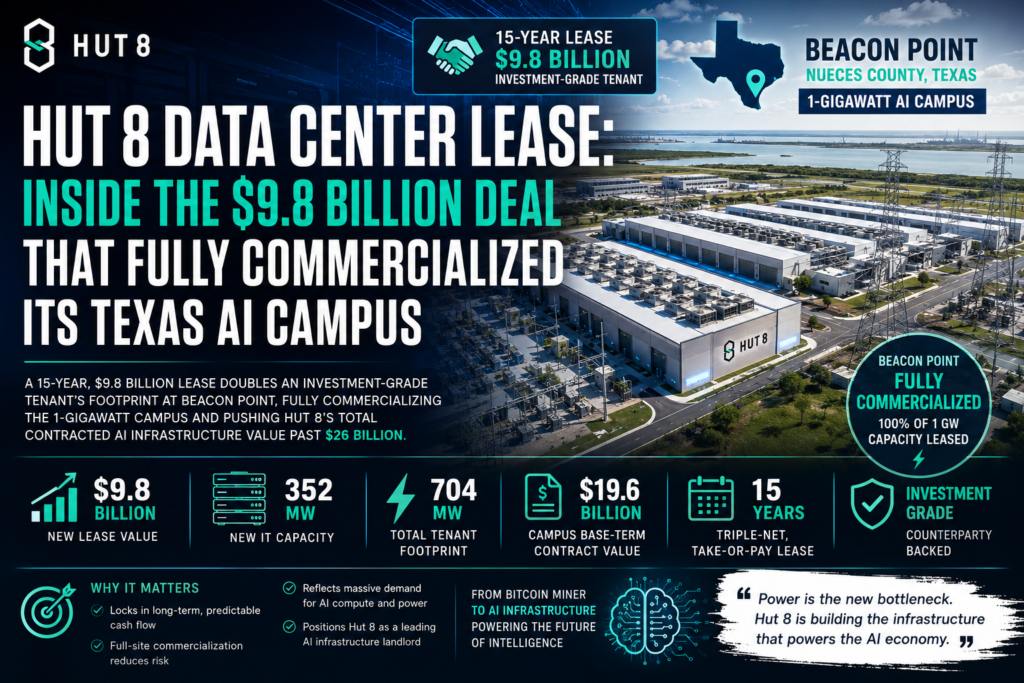
Hut 8 just signed a second 15-year, $9.8 billion Hut 8 data center lease at its Beacon Point campus in Texas, fully commercializing the 1-gigawatt site and pushing its total contracted AI infrastructure value past $26 billion. The deal, announced July 20, 2026, doubles an existing investment-grade tenant’s footprint at the campus to 704 megawatts and cements Hut 8’s transformation from a bitcoin miner into one of North America’s fastest-growing AI infrastructure landlords.
If you’re trying to understand what this deal means, who’s involved, and why it matters for the broader AI infrastructure race, this guide breaks it all down in plain terms.
What Is the Hut 8 Data Center Lease, Exactly?
The Hut 8 data center lease announced on July 20, 2026, is a 15-year agreement covering 352 megawatts (MW) of IT capacity at Hut 8’s Beacon Point campus in Nueces County, Texas. It’s the second lease signed with the same unnamed, investment-grade tenant at that site — the first was announced in May 2026 — and together the two agreements now cover the campus’s entire 1 GW of planned utility capacity.
In simple terms: a large, financially strong AI company has now committed to lease 100% of the compute capacity at one of Hut 8’s flagship data center campuses, for the next 15 years, with options to extend further.
Key Numbers Behind the Deal
- New lease value: $9.8 billion in base-term contract value
- New lease capacity: 352 MW of IT capacity
- Total tenant footprint at Beacon Point: 704 MW (after doubling)
- Campus-level base-term contract value: $19.6 billion over 15 years
- Campus value with renewals exercised: up to $50.2 billion
- Hut 8’s total contracted AI data center capacity (portfolio-wide): 949 MW
- Utility capacity backing that portfolio: 1,330 MW
- Aggregate base-term contract value across Hut 8’s portfolio: $26.6 billion
Every dollar of that contracted capacity, according to Hut 8, is leased to or backed by investment-grade counterparties — a detail investors care about because it signals lower default risk on long-duration infrastructure bets.
Why This Hut 8 Data Center Lease Matters for the AI Industry
Question: Why is a data center lease from a former crypto miner such a big deal?
Direct answer: Because it shows how severe the AI compute shortage has become — hyperscalers are now signing billion-dollar, decade-long leases with power-infrastructure companies just to secure electricity and land, not just chips.
Demand for AI compute has surged since generative AI tools went mainstream, pushing tech companies to commit hundreds of billions of dollars toward data centers stacked with advanced GPUs from Nvidia and other chipmakers. But the real bottleneck isn’t silicon anymore — it’s electricity. Power availability, transmission access, and construction-ready land have become the industry’s tightest constraints, and that shift has created an opening for companies like Hut 8 that already control power assets.
From Bitcoin Miner to AI Infrastructure Landlord
Hut 8’s pivot mirrors a broader trend among former cryptocurrency miners. These companies spent years building expertise in three things AI data centers desperately need:
- Power procurement — securing large blocks of electricity capacity, often in deregulated or resource-rich markets like Texas
- Site development — acquiring land with utility interconnection rights already in place
- Data center operations — running dense, always-on computing facilities at scale
That crypto-mining-era experience is now being redirected toward AI training and inference workloads, and the market has noticed — Hut 8’s shares have nearly doubled in 2026 and rose roughly 5% in premarket trading following the July 20 announcement.
Beacon Point Campus: Location, Design, and Capacity
The Beacon Point campus sits on a 525-acre site in Nueces County, Texas, near Corpus Christi. Hut 8 holds an interconnection agreement for 1 GW of utility capacity at the site, with initial energization expected in Q1 2027 and the first data hall delivery targeted for Q3 2027.
Why Hut 8 Redesigned the First Data Hall
One of the more technically interesting details in this Hut 8 data center lease story is how the design evolved. The original data hall at Beacon Point was planned around 224 MW of IT capacity, based on the chip architectures commercially available during early design. As AI systems moved toward higher rack-level power density, Hut 8 redesigned the facility around Nvidia’s architecture, increasing planned capacity by 57% — to 352 MW — without expanding the physical footprint.
That redesign matters beyond Beacon Point. It illustrates a pattern playing out across the industry: data center developers are having to retrofit plans mid-construction as GPU power density keeps climbing faster than site designs anticipated.
Hut 8’s Broader AI Infrastructure Portfolio
Beacon Point isn’t Hut 8’s only AI campus. The company’s other major site, River Bend, is leased to Fluidstack, which supplies capacity to AI firm Anthropic, with the deal reportedly backed by Google. Together, River Bend and Beacon Point form the backbone of Hut 8’s “power-first” development strategy — a model built on identifying sites with strong power fundamentals before building out digital infrastructure on top.
Comparison: Hut 8’s Two AI Data Center Campuses
| Feature | Beacon Point (Texas) | River Bend |
|---|---|---|
| Location | Nueces County, Texas | Not specified in Beacon Point disclosures |
| Total utility capacity | 1,000 MW (1 GW) | Contributes to portfolio total of 1,330 MW |
| Commercialization status | Fully commercialized (2 leases) | Leased to Fluidstack (for Anthropic workloads) |
| Lease structure | 15-year, triple-net, take-or-pay | Triple-net, take-or-pay |
| Key tenant | Unnamed high-investment-grade company | Fluidstack (backed by Google) |
| Base-term contract value | $19.6 billion (campus-level) | Part of $26.6 billion portfolio total |
| Technology partner | Nvidia | Not disclosed in available reporting |
How the Lease Is Structured Financially
Each Hut 8 data center lease at Beacon Point follows a triple-net, take-or-pay structure — a lease format that’s become the industry standard for hyperscale AI data centers. Here’s what that means in practice:
- Triple-net lease: The tenant, not Hut 8, covers taxes, insurance, and maintenance costs tied to the facility
- Take-or-pay: The tenant is contractually obligated to pay for the leased capacity whether or not it fully uses it
- Annual rent escalator: The base contract includes a 3.0% annual increase, protecting Hut 8’s revenue against inflation over the 15-year term
- Renewal options: Multiple five-year renewal periods can push total potential contract value well beyond the base-term figure — in Beacon Point’s case, up to $50.2 billion campus-wide if all options are exercised
This structure gives Hut 8 highly predictable, long-duration cash flow — which is exactly why the company expects an average annual net operating income (NOI) contribution in the hundreds of millions of dollars once projects stabilize.
What This Means for Investors and the Data Center Market
Question: Is the Hut 8 data center lease good news for shareholders?
Direct answer: Yes — the market reacted positively, with shares rising about 5% in premarket trading on the news, adding to a nearly two-fold gain for the stock so far in 2026.
That reaction reflects a few things investors tend to weigh heavily in data center real estate deals:
- Revenue visibility — a 15-year lease with a take-or-pay structure locks in predictable cash flow far into the future
- Counterparty quality — the tenant is described as investment-grade, reducing the risk of default over the lease term
- Full-site commercialization — leasing out 100% of a campus’s planned capacity removes uncertainty about whether remaining space will find tenants
- Scalability proof — the successful capacity increase from 224 MW to 352 MW at the same footprint suggests Hut 8 can adapt its designs as chip technology evolves, without needing new land
Risks Worth Watching
No infrastructure bet this size is risk-free. Analysts following Hut 8 point to a few areas worth monitoring:
- Execution risk on a multi-year, multi-phase construction timeline
- Financing structure, since Hut 8 intends to fund Beacon Point through project-level financing rather than solely corporate balance-sheet debt
- Hut 8’s ability to keep commercializing capacity across its broader development pipeline at the same pace
- Broader AI infrastructure demand holding up over a 15-year horizon, given how quickly compute requirements and chip architectures are shifting
Hut 8 Data Center Lease: Frequently Asked Questions
Who is the tenant in the new Hut 8 data center lease?
Hut 8 has not publicly named the tenant. The company describes it only as an “existing investment-grade customer” that had already signed an initial lease at Beacon Point in May 2026 and has now doubled its contracted footprint to 704 MW.
How much is the Hut 8 Beacon Point campus worth in total?
With both leases combined, Beacon Point now carries a base-term contract value of $19.6 billion over 15 years. If all renewal options are exercised, that figure could climb to as much as $50.2 billion.
What is Hut 8’s total AI data center capacity across all sites?
As of the July 20, 2026 announcement, Hut 8’s total contracted AI data center capacity across its portfolio stands at 949 MW, supported by 1,330 MW of underlying utility capacity, with an aggregate base-term contract value of $26.6 billion.
When will the new Beacon Point capacity go live?
Initial energization of the 1 GW utility interconnection is expected in Q1 2027, with the first data hall delivery targeted for Q3 2027.
Why did Hut 8 pivot from bitcoin mining to AI data centers?
Hut 8 built expertise in power procurement, site development, and large-scale facility operations during the cryptocurrency mining boom. As AI compute demand accelerated, the company redirected those same power assets and operational know-how toward AI training and inference infrastructure, which now commands significantly higher and more stable long-term lease values than crypto mining ever did.
The Bigger Picture: Power Is the New Bottleneck in AI
The Hut 8 data center lease is one data point in a much larger story. As generative AI adoption grows, the constraint on AI development is shifting away from chip supply and toward electricity, land, and grid access. Companies that control power assets — even ones that entered the space through cryptocurrency mining — are increasingly positioned as critical infrastructure partners for the AI economy, not just landlords.
For Hut 8, fully commercializing Beacon Point is proof that its power-first development model works beyond a single site. With River Bend already leased and Beacon Point now fully booked, the company’s next test will be whether it can replicate this success across new locations as the AI infrastructure buildout continues into 2027 and beyond.