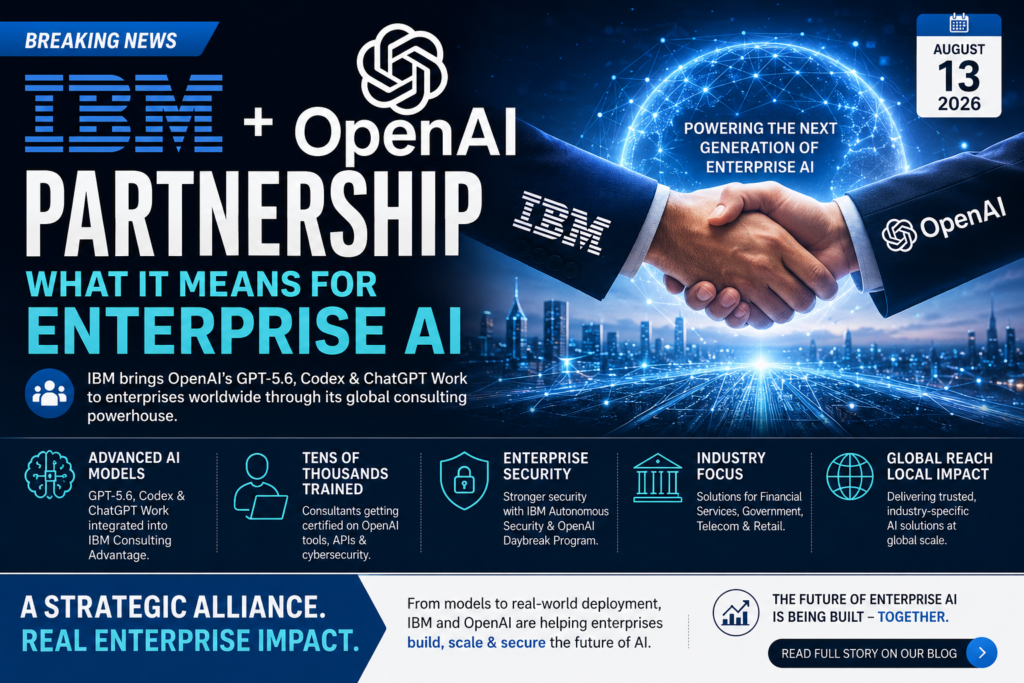
Picture a 300,000-person global consulting workforce suddenly retraining tens of thousands of employees on a single AI company’s tools , that’s exactly what’s happening right now. The IBM OpenAI partnership, announced on August 13, 2026, brings OpenAI’s models, including GPT-5.6 and Codex, directly into IBM Consulting’s enterprise AI toolkit, letting IBM sell OpenAI-powered solutions to banks, governments, telecom firms, and retailers worldwide. In short: IBM is betting big on OpenAI to win corporate AI budgets, and OpenAI is betting big on IBM’s army of consultants to reach clients it couldn’t reach alone.
For students and young professionals in Odisha and across India tracking where enterprise AI jobs are headed, this deal is a signal worth understanding closely. It shows how the AI industry’s center of gravity is shifting from “who builds the smartest model” to “who can actually deploy AI inside a real company.” Let’s break down what happened, why it matters, and what it means for the AI consulting and enterprise software landscape.
What Is the IBM OpenAI Partnership, Exactly?
Enterprise AI partnership refers to a formal business arrangement where a technology vendor and a consulting or systems-integration firm jointly sell, customize, and deploy AI products for large organizations. The IBM OpenAI partnership fits this mold precisely: IBM announced the deal on Thursday, August 13, 2026, confirming it would bring OpenAI’s AI company models and tools to more enterprise customers. The terms of the deal were not disclosed, but the scope is clear , IBM and OpenAI will jointly market AI offerings and build industry-specific solutions for financial services, government, telecommunications, and retail.
At the center of the deal is IBM Consulting Advantage, IBM’s internal AI platform built for its consultants. IBM Consulting Advantage is a proprietary platform that equips IBM’s consulting workforce with AI-assisted tools to design and deliver client projects. Under the new agreement, IBM will integrate OpenAI’s latest models , including GPT-5.6, Codex, and ChatGPT Work , directly into this platform, meaning IBM’s consultants will use OpenAI’s technology as part of their daily client work, not just recommend it from a slide deck.
Why Did IBM Also Set Up a Dedicated OpenAI Practice?
Will IBM create a specialized team for OpenAI work? Yes , IBM is establishing a dedicated OpenAI practice inside IBM Consulting, and it plans to train and certify tens of thousands of consultants on OpenAI’s technologies over the next several months, according to Mike Healy, managing partner at IBM Consulting, who spoke to TechCrunch. Most of this retraining will involve existing IBM employees rather than new hires, which tells you how central AI skills have become to consulting careers that used to focus on ERP systems, cloud migration, or traditional software integration.
Why Is IBM Partnering With OpenAI Now?
The timing of the IBM OpenAI partnership isn’t random , it lands directly on the heels of a rough earnings stretch for IBM. IBM lowered its 2026 revenue forecast last month following weaker-than-expected quarterly results, and CEO Arvind Krishna has been publicly defending AI as a long-term growth driver even as skeptics question the pace of enterprise AI monetization. Krishna has also maintained that AI adoption is complementing, rather than replacing, demand for IBM’s mainframe business , a point he’s had to make repeatedly as investors watch IBM’s core hardware revenue closely.
Why would IBM add OpenAI when it already has its own Granite AI models? IBM has chosen a model-agnostic strategy, meaning it doesn’t force clients to use only its in-house AI. Instead, IBM increasingly positions itself as an integrator that combines its own Granite family of AI models with third-party offerings, delivered through its watsonx platform and global consulting arm. Adding OpenAI to that mix , alongside its Anthropic partnership from less than a year earlier , gives IBM more flexibility to pitch whichever AI model best fits a client’s needs, rather than being locked into one vendor’s roadmap.
This is a subtle but important shift in enterprise AI strategy. A company like IBM, which touches thousands of large organizations, doesn’t need to “pick a winner” among AI labs , it can profit by being the trusted middle layer that helps enterprises deploy any of them safely and effectively.
What Will IBM Consultants Actually Do Under This Deal?
The IBM OpenAI partnership isn’t just a marketing headline , it comes with concrete training and delivery commitments. Here’s what’s changing on the ground for IBM’s consulting workforce:
- Mass certification: Tens of thousands of consultants, mostly existing IBM staff, will be trained and certified on OpenAI’s technologies over the coming months.
- Focused curriculum: Training will center on OpenAI’s Codex (its AI coding tool), OpenAI’s API, cybersecurity applications, and consultative solution credentials.
- Forward Deployed Experts: IBM will build a specialized group of “Forward Deployed Experts” trained through OpenAI’s own Partner Network , essentially an elite tier of consultants who work hands-on inside client environments.
- Platform integration: OpenAI’s GPT-5.6, Codex, and ChatGPT Work will be embedded directly into IBM Consulting Advantage, IBM’s client-facing AI delivery platform.
- Security expansion: OpenAI’s models will be integrated with IBM Autonomous Security, IBM’s multi-agent-powered cybersecurity service, building on the OpenAI Daybreak Cyber Partner Program the two companies launched back in June 2026.
This last point matters , the IBM OpenAI partnership isn’t a one-time announcement but an expansion of a relationship that was already forming. IBM and OpenAI had already partnered in June 2026 on the cybersecurity-focused Daybreak Cyber Partner Program, and this new, broader deal builds directly on that foundation.
How Does This Fit Into OpenAI’s Broader Enterprise Strategy?
What is OpenAI’s strategy for winning enterprise customers? OpenAI is increasingly relying on large IT consulting and systems-integration firms to reach corporate clients it can’t easily reach through direct sales alone. The IBM OpenAI partnership is the latest example of this approach, following earlier OpenAI tie-ups with Infosys in April 2026 and Tata Consultancy Services (TCS) in February 2026, the latter of which also included a deal for 100MW of AI data center capacity in India.
This pattern reflects a bigger industry-wide shift. Competition among AI model developers is moving away from simply “who has the most capable model” toward “who can actually get that model deployed at scale inside real enterprises.” Large consulting firms like IBM, Infosys, and TCS have something OpenAI doesn’t have on its own: decades of trusted relationships with CIOs, CFOs, and procurement teams at the world’s biggest companies. Systems integrator is the industry term for a firm like IBM that combines multiple vendors’ technologies into a working solution for a client, and it’s exactly the role IBM is playing here for OpenAI.
Is This a Sign That AI Competition Has Changed?
Has the AI industry shifted its competitive focus? Yes , the emphasis has moved from raw model capability to deployment reach. As more AI labs release genuinely capable models, the real battleground has become distribution: who can put that model in front of paying enterprise customers fastest, with the right industry customization, compliance guardrails, and change-management support. That’s precisely why IBM’s global consulting footprint is now considered a strategic asset worth partnering with, not just for OpenAI but for Anthropic before it.
What Are GPT-5.6, Codex, and ChatGPT Work , and Why Do They Matter Here?
The deal names three specific OpenAI products that will now flow into IBM’s consulting toolkit, and each plays a different role for enterprise clients. GPT-5.6 is OpenAI’s latest general-purpose large language model, the kind of system used for reasoning-heavy tasks like drafting reports, analyzing documents, and answering complex business questions. Codex is OpenAI’s AI coding tool, built to help developers and, increasingly, non-technical consultants generate, review, and debug software. ChatGPT Work is OpenAI’s enterprise-oriented chat product, designed with the security, admin controls, and workflow integrations that large organizations expect before they’ll let employees use an AI chatbot on company data.
Bringing all three into IBM Consulting Advantage matters because it turns IBM’s consultants into a delivery channel, not just an advisory one. Instead of an IBM team recommending that a bank “consider adopting generative AI,” the same team can now build, deploy, and support a working GPT-5.6 or Codex-based solution using OpenAI’s actual technology stack. This is the practical difference between selling advice and selling a finished, supported product , and it’s exactly the shift that makes the IBM OpenAI partnership meaningful rather than symbolic.
How Does This Compare to Other Enterprise AI Players Like Microsoft, Google, and AWS?
Are IBM and OpenAI alone in chasing enterprise AI deals? Not even close. Microsoft has deep enterprise ties through Azure and its own OpenAI investment, Google is pushing Gemini through Google Cloud, and Amazon is expanding AWS’s Bedrock platform with multiple third-party models. What makes the IBM OpenAI partnership distinct is that IBM isn’t a cloud hyperscaler competing on infrastructure , it’s a consulting-first company competing on deployment expertise and client trust built over decades. That’s a different lane in the same race, and it’s one IBM is betting will remain valuable even as more companies gain direct access to powerful AI models.
IBM’s AI Partnerships Compared
IBM now has multiple frontier AI partnerships running in parallel, each with a slightly different flavor. Here’s how the IBM OpenAI partnership stacks up against IBM’s other major AI alliances and OpenAI’s other consulting deals:
| Partnership | Announced | Primary Focus | Key Detail |
| IBM + OpenAI | August 2026 | Enterprise consulting, cybersecurity, industry solutions | Tens of thousands of consultants trained on Codex, API, and cybersecurity credentials |
| IBM + Anthropic | Late 2025 | Enterprise consulting alliance | Announced less than a year before the OpenAI deal |
| OpenAI + Infosys | April 2026 | Bringing AI tools to more businesses | Focus on broader enterprise AI tool adoption |
| OpenAI + TCS | February 2026 | AI deployment plus data center capacity | Included 100MW AI data center capacity commitment in India |
| IBM + OpenAI (Daybreak) | June 2026 | Cybersecurity | Precursor deal, now folded into the broader August 2026 agreement |
This comparison makes one thing obvious: this deal isn’t happening in isolation. It’s part of a widening web of AI-consulting alliances where the same handful of AI labs are working with the same handful of global systems integrators, each racing to lock in enterprise mindshare before competitors do.
What This Means for AI Careers and Enterprise AI in India
For readers based in India , especially students and early-career professionals eyeing consulting or enterprise AI roles , the IBM OpenAI partnership is a useful case study in where the job market is heading. IBM’s decision to retrain tens of thousands of existing consultants, rather than simply hiring new AI specialists from scratch, tells you that AI upskilling is now core to consulting career survival, not an optional add-on.
It also reinforces a trend already visible in OpenAI’s TCS deal, which included a major India-based data center commitment. Large AI labs increasingly see India not just as a talent pool for offshore delivery, but as a genuine market and infrastructure hub. For anyone building a career around enterprise AI, cybersecurity-plus-AI skills, or AI-assisted software delivery (the exact areas IBM is now certifying consultants in), this is a strong signal about which skills will be in demand over the next few years.
Why should someone outside IBM or OpenAI care about this deal? Because it previews the kind of AI fluency enterprises will expect from consultants, engineers, and analysts going forward , not deep model-building expertise, but practical skill in deploying, customizing, and securing AI tools like Codex and ChatGPT Work inside real business workflows.
FAQ: IBM OpenAI Partnership
What did IBM and OpenAI actually announce? IBM and OpenAI announced a partnership on August 13, 2026, under which IBM will integrate OpenAI’s models , including GPT-5.6, Codex, and ChatGPT Work , into IBM Consulting Advantage and jointly market AI solutions across industries like financial services, government, telecom, and retail.
How many IBM consultants will be trained on OpenAI’s technology? IBM plans to train and certify tens of thousands of consultants, primarily by retraining existing employees, over the next several months, focusing on OpenAI’s Codex, API, cybersecurity, and consultative solution credentials.
Is this IBM’s first major AI partnership with a frontier AI lab? No. IBM previously announced a similar alliance with Anthropic less than a year before this OpenAI deal, and IBM already had a cybersecurity-focused partnership with OpenAI through the Daybreak Cyber Partner Program launched in June 2026.
Why is IBM partnering with OpenAI instead of relying only on its own Granite AI models? IBM follows a model-agnostic strategy, positioning itself as an integrator that combines its own Granite models with third-party AI like OpenAI’s and Anthropic’s, delivered through its watsonx platform and global consulting business, rather than betting solely on in-house AI.
Does this partnership affect IBM’s mainframe business? IBM CEO Arvind Krishna has stated that AI adoption is complementing, rather than replacing, demand for IBM’s mainframe business, even as the company navigates a lowered 2026 revenue forecast announced after its last earnings report.
How does this compare to OpenAI’s other enterprise partnerships? This latest deal follows a similar pattern to OpenAI’s earlier deals with Infosys (April 2026) and Tata Consultancy Services (February 2026), reflecting OpenAI’s broader strategy of working with large global systems integrators to reach enterprise customers.
What industries will the partnership focus on first? IBM said it will jointly develop industry-specific solutions with OpenAI for financial services, government, telecommunications, and retail , sectors where IBM Consulting already has deep, long-standing client relationships.
Were the financial terms of the deal disclosed? No. TechCrunch reported that the terms of the agreement were not disclosed by either company, which is common for large-scale enterprise technology partnerships of this kind.
What to Watch Next
This deal was announced without disclosed financial terms, so several details remain to be seen over the coming months. It’s worth watching how quickly IBM actually rolls out its “tens of thousands” of certified consultants, whether the Forward Deployed Experts program produces visible client case studies, and how competitors like Accenture, Deloitte, and Capgemini respond with their own AI-lab partnerships.
It’s also worth tracking whether IBM’s next quarterly earnings call shows any measurable revenue impact from the deal, given that the announcement comes directly after IBM lowered its 2026 revenue guidance. Investors and industry watchers will be looking for concrete signs , new client wins, expanded watsonx integrations, or updated guidance , that this alliance is translating into real enterprise AI adoption rather than just another partnership press release. For now, the clearest takeaway is that enterprise AI consulting is becoming a crowded, high-stakes battlefield, and companies with global delivery networks like IBM are positioning themselves as the connective tissue between powerful AI models and the businesses that need help actually using them.
Keep Following the Enterprise AI Story
Deals like the IBM OpenAI partnership are reshaping what “AI skills” mean for consultants, engineers, and freshers across India. If you want to build hands-on, job-ready expertise in the same areas IBM is now certifying its workforce in, check out Kalinga.ai’s LLM Engineering program and upcoming AI workshops designed for students and young professionals in Odisha.