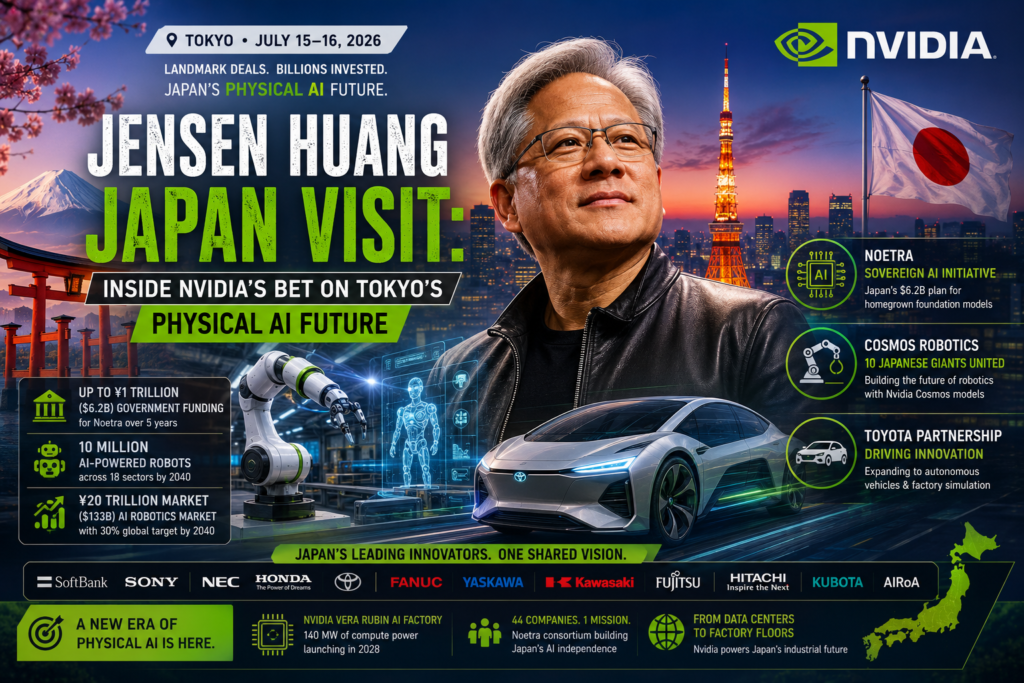
The Jensen Huang Japan visit on July 15–16, 2026, produced three major agreements: a sovereign AI foundation model project called Noetra, a robotics coalition built on Nvidia’s Cosmos models, and an expanded Toyota partnership covering autonomous vehicles and factory simulation. Together, these deals signal that Nvidia’s next growth phase is no longer just about data centers — it’s about the factory floor.
For anyone tracking AI infrastructure, chip supply chains, or Japan’s industrial strategy, this trip matters far beyond a single news cycle. It marks the moment Japan formally chose to build “physical AI” — AI systems that control robots, vehicles, and machines — on top of Nvidia’s hardware stack, while trying to keep the software layer sovereign and homegrown.
This article breaks down exactly what was announced, why Tokyo is spending billions to make it happen, and how this trip fits into Nvidia’s broader Asia strategy.
There’s also a symbolic thread running through this story. Roughly thirty years ago, a $5 million investment from Sega helped keep a near-bankrupt Nvidia afloat during its early years. Today, the relationship has effectively reversed: Japan’s industrial giants need Nvidia’s compute and physical AI models to build the next generation of robots and factories, while Nvidia needs Japan’s manufacturing base and data to prove that physical AI can scale beyond the lab. That mutual dependency is the real subtext of the trip.
What Happened During the Jensen Huang Japan Visit?
Over two days in Tokyo, Nvidia CEO Jensen Huang met with the leadership of nearly every major Japanese industrial and technology company — including the CEOs of Toyota, Fanuc, Yaskawa, Fujitsu, and Kawasaki Heavy Industries — before capping the trip with informal supply-chain discussions at a Kanda izakaya. The Jensen Huang Japan visit came weeks after a keynote in Taiwan and months after a similar tour through South Korea, continuing a pattern of regional trips where Huang courts local industrial giants directly rather than working solely through corporate deal teams.
Three Landmark Deals From the Trip
The Jensen Huang Japan visit resulted in three distinct but connected announcements:
- Noetra — a government-backed sovereign AI initiative building foundation models for robots, vehicles, and factories, powered by a new Nvidia-built data center.
- A robotics coalition — ten of Japan’s largest manufacturing and robotics companies committing to build on Nvidia’s Cosmos physical AI models.
- An expanded Toyota partnership — extending Nvidia’s Drive platform and simulation tools deeper into Toyota’s vehicle software and manufacturing operations.
Each of these deals targets a different layer of Japan’s industrial base, but all three depend on the same underlying Nvidia hardware and software stack, which is exactly the point: Nvidia is positioning itself as the infrastructure layer beneath Japan’s entire physical AI transition.
Noetra: Japan’s Sovereign AI Foundation Model
Noetra is the centerpiece of the Jensen Huang Japan visit. It’s a consortium of roughly 44 domestic companies — anchored by SoftBank, Sony, NEC, and Honda — formed to build Japanese-owned foundation models for robots, vehicles, and factory equipment, rather than relying on American or Chinese AI systems.
Why Japan Wants Its Own AI Layer
Definition: Sovereign AI refers to a country’s effort to control the data, models, and compute infrastructure that power its critical AI systems, rather than depending entirely on foreign providers.
Expansion: Japan’s leadership has been explicit that it doesn’t want its factories, robots, and vehicles running on AI models built and controlled outside the country. The Japanese government is committing up to 1 trillion yen (roughly $6.2 billion) over five years to fund Noetra’s model development. That’s the software half of the equation. The hardware half still runs through Nvidia — which is precisely why this Tokyo trip was necessary in the first place.
The Hardware Backbone Behind Noetra
Nvidia is building what it calls a “Vera Rubin AI factory” to power Noetra’s models — a data center packed with next-generation chips, expected to launch in 2028. The planned configuration includes 13,750 Vera CPUs and 27,500 Rubin GPUs, delivering roughly 140 megawatts of compute capacity. Noetra will oversee construction and operation of the facility, which Nvidia has described as the world’s first national AI infrastructure project of its kind.
Noetra’s Three-Stage Roadmap
Question: What is Noetra actually building, and when?
Direct answer: Noetra plans to release its models in three stages, moving from language-focused reasoning to full physical-world control:
| Stage | Model Type | Target Timeline |
|---|---|---|
| Stage 1 | Reasoning model with strong Japanese-language capabilities | Fiscal 2026 |
| Stage 2 | Omni-modal model handling text, images, video, and audio | 2028 |
| Stage 3 | “Real-world Native AI” built to operate robots directly | 2030, released to outside developers in phases |
This staged approach mirrors how most foundation model programs mature — starting with language and reasoning, then expanding into multimodal understanding, and finally into embodied control of physical systems.
The Robotics Coalition Behind Nvidia Cosmos
The second pillar of Huang’s Tokyo trip is a coalition of Japanese manufacturing and robotics leaders committing to build on Nvidia’s Cosmos physical AI models, an open-model initiative Nvidia launched earlier in the year with a handful of global AI labs.
Who Joined the Coalition
Ten major Japanese companies have signed on to build with Nvidia Cosmos models:
- Fanuc
- Yaskawa
- Kawasaki Heavy Industries
- Fujitsu
- Hitachi
- NEC
- Sony
- SoftBank
- Kubota
- AIRoA (a robotics industry group)
Some members, including Honda R&D and Omron, are already testing a shared control system built on these tools, while others are still in earlier stages of integration.
What Is Cosmos 3 Edge?
Definition: Cosmos 3 Edge is a version of Nvidia’s Cosmos physical AI model designed to run directly on Nvidia’s Jetson Thor chips embedded inside robots and industrial machines, rather than relying on a remote data center connection.
Expansion: This edge-deployment capability is what turned interest into commitment for many of Nvidia’s Japanese partners. Running inference directly on the machine reduces latency and keeps factory-floor robots operational even with intermittent connectivity — a meaningful advantage for manufacturers running continuous production lines. During this Tokyo visit, Huang framed the moment as a generational opportunity, arguing that Japan invented modern manufacturing and now has the chance to reinvent it for an era of intelligent, AI-run industry.
Toyota’s Expanded Nvidia Partnership
Toyota was already a deep Nvidia customer heading into Huang’s Tokyo visit, having committed its next-generation vehicles to Nvidia’s Drive platform back in January 2025. What changed in Tokyo is the scope: Toyota is now extending Nvidia’s tools into manufacturing simulation for designing production lines, the software running inside its vehicles, and systems that read and respond to road traffic conditions.
Notably, Toyota’s approach remains more conservative than some U.S. competitors. Its vehicles are built around advanced driver-assistance systems that still require a human driver behind the wheel, rather than the more autonomous, driver-optional systems being developed by companies like Waymo and Tesla. That distinction matters for anyone comparing Japan’s physical AI strategy to the U.S. approach: Japan is optimizing for augmentation and manufacturing efficiency first, full autonomy second.
Why the Jensen Huang Japan Visit Matters
The Jensen Huang Japan visit didn’t just produce corporate deals — it placed physical AI at the center of Japan’s national industrial strategy, backed by real government money and firm long-term targets.
Japan’s Robotics and Economic Targets
Japan is facing a shrinking workforce, and its government has set an ambitious goal: 10 million AI-equipped robots deployed across 18 sectors by 2040. That target is backed by an estimated $65 billion in combined public and private physical AI investment.
The numbers get bigger from there. Japan’s AI Robotics Strategy, released in March 2026, aims to capture more than 30% of the global AI robotics market by 2040 — a market Tokyo values at roughly ¥20 trillion, or about $133 billion. Japan’s Ministry of Economy, Trade and Industry (METI) is funding the domestic foundation model effort, and Noetra’s Nvidia-powered data center is where models at that scale — potentially reaching trillions of parameters — will be trained.
The Sovereign AI Angle
Beneath the industrial pitch is a geopolitical one. As the U.S. and China continue to pull ahead in large-scale AI development, Japan wants greater control over its own data, compute, and model infrastructure. Huang appeared alongside Japan’s trade minister, Ryosei Akazawa, at the government’s physical AI launch event on July 16, with Prime Minister Sanae Takaichi joining by video. The Takaichi administration has made AI and semiconductors central to a growth plan targeting roughly ¥370 trillion ($2.3 trillion) in combined public and private investment by 2040.
There’s an unresolved tension worth noting here: Japan’s push for AI independence still depends heavily on American-made chips. Noetra’s data center — Nvidia’s self-described “world’s first national AI infrastructure” project — is powerful evidence of what sovereign AI can look like in practice, but it also shows how deeply that sovereignty currently runs through a single U.S. supplier.
Jensen Huang’s 2026 Asia Tour: Taiwan vs. South Korea vs. Japan
Huang’s July 2026 Tokyo trip is the third stop in a broader regional tour, following earlier trips to Taiwan and South Korea. Each stop has followed a similar playbook — high-profile meetings with local industrial leaders, informal dinners, and headline-grabbing deals — but the outcomes differ by market.
| Region | Visit Timing | Key Focus | Headline Outcome |
|---|---|---|---|
| Taiwan | Weeks before Japan trip | Chip manufacturing ecosystem | Ecosystem-wide AI infrastructure keynote |
| South Korea | Fall 2025 | Consumer electronics and chips | 50,000-GPU deal with Hyundai, Samsung, SK, Naver |
| Japan | July 15–16, 2026 | Robotics and industrial manufacturing | Noetra sovereign AI project, Cosmos robotics coalition, expanded Toyota deal |
This pattern shows Nvidia adapting its pitch to each country’s industrial strengths — chip fabrication in Taiwan, electronics and mobile hardware in South Korea, and precision robotics and manufacturing in Japan — while keeping its own hardware stack as the common thread across all three.
Frequently Asked Questions About the Jensen Huang Japan Visit
What is Noetra? Noetra is a Japanese government-backed AI consortium of roughly 44 companies, led by SoftBank, Sony, NEC, and Honda, building sovereign foundation models for robots, vehicles, and factory equipment, powered by a new Nvidia-built data center.
How much money is Japan committing to this effort? The Japanese government is funding Noetra with up to 1 trillion yen (about $6.2 billion) over five years, part of a broader $65 billion physical AI investment push targeted through 2040.
What is Nvidia Cosmos? Nvidia Cosmos is an open physical AI model initiative that ten major Japanese manufacturing and robotics companies — including Fanuc, Yaskawa, and Sony — are now building on, following commitments made during the Jensen Huang Japan visit.
Why did Toyota expand its Nvidia partnership? Toyota is extending its existing Nvidia Drive platform relationship into manufacturing simulation, in-vehicle software, and traffic-response systems, while keeping its driver-assistance systems more conservative than fully autonomous competitors like Waymo and Tesla.
How does the Japan visit compare to Nvidia’s Taiwan and South Korea trips? All three trips follow the same pattern of direct CEO-to-CEO dealmaking, but each targets a different industrial strength: chip manufacturing in Taiwan, electronics in South Korea, and robotics and manufacturing in Japan.
What This Means for the Global AI Chip Race
Question: Does this trip change Nvidia’s competitive position?
Direct answer: Yes — it extends Nvidia’s dominance beyond data-center AI chips into the emerging physical AI and robotics category, a market most analysts expect to grow far faster than traditional cloud AI infrastructure over the next decade.
Nvidia has spent the better part of two years building an unmatched position in training and inference chips for large language models. What this trip demonstrates is a deliberate pivot toward a second growth engine: chips and software that let AI control physical machines rather than just generate text or images. By locking in Japan’s robotics and manufacturing giants — companies with decades of precision-engineering expertise and manufacturing data that’s difficult to replicate — Nvidia is trying to make itself the default compute layer for physical AI the same way it became the default layer for generative AI.
This also raises the stakes for competitors. Chipmakers and AI labs racing to catch up in robotics-focused silicon and models now have to contend with a Nvidia ecosystem that spans not just Japan, but also the earlier Taiwan and South Korea agreements — giving Nvidia design wins, manufacturing partnerships, and real-world deployment data across three of Asia’s most important industrial economies at once.
Chip-Material Suppliers Round Out the Ecosystem
Beyond the headline robotics and sovereign AI deals, Nvidia also struck agreements with Japanese chip-material suppliers that feed its next-generation chip manufacturing process. These partnerships matter less for headlines and more for supply-chain resilience — Japan remains one of the few countries with deep expertise in the specialty materials, photoresists, and precision equipment that advanced chip fabrication depends on. Securing those relationships gives Nvidia a hedge against the kind of export-control disruptions that have periodically rattled the broader semiconductor industry.
What Businesses and Investors Should Watch Next
For companies tracking the AI infrastructure and robotics space, a few signals from this trip are worth monitoring over the coming months:
- Noetra’s fiscal 2026 model release — the first concrete test of whether Japan’s sovereign AI ambitions can produce a competitive Japanese-language reasoning model on schedule.
- Cosmos adoption rates among the ten robotics coalition members — particularly whether Honda R&D and Omron’s early shared control system moves from pilot to production.
- Progress on the Vera Rubin AI factory build-out, since delays in data center construction would push back every downstream Noetra milestone.
- Toyota’s simulation and Drive platform rollout, which offers an early read on how quickly Nvidia’s tools move from pilot programs into full-scale automotive production.
- Follow-on policy moves from METI and the Takaichi administration, given how central AI and semiconductors are to Japan’s broader ¥370 trillion investment plan through 2040.
Key Takeaways From the Jensen Huang Japan Visit
- The Jensen Huang Japan visit produced three major deals: Noetra (sovereign AI), a ten-company robotics coalition built on Nvidia Cosmos, and an expanded Toyota partnership.
- Japan is committing up to $6.2 billion in government funding to Noetra, part of a broader $65 billion national physical AI investment push.
- Nvidia’s Vera Rubin AI factory, expected to launch in 2028, will provide the compute backbone for Noetra’s models.
- Ten major Japanese manufacturers, including Fanuc, Yaskawa, and Sony, are now building on Nvidia’s Cosmos physical AI models, with Cosmos 3 Edge enabling on-device robot control.
- Japan’s stated goal is 10 million AI-equipped robots across 18 sectors by 2040, aiming to capture over 30% of the global AI robotics market.
- Despite the sovereignty framing, Japan’s physical AI ambitions currently depend heavily on Nvidia’s American-made chips.
Meta Description: Jensen Huang’s Japan visit sealed Nvidia deals with Toyota, Sony, SoftBank and more, powering Japan’s $65B bet on sovereign physical AI and robotics.
Slug: jensen-huang-japan-visit-nvidia-physical-ai