File Name:
nvidia-ai-advantage-beyond-gpu.jpg
Title:
Nvidia AI Advantage Beyond GPUs
Caption:
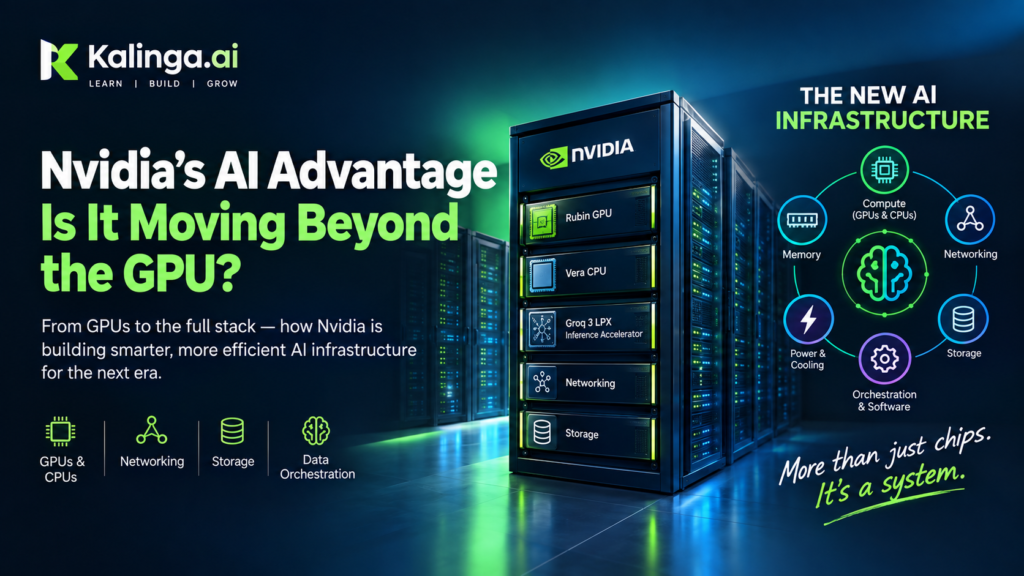
Nvidia’s AI advantage is evolving beyond powerful GPUs into a complete, smarter AI infrastructure system.
Description:
A futuristic AI data center visualizes Nvidia’s expanding infrastructure strategy, featuring a Rubin GPU, Vera CPU, inference accelerator, networking, and storage. The graphic highlights how Nvidia’s AI advantage increasingly depends on system-wide data orchestration and efficiency, not just GPU performance.
Alt Text:
Nvidia AI advantage expands beyond GPUs with CPUs, networking, storage, and smarter data orchestration.
I infrastructure is entering a new phase: the fastest GPU alone is no longer enough to make a giant AI data center run efficiently. Nvidia’s latest strategy suggests its advantage is expanding from individual GPUs to the complete system around them, including CPUs, networking, storage, inference accelerators, and data orchestration.
Planned Structure
- Why Nvidia’s AI advantage is changing
- What Nvidia is selling beyond the GPU
- Vera Rubin architecture
- Vera CPU and data orchestration
- Networking, storage, and inference
- Why data movement has become an AI bottleneck
- Nvidia vs. the integrated-chip approach
- Nvidia’s system-level strategy
- OpenAI’s Jalapeño approach
- How Nvidia can defend its AI lead beyond GPUs
- What this means for the AI chip market
- What Nvidia’s strategy means for AI developers and businesses
- FAQ
Focus Keywords
- Primary keyword: Nvidia AI advantage
- Secondary keywords: Nvidia beyond GPUs, AI data orchestration, Vera Rubin architecture, AI infrastructure
- LSI/long-tail keywords: Nvidia AI infrastructure strategy, GPU data movement bottleneck, AI data center efficiency, Nvidia Vera CPU
Nvidia’s AI Advantage: Is It Moving Beyond the GPU?
Imagine building a Formula 1 car and then discovering that the biggest problem isn’t the engine. It is getting fuel, information, and instructions to the engine quickly enough.
That is increasingly the problem facing massive AI data centers. Nvidia still makes some of the industry’s most important AI GPUs, but its AI advantage is increasingly about everything surrounding those GPUs,from CPUs and networking to storage, inference accelerators, and the software and hardware responsible for moving data efficiently.
This shift matters because AI models are becoming enormous, and operating them efficiently requires much more than simply installing more GPUs.
According to TechCrunch’s Russell Brandom, Nvidia’s latest strategy points toward a broader definition of AI computing: the system itself is becoming the product.
Why Is Nvidia’s AI Advantage Moving Beyond GPUs?
For years, Nvidia’s AI story was relatively straightforward.
The company developed powerful GPUs that became the hardware foundation for training and running large AI models. As companies rushed to build generative AI systems, demand for Nvidia GPUs exploded.
That created an extraordinary business advantage.
But the market has changed.
Companies such as Amazon and Google have developed their own AI chips, while other technology companies are exploring specialized silicon designed for particular workloads. That means Nvidia is facing more competition at the processor level.
The question is no longer simply:
Who makes the fastest AI chip?
It is becoming:
Who can make an entire AI computing system operate most efficiently?
Nvidia AI advantage , Definition + Expansion
Nvidia AI advantage refers to Nvidia’s competitive position in AI computing, increasingly based not only on GPUs but also on the surrounding hardware and infrastructure required to run large-scale AI workloads efficiently.
That infrastructure includes CPUs, networking, storage, memory systems, inference accelerators, and technologies for coordinating data movement. As AI clusters grow to enormous scales, these components can determine how effectively expensive GPUs are actually used.
In other words, Nvidia is trying to move from selling the engine to controlling more of the car.
Why does this matter?
Because an extremely powerful GPU can still be inefficient if it spends too much time waiting for data.
At a small scale, that may not be a major concern. At the scale of modern AI data centers, however, even small inefficiencies can become extremely expensive.
What Is Nvidia Actually Selling Beyond the GPU?
The easiest way to understand Nvidia’s changing strategy is to look at its Vera Rubin architecture.
Nvidia is rolling out Vera Rubin as a broader computing platform rather than treating the GPU as an isolated component. The architecture combines the Rubin GPU with additional technologies, including the Vera CPU and the Groq 3 LPX inference accelerator, alongside systems for networking and storage.
This is important because AI workloads don’t happen entirely inside a GPU.
Data has to be stored somewhere.
It has to be retrieved.
It has to travel through different components.
It has to be processed and coordinated.
And the results have to be delivered to other parts of the system.
The GPU is only one part of that chain.
What is the Vera CPU designed to do?
The Vera CPU is focused heavily on coordinating data and helping manage the flow of information through an AI computing system.
Nvidia VP of storage technology Jason Hardy explained to TechCrunch that there is a limit to how much memory can be placed in a single server or computing platform. As AI systems grow, that creates a fundamental challenge: how do you deliver the right data to the right processor at the right moment?
This is where data orchestration becomes important.
Think about a restaurant during peak dinner service.
The kitchen might have extremely talented chefs, but that does not guarantee fast service. If ingredients arrive late, orders are badly coordinated, or servers cannot communicate efficiently with the kitchen, the entire restaurant slows down.
The same basic principle applies to AI infrastructure.
The GPU may be incredibly powerful, but it cannot work efficiently if the information it needs arrives too slowly.
Nvidia AI advantage , Question → Direct Answer
Why is Nvidia building CPUs and other components around its GPUs?
Because large AI systems increasingly depend on efficient coordination between computing, memory, storage, networking, and acceleration components. Nvidia can potentially improve overall performance by optimizing these pieces as a unified system instead of treating the GPU as an isolated product.
Why Has Data Movement Become an AI Bottleneck?
One of the most important ideas in the latest Nvidia strategy is surprisingly simple:
Moving data can be just as important as processing data.
AI models consume enormous amounts of information. That information may live in different memory systems, storage devices, or servers.
Every time data needs to travel between those components, the system has to spend time and energy moving it.
And at massive scale, those costs add up.
What is AI data orchestration?
AI data orchestration is the process of coordinating where data comes from, where it needs to go, and when it must arrive so computing resources can work efficiently.
In a large AI data center, orchestration involves much more than simply transferring files. It can determine whether expensive processors remain busy or sit idle while waiting for information.
That makes data movement a major part of AI infrastructure efficiency.
Nvidia’s Jason Hardy told TechCrunch that the company had seen upwards of 3x improvement in certain operations when the Vera CPU accelerated these processes.
The significance is not simply the number.
The bigger point is that Nvidia believes improving the movement of information can unlock more of the performance already available in storage and computing hardware.
Why can’t companies just add more GPUs?
Adding processors sounds like the obvious solution to increasing AI demand.
But more GPUs do not automatically solve every infrastructure problem.
Imagine adding 100 additional chefs to a restaurant without expanding the kitchen, storage area, communication systems, or ingredient supply.
You might have more cooking capacity, but you could actually create more congestion.
AI clusters face a similar challenge.
If processors become faster while memory, networking, storage, or data transfer fail to keep pace, the additional computing power may not translate into proportional real-world performance.
That is why AI data center efficiency is becoming such an important competitive factor.
Nvidia’s AI Advantage Is About Keeping Expensive GPUs Busy
There is a simple economic reason Nvidia cares so much about orchestration.
GPUs used for large-scale AI workloads are expensive pieces of infrastructure. Companies operating giant AI clusters therefore want to extract as much useful computation from every accelerator as possible.
If a GPU spends significant time waiting for data, its theoretical performance becomes less meaningful.
This creates a new optimization target.
Instead of asking only:
How many calculations can this GPU perform?
Data center operators increasingly need to ask:
How much useful AI work can the entire system complete per unit of energy, time, and hardware?
That is a much broader question.
Nvidia AI advantage , Question → Direct Answer
Does a faster GPU automatically create a faster AI system?
No. Overall AI performance also depends on memory, storage, networking, data movement, communication delays, and orchestration. A powerful GPU can be underutilized when the surrounding infrastructure cannot supply data quickly enough.
This helps explain why Nvidia’s strategy is expanding beyond GPUs.
The company is attempting to optimize the entire path between data and computation.
Nvidia vs. OpenAI: Two Different Ways to Solve the Same Problem
Nvidia is not the only company thinking about data movement.
OpenAI has also been working on specialized AI hardware, including its Jalapeño chip.
The approaches are different, but the underlying problem is remarkably similar.
Nvidia’s strategy is to build more of the infrastructure around the GPU so data can move efficiently between computing, memory, storage, and networking components.
OpenAI’s approach, as described in a company blog post earlier this month, focuses on minimizing the need for data movement in the first place.
The company said Jalapeño was designed to reduce data movement and communication delays by keeping an entire workload within one connected system.
Nvidia AI advantage vs. integrated-chip approach
| Approach | Nvidia | OpenAI’s Jalapeño |
| Core strategy | Optimize the broader AI computing system | Minimize data movement |
| Main idea | Coordinate computing, storage, memory and networking | Keep workloads within an integrated system |
| GPU role | Central component of a larger platform | Specialized architecture designed around workload efficiency |
| Data movement | Improve how data travels | Reduce how much data needs to travel |
| Goal | Increase system-wide utilization | Reduce communication delays |
| Competitive layer | Full AI infrastructure | Specialized AI silicon/system design |
Neither approach automatically wins.
They represent two different answers to the same fundamental challenge: how do you prevent data movement and communication from slowing down AI computation?
What Is the GPU Data Movement Bottleneck?
A GPU data movement bottleneck occurs when an accelerator has the capacity to process information faster than the surrounding system can supply that information.
The processor effectively waits.
That waiting may be caused by memory limitations, storage performance, networking constraints, or communication between different components.
This is particularly important for AI because modern workloads can involve enormous amounts of data moving across increasingly complex computing systems.
Why does data movement matter so much?
Because moving information consumes both time and energy.
If an AI system repeatedly moves data between components, the infrastructure must spend resources transporting that information rather than performing useful computation.
That is why companies are exploring different solutions.
Some are building faster interconnects.
Others are developing larger memory systems.
Some are designing specialized CPUs or accelerators.
And others, like OpenAI with Jalapeño, are attempting to reduce communication requirements through architecture.
Why Nvidia’s System-Level Strategy Could Be Difficult to Beat
The most interesting part of Nvidia’s position is that it already operates across many layers of AI infrastructure.
It has GPUs.
It has CPUs.
It has networking technology.
It has storage-related technologies.
It has inference accelerators.
And it has software designed to connect these pieces.
That creates a potentially powerful ecosystem.
A competitor does not necessarily need to build a better GPU to challenge Nvidia anymore.
But it may need to build a better overall system.
That can be much harder.
What makes a complete AI infrastructure platform valuable?
A system-level platform can potentially provide:
- Better coordination between processors
- More efficient data movement
- Higher utilization of expensive GPUs
- Lower communication delays
- Better storage performance
- More efficient inference workloads
- Tighter integration between hardware components
- Potentially better performance per watt
This changes the competitive battlefield.
Instead of comparing two GPUs using a single benchmark, companies increasingly have to evaluate the performance of entire AI clusters.
Nvidia Beyond GPUs: The New Competition Is at the System Level
This does not mean Nvidia has won the AI hardware race permanently.
In fact, the opposite may be true.
By moving into system-level infrastructure, Nvidia is entering more competitive categories.
Hyperscalers already have strong incentives to develop their own chips because they operate enormous data centers and can tailor hardware to their workloads.
Specialized chip companies can also target specific AI applications.
And companies building AI models may design custom silicon around their own architectures.
So Nvidia’s broader strategy creates new opportunities for competitors.
But it also raises the cost of competing with Nvidia.
A company that wants to replace Nvidia may have to answer several questions simultaneously:
Can it match GPU performance?
Can it deliver competitive networking?
Can it manage memory and storage efficiently?
Can its system move data quickly enough?
Can developers easily program for it?
Can it operate reliably at enormous scale?
Can customers deploy it without rebuilding their entire infrastructure?
That is a much harder challenge than simply producing an alternative GPU.
What Does Nvidia’s Strategy Mean for AI Data Centers?
The move toward system-level optimization could fundamentally change how AI data centers are designed.
For years, AI infrastructure conversations often centered on accelerator performance.
How many GPUs can a company buy?
How fast are those GPUs?
How much memory do they have?
Those questions still matter.
But increasingly, operators need to think about the entire system.
AI infrastructure strategy is becoming a coordination problem
The larger an AI cluster becomes, the more components must communicate.
That creates additional complexity.
A modern AI data center may involve:
- Compute accelerators
- CPUs
- High-speed memory
- Storage systems
- Networking hardware
- Interconnects
- Power infrastructure
- Cooling
- Software for orchestration
- Monitoring and optimization systems
The result is a simple but important lesson:
AI infrastructure is no longer just about buying the fastest processor.
It is about making thousands,or potentially far more,components behave like one efficient computing machine.
Why Energy Efficiency Is Becoming More Important
Another reason orchestration matters is energy.
AI computing is becoming increasingly power-intensive. As companies deploy larger models and more inference workloads, they have a strong financial incentive to reduce the amount of energy required to produce each useful result.
This is where concepts such as tokens-per-watt become relevant.
A token is a unit of text processed or generated by an AI model. Tokens-per-watt is a way of thinking about how much useful AI output a system can generate for the energy it consumes.
The exact metric varies by workload, but the broader goal is straightforward:
Get more AI work from every unit of electricity.
Improving data movement and system coordination can contribute to that goal because processors spend less time waiting and infrastructure resources are used more effectively.
Nvidia AI advantage , Question → Direct Answer
Why does data orchestration matter for AI energy efficiency?
Efficient orchestration can reduce unnecessary waiting and improve hardware utilization. When expensive processors spend more time performing useful computation rather than waiting for data, the system can potentially deliver more AI work for the energy consumed.
What Happens If AI Compute Reaches Gigawatt Scale?
The scale of AI infrastructure is one of the biggest reasons this trend matters.
As AI deployments become enormous, infrastructure problems that were manageable at smaller scales become much harder.
A delay between two components may seem insignificant inside a small system.
Multiply that across huge clusters operating continuously, however, and the impact can become substantial.
This is why megascale data centers require a different approach.
The challenge is no longer simply assembling powerful components.
It is coordinating them.
The bigger the AI cluster, the bigger the orchestration challenge
At extreme scale:
- More machines need to communicate.
- More data needs to move.
- More storage needs to feed computation.
- More memory needs to be coordinated.
- More networking capacity is required.
- More energy is consumed.
- More opportunities exist for bottlenecks.
This creates an unusual situation.
The future of AI performance may increasingly depend on technologies that users never directly see.
A chatbot user sees an answer.
An AI developer sees an API response.
But underneath that response could be a highly complex chain involving CPUs, GPUs, memory, storage, networking and specialized accelerators.
Does This Make Nvidia’s GPU Competition Less Important?
Not necessarily.
GPUs remain fundamental to AI computing.
A weak GPU cannot suddenly become competitive because the surrounding infrastructure is excellent.
But Nvidia’s changing strategy means GPU performance may no longer tell the whole story.
Imagine two companies offering comparable accelerators.
One provides only the chip.
The other provides the chip plus CPUs, networking, storage technologies, interconnects, software and system-level optimization.
The second company may have an easier time selling a complete infrastructure solution.
That is the strategic opportunity Nvidia is pursuing.
Nvidia AI advantage , Question → Direct Answer
Is Nvidia moving away from GPUs?
No. Nvidia’s strategy is better understood as expanding beyond GPUs rather than abandoning them. The GPU remains central, while Nvidia is adding more hardware and infrastructure around it to improve overall AI system performance.
That distinction is critical.
The GPU is still the engine.
Nvidia is simply trying to control more of everything that makes the engine useful.
What Could Challenge Nvidia’s AI Advantage?
Nvidia’s broader infrastructure strategy is powerful, but it is not unbeatable.
Competitors can attack at several levels.
1. Custom chips from hyperscalers
Companies operating huge cloud platforms have an economic reason to design specialized processors.
Google, Amazon and others can optimize chips for their own workloads and potentially reduce dependence on external suppliers.
2. Specialized AI accelerators
A company does not necessarily need to reproduce Nvidia’s entire platform.
It can target a specific workload where a specialized accelerator provides better performance, efficiency or cost.
3. Alternative system architectures
OpenAI’s Jalapeño example demonstrates another possibility: redesign the architecture so that data does not need to travel as much.
Instead of making transportation faster, the system can attempt to eliminate unnecessary transportation.
4. Open software ecosystems
Hardware becomes more attractive when developers can easily use it.
Software compatibility, developer tools and ecosystem support can therefore become just as important as silicon performance.
5. Energy and operating costs
At huge scale, the cheapest system to purchase is not necessarily the cheapest system to operate.
Data center operators care about the total cost of running AI infrastructure over time.
Why This Matters for Students and AI Professionals
If you’re learning AI today, Nvidia’s strategy offers a useful lesson.
AI is not simply about models.
And AI engineering is not simply about writing prompts.
The industry is moving toward a world where understanding the full computing stack can become increasingly valuable.
You do not need to become a chip designer to benefit from this understanding.
But knowing how GPUs, CPUs, memory, storage, networking and software interact can help you understand why an AI application performs the way it does.
What should aspiring AI professionals learn?
Consider building knowledge in:
- GPU computing fundamentals
- AI inference and training
- Memory and storage basics
- Networking fundamentals
- Distributed computing
- Data center architecture
- AI optimization
- Energy-efficient computing
- Cloud infrastructure
- AI system design
The important shift is from thinking about AI as a model running on a chip to thinking about AI as a complete computing system.
The Bigger Picture: Nvidia Is Selling a System, Not Just a Chip
The most important takeaway from Nvidia’s latest direction is not that GPUs suddenly became less valuable.
It is that the definition of AI computing is getting broader.
When AI systems were smaller, the processor received most of the attention.
As systems scale, the connections between processors become increasingly important.
That creates an opportunity for Nvidia.
If the company can make its GPUs, CPUs, networking, storage, accelerators and software work together efficiently, its competitive advantage could become much harder to replicate.
But there is a catch.
The broader Nvidia becomes, the more areas it must defend.
Competitors no longer have to beat Nvidia exclusively in GPU performance. They can compete through specialized chips, custom architectures, better networking, improved software or lower operating costs.
So the next phase of the AI chip race may not be a simple contest over who has the fastest GPU.
It could be a contest over who builds the most efficient AI computing system.
And Nvidia appears determined to make sure it remains at the center of that system.
Frequently Asked Questions
What is Nvidia’s AI advantage?
Nvidia’s AI advantage is its strong position across AI computing hardware and software. While GPUs remain central, the company is increasingly expanding into CPUs, networking, storage, inference accelerators and system-level orchestration.
Why is Nvidia moving beyond GPUs?
Nvidia is moving beyond GPUs because large AI systems increasingly depend on efficient data movement, memory, networking, storage and coordination. Improving these components can help expensive GPUs operate closer to their full potential.
What is AI data orchestration?
AI data orchestration is the coordination of data movement between storage, memory, CPUs, GPUs and other components so that AI workloads can run efficiently. It becomes increasingly important as AI clusters grow larger and more complex.
What is the Vera Rubin architecture?
Vera Rubin is Nvidia’s broader AI computing architecture that combines the Rubin GPU with other components, including the Vera CPU and Groq 3 LPX inference accelerator, alongside networking and storage systems.
How is OpenAI’s Jalapeño approach different from Nvidia’s strategy?
OpenAI’s Jalapeño approach focuses on reducing data movement by keeping workloads within an integrated system. Nvidia’s approach includes optimizing the broader infrastructure surrounding its GPUs so data can be moved and coordinated more efficiently.
Does Nvidia still depend on GPUs for its AI advantage?
Yes. GPUs remain a core part of Nvidia’s AI strategy. The company’s broader approach is to build additional hardware and infrastructure around those GPUs rather than move away from GPU computing.
The Bottom Line
Nvidia’s AI advantage is evolving from GPU dominance toward system-level AI infrastructure. As AI clusters become larger, efficient data movement, memory, networking, storage and orchestration could become just as strategically important as raw processor performance.
For anyone entering AI, the lesson is worth remembering: the future of AI may be determined not just by smarter models or faster chips, but by how efficiently the entire system works together.
SEO Meta Configuration
Keyword Categorization
Primary Keyword:
- Nvidia AI advantage
Secondary Keywords:
- Nvidia beyond GPUs
- AI data orchestration
- Vera Rubin architecture
- AI infrastructure
LSI/Long-Tail Keywords:
- how Nvidia is moving beyond GPUs
- Nvidia AI infrastructure strategy
- why data movement matters for AI
- how AI data centers improve efficiency
Meta Title
Nvidia AI Advantage: Ultimate AI Infrastructure Guide 2026
SEO Meta Description:
Nvidia AI advantage is moving beyond GPUs as data orchestration, CPUs and networking reshape AI infrastructure. Discover what changes in 2026.
URL Slug:
nvidia-ai-advantage