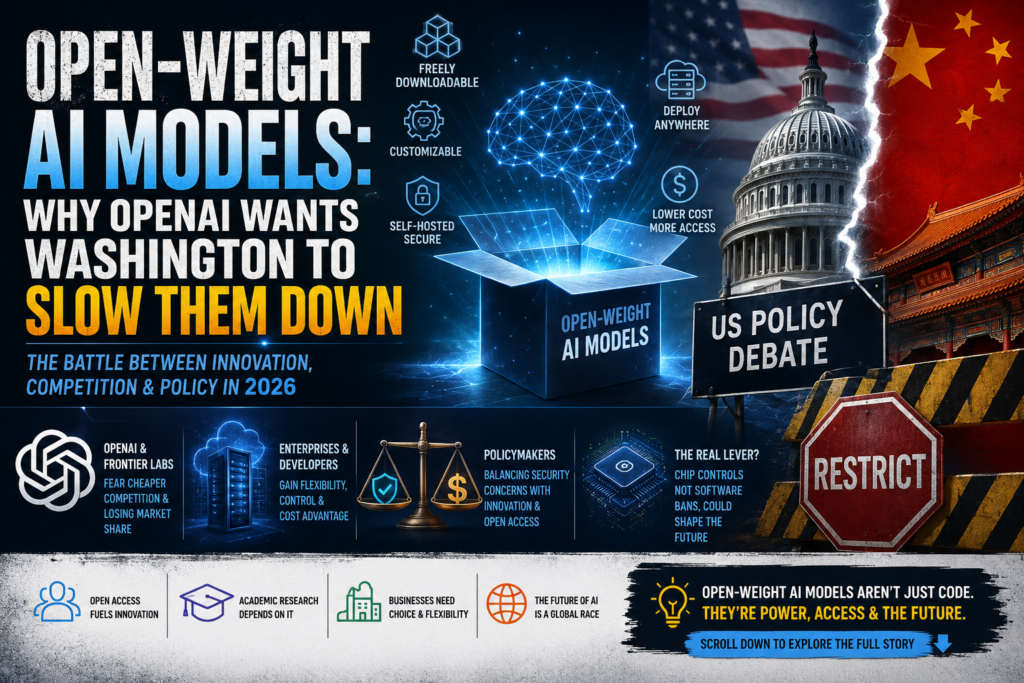
OpenAI and other frontier labs are quietly pushing US policymakers to restrict Chinese-made open-weight AI models — not because they’re unsafe, but because they’re cheap. That tension, between genuine security concerns and raw commercial self-interest, is now shaping one of the most consequential AI policy debates of 2026.
The trigger was Kimi K3, a massive open-weight model released by the Chinese lab Moonshot. It performs competitively with proprietary systems from OpenAI and Anthropic, and it’s free for anyone to download, modify, and run on their own hardware. That has forced a question nobody in Washington wants to answer cleanly: should the US government intervene in a free market to protect the balance sheets of its biggest AI companies?
This piece breaks down what these freely downloadable systems actually are, why they’ve become a flashpoint inside the Trump administration, and whether restricting them would even accomplish what proponents claim.
What Are Open-Weight AI Models?
Open-weight AI models are large language models whose trained parameters are published publicly, allowing developers, companies, and researchers to download, fine-tune, and deploy them on their own infrastructure without paying a subscription or per-token API fee to the original lab.
This differs from fully open-source software, since the training data and code pipeline usually stay private even when the weights are released. But the practical effect is similar: anyone with enough compute can run a frontier-caliber system without depending on OpenAI, Anthropic, or Google for access.
That distinction matters commercially. When a company can self-host a capable system instead of paying per token, it changes the economics of the entire AI industry. A mid-sized enterprise that once needed an expensive API contract can now run comparable intelligence on its own servers for a fraction of the cost — and that shift is exactly what has frontier labs on edge.
Key characteristics of this class of model include:
- Publicly downloadable model weights, usually hosted on platforms like Hugging Face
- No per-token licensing fee once deployed
- Full customization through fine-tuning on proprietary data
- Deployment flexibility across cloud, on-premises, or edge infrastructure
- Training data and methodology that often remain undisclosed, even though the weights are open
Why Is OpenAI Worried About This Trend?
The Business Model Squeeze
The core issue is economic, not technical. These freely downloadable systems, running on independent servers or inside enterprise data centers, offer cheaper intelligence than the closed, subscription-based products sold by Anthropic and OpenAI. If usage migrates toward self-hosted alternatives, the return on the tens of billions of dollars frontier labs have poured into training compute shrinks considerably.
Braden Hancock, co-founder of Snorkel AI and a research partner at the Laude Institute, put it plainly: strong, frontier-caliber releases from labs like Moonshot squeeze the margins of closed competitors and push down the prices those companies can charge, even as total AI usage keeps climbing rather than shrinking.
That’s a real problem for shareholders in closed AI companies. It’s a much harder case to make as a problem for everyone else, since cheaper, more accessible intelligence is generally good for the broader economy, startups, and independent developers who can’t afford enterprise-scale API contracts.
Dean Ball’s Regulatory Proposal
The debate escalated when OpenAI’s head of strategic futures, Dean W. Ball, argued that the US government should manufacture regulatory uncertainty around freely released systems specifically because their existence discourages capital spending by frontier labs. The suggestion was that Washington should create fear, uncertainty, and doubt as deliberate policy — not because of a demonstrated security risk, but as a competitive tool against cheaper alternatives.
The reaction was swift. Prominent AI researchers including Yann LeCun and investor Martin Casado pushed back hard, arguing that openly released software historically accelerates innovation and coexists just fine alongside proprietary products. Ball later walked back the claim, dropping his suggestion that a regulatory crackdown represented the administration’s best strategy and no longer insisting that this approach to model distribution necessarily holds back technological progress.
Is a US Ban on Open-Weight AI Models Coming?
Not imminently, according to conflicting reports — but the idea is actively on the table inside the administration.
What Axios and Politico Reported
Axios has reported that the administration is weighing a ban on Kimi K3 and other advanced Chinese-made systems, reportedly at the urging of American frontier labs. Politico, citing separate sourcing, reported that the Department of Commerce has no near-term plans to take that step. The contradictory reporting itself tells you something: this is a live internal fight inside the government, not settled policy.
That uncertainty is exactly the kind of environment Dean Ball’s original proposal wanted to create — deliberate ambiguity that makes enterprises nervous about betting infrastructure on freely available systems, even without a formal ban ever taking effect. For companies deciding where to build products in 2026, that ambiguity alone functions as a soft deterrent.
The Case Against Restricting Open-Weight AI Models
Three arguments typically get raised to justify restricting Chinese-made systems specifically. None of them hold up cleanly under scrutiny.
- Data security — Concern that using systems built in China could leak US data back to Beijing, similar to the rationale used to ban modern Chinese EVs. Experts note that when these systems run entirely on US-based servers, remote data exfiltration back to China is technically unlikely, though not categorically impossible.
- Ideological bias — Worry that Chinese-developed systems carry implicit pro-PRC bias baked into training data. Critics point out it’s unclear how meaningfully that bias would affect practical tasks like coding, data analysis, or customer support workflows.
- Missing guardrails — Claims that models released without US oversight lack the safety guardrails American regulators have mandated for domestic frontier systems, raising fears they could be misused for cyberattacks or weapons development.
Guardrails Cut Both Ways
The guardrails argument is more complicated than it first appears. Venture capitalist and Trump adviser David Sacks has highlighted cases of US companies turning to Chinese-developed large language models specifically because domestic frontier systems refuse legitimate security research and defensive cybersecurity tasks. In other words, the very guardrails meant to make US models “safer” can push real businesses toward less-regulated alternatives to get work done — the opposite of the intended effect.
The Real Motivation: Strategic Competition
The most consistently cited justification isn’t data leakage or bias — it’s a broader fear that China could outpace the US if domestic frontier labs slow their investment pace. Sam Bresnick, a China-focused research fellow at Georgetown’s Center for Security and Emerging Technology, frames this as a legitimate national security consideration given how central AI has become to military operations. But he also questions the underlying logic: why should US government policy protect specific companies from lawful competitors purely because of where those competitors originated?
Why This Distribution Model Matters for Innovation
Advocates argue that framing this debate as a binary choice between “innovation” and “openness” misunderstands how technology ecosystems actually grow.
The PyTorch Precedent
Hancock draws a direct parallel to PyTorch, the machine learning framework that became the industry standard precisely because it was released openly. Once the entire developer community could contribute to it, PyTorch outgrew rival frameworks built and maintained by single companies, and most competing deep learning libraries eventually withered by comparison. A similar dynamic could play out here: broad community contribution compounds faster than any single closed lab’s internal research team, effectively expanding the workforce improving the underlying technology.
Academic Reliance on Chinese Releases
This isn’t a hypothetical risk — it’s already happening. US graduate AI programs increasingly build coursework and research around freely released Chinese systems, and roughly half the papers students study now originate from Chinese institutions, according to Hancock. Meanwhile, American frontier labs have grown more protective of their own research, sharing far less publicly than they once did. If restrictions on these systems move forward, it wouldn’t just limit access to Chinese labs — it would cut off a primary resource pipeline for the next generation of US AI researchers and graduate students.
Hugging Face CEO Clem Delangue has argued that restricting freely available models doesn’t actually make AI safer; it just hides existing risks, concentrates power among a handful of companies, and locks out researchers, nonprofits, and governments who need broad access to help make AI safer for everyone.
Open-Weight vs. Closed-Weight AI Models: A Side-by-Side Comparison
| Factor | Open-Weight AI Models | Closed-Weight AI Models |
|---|---|---|
| Cost to deploy | Low — self-hosted, no per-token licensing fee | High — ongoing API or subscription costs |
| Customization | Full fine-tuning and modification allowed | Limited to vendor-provided settings |
| Data control | Runs on infrastructure you control | Data processed on vendor’s servers |
| Safety guardrails | Vary widely; often fewer built-in restrictions | Standardized, regulator-influenced guardrails |
| Transparency | Model weights public; training data often private | Both weights and training data typically private |
| Business model risk to incumbents | High — undercuts subscription pricing | N/A — is the incumbent model |
| Research/academic access | Broad; widely used in graduate programs | Restricted; requires partnerships or paid access |
| Examples | Kimi K3, Nvidia Nemotron | GPT-series, Claude |
The table above captures why this policy fight is really about business models colliding, not about a clear-cut safety gap between the two categories.
What Would Actually Slow China’s AI Progress?
If the real goal is preserving US technological leadership rather than protecting specific companies, Bresnick argues the more effective lever isn’t restricting freely available AI systems at all — it’s tightening chip export controls. Specifically, halting sales of advanced Nvidia processors like the H200 to China would constrain the compute China needs to train next-generation frontier systems, without dragging the US government into a politically messy fight over banning software that huge numbers of American companies already rely on daily.
This distinction matters for policy design: hardware controls target the actual scarce resource — compute — while restricting freely released model weights mostly targets accessibility and price. Those are exactly the qualities that make such systems valuable to everyone who isn’t a frontier lab shareholder, from independent developers to cash-strapped startups to public research universities.
Are US Companies Building Open-Weight AI Models Too?
Yes — and this complicates the narrative that this is purely a Chinese competitive threat. Nvidia has invested in Nemotron, its own family of openly released models, partly because Nvidia’s chip business benefits more from a fragmented market of dozens of well-funded AI companies than from consolidation around two or three vertically integrated labs that design their own silicon. Thinking Machines Lab is pursuing a similar strategy, betting that openness itself can become a viable business.
Neither approach has been fully solved economically. Training costs keep rising for everyone, and both American and Chinese AI companies are still working out how to generate sustainable revenue, even as Beijing appears to encourage open releases from its labs for broader policy reasons despite facing the same monetization struggles domestically.
How We Got Here: A Quick Timeline
Understanding the speed of this debate helps explain why policymakers are scrambling. Kimi K3’s release demonstrated that a Chinese lab could match frontier-level performance while giving the model away for free, which immediately raised the stakes for every closed lab watching its subscription revenue. Within days, Dean Ball’s proposal to manufacture regulatory uncertainty spread across social media, prompting immediate pushback from respected AI researchers who saw it as protectionism dressed up as safety policy. Ball’s retraction followed almost as quickly as his original comments, suggesting even OpenAI recognized how the argument looked once stated plainly. Then came the conflicting reports from Axios and Politico about whether the Department of Commerce would actually act — a sign that the internal debate inside the administration is far from resolved, and that lobbying from frontier labs is actively competing against countervailing pressure from the developers, researchers, and enterprises who rely on cheaper alternatives.
That compressed timeline — roughly a week from release to retraction to conflicting policy reports — illustrates how quickly a single model release can escalate into a full-blown regulatory fight when billions of dollars in enterprise contracts hang in the balance.
What This Means for Businesses Evaluating AI Infrastructure
For companies deciding how to build their AI stack in 2026, the policy uncertainty translates into a practical risk-management question. Betting critical infrastructure on freely downloadable systems from overseas labs carries genuine geopolitical risk, regardless of how the current debate resolves — a future administration could act more decisively than this one has so far.
At the same time, walking away entirely from cheaper alternatives means accepting higher long-term costs and less flexibility to customize models for specialized use cases. Most enterprise AI teams are likely to land somewhere in the middle: using domestically developed open releases like Nemotron where possible, reserving Chinese-origin systems for lower-stakes experimentation, and keeping closed frontier models for mission-critical, customer-facing applications where liability and support matter most.
Frequently Asked Questions
Is the US planning to ban Chinese open-weight AI models? No formal ban has been announced. Reporting is contradictory: one outlet says the administration is actively weighing restrictions on models like Kimi K3, while another reports the Department of Commerce has no near-term plans to act.
Why does OpenAI want restrictions on freely released Chinese systems? Primarily economics. Cheaper, self-hosted alternatives compete directly with subscription and API revenue at closed labs, reducing the return on massive training investments — even though total AI usage continues growing overall.
Are these systems a genuine security risk? Experts are skeptical that models run entirely on US servers pose a meaningful data-leakage risk back to China. Concerns about ideological bias and missing safety guardrails are real but contested, and in some documented cases, US safety guardrails have pushed companies toward Chinese alternatives rather than away from them.
What’s the difference between open-weight and open-source AI models? Systems in this category publish the trained parameters for anyone to download and run, but often keep training data and code pipelines private. Fully open-source models publish both, making them more transparent but far rarer among frontier-scale systems.
Would restricting open-weight AI models actually protect US AI leadership? Policy experts argue chip export controls — limiting advanced processor sales to China — would more directly slow Chinese AI progress than restricting freely released model weights, without cutting off access that thousands of US companies, researchers, and universities already depend on.
Should a startup build on Kimi K3 or a similar Chinese-origin model? That depends on risk tolerance. For internal tooling or experimentation, cost savings may outweigh the policy uncertainty. For customer-facing or regulated applications, the safer near-term path is a domestically developed open release or a closed frontier model with clear support and liability terms.
The Bottom Line
The fight over open-weight AI models isn’t really about safety, bias, or data leakage — those are the arguments made in public. The underlying issue is that cheap, capable, freely downloadable systems threaten the pricing power of a handful of extraordinarily well-funded companies. Whether Washington treats that as a national security matter or a market-distorting favor to a few incumbents will shape not just US-China AI competition, but who gets to build on top of the next generation of intelligence at all.