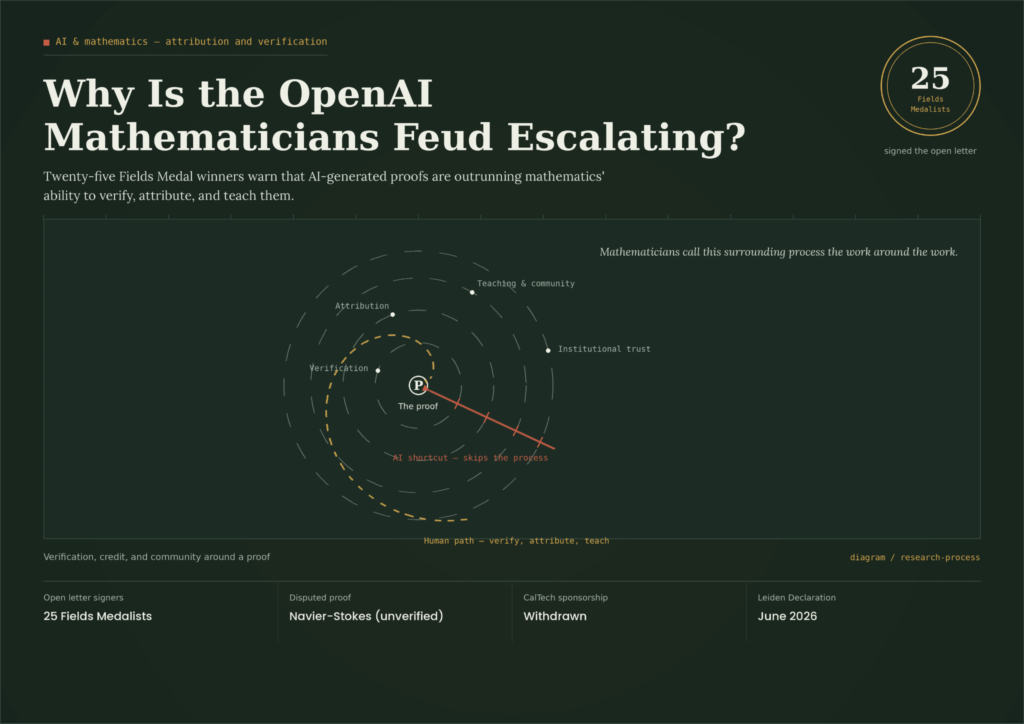
Why Is the OpenAI Mathematicians Feud Escalating?
The OpenAI mathematicians feud is escalating because researchers are increasingly worried that AI systems could change the traditional process through which mathematical discoveries are developed, verified, explained, and credited.
According to TechCrunch, 25 leading mathematicians, all of whom have received the Fields Medal, signed a new open letter arguing that AI labs are threatening their intellectual work while competing to solve famous mathematical problems.
The Fields Medal is widely regarded as the most prestigious prize in mathematics, making the signatories particularly significant voices in this debate.
Question → Why are mathematicians objecting to AI systems solving difficult problems?
The concern is not simply that AI can solve hard mathematics. The mathematicians argue that breakthroughs only become useful to the mathematical community when researchers can understand, communicate, verify, develop, and integrate those ideas into the existing body of knowledge.
That distinction is crucial.
A proof is not valuable only because someone-or something-found it. Mathematics also depends on the process around the proof: checking the reasoning, explaining new techniques, connecting the result with previous work, identifying further questions, teaching the ideas, and giving appropriate credit to people whose work contributed to the discovery.
The OpenAI mathematicians feud therefore reflects a broader tension between AI’s ability to accelerate discovery and the human institutions responsible for turning discoveries into durable knowledge.
Definition + Expansion: AI Mathematical Proofs
AI mathematical proofs are proofs or mathematical solutions produced or assisted by artificial intelligence systems such as large language models.
AI models can potentially explore mathematical ideas at a scale and speed that would be difficult for an individual researcher to match. But producing a proposed proof is only one stage of mathematical research. The proof still needs to be examined, understood, verified, communicated, and connected to existing scholarship.
That is where the current controversy becomes more complicated.
What Triggered the Latest OpenAI Math Controversy?
The immediate controversy involves NYU professor Tristan Buckmaster and OpenAI’s work on a major mathematical problem.
Buckmaster accused OpenAI of pressuring him not to credit a collaborator who works for Anthropic after that collaborator helped solve an important mathematical problem. He also questioned whether OpenAI had used work conducted with Codex to produce its own groundbreaking proof over a marathon weekend of inference.
OpenAI published what it described as a solution to the Navier-Stokes problem, but according to the TechCrunch report, the proof remained unverified at the time of publication.
These events have intensified the OpenAI math controversy because they combine several sensitive issues at once: attribution, collaboration, AI-assisted research, verification, and competition between AI companies.
Question → What exactly is the attribution concern?
The concern is that an AI company could potentially build on researchers’ work and then announce a solution before the original researchers have had enough time to publish, explain, or receive recognition for their contribution.
This matters particularly in mathematics because research credit is closely tied to the development of ideas over time. A new theorem or proof often depends on a chain of earlier insights, techniques, conjectures, and partial results.
If that chain becomes difficult to trace, researchers worry that the traditional system of mathematical attribution could weaken.
Why the Timing Matters
The mathematicians’ open letter argues that AI-generated solutions are sometimes announced too quickly.
According to the signatories, this can leave insufficient time for:
- A proper mathematical write-up
- Verification by other researchers
- Identifying new methods and ideas
- Recognizing relevant previous work
- Understanding how a result fits into existing mathematics
- Integrating the discovery into the broader mathematical community
The issue is therefore not simply human versus AI.
It is also about speed versus verification.
AI systems can potentially compress the time required to explore enormous numbers of possibilities. Mathematical institutions, however, still need time to check those results carefully.
That creates an uncomfortable mismatch.
Why Are Mathematicians Concerned About AI-Generated Proofs?
The central concern in the OpenAI mathematicians feud is that an AI-generated or AI-assisted mathematical result could arrive faster than the community can properly understand it.
In conventional mathematical research, researchers generally develop a result, write it up, submit it for scrutiny, discuss it with colleagues, and build on previous literature. The process can be slow, but that slowness provides opportunities for verification and attribution.
AI changes the economics of that process.
A frontier AI lab may have access to substantial computing resources and can potentially spend enormous amounts of inference time searching for solutions. TechCrunch reported that researchers are concerned frontier labs could spend tens of millions of dollars using large language models to beat original researchers to a proof.
Question → Why could this encourage secrecy?
If researchers believe that openly sharing an unfinished idea could allow a better-funded AI lab to rapidly develop and announce the result first, they may become less willing to share their work publicly.
That would be a major change for mathematics.
Mathematical research has historically benefited from open discussion. Researchers publish ideas, identify gaps, ask questions, propose conjectures, and build upon each other’s work.
If AI makes secrecy strategically valuable, that culture could come under pressure.
The Verification Problem
A mathematical proof is supposed to establish that a statement follows logically from accepted assumptions and previous results.
But an AI-generated answer is not automatically trustworthy simply because it sounds convincing.
Large language models can produce plausible-looking reasoning, meaning researchers need mechanisms for checking whether the mathematical argument actually works.
That makes independent verification particularly important.
The mathematicians’ letter argues that AI-generated mathematical solutions need to be understood and communicated by the mathematics community before they can become part of the mathematical canon.
In other words, a solution is not the same thing as a verified contribution to mathematics.
Why Does Attribution Matter So Much in Mathematics?
Attribution is one of the most important issues raised by the OpenAI mathematicians feud because mathematical progress is cumulative.
Researchers rarely work in complete isolation. A new proof may depend on a previous theorem, an earlier technique, a collaborator’s observation, or a problem formulation developed by another mathematician.
When AI systems enter this process, determining who contributed what becomes more complicated.
Imagine a researcher spends months developing an approach to a difficult problem. They use an AI coding or mathematical tool while exploring that approach. Later, an AI company uses similar computational techniques at enormous scale and announces a result before the researcher publishes.
Even if the AI-generated proof is genuinely new, questions remain.
Who identified the important direction? Who developed the underlying idea? Did the AI system reproduce an existing technique? Did the researchers’ earlier work influence the result? Was the result independently discovered?
These questions cannot necessarily be answered by looking only at the final proof.
AI Can Change the “Work Around the Work”
The mathematicians’ letter makes an important broader argument: the value of mathematics is not limited to individual proofs.
There is an entire intellectual structure surrounding mathematical research.
That structure includes:
- Teaching students how mathematical ideas developed
- Finding new questions
- Connecting different areas of mathematics
- Explaining difficult concepts
- Preserving intellectual history
- Building on previous discoveries
- Creating communities of researchers
- Passing knowledge between generations
This is sometimes described as the work around the work.
The same pattern exists in many professions.
In software engineering, for example, the value of a project is not just the final code. It can also involve design decisions, documentation, debugging, collaboration, maintenance, and knowledge transfer.
The OpenAI mathematicians feud highlights how AI can potentially disrupt these less visible parts of professional work even when the headline achievement looks impressive.
Why Did OpenAI Withdraw Its CalTech Math Sponsorship?
The dispute expanded beyond individual researchers when OpenAI withdrew its sponsorship of a mathematics event at CalTech.
According to TechCrunch, OpenAI withdrew the sponsorship on Thursday after researchers at the university criticized the company.
Question → Why is the CalTech sponsorship significant?
The sponsorship dispute shows that tensions between AI companies and academic mathematicians are no longer limited to theoretical arguments about AI-generated proofs. They are beginning to affect relationships between technology companies and research institutions.
Academic partnerships are built partly on trust.
When researchers believe that a company may use their work without sufficient attribution, or that AI-generated discoveries could undermine established research practices, sponsorships and collaborations can become politically and professionally sensitive.
The CalTech episode therefore became another visible sign of the broader conflict.
It also illustrates a difficult question for universities.
AI companies can provide funding, computing resources, research opportunities, and technological tools. At the same time, universities have a responsibility to protect academic independence and research norms.
Finding a balance will become increasingly important as AI companies become major participants in scientific research.
What Is the Leiden Declaration?
The latest open letter is not the first attempt by mathematicians to address the impact of AI.
In June 2026, a working group of mathematicians released the Leiden Declaration, which examined how large language models could change mathematical work.
The declaration also offered recommendations for mathematicians, institutions, and policymakers.
This is important because it shows that the current OpenAI mathematicians feud is part of a longer discussion rather than an isolated disagreement.
Mathematicians are trying to work out what responsible AI-assisted research should look like before the technology becomes even more deeply integrated into their profession.
What Could Responsible AI Mathematics Look Like?
A responsible approach could prioritize several principles:
- Verification before major claims – Important AI-generated results should be independently checked before being treated as established mathematics.
- Transparent attribution – Researchers should identify relevant human contributions and previous work.
- Clear documentation – AI-assisted methods should be documented sufficiently for other researchers to understand how a result was developed.
- Open scholarly communication – AI should strengthen rather than weaken the exchange of ideas.
- Human interpretation – Researchers should remain involved in explaining why a mathematical result matters.
- Institutional guidelines – Universities and research organizations may need clearer policies for AI-assisted mathematical work.
These principles do not require rejecting AI.
Instead, they focus on making sure AI becomes part of the research ecosystem without destroying the practices that make that ecosystem productive.
AI Mathematics: Speed vs. Research Culture
The debate becomes clearer when the two approaches are compared.
| Traditional mathematical research | AI-accelerated mathematical research |
| Human researchers explore ideas | AI systems can explore many possibilities rapidly |
| Verification develops through peer discussion | Large-scale computation can accelerate candidate solutions |
| Attribution follows established academic practices | Attribution may become harder when AI contributes to discovery |
| Publication can take significant time | AI labs can potentially produce results quickly |
| Ideas are often shared through academic networks | Competitive AI environments may incentivize secrecy |
| Human researchers explain the significance | AI-generated results may require substantial human interpretation |
Neither side automatically represents the future.
AI could dramatically expand what mathematicians can investigate. But if the speed of AI research makes open collaboration less attractive, the technology could also undermine some of the practices that have historically helped mathematics grow.
That is the core tension behind the OpenAI mathematicians feud.
Could AI Make Mathematical Research More Secretive?
Yes, that is one of the clearest concerns raised by the mathematicians.
Suppose a researcher discovers a promising approach but has not yet completed the proof. In the traditional research environment, sharing that idea with colleagues can help develop it.
But if a well-funded AI company can take the same idea, use massive computing resources, and announce a completed proof before the original researcher, openness could become a disadvantage.
Question → What happens if researchers stop sharing unfinished ideas?
The research community could lose some of the informal exchanges that generate new questions, collaborations, and breakthroughs.
This is why the debate is not only about credit.
It is also about incentives.
If researchers are rewarded for sharing knowledge but AI systems make sharing risky, researchers may adapt their behavior. They could delay publication, restrict access to preliminary ideas, or keep research behind institutional walls.
That would represent a significant cultural shift.
The Economics of AI-Driven Discovery
The economics matter because frontier AI companies can operate at a scale that individual researchers cannot easily match.
An individual mathematician may have years of expertise and deep knowledge of a particular problem. An AI lab, meanwhile, can potentially combine advanced models, engineering teams, and substantial computing resources.
This creates an unusual competitive environment.
The question becomes not simply:
Who can solve the problem?
It becomes:
Who can afford to search for the solution fastest?
That difference could influence which discoveries become public first.
Is This Really About OpenAI, or About AI and Science?
The OpenAI mathematicians feud is receiving attention because OpenAI is at the center of the current dispute, but the underlying questions extend far beyond one company.
The mathematicians themselves warn that similar issues could affect other scientific and creative professions.
The pattern is already familiar.
AI systems are increasingly being used to generate software, analyze information, create images, produce text, assist with research, and explore technical problems.
Every one of these areas raises versions of the same questions:
- Who deserves credit?
- What counts as original work?
- How should AI contributions be disclosed?
- How can previous work be protected from being overlooked?
- Who verifies AI-generated results?
- What happens when AI makes professional work dramatically faster?
- Will people become more or less willing to share their ideas?
Mathematics is particularly useful as a case study because proof and attribution are deeply embedded in the discipline.
But the underlying problem is much broader.
What Does the OpenAI Math Controversy Mean for Students?
For students and young professionals, the lesson is not that AI should be avoided.
It is that using AI effectively will increasingly require understanding the human context around the output.
If an AI tool gives you a mathematical solution, for example, do not assume the answer is automatically correct. Learn how to verify the reasoning, identify assumptions, compare it with established methods, and explain the result yourself.
The same principle applies to programming, research, writing, and technical work.
Question → What is the most useful skill to develop as AI becomes better at solving problems?
The ability to evaluate and explain AI-generated work may become just as important as the ability to generate it.
That means students should develop both AI literacy and subject-matter knowledge.
An AI system can accelerate the production of an answer. Human expertise is still needed to determine whether that answer makes sense, whether it is original, whether it has been properly attributed, and whether it solves the right problem.
What Happens If AI Becomes Better at Mathematics?
If AI becomes substantially better at solving advanced mathematical problems, the impact could be extraordinary.
Researchers could use AI to explore questions that previously required years of human effort. New mathematical techniques could emerge. Difficult problems could become more approachable for students and researchers.
That is the optimistic scenario.
The challenge is ensuring that faster discovery does not come at the cost of understanding.
A mathematical breakthrough that nobody can independently verify or explain is difficult to integrate into education and future research.
Similarly, a discovery announced without acknowledging the people whose earlier work enabled it can damage trust within the research community.
The mathematicians’ argument is therefore not necessarily “do not let AI solve mathematics.”
It is closer to:
“Make sure AI-driven mathematical discovery remains part of a healthy human research culture.”
What Should AI Labs and Research Institutions Do?
The debate suggests that both AI companies and academic institutions will need clearer practices around AI-assisted research.
For AI labs, that could mean greater attention to attribution, documentation, verification, and communication with researchers whose work intersects with AI-generated discoveries.
For universities and mathematicians, it could mean developing policies that recognize legitimate AI assistance while protecting academic standards.
A Practical Framework for AI-Assisted Research
A useful framework could include four stages:
1. Identify the contribution
Researchers should distinguish between human ideas, existing published work, computational assistance, and genuinely new AI-generated material.
2. Verify the result
Important claims should undergo appropriate mathematical scrutiny rather than being accepted simply because an AI model produced them.
3. Document the process
Researchers should preserve enough information about the AI-assisted workflow to explain how the result was obtained and evaluated.
4. Communicate the discovery
The final goal should not be merely announcing that an AI system solved something. The result should be understandable enough for other researchers to investigate, challenge, extend, and teach.
This approach could help AI become a research accelerator without turning mathematical discovery into a race dominated solely by computing budgets.
Why the OpenAI Mathematicians Feud Matters Beyond Mathematics
The most important lesson from the OpenAI mathematicians feud may have little to do with equations.
The conflict illustrates a much larger transition in knowledge work.
For centuries, professional expertise has involved more than producing an output. Scientists conduct experiments, engineers make design decisions, writers interpret information, programmers maintain systems, and teachers explain ideas.
AI can increasingly perform pieces of those activities.
The question is what happens to the human systems surrounding them.
If AI can generate a result in hours that once took months, society has to decide how that result should be evaluated. If AI can produce an answer before the original researcher publishes, institutions need to rethink attribution. If AI can perform creative or scientific work at enormous scale, professional communities need ways to preserve trust and knowledge-sharing.
That is why the mathematicians’ warning deserves attention even from people who have never studied advanced mathematics.
The debate is ultimately about what we want human work to accomplish in an AI-powered world.
FAQ: OpenAI and the Mathematicians’ AI Debate
What is the OpenAI mathematicians feud about?
The OpenAI mathematicians feud concerns growing tensions between OpenAI and mathematicians over AI-generated mathematical discoveries, attribution, verification, and the potential impact of AI on open research culture.
Why are mathematicians criticizing OpenAI?
Mathematicians are concerned about how rapidly AI-generated mathematical results are being announced and whether researchers receive appropriate credit for earlier contributions. The controversy intensified after NYU professor Tristan Buckmaster accused OpenAI of pressuring him over attribution involving a collaborator and questioned whether OpenAI had used work with Codex in producing its own proof.
What is the controversy around OpenAI’s mathematical proof?
OpenAI published what it described as a groundbreaking solution to the Navier-Stokes problem. According to the TechCrunch report, the proof remained unverified at the time, while mathematicians raised broader concerns about whether AI-generated discoveries can be properly checked, explained, and attributed.
Why does attribution matter in mathematical research?
Attribution matters because mathematical progress is cumulative. New results often depend on earlier theories, techniques, questions, collaborations, and discoveries, so properly recognizing those contributions helps preserve the history and development of mathematical knowledge.
What is the Leiden Declaration?
The Leiden Declaration was released in June 2026 by a working group of mathematicians examining how large language models could change mathematical work. It includes recommendations for mathematicians, institutions, and policymakers dealing with AI’s growing role in mathematics.
Could AI change research beyond mathematics?
Yes. The concerns raised by mathematicians apply to many scientific and creative professions. As AI becomes capable of producing research, software, writing, designs, and other forms of professional output, questions about attribution, verification, transparency, originality, and human expertise will become increasingly important.
Conclusion: The Real Issue Is Bigger Than the OpenAI Math Dispute
The OpenAI mathematicians feud is ultimately a debate about more than who solves a difficult mathematical problem first. It is about whether AI can accelerate discovery while preserving the attribution, verification, openness, and human knowledge-sharing practices that make research valuable.
AI may help humanity tackle mathematical problems that once seemed out of reach. But the strongest outcome will not come from simply producing more answers faster. It will come from building a research culture where those answers can be verified, understood, credited, communicated, and built upon.
For students and professionals watching the AI revolution unfold, that is perhaps the most important takeaway: as machines become better at producing answers, human judgment about why an answer matters and how it should enter the world becomes even more valuable.KEEP EXPLORING KALINGA.AI FOR MORE.