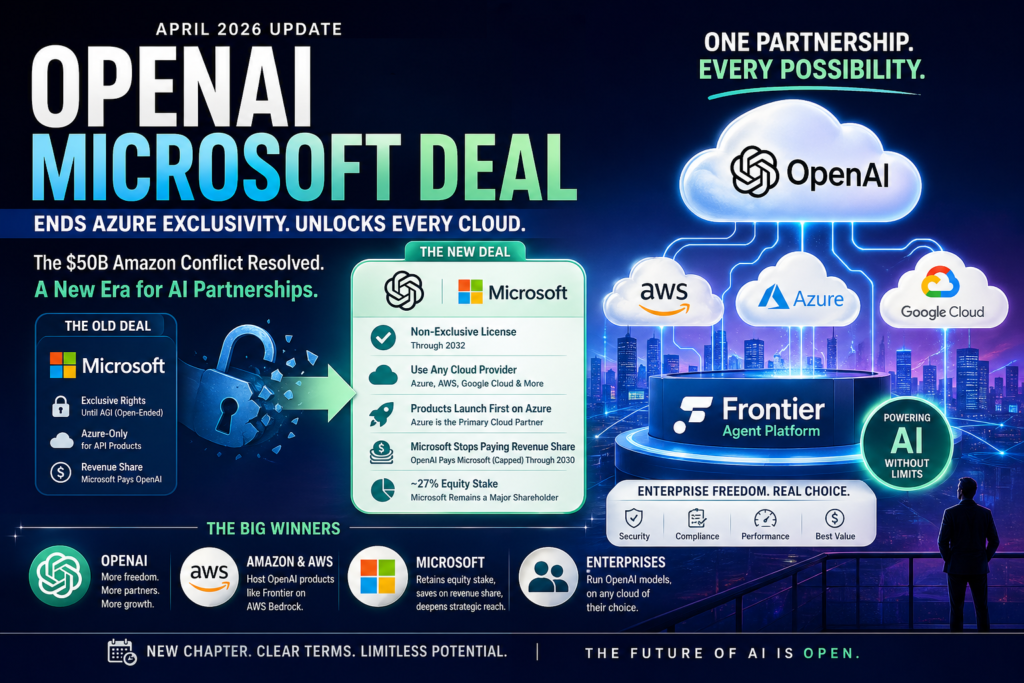
The OpenAI Microsoft deal has been renegotiated — and it rewrites the rules of the AI industry’s most consequential partnership. In short: OpenAI can now serve its products on any cloud provider, Microsoft’s exclusive lock on OpenAI’s IP has a firm expiry date, and the legal threat hanging over OpenAI’s landmark Amazon investment has been neutralized.
If you’ve been trying to understand what changed, why it matters, and who comes out ahead — this is the complete breakdown.
What the OpenAI Microsoft Deal Actually Changed
The original partnership between OpenAI and Microsoft gave Microsoft sweeping, exclusive rights to OpenAI’s intellectual property — including all models and products accessed via API — until the day OpenAI achieved Artificial General Intelligence (AGI). That was an open-ended, potentially decade-long lock-in with no calendar endpoint.
The April 2026 renegotiation changes that fundamentally:
- Microsoft now holds a non-exclusive license to OpenAI’s IP for models and products — through 2032.
- OpenAI can now run all its products on any cloud provider, not just Azure.
- Microsoft no longer needs to pay OpenAI a revenue share, while OpenAI continues paying Microsoft revenue share through 2030 (subject to a cap).
- Microsoft remains a major shareholder in OpenAI’s for-profit entity, holding approximately 27%.
The phrase “non-exclusive” is doing enormous work in that first bullet. It transforms a deal that could have become a legal war into a structured, time-bounded commercial partnership with clear benefits on both sides.
Why Microsoft’s Exclusive Rights Were a Legal Timebomb
To understand why this renegotiation was urgent, you need to understand the specific contractual tension that the OpenAI Amazon partnership created.
The Amazon Deal That Triggered the Crisis
In February 2026, Amazon announced an investment of up to $50 billion in OpenAI — comprising a $15 billion initial tranche and up to $35 billion more when certain undisclosed conditions were met. In exchange, OpenAI agreed to:
- Co-develop “stateful runtime technology” — the infrastructure that allows AI agents to remember tasks and context over time — on Amazon Web Services (AWS) Bedrock.
- Give AWS exclusive rights to serve OpenAI’s new agent-creation platform, Frontier.
That second point was the problem. Under the original OpenAI Microsoft deal, Microsoft held exclusive rights to any OpenAI product delivered via API. Frontier — an API-accessible product — fell squarely inside that exclusivity boundary.
Microsoft made its position public the same day the Amazon deal was announced, issuing a statement that explicitly contradicted OpenAI’s AWS exclusivity promise:
“Azure remains the exclusive cloud provider of stateless OpenAI APIs. … OpenAI’s first party products, including Frontier, will continue to be hosted on Azure.”
The Financial Times subsequently reported that Microsoft had even contemplated legal action to enforce those terms. The stage was set for a costly and reputation-damaging dispute between OpenAI and its most important institutional partner.
What Microsoft’s Original Contract Said
The original agreement gave Microsoft blanket API exclusivity with one notable carve-out: consumer-facing products like ChatGPT could run on other clouds. Everything else — any product accessed programmatically — was Azure-only.
This made perfect commercial sense in 2019 when OpenAI was an ambitious research lab. By 2026, with OpenAI generating billions in revenue and partnering with the biggest names in cloud infrastructure, that clause had become a structural constraint on OpenAI’s growth — and a litigation risk for every new partnership it tried to form.
Breaking Down the New Terms: Old Deal vs. New Deal
The following table summarizes the critical differences between the original OpenAI Microsoft deal and the renegotiated April 2026 agreement.
| Term | Original Agreement | April 2026 Agreement |
|---|---|---|
| Microsoft’s License Type | Exclusive to all OpenAI IP (models + products) | Non-exclusive license through 2032 |
| Duration of Exclusivity | Until OpenAI achieves AGI (open-ended) | Fixed end date: 2032 |
| Cloud Hosting Rights | Azure-only for all API products | OpenAI can use any cloud provider |
| Azure’s Status | Exclusive cloud provider | “Primary cloud partner” (non-exclusive) |
| Frontier on AWS | Prohibited under original terms | Now permitted |
| Product Launch Priority | Azure-first, exclusive | Azure-first unless Azure can’t support it |
| Revenue Share (Microsoft → OpenAI) | Microsoft paying revenue share | Eliminated |
| Revenue Share (OpenAI → Microsoft) | Existing arrangement | Continues through 2030, now capped |
| Microsoft Equity Stake | ~27% of for-profit entity | ~27% of for-profit entity (unchanged) |
| Legal Risk | Active threat of litigation over AWS deal | Resolved |
The most consequential row in that table is the third one. The ability for OpenAI to serve its full product portfolio across multiple clouds is what makes the new OpenAI Microsoft deal a genuine restructuring — not just a cosmetic amendment.
Who Wins, Who Loses, and Who Wins the Most
Winners
- OpenAI escapes the legal jeopardy that threatened its $50B Amazon partnership. It retains Microsoft as a major cloud partner and shareholder while gaining the freedom to partner with AWS, Google Cloud, or any other provider without risking a lawsuit.
- Amazon and AWS can now legitimately host OpenAI’s products — including Frontier — on Bedrock. Amazon CEO Andy Jassy publicly celebrated the resolution, confirming that OpenAI models would be available to AWS customers in the coming weeks.
- Microsoft exits its revenue share obligation to OpenAI (previously worth billions), retains a 27% equity stake that appreciates with every OpenAI partnership deal, and gains a new relationship with Anthropic that partially replaces what it’s ceding in OpenAI exclusivity.
- Enterprises are arguably the biggest winners. They now get genuine cloud portability for OpenAI’s models — meaning they can use ChatGPT, Frontier, and OpenAI’s agent technology on Azure, AWS, or whichever platform best fits their infrastructure, pricing, and compliance needs.
Losers (or at Least, Net-Neutral Parties)
- Microsoft’s Azure cloud business loses the incremental advantage that exclusive hosting of all OpenAI API products would have provided. Any enterprise that might have chosen Azure specifically to access OpenAI’s full product suite no longer has to.
- Azure’s competitive positioning takes a soft hit, though this is partially offset by Microsoft’s growing Anthropic relationship and the fact that Azure remains OpenAI’s “primary cloud partner.”
The Nuanced Middle Ground
Microsoft’s financial exposure here is worth noting carefully. The company reported earning $7.5 billion in a single quarter from its OpenAI investment in early 2026. Its 27% equity stake means it financially benefits from OpenAI’s growth regardless of which cloud OpenAI’s customers use. The company loses some cloud revenue upside but gains deal certainty and eliminates litigation risk.
The Timeline: How We Got Here
Understanding the OpenAI Microsoft deal in its current form requires following a sequence of events that unfolded rapidly over six months.
- October 2025: Microsoft and OpenAI announce an updated agreement allowing OpenAI to run non-API consumer products on other clouds. This helps OpenAI navigate Elon Musk’s lawsuit over its corporate structure.
- November 2025: OpenAI and Amazon sign a multi-year cloud agreement worth $38 billion in AWS infrastructure.
- February 2026: Amazon announces up to $50 billion in OpenAI investment, contingent on an exclusive deal for Frontier and stateful agent technology on AWS. That same day, Microsoft publicly contradicts OpenAI’s AWS exclusivity promise.
- March 2026: The Financial Times reports Microsoft is considering legal action to enforce its contract.
- April 2026: The renegotiated OpenAI Microsoft deal is announced, eliminating exclusivity, setting a 2032 endpoint, and permitting OpenAI to serve all products across all clouds.
The speed of this resolution — from public contradiction to renegotiated deal in under three months — suggests both parties recognized that a prolonged dispute would harm them more than any concession either side made.
What This Means for the AI Cloud Wars
The OpenAI Microsoft deal resolution is not just a bilateral business story. It signals a structural shift in how hyperscale cloud providers are competing for AI workloads.
AI Workloads Are Becoming the Core Battleground
For Microsoft, Google, and Amazon, AI models are not just software products — they are the reason enterprises choose (or stay loyal to) a cloud platform. Hosting OpenAI’s models was not merely a revenue line for Microsoft; it was a customer acquisition and retention mechanism at massive scale.
Now that OpenAI can route workloads to any provider, the competition shifts from “who has exclusivity” to “who offers the best price, performance, compliance, and integration layer.” This is healthier for the market but intensifies the arms race between Azure, AWS, and Google Cloud.
Microsoft’s Anthropic Bet Gets More Important
With its OpenAI exclusivity diminished, Microsoft has been quietly deepening its relationship with Anthropic — building agentic products powered by Claude AI. This is a notable strategic hedge: Microsoft is ensuring that regardless of how the OpenAI partnership evolves, it has access to frontier AI capability.
The “Primary Cloud Partner” Language Matters
The new OpenAI Microsoft deal still designates Azure as OpenAI’s “primary cloud partner,” and OpenAI has agreed to buy $250 billion in Microsoft cloud services. OpenAI products also launch “first on Azure” — though what “first” means in terms of exclusivity duration remains deliberately vague in the public announcement.
This ambiguity is likely intentional. It preserves Microsoft’s ability to tell its shareholders that Azure has preferential access to new OpenAI products, while giving OpenAI the commercial freedom to offer those products to AWS and other providers shortly afterward.
Frequently Asked Questions
Does Microsoft still have any exclusive rights to OpenAI products?
No. Under the renegotiated OpenAI Microsoft deal, Microsoft holds a non-exclusive license to OpenAI’s IP through 2032. It retains “primary cloud partner” status and first-launch rights, but OpenAI can now serve all products across any cloud provider.
Why was the Amazon deal a legal problem?
OpenAI’s original agreement with Microsoft gave Azure exclusive rights to all OpenAI products delivered via API. When OpenAI promised AWS exclusive rights to host Frontier, it created a direct conflict with Microsoft’s contractual terms — potentially exposing OpenAI to litigation.
What is OpenAI’s Frontier product?
Frontier is OpenAI’s agent-creation platform — a tool that allows developers and enterprises to build AI agents. It is a key commercial product and was at the center of the AWS exclusivity dispute because it is accessed via API, which placed it under Microsoft’s original exclusivity clause.
What is stateful runtime technology?
Stateful runtime is the technical infrastructure that allows AI agents to maintain memory and context over extended periods. Unlike stateless API calls (which treat each request independently), stateful systems let agents remember previous interactions, track task progress, and operate autonomously over longer workflows. OpenAI agreed to co-develop this with AWS on the Bedrock platform.
How does this affect enterprises using OpenAI products?
Significantly and positively. Enterprises can now access the full suite of OpenAI models and products — including agentic tools — on AWS, Azure, or other clouds. This removes cloud lock-in concerns and increases bargaining power with all three major providers.
Will OpenAI still use Azure predominantly?
Yes, at least through 2032. Azure is OpenAI’s “primary cloud partner” and OpenAI has committed to purchasing $250 billion in Microsoft cloud services. New products also launch first on Azure. But the relationship is now commercial rather than contractually exclusive.
The Bigger Picture
The resolution of the OpenAI Microsoft deal is a landmark moment in the commercialization of generative AI. It marks the end of a period when a single cloud giant could use contractual exclusivity to shape which AI products enterprises could access and where.
Going forward, the real competition in AI infrastructure will play out on technical merit, pricing, and ecosystem depth — not contractual lock-in. For enterprises, that is unambiguously good news. For Microsoft, Amazon, and Google, it raises the stakes on every infrastructure decision they make.
OpenAI, meanwhile, emerges from this episode with more commercial freedom than it has ever had — and the financial firepower (up to $50 billion from Amazon alone) to use it aggressively.
Conclusion: The OpenAI Microsoft Deal Marks a Defining Shift in AI Power Dynamics
The OpenAI Microsoft deal stands as one of the most transformative agreements in the modern AI era, not just because of its scale, but because of what it fundamentally changes about how artificial intelligence is built, deployed, and commercialized. What began as a tightly coupled partnership defined by exclusivity has now evolved into a more flexible, competitive, and strategically balanced relationship. This shift reflects a broader maturation of the AI industry, where control is no longer the primary objective—adaptability, scalability, and ecosystem expansion are.
At its core, the renegotiated OpenAI Microsoft deal resolves a critical tension that had been building for years. The original agreement made sense in a world where OpenAI needed infrastructure, funding, and a launch partner. Microsoft provided all three, and in return secured deep integration and exclusive rights that positioned Azure as the central hub for OpenAI innovation. However, as OpenAI grew into a global AI powerhouse with multiple enterprise partnerships and massive capital inflows, those same terms became restrictive. The OpenAI Microsoft deal had to evolve—or risk collapsing under its own weight.
The introduction of a non-exclusive licensing model is perhaps the most important outcome of the new OpenAI Microsoft deal. By removing Azure-only constraints, OpenAI has unlocked the ability to operate across multiple cloud environments, including AWS and potentially others. This is not just a technical adjustment—it is a strategic liberation. It allows OpenAI to align with enterprise customers who demand flexibility, regional compliance, and cost optimization. In this sense, the OpenAI Microsoft deal is no longer about control, but about enabling broader adoption at scale.
Equally significant is the resolution of the Amazon-related conflict. Without changes to the OpenAI Microsoft deal, the AWS partnership could have triggered legal disputes, delayed product rollouts, and damaged relationships with key stakeholders. Instead, the renegotiation neutralized that risk entirely. The OpenAI Microsoft deal now supports, rather than obstructs, OpenAI’s ability to form high-value partnerships. This signals a new phase where collaboration across ecosystems is not only possible but encouraged.
From Microsoft’s perspective, the updated OpenAI Microsoft deal may appear like a concession on exclusivity, but it is far from a loss. Microsoft retains a substantial equity stake and continues to benefit from OpenAI’s growth trajectory. The removal of revenue-sharing obligations also improves Microsoft’s financial position. More importantly, the OpenAI Microsoft deal still preserves Azure’s role as the primary cloud partner, ensuring early access to innovations and maintaining a strong competitive edge. In many ways, Microsoft has traded exclusivity for sustainability—a move that reduces legal risk while securing long-term upside.
For enterprises, the implications of the OpenAI Microsoft deal are overwhelmingly positive. Organizations are no longer forced into a single cloud ecosystem to access OpenAI’s most advanced tools. This newfound flexibility empowers businesses to choose infrastructure based on performance, compliance, and cost rather than contractual limitations. As a result, the OpenAI Microsoft deal enhances enterprise autonomy and accelerates the adoption of AI across industries.
Looking at the broader market, the OpenAI Microsoft deal signals a turning point in the AI cloud wars. Exclusivity is giving way to interoperability, and partnerships are becoming more dynamic. Cloud providers must now compete on merit—offering better performance, pricing, and integration capabilities. This shift raises the bar for innovation and benefits customers across the board. The OpenAI Microsoft deal is not just a business agreement; it is a catalyst for a more competitive and open AI ecosystem.
Ultimately, the OpenAI Microsoft deal reflects the reality that no single company can dominate the AI landscape in isolation. Success will depend on collaboration, adaptability, and the ability to integrate across platforms. OpenAI’s move toward a multi-cloud strategy, enabled by the revised OpenAI Microsoft deal, positions it for sustained growth and global reach. At the same time, Microsoft remains deeply embedded in that success story, proving that strategic partnerships can evolve without breaking.
In conclusion, the OpenAI Microsoft deal is a blueprint for the future of AI partnerships. It demonstrates how companies can renegotiate power structures without destroying value, how conflicts can be resolved through strategic compromise, and how the industry can move toward a more open and competitive model. As AI continues to reshape every sector, the lessons from the OpenAI Microsoft deal will likely influence how future alliances are formed, challenged, and ultimately redefined.