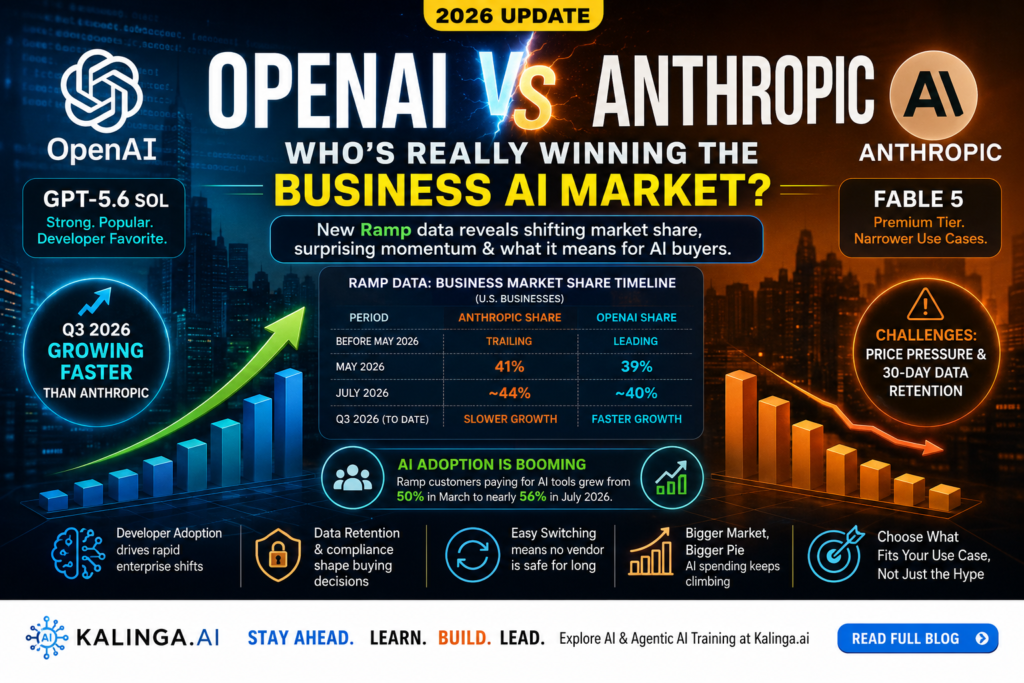
If you’ve been assuming Anthropic had permanently pulled ahead of OpenAI with business customers, new data says think again. Fresh numbers from corporate card company Ramp show that in the OpenAI vs Anthropic race for enterprise wallet share, OpenAI is closing the gap it lost back in May 2026, and is now growing faster than Anthropic through the current quarter. Neither company has released full financials ahead of their planned IPOs, so this Ramp dataset, reported by TechCrunch on August 20, 2026, is one of the clearest public signals we have into how real businesses are actually spending their AI budgets.
For students and young professionals in Odisha tracking the AI industry, this isn’t just a Silicon Valley story. It’s a live preview of how volatile, and how winnable, the enterprise AI market still is, even for the two best-funded labs on the planet. And because this is a market both companies keep fighting over, understanding the OpenAI vs Anthropic dynamic is quickly becoming useful general knowledge for anyone entering the AI workforce.
What Is Ramp’s New Data, and Why Does It Matter?
Ramp is a corporate credit card and expense-management platform that tracks how tens of thousands of American businesses actually spend money, including on AI subscriptions. Because Ramp sits inside real company payment flows rather than survey responses, its data offers a rare, near-real-time proxy for enterprise AI adoption trends. Since neither OpenAI nor Anthropic publicly reports revenue splits by customer, journalists and analysts have started leaning on datasets like Ramp’s to read the tea leaves on the ongoing OpenAI vs Anthropic contest.
According to TechCrunch’s reporting, the dataset covers more than 70,000 American businesses that collectively spend billions of dollars through Ramp’s bill pay and corporate card products. That’s a meaningful sample size, though it comes with a caveat worth remembering before you treat it as gospel on OpenAI vs Anthropic market dynamics.
Is Ramp’s data a complete picture of the AI market? No, and Ramp is upfront about that. Ramp’s customer base spans many industries but skews toward tech, since it’s a popular Silicon Valley corporate card, and the dataset excludes large enterprises that rely on other spend-management tools, such as American Express, instead of Ramp. In other words, this is a leading indicator from a tech-heavy slice of the market, not the full enterprise AI economy, a nuance worth keeping in mind whenever you see confident claims about who’s “winning” the OpenAI vs Anthropic battle.
The OpenAI vs Anthropic Market Share Timeline: What Changed and When
The most striking part of the Ramp data is how quickly the lead has flipped, twice, in just a few months. Here’s the timeline as reported by TechCrunch.
| Period | Anthropic Share | OpenAI Share | What Happened |
| Before May 2026 | Trailing | Leading | OpenAI was the runaway leader with both consumers and businesses |
| May 2026 | 41% | 39% | Anthropic overtook OpenAI among Ramp’s paying business users for the first time |
| July 2026 | ~44% | ~40% | Anthropic’s lead widened slightly, and OpenAI had still not regained its former position |
| Q3 2026 (to date) | Slower growth | Faster growth | Ramp economist Ara Kharazian noted OpenAI is growing faster than Anthropic among this business segment so far this quarter |
Question: Has OpenAI actually retaken the lead from Anthropic? Not yet, based on the published percentages, Anthropic was still ahead as of July 2026. What’s changed is the direction of momentum: OpenAI’s growth rate among Ramp’s business customers has picked up again after months of losing ground, which is why the story is framed as OpenAI “gaining on” Anthropic rather than overtaking it outright. This is exactly the kind of nuance that gets lost when the OpenAI vs Anthropic rivalry gets reduced to a single headline number.
It’s also worth remembering that Ramp intentionally withheld one important figure. Ramp declined to share actual dollar amounts, releasing only percentage market-share data, so we know the direction of the trend in the OpenAI vs Anthropic race, but not its true scale in revenue terms. A one-point swing in market share could represent a small shift or a very large one in absolute dollars, and outside observers currently have no way to tell which.
Why Is OpenAI Gaining Ground Again?
Momentum in enterprise AI spending tends to track product releases closely, and this swing is no exception. According to Kharazian, developers are increasingly favoring OpenAI’s newest model, GPT-5.6 Sol, which he described as strong and increasingly popular among technical teams. That single factor appears to be doing much of the work behind OpenAI’s renewed Q3 growth in the broader OpenAI vs Anthropic comparison.
Definition: What is “developer adoption” as a growth signal? Developer adoption refers to how quickly software engineers and technical teams, often the earliest and most price-sensitive AI buyers inside a company, start building on a new model. Because developers can switch API providers with a few lines of code, their loyalty is famously fickle; a well-received model release can move enterprise spending within weeks, not years. That’s exactly the kind of shift Ramp’s data appears to be capturing in the current quarter, and it’s a big reason the OpenAI vs Anthropic scoreboard can move so fast.
This also explains why the Ramp numbers move as quickly as they do. Unlike enterprise software contracts that lock companies in for a year or more, AI model subscriptions and API usage are comparatively easy to shift between providers, which is part of why the OpenAI vs Anthropic market share split can swing by several percentage points in a single quarter. For a founder or IT lead, that volatility is itself useful information: it means neither vendor can afford to get complacent, and buyers genuinely have leverage.
Why Did Anthropic’s Fable Tier Stumble With Businesses?
The flip side of OpenAI’s Q3 momentum is a rockier stretch for one of Anthropic’s premium offerings. Kharazian pointed specifically to Fable 5, Anthropic’s higher-end model tier, saying it fell short of expectations both in adoption and in real-world application, a shortfall he tied to its pricing combined with new data-retention requirements imposed on the model by regulators.
Definition: What is data retention, and why does it matter to businesses? Data retention refers to how long an AI provider keeps a copy of the prompts, files, and outputs a customer sends to the model. Enterprises, especially in regulated industries like finance, healthcare, and law, care deeply about this because longer retention windows can create compliance risk, increase exposure in the event of a data breach, and complicate contracts with their own customers. TechCrunch’s reporting notes that Anthropic drew criticism when it informed Fable users that their data would need to be retained for 30 days, a policy that reportedly made some business buyers hesitant even though Fable is a smaller, more specialized product line than Anthropic’s mainstream Claude offering.
It’s worth noting that TechCrunch’s own reporting pushes back a little on treating this as a simple story of Fable “losing” the OpenAI vs Anthropic contest. Fable is positioned as an expensive, higher-end tier built for a narrower set of use cases than a general-purpose chatbot, so comparing its adoption curve directly to a mass-market model like GPT-5.6 Sol may be an oversimplification of what’s actually happening in the market. Two products built for different jobs will naturally show different adoption curves, regardless of underlying quality.
The Bigger Picture: The Whole AI Market Is Still Expanding
Here’s the part of the story that’s easy to miss if you only focus on who’s “winning” the OpenAI vs Anthropic rivalry: both companies can grow at the same time, because the overall pie is getting bigger. Ramp’s data indicates that both companies’ business revenue is growing even as they compete for share, simply because overall AI spending among Ramp’s customers is expanding.
The adoption numbers back this up clearly:
- The share of Ramp business customers paying for AI tools crossed 50% in March 2026
- By July 2026, that figure had climbed to nearly 56%
- That’s a jump of roughly six percentage points in just four months, among a base of over 70,000 businesses
- Growth is happening even as the OpenAI vs Anthropic competition for share stays volatile month to month
Question: Does OpenAI vs Anthropic competition slow down overall AI adoption? No, if anything, the opposite seems true. Head-to-head competition between the two labs is pushing out better models faster, which appears to be pulling more businesses into paid AI subscriptions rather than scaring them away. Rivalry, in this case, looks like it’s expanding the market rather than splitting a fixed one.
OpenAI vs Anthropic: How Should a Business Actually Choose?
Market share headlines are interesting, but they don’t answer the practical question a founder, IT lead, or freelancer actually has: which one should you pay for? Based on what’s publicly known about each company’s current positioning, here’s a simple comparison to help frame the decision.
| Factor | OpenAI (ChatGPT / GPT-5.6 Sol) | Anthropic (Claude / Fable 5) |
| Recent momentum | Growing faster in Q3 2026 among Ramp’s business base | Held the overall lead in Q3 2026, but growth had slowed |
| Developer sentiment | Strong recent reception for GPT-5.6 Sol | Mixed reception for the premium Fable 5 tier specifically |
| Positioning | General-purpose chatbot, broad use cases | Fable 5 targets narrower, specialized enterprise use cases |
| Known friction point | Not highlighted in this dataset | 30-day data-retention requirement on Fable drew criticism |
| Market share (Jul 2026, Ramp) | ~40% | ~44% |
Bulleted takeaway, what to actually weigh before choosing a provider:
- Match the tier to the task. A narrow, specialized workload may genuinely need Anthropic’s Fable-class model, even at a premium price, while general drafting, support, or coding assistance may be well served by a mainstream ChatGPT plan.
- Check the data-retention and compliance terms, not just the price sheet, especially if you’re in fintech, healthcare, ed-tech, or government-adjacent work in India, where data localization conversations are only getting louder.
- Don’t assume today’s leader stays the leader. The OpenAI vs Anthropic gap has flipped direction twice in a matter of months, build contracts and workflows that don’t lock you into one vendor forever.
- Watch API and developer experience closely. Ramp’s data suggests developer sentiment is currently one of the biggest swing factors in enterprise AI spending, and it can move faster than pricing or feature announcements.
- Treat percentage-only data with some caution. Since Ramp withheld absolute dollar figures, a shift of a few points in the OpenAI vs Anthropic split may look dramatic without necessarily representing a huge change in real spending.
What This Means for Odisha’s AI Students and Young Professionals
For learners going through Kalinga.ai’s AI and Agentic AI training tracks, this OpenAI vs Anthropic tug-of-war is a useful real-world case study, not just industry gossip. It shows that even at the frontier, with the two best-capitalized AI labs in the world, market leadership isn’t permanent, pricing and compliance details genuinely move enterprise buying decisions, and being fluent across multiple model providers, rather than loyal to just one, is becoming a real, marketable skill.
If you’re building projects, job-hunting, or advising local businesses on AI adoption in Bhubaneswar or elsewhere in Odisha, understanding why companies switch between OpenAI and Anthropic, pricing, data retention, developer experience, model quality, will make you far more useful than simply knowing which chatbot happens to be “winning” this month. Employers increasingly want people who can evaluate tools on merit, not just default to whichever brand is trending.
Why the OpenAI vs Anthropic Numbers Matter More Than Usual Right Now
Most quarters, a few points of market-share movement between two AI labs would be a footnote. This time, the stakes are higher because both companies are widely expected to eventually go public, and investors are starved for hard numbers on how “sticky” enterprise AI spending really is. Until OpenAI and Anthropic release official financials as part of their IPO processes, external proxies like Ramp’s dataset are effectively filling the information gap for anyone trying to value either business.
That’s also why the framing of “flip-flopping” matters so much in this story. If businesses are genuinely willing to switch between OpenAI and Anthropic every time a strong new model drops, that suggests enterprise AI revenue may be less durable, and less predictable, than a typical software-as-a-service subscription business, where customers rarely churn month to month. For prospective investors, job seekers evaluating which company to work for, and even students choosing which AI ecosystem to specialize in, that volatility is itself a meaningful signal about how the industry is likely to evolve over the next few years.
It’s a good reminder that in the OpenAI vs Anthropic contest, momentum can be a moving target. A lab that looks dominant in one quarterly snapshot can look like it’s playing catch-up in the next, simply based on how well its latest flagship model lands with developers and enterprise buyers.
FAQ: OpenAI vs Anthropic Business Market Share
Is Anthropic still ahead of OpenAI with business customers as of mid-2026? Yes, based on Ramp’s July 2026 data, Anthropic held roughly 44% market share among Ramp’s paying business users compared to OpenAI’s roughly 40%. However, OpenAI was reported to be growing faster than Anthropic within this segment through the early part of Q3 2026.
When did Anthropic first overtake OpenAI in this dataset? Ramp’s data shows Anthropic first passed OpenAI among its business customers in May 2026, with Anthropic at 41% share versus OpenAI’s 39%, the first time OpenAI had lost that lead since Ramp began tracking it.
Why did Anthropic’s Fable 5 model reportedly struggle with business adoption? According to Ramp economist Ara Kharazian, Fable 5’s adoption was held back by its price combined with new data-retention requirements imposed by regulators, which required Anthropic to retain user data for 30 days, a policy that drew criticism from some users and business buyers.
Does this Ramp data represent the entire AI market? No. It covers more than 70,000 U.S. businesses that use Ramp’s bill pay and card products, which skew toward the tech industry, and it excludes large enterprises using other expense-management providers like American Express.
Is the overall AI market growing regardless of who leads, OpenAI or Anthropic? Yes. The share of Ramp’s business customers paying for AI tools rose from just over 50% in March 2026 to nearly 56% by July 2026, suggesting both companies can grow their business revenue simultaneously even as their market-share battle continues.
Why do businesses switch between OpenAI and Anthropic so often? Unlike traditional enterprise software with long lock-in contracts, AI model subscriptions and APIs are relatively easy to switch between providers. This makes enterprise AI spending more responsive to new model releases, pricing changes, and policy shifts like data-retention terms, which is why the OpenAI vs Anthropic market share can move several percentage points within a single quarter.
What’s Next?
The OpenAI vs Anthropic business battle is far from settled, and with a full month still left in the quarter, these numbers could easily shift again before September ends. If you’re looking to build practical, job-ready skills in exactly this kind of fast-moving AI landscape, explore Kalinga.ai’s AI and Agentic AI training programs, or browse our latest AI industry coverage for more breakdowns like this one.