Every production AI agent has a dirty secret: when the session ends, it forgets everything. CopilotKit’s new Enterprise Intelligence Platform directly fixes this by delivering persistent memory for agentic applications — without requiring dev teams to build a custom storage layer from scratch.
If you’re shipping agentic AI to real users, this changes the architecture conversation entirely.
The Memory Problem Killing Production AI Agents
Here’s the scenario most AI teams know too well. You demo a beautiful agentic workflow — the agent drafts documents, orchestrates multi-step decisions, adapts to the user in real time. The demo goes perfectly. Then you try to move it to production, and the cracks appear immediately.
Every time a user starts a new session, the agent resets to zero. No recollection of previous decisions. No awareness of workflows already in progress. No memory of the user’s preferences, uploaded files, or voice inputs from last week. The entire interaction history — gone.
This isn’t a small UX issue. It’s a fundamental infrastructure gap.
The conventional workaround has been to hand-roll a persistence layer: pick a database, serialize agent state, manage session IDs, wire it back into the agent runtime. That’s weeks of engineering work before you’ve written a single line of actual product logic. And it still won’t capture the full interaction surface of a modern agentic application — the generative UI components, the human-in-the-loop approval steps, the multimodal inputs.
Persistent memory for agentic applications is not just a convenience feature. It is the difference between a demo and a product.
What Is CopilotKit Enterprise Intelligence Platform?
CopilotKit Enterprise Intelligence is a managed infrastructure layer that sits on top of the open-source CopilotKit SDK. It does not replace the SDK. It adds the one thing the SDK was missing: durable, structured, resumable memory that survives across sessions, users, and devices.
CopilotKit is already well-known in the developer community as the frontend stack for AI agents — production infrastructure for building Generative UI that lets users and agents collaborate directly inside the interface through interactive, stateful workflows. The company is also behind the AG-UI (Agent-User Interaction) Protocol, a standardized solution for connecting AI agents to user-facing applications.
The Enterprise Intelligence Platform extends this foundation with a managed memory layer that any agent can use, regardless of the underlying framework.
How It Differs from the Open-Source SDK
The distinction is worth being precise about:
| Layer | What It Provides |
|---|---|
| CopilotKit Open-Source SDK | Generative UI, MCP app support, multimodal inputs, durable streaming, agent framework integrations |
| Enterprise Intelligence Platform | Persistent session memory (Threads), cross-device state resumption, enterprise security, analytics (roadmap), self-improvement via CLHF (roadmap) |
The SDK handles the real-time interaction layer. The Enterprise Intelligence Platform handles what survives after the interaction ends. Together, they provide full-stack infrastructure for production agentic applications.
Threads — The Core Primitive for Persistent Memory
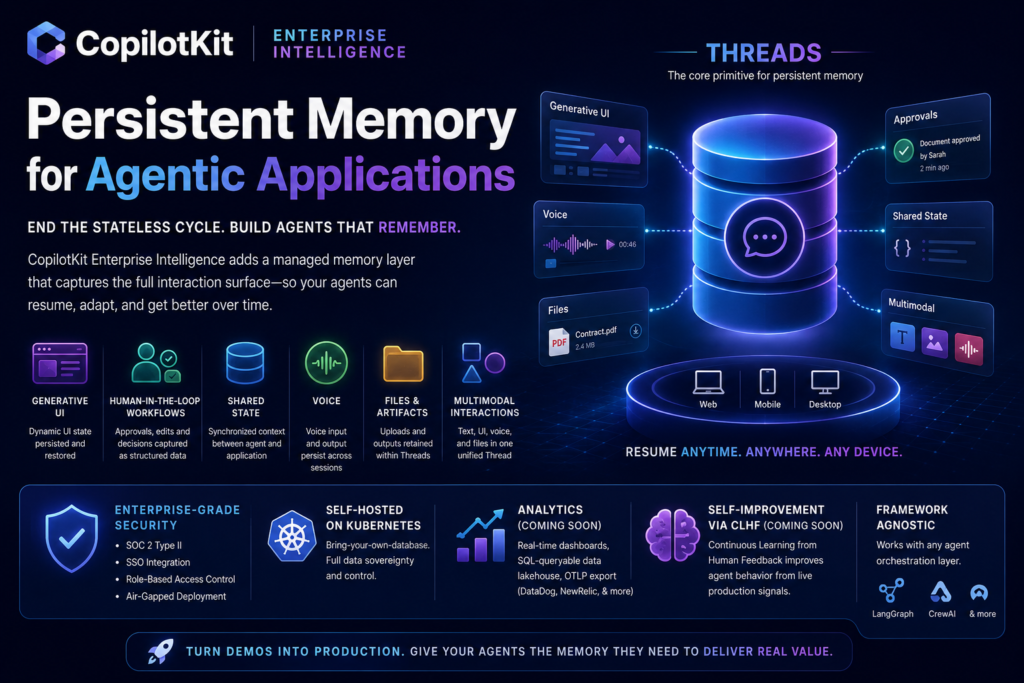
The central concept inside CopilotKit Intelligence is the Thread. Understanding what a Thread actually is — and what it is not — clarifies why this approach to persistent memory for agentic applications is architecturally meaningful.
A Thread is not a flat chat log. Storing an array of message strings in a database is trivially achievable; it is also deeply insufficient for agentic applications. What gets lost in that approach is everything that makes an agentic interaction different from a chat conversation: the dynamic UI components rendered by the agent, the approval decisions made by users mid-workflow, the shared state synchronization between the backend agent and the frontend application.
A Thread in CopilotKit Intelligence is a first-class, persistent session object that captures the full interaction surface of an agentic application across time.
What a Thread Captures
A single Thread preserves six categories of interaction state:
- Generative UI — dynamic UI components rendered by the agent at runtime are stored, not just the text prompts that triggered them. When a user resumes a session, the interface regenerates from the stored UI state, not from scratch.
- Human-in-the-loop workflows — approval steps, guided edits, and mid-workflow decisions made by one or more users are preserved as structured records within the interaction trace.
- Shared state — the synchronized data layer between the agent backend and the frontend application is captured, allowing both sides to resume from an identical shared context.
- Voice — both voice input and output persist across sessions, which is critical for agentic applications that support speech interfaces.
- Files — uploaded documents, generated artifacts, and output files are stored within the Thread rather than expiring when the session ends.
- Multimodal interactions — text, UI components, audio, and files coexist as a single structured object rather than being fragmented across separate storage systems.
The practical implication: a complex, long-running workflow — drafting a legal document, managing a multi-step data pipeline, coordinating approvals across a team — can be interrupted and resumed exactly where it left off, potentially by a different user on a different device. Threads are not static logs. They are resumable objects that the agent runtime reads from directly to restore continuity.
Stateless vs. Stateful Agents: A Direct Comparison
The difference between a stateless and a stateful agent is not just technical. It determines whether your agentic application is demo-ready or production-ready.
| Dimension | Stateless Agent (Default) | Stateful Agent with Persistent Memory |
|---|---|---|
| Session continuity | Resets on every new session | Resumes from last known state |
| Interaction history | Chat messages only, or none | Full trace: UI, voice, files, approvals |
| Multi-user workflows | Not supported | Multiple users can pick up the same Thread |
| Cross-device access | Not possible | State is device-agnostic |
| Generative UI persistence | UI components re-render from scratch | UI state is restored from Thread record |
| File and artifact retention | Lost on session end | Preserved within the Thread |
| Developer implementation cost | Custom storage layer required | Managed by CopilotKit Intelligence |
| Agent framework dependency | Varies | Framework-agnostic |
This comparison makes the value proposition of persistent memory for agentic applications concrete. Every row in the right column represents a production requirement that stateless agents simply cannot meet.
Enterprise-Grade Security and Deployment
Persistent memory for agentic applications in enterprise environments carries real security requirements. CopilotKit Intelligence ships with a compliance and deployment model designed for these constraints.
Deployment options:
- Self-hosted on Kubernetes — available now, with teams retaining full control over where data lives and how it is managed. Self-hosted deployments also support bring-your-own-database, preserving complete data sovereignty.
- Managed cloud — in development, for teams that prefer a fully hosted option without the overhead of infrastructure management.
Security features included at launch:
- SOC 2 Type II compliance
- Single sign-on (SSO) integration
- Role-based access control (RBAC)
- Air-gapped offline deployment support via license key validation
The air-gapped deployment option in particular addresses a real need for organizations in regulated industries or with strict data residency requirements — where the only acceptable deployment is one that never calls home.
What’s Coming: Analytics and Continuous Self-Improvement
CopilotKit Intelligence is launching with the Thread-based memory layer as its foundation, but the platform roadmap extends meaningfully into two additional capability areas.
Analytics and Insights
The Analytics layer will add real-time monitoring through dedicated dashboards and a SQL-queryable data lakehouse. OTLP (OpenTelemetry Protocol) support is included for integration with existing observability tooling — DataDog, NewRelic, and similar platforms. This means teams shipping agentic applications will be able to query production interaction data directly, understand where workflows break down, and measure how agents are being used without building a separate analytics pipeline.
Self-Improvement via CLHF
The more technically ambitious layer on the roadmap is Continuous Learning from Human Feedback (CLHF). The mechanism combines in-context reinforcement learning with prompt mutation to refine agent behavior directly from live production signals.
What makes this different from conventional fine-tuning is the feedback loop. Instead of collecting data, labeling it, and running an expensive training job, CLHF treats every user interaction as a direct learning event. Agent behavior adapts to production usage patterns — including per-user adaptation — without the latency and cost of traditional fine-tuning cycles.
For teams building persistent memory for agentic applications into production products, this means the agents don’t just remember past interactions. Over time, they get measurably better at handling them.
Who Should Use CopilotKit Intelligence?
If you’re building an agentic application that real users return to, this is the infrastructure question you need to answer before you ship.
The platform is most directly relevant to:
- Development teams shipping production agentic applications that involve multi-session workflows, returning users, or long-running processes. Any application where a user’s work needs to survive beyond a single session is a candidate.
- Enterprise AI teams building internal tools where compliance, access control, and data sovereignty are non-negotiable. The self-hosted Kubernetes deployment with RBAC and SOC 2 Type II is designed precisely for this audience.
- Teams already using CopilotKit’s open-source SDK who have hit the limitations of the stateless interaction model and need a managed solution rather than a hand-rolled one.
- Builders of multimodal agentic interfaces — applications that combine text, voice, file uploads, and dynamic UI — where the current approach of losing all non-text state at session end is a genuine product limitation.
It is worth noting that persistent memory for agentic applications is framework-agnostic in CopilotKit’s implementation. Any agent, regardless of the orchestration layer it runs on, can integrate with the Thread-based memory system. This matters because the enterprise AI landscape is fragmented; teams using LangGraph, CrewAI, or proprietary orchestration layers should not need to rebuild their agent runtime to gain session persistence.
The Bigger Picture: Memory as Infrastructure
There’s a useful analogy here. In the early days of web development, session management was something every team built from scratch — custom cookie handling, hand-rolled database schemas for user state, session ID generation and validation all written in-house. Eventually, managed session infrastructure became standard: frameworks handled it, hosting platforms handled it, and developers stopped thinking about it as a custom build.
Persistent memory for agentic applications is in the same early phase right now. The teams shipping agentic products in 2025 and 2026 are overwhelmingly building their own storage layers from scratch, because there has been no managed alternative. CopilotKit Enterprise Intelligence is a direct attempt to shift that. It argues that agent memory should be infrastructure — something you plug into, not something you architect and maintain.
Whether that argument lands depends on execution. The Thread primitive is well-designed: it captures the right categories of state and is structured as a resumable object rather than a flat log. The security model covers the table-stakes enterprise requirements. The roadmap into analytics and CLHF is ambitious but coherent — both capabilities are logical extensions of what persistent memory enables.
The platform’s timing is also notable. The gap between what agentic applications can demo and what they can actually ship to production has been a consistent friction point across the industry. A managed memory layer that eliminates a significant portion of the custom infrastructure work is a meaningful step toward closing that gap.
Key Takeaways
- The stateless agent problem is a production blocker. Most agentic applications reset entirely on each new session, requiring dev teams to build custom storage infrastructure before shipping any actual product logic.
- CopilotKit Enterprise Intelligence adds a managed memory layer on top of the open-source SDK — specifically, durable persistent memory for agentic applications without replacing or requiring changes to the underlying framework.
- Threads are the core primitive: first-class, persistent session objects that capture generative UI, human-in-the-loop decisions, shared state, voice, files, and multimodal interactions — not just chat messages.
- Deployment is self-hosted on Kubernetes today, with managed cloud in development. SOC 2 Type II, SSO, RBAC, and air-gapped support are included for enterprise requirements.
- The roadmap includes a SQL-queryable analytics layer with OTLP observability export and a Continuous Learning from Human Feedback (CLHF) system that improves agent behavior directly from production usage.
- Framework agnosticism means any agent — regardless of the orchestration layer — can integrate with CopilotKit Intelligence’s Thread-based memory system.
Frequently Asked Questions
What is persistent memory for agentic applications? Persistent memory for agentic applications refers to infrastructure that allows an AI agent to retain context, interaction history, and state across multiple user sessions and devices — rather than starting from zero each time a session begins.
Does CopilotKit Enterprise Intelligence replace the open-source SDK? No. It adds a managed infrastructure layer on top of the open-source CopilotKit SDK. The SDK handles the real-time interaction layer; the Enterprise Intelligence Platform handles session persistence and memory.
What is a Thread in CopilotKit Intelligence? A Thread is a first-class, persistent session object that captures the full interaction surface of an agentic application — including generative UI, human-in-the-loop workflows, shared state, voice, files, and multimodal interactions — making it resumable across sessions and devices.
Is CopilotKit Intelligence framework-agnostic? Yes. Any agent, regardless of the orchestration layer (LangGraph, CrewAI, or others), can integrate with the Thread-based persistent memory system.
What security certifications does CopilotKit Intelligence support? The platform ships with SOC 2 Type II compliance, SSO integration, role-based access control, and air-gapped offline deployment support.