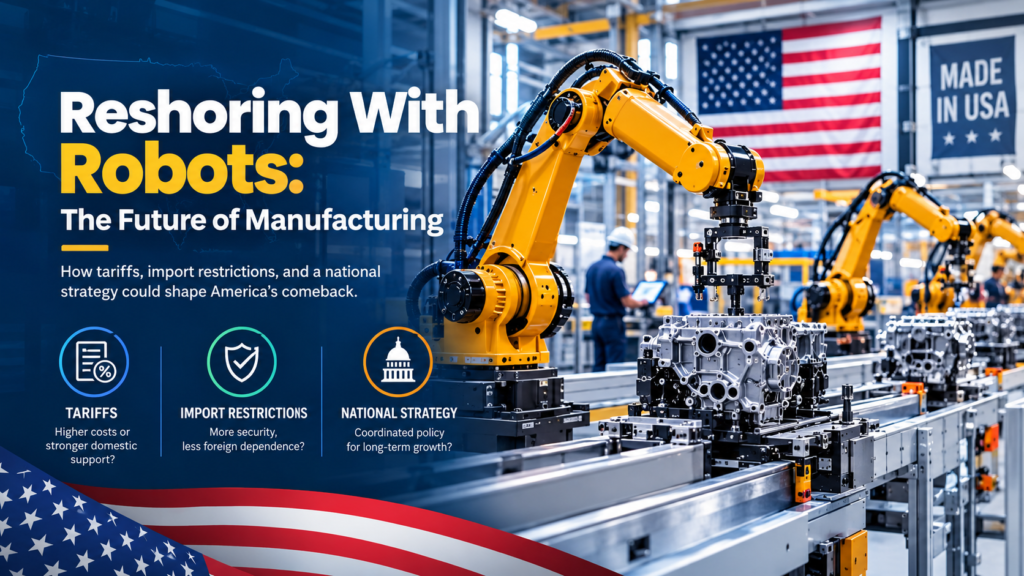
Reshoring with robots works technically, but whether it works economically depends on policy choices that U.S. industry has not yet agreed on. Tariffs, import restrictions, and a coordinated national strategy are the three main levers. Each carries real trade-offs for manufacturers, robot makers, and workers.
RoboBusiness 2026 will host a panel on Oct. 21 that examines reshoring with robots from a policy angle. It will cover tariffs, FCC import restrictions, and the case for a national robotics strategy. This analysis previews the debate so you can read it with context. It explains the stakes, compares the options, and flags the questions that matter most. robobusiness
What Is Reshoring With Robots?
Reshoring with robots is the practice of moving production back to the United States and using automation to offset the labor-cost gap that originally drove it offshore.
The idea is simple, but the details matter. Reshoring means returning manufacturing from overseas sites to domestic ones. Robots change the math by lowering the share of unit cost that comes from labor. A factory in a high-wage country can compete with a low-wage one if automation shrinks the difference.
In practice, reshoring with robots is a bundle of decisions, not one. A manufacturer must decide which processes to automate, which robots to buy, where to source them, and how to staff and train the people who run them. Policy shapes every one of those choices through costs, availability, and risk.
How It Differs From Simple Automation
Automating an existing U.S. plant is not the same as reshoring. Automation raises productivity at a site that already exists. Reshoring with robots also involves a location decision, often at a site that doesn’t exist yet. That makes it a capital-intensive, multi-year bet, and that is why policy certainty matters so much.
Why Reshoring With Robots Is Accelerating
Three forces are pushing manufacturers toward reshoring with robots: persistent labor gaps, improving robot economics, and geopolitical risk. None of these is new. What has changed is that they now point in the same direction.
Labor Constraints
Industry coverage has long described labor shortages as a brake on domestic production. Robotics trade reporting frames the labor shortage as something that must change before a serious increase in reshoring is possible. Robots help on two fronts. They fill roles that are hard to staff, and they let a smaller team produce more. robotics247
Improving Robot Economics
Robots have become cheaper and easier to deploy. Analysts argue that reshoring is increasingly viable as robots grow more affordable and flexible. Better sensors, friendlier programming interfaces, and vision-guided systems have cut the setup and changeover time that once made automation impractical for smaller production runs. vaneck
Business models matter too. Robotics pioneer Rodney Brooks has pointed to Robots-as-a-Service as a way for companies to scale automation incrementally and move gradually from manual labor to collaborative work. That lowers the upfront barrier for mid-sized plants. aiconference
Geopolitical and Supply Chain Risk
Tariffs, export controls, and national security concerns have made long overseas supply chains riskier. IDC’s analysis concludes that reshoring is real and accelerating. Notably, IDC also cautions that reshoring is not uniform across product categories. idc
Not All Robots Support Reshoring Equally
Robot type affects how well a reshoring project can work. Industry reporting notes that collaborative robots and autonomous mobile robots (AMRs) offer advantages for reshoring projects that traditional industrial robots do not. robotics247
- Traditional industrial robots (articulated arms, SCARA, parallel robots) excel at high-volume, repetitive work.
- Collaborative robots (cobots) suit smaller batches and work alongside people.
- AMRs move materials flexibly without fixed infrastructure.
This distinction matters for policy because rules aimed at one robot category can leave another untouched. That point becomes important when we reach the FCC rule.
The Central Paradox: Who Builds the Robots?
The core tension in reshoring with robots is that the machines needed to bring factories home are mostly built abroad. The panel’s own description notes that most industrial automation is made by foreign-owned companies, and that there is little consensus on how best to encourage reshoring. robobusiness
That produces a policy puzzle. If the goal is domestic production, should policy raise the cost of imported robots to favor domestic builders? Or does that raise the cost of automation for the very manufacturers trying to reshore? Both arguments are serious, and this is the real subject of the debate.
Definition and Expansion: Robotics Industrial Policy
Robotics industrial policy is government action intended to strengthen domestic robot design, component supply, and manufacturing capacity.
Expanding on that, such policy can take many forms, including tariffs, import restrictions, tax incentives, workforce funding, research support, and procurement preferences. A coherent approach combines several tools. A scattershot approach can work against itself. For example, a tariff that raises robot prices undercuts a tax credit meant to encourage robot adoption.
Policy Levers Compared
The table below summarizes the three levers likely to dominate the discussion. It is a simplified framework, not a verdict.
| Policy Lever | What It Does | Potential Upside | Main Risk |
|---|---|---|---|
| Robotics tariffs | Raise the price of imported robots and key components | Favor domestic robot makers; generate revenue | Raise automation costs for U.S. factories; may slow adoption |
| FCC import restrictions | Block new equipment authorizations for covered foreign-made robots | Address national security; push supply chain diversification | Narrow scope; limited effect on thin-margin consumer products |
| National robotics strategy | Coordinates funding, standards, workforce, and permitting | Aligns incentives across agencies and industry | Requires funding and political will; slow to produce results |
| Workforce and training programs | Build the skilled labor base to run automated plants | Makes automation investments productive | Long lead times; depends on local partnerships |
Lever One: Robotics Tariffs
Tariffs are the bluntest instrument. In October 2025, industrial robots and medical devices came under U.S. national security inquiries that could lead to tariffs. I’d check the current status of any resulting measures before relying on them, since trade policy changes quickly. robotics247
The industry’s main association pushed back. A3 urged the administration not to tariff countries whose robots and components are crucial to strengthening the American robotics industry, and to adopt a comprehensive national robotics strategy instead. The argument is that robotics tariffs could tax the capital equipment that reshoring with robots depends on. robotics247
Lever Two: The FCC Robot Import Ban
The FCC rule is narrower than a tariff but still significant. On July 28, 2026, the FCC added “advanced robotic devices” to its Covered List, blocking new equipment authorizations for foreign-made robots. idc
The definition is broad in one way and narrow in another. It covers foreign-made mobile robots above roughly 4.4 pounds that sense their surroundings, move along the ground, and connect wirelessly, which captures humanoids, quadrupeds, and robot vacuums alike. Based on that definition, fixed industrial arms appear to fall outside it, which limits its direct effect on factory automation. Check the FCC’s own text before drawing firm conclusions. idc
Two further points shape the debate. First, sources indicate the measure does not automatically pull already-sold or already-authorized hardware off the market, though the FCC can revoke prior authorizations case by case. Second, a MassRobotics survey found respondents evenly split between favorable and unfavorable views of the ban. ecosistemastartuptherobotreport
For reshoring with robots, the FCC rule is more of a security and supply chain measure than a manufacturing strategy. IDC argues that reshoring consumer robotics is unlikely given thin margins, and that the ban accelerates supply chain diversification already underway. That is a useful reminder that import restrictions do not by themselves create factories. idc
Lever Three: A National Robotics Strategy
The third lever is the one industry groups say they prefer. The Congressional Robotics Caucus has argued that a national robotics strategy is necessary to reshore manufacturing, and Rep. Jay Obernolte said, “We need a national strategy.” therobotreport
A national strategy would try to coordinate what separate policies cannot. A3’s Jeff Burnstein told The Robot Report that the caucus plans to explore with legislators, the administration, and industry whether such a strategy would need funding or a dedicated office. Legislation has also been proposed to create a National Commission on Robotics and restrict humanoid imports. therobotreporttherobotreport
The risk is vagueness. A strategy without budget, ownership, or deadlines can become a document rather than a program. The panel’s value will depend on whether participants get specific about what a strategy should contain.
Key Questions the Panel Needs to Answer
If you attend or follow the session, these are the questions that separate a useful debate from a generic one:
- What counts as success for reshoring with robots? Jobs created, output gained, share of automation made domestically, or resilience in a crisis? Each metric favors different policies.
- Which robot categories deserve protection or support? A rule that fits humanoids may not fit welding cells or palletizers.
- Can tariffs and incentives coexist? Raising import costs while subsidizing adoption pulls in opposite directions.
- Who builds the components? Reducing dependence on foreign robot makers matters less if key subsystems still come from abroad.
- Where will the skilled workforce come from? Technicians, integrators, and programmers are the bottleneck for any automated plant.
- How should small and midsize manufacturers be supported? The National Association of Manufacturers notes that most manufacturers are small and midsize businesses, and they have the least capacity to absorb policy shocks. therobotreport
Frequently Asked Questions
Does Reshoring With Robots Cost Jobs?
Not necessarily. Robots change the type of work more than the total amount. Reshoring creates domestic production jobs that did not exist while the work was offshore, but those jobs lean toward operating, maintaining, and programming equipment. The open question is whether training programs can supply enough people with those skills, which is why workforce policy is part of the debate.
Are Robotics Tariffs Good or Bad for Reshoring?
It depends on the goal. Tariffs can help domestic robot makers and signal commitment to local production. They also raise costs for factories that need to buy robots. Industry groups have largely argued that a coordinated national robotics strategy is a better tool than tariffs alone.
Does the FCC Robot Ban Help Reshore Manufacturing?
Only indirectly. The rule is framed around national security and covers a defined class of mobile robots. It may encourage domestic or diversified sourcing over time, but it does not directly fund factories, training, or component supply.
Is Reshoring With Robots Realistic for Small Manufacturers?
Increasingly, yes, but with caveats. Cobots, AMRs, and subscription models like Robots-as-a-Service lower the upfront barrier. Smaller firms still face constraints in capital, integration expertise, and staff, which is why support for small and midsize businesses is a recurring policy theme.
What Is a National Robotics Strategy?
A national robotics strategy is a coordinated federal plan that aligns funding, standards, workforce development, permitting, and trade policy around strengthening domestic robotics. Supporters say it prevents conflicting policies. Skeptics worry it could stay too abstract to change outcomes.
Practical Takeaways for Manufacturers
Policy is unsettled, so planning has to account for uncertainty. A few principles hold up regardless of how the debate resolves.
- Map your exposure. Identify which robots and components in your plan are foreign-made and how a tariff or import restriction would change their cost.
- Stress-test the business case. Before committing to reshoring with robots, model several scenarios for robot prices, lead times, and labor costs.
- Favor flexible automation. Cobots and AMRs can adapt to changing product mixes, which reduces the risk of locking into one design.
- Invest in people early. Technicians and integrators take time to train, and they are often the real constraint.
- Track official sources. Check the FCC Covered List and current trade actions directly, since details change quickly.
What This Means for Robot Makers and Investors
Foreign-owned robot makers face the clearest policy risk, but the picture is mixed. Restrictions can open space for domestic and allied suppliers. They can also disrupt supply chains and component sourcing that nearly every builder relies on.
For investors, the signal to watch is not any single rule. It is whether policy converges on a consistent framework. Fragmented measures create uncertainty, and uncertainty delays the multi-year capital commitments that reshoring with robots requires.
Bottom Line: Reshoring With Robots Needs Aligned Policy
The technology case for reshoring with robots is largely made. The unresolved piece is policy. Tariffs raise costs, the FCC rule addresses security rather than manufacturing capacity, and a national robotics strategy remains a proposal that still needs a budget and an owner.
The most useful outcome from the Oct. 21 panel would be specificity: clear definitions of success, honest accounting of trade-offs, and concrete commitments on workforce and components. Reshoring with robots will move forward either way, but aligned policy would make it faster, cheaper, and more durable. I’d watch for coverage of the session and update this analysis with what is actually said.