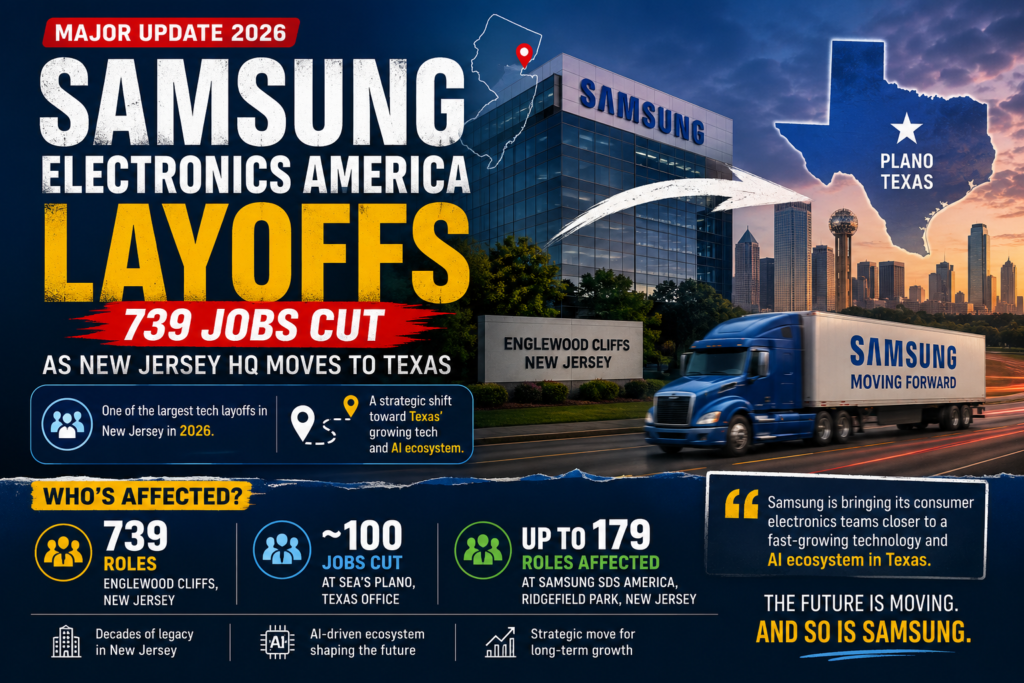
Samsung Electronics America is cutting 739 roles at its Englewood Cliffs, New Jersey headquarters as part of a broader plan to relocate its consumer electronics operations to Texas. The move, confirmed through a state WARN notice and a company statement to Reuters, marks one of the largest single tech layoffs in New Jersey so far in 2026.
If you’re trying to understand what happened, who’s affected, and what it means for the future of Samsung’s U.S. operations, this guide breaks down everything currently known — straight from regulatory filings, company statements, and on-the-record reporting.
What Happened — The Samsung Electronics America Layoffs Explained
The Samsung Electronics America layoffs became public after a Worker Adjustment and Retraining Notification (WARN) filing surfaced showing that 739 positions in Englewood Cliffs, New Jersey, would be affected. Samsung confirmed the filing in a statement, tying the cuts to its decision to relocate the headquarters of Samsung Electronics America (SEA) — the unit responsible for selling and marketing displays, smartphones, TVs, and home appliances in the United States — from New Jersey to Texas.
Importantly, SEA does not include Samsung’s semiconductor business, which remains a separate and, at the moment, extremely profitable division. This is a consumer electronics story, not a chips story.
Samsung was careful in its public language, describing the changes as a natural consequence of relocation rather than a traditional layoff. The company said the headquarters shift “may lead to changes in our workforce structure, such as employees who are unable to relocate, or certain functions that are optimized to ensure our roles align to key business priorities.” In practice, that means a mix of relocation offers, job eliminations, and organizational restructuring — the hallmarks of what’s now being called the Samsung Electronics America layoffs.
Quick Answer: How Many Jobs Are Affected?
- 739 roles flagged in the New Jersey WARN notice (Englewood Cliffs)
- About 100 additional jobs cut at SEA’s Plano, Texas office, including mobile division staff
- Up to 179 roles potentially affected at Samsung SDS America in Ridgefield Park, New Jersey — a separate, related relocation
Samsung’s New Jersey Legacy: A Brief History
Before diving deeper into the numbers, it’s worth understanding what New Jersey stands to lose. Samsung Electronics America has operated its consumer electronics headquarters out of Englewood Cliffs, Bergen County, for decades, becoming one of the most recognizable corporate names in the region. The company’s riverside campus, visible from Manhattan across the Hudson, has long symbolized New Jersey’s ability to attract and retain major international tech employers.
Local officials have repeatedly highlighted SEA’s presence as a source of stable, well-paying jobs and a magnet for ancillary business activity in Bergen County. That’s part of why the Samsung Electronics America layoffs have drawn attention well beyond typical corporate restructuring news — they represent the potential loss of a marquee regional employer, not just a routine staffing adjustment. With around 1,200 workers on-site prior to the announcement, the reduction of 739 roles touches the majority of the local workforce, even accounting for those who accept relocation offers. County and state economic development officials have not yet detailed what, if anything, might replace SEA’s footprint in Englewood Cliffs once the relocation is complete.
Why Is Samsung Moving Its Headquarters to Texas?
Samsung says the relocation is designed to bring its consumer electronics teams closer to a fast-growing technology and AI ecosystem. Texas has become a magnet for major corporate relocations and expansions in recent years, and Samsung’s move places it alongside other large companies that have shifted operations to the state.
The AI-Driven Ecosystem Argument
Samsung has framed the Texas move as a strategic bet on proximity to AI infrastructure and talent. This mirrors a broader industry pattern: as AI investment reshapes where tech companies want their teams physically located, headquarters relocations have become a visible side effect — and the Samsung Electronics America layoffs are one of the clearest recent examples of that trend colliding with existing workforces.
Following Tesla and Oracle to Texas
Samsung joins Tesla and Oracle among major companies that have relocated significant operations to Texas, largely citing lower taxes and a more business-friendly regulatory environment. For New Jersey, which has depended on Samsung’s presence in Bergen County for decades, the departure represents a meaningful loss of corporate anchor and local employment.
Breaking Down the Numbers — Who’s Affected
The Samsung Electronics America layoffs span multiple locations and, in the case of Samsung SDS America, a technically separate business entity. Here’s how the numbers break down.
New Jersey: 739 Roles in Englewood Cliffs
The core of the story is the 739 positions at SEA’s longtime Englewood Cliffs headquarters. According to a September press release from U.S. Representative Josh Gottheimer, whose district includes Englewood Cliffs, SEA employed roughly 1,200 workers in New Jersey — meaning the affected roles represent a substantial share of the local workforce. Samsung said a majority of those affected received relocation offers to Texas, while others were let go.
Texas: About 100 Jobs Cut in Plano
Even as Samsung shifts its headquarters toward Texas, the move hasn’t been painless for the state’s existing workforce. Roughly 100 employees at SEA’s Plano, Texas office — including staff in the mobile division — have reportedly been let go as roles are consolidated or restructured ahead of the relocation.
Samsung SDS America: A Separate but Related Move
Samsung’s IT services affiliate, Samsung SDS America, filed its own New Jersey WARN notice in June, flagging up to 179 roles at its Ridgefield Park location. Samsung says this is tied to relocating Samsung SDS’s North American headquarters and is unrelated to broader layoffs or restructuring — but the timing has understandably fueled comparisons to the SEA cuts.
What Is a WARN Notice, and Why Does It Matter?
A WARN notice — short for Worker Adjustment and Retraining Notification — is a filing required under federal and state law whenever a company with 100 or more employees plans a mass layoff or plant closure. The federal WARN Act requires at least 60 days’ advance notice, giving affected workers time to seek new employment, retraining, or benefits before job losses take effect.
Why it matters here: This particular round of cuts came to light specifically because of this legal disclosure requirement — not through a company press release or earnings call. That’s a common pattern in 2026’s tech layoff cycle, where WARN filings frequently reveal workforce reductions before companies publicly confirm them.
How WARN Notices Typically Work
- Coverage threshold: Employers with 100 or more full-time employees are generally required to file.
- Advance notice: At least 60 calendar days must pass between the notice and the effective layoff date in most cases.
- State-level variations: New Jersey has its own WARN Act provisions that can impose additional requirements beyond the federal standard, including severance obligations in some circumstances.
- Public record: Once filed, WARN notices typically become part of a state’s public labor records, which is how journalists and researchers — and, in this case, Reuters — often first identify major layoffs before companies confirm them directly.
- Trigger events: Common triggers include plant closures, mass layoffs, and, as with Samsung’s New Jersey workforce reduction, headquarters relocations that leave employees unable or unwilling to relocate.
Because WARN filings are procedural and legally mandated, they don’t always tell the full story. In Samsung’s case, follow-up reporting — including a company statement to Reuters and LinkedIn posts from affected employees — filled in critical context that the filing alone didn’t provide, such as the Texas relocation plan and the mix of relocation offers versus outright terminations.
Samsung Electronics America Layoffs vs. Other 2026 New Jersey Layoffs
To put the scale of Samsung’s cuts in context, here’s how they compare to other major New Jersey WARN filings from the same period.
| Company | Location | Jobs Affected | Stated Reason |
|---|---|---|---|
| Samsung Electronics America | Englewood Cliffs, NJ | 739 | HQ relocation to Texas |
| Verizon | Basking Ridge, NJ | 1,319 | Workforce restructuring |
| Samsung SDS America | Ridgefield Park, NJ | Up to 179 | Regional HQ relocation |
| Target | Multiple NJ counties | 107 | Store/operations reduction |
| Walmart | Hoboken, NJ | 100 | Facility closure |
While Verizon’s cuts are larger in raw headcount, the Samsung Electronics America layoffs stand out because they involve the near-total departure of a major corporate headquarters from the state — not just a workforce trim within an existing footprint.
What Happens Next for Affected Employees?
For workers caught up in the Samsung Electronics America layoffs, the practical next steps generally follow a predictable pattern based on WARN Act protections and Samsung’s public statements:
- Relocation offers: Samsung says a majority of affected New Jersey employees received offers to relocate to the new Texas headquarters.
- 60-day notice period: Under the WARN Act, affected employees are entitled to advance notice before separation takes effect, giving time to plan next steps.
- Severance details pending: As of this writing, Samsung has not publicly detailed severance packages, exact effective dates, or which specific departments are most affected.
- State unemployment resources: New Jersey’s Department of Labor maintains resources and rapid-response services for workers affected by mass layoffs and WARN filings.
- Internal transfers: Some employees may be offered lateral moves into other Samsung divisions, such as the semiconductor business, which is not affected by this particular filing.
- Job search support: Large-scale WARN filings often trigger rapid-response programs coordinated between the state labor department and the employer, connecting affected workers with job fairs, résumé assistance, and referrals to open positions at other regional employers.
- Health coverage considerations: Employees separated from a company typically retain the option to continue employer-sponsored health coverage temporarily through COBRA, though eligibility and cost details depend on individual circumstances and should be confirmed directly with HR.
The Bigger Picture — Samsung’s Financial Context
This round of job cuts is unfolding at an unusual moment for the parent company. Samsung has flagged that it expects a roughly 19-fold jump in second-quarter profit, driven largely by surging AI-related chip demand. The company also announced plans last month to invest hundreds of billions of dollars in new chip manufacturing facilities.
That contrast is worth noting: Samsung’s semiconductor division is booming on the back of AI infrastructure spending, while its consumer electronics arm — phones, TVs, displays, and appliances — is undergoing a headquarters relocation and workforce reduction. This split reflects a broader trend across the tech sector, where AI-driven divisions are expanding rapidly even as traditional hardware and consumer-facing units face cost pressure and restructuring.
The 2026 Tech Layoff Landscape
Samsung isn’t operating in isolation. New Jersey alone has seen a wave of mass layoffs in 2026, with more than 1,300 workers cut in a single week earlier this year across companies including Verizon, Target, Walmart, and Eddie Bauer. Nationally, the tech and consumer electronics sectors have continued a pattern of restructuring that started well before 2026, driven by a mix of cost discipline, automation, and a strategic pivot toward AI-related investment.
Several patterns tie these events together:
- Consumer electronics under pressure: Hardware-focused divisions across the industry have faced slower growth than AI and cloud infrastructure businesses, prompting many companies to consolidate operations.
- Geographic consolidation: Companies increasingly favor states like Texas that offer lower corporate tax burdens and proximity to expanding tech hubs.
- AI investment offsetting hardware cuts: Even as consumer-facing divisions shrink, companies are funneling capital into AI infrastructure, chip production, and data centers — a dynamic clearly visible in Samsung’s own results.
- WARN filings as an early warning system: As seen with Samsung, regulatory filings are increasingly the first public signal of major restructuring, often preceding formal company announcements by days or weeks.
Understanding the Samsung Electronics America layoffs in this broader context helps explain why a company posting record profits can still be cutting hundreds of jobs at the same time — the growth and the contraction are happening in different parts of the business.
For investors and industry watchers, the split reinforces a theme that has defined much of 2026’s tech sector: capital and headcount are flowing toward AI infrastructure and semiconductor production, while legacy consumer hardware divisions are being trimmed, consolidated, or relocated to lower-cost regions. Samsung’s own quarterly guidance illustrates the point clearly — chip demand tied to AI data centers is driving the bulk of projected profit growth, even as the company simultaneously restructures the teams responsible for selling phones, TVs, and appliances to everyday consumers.
Frequently Asked Questions
How many jobs is Samsung Electronics America cutting? The New Jersey WARN notice lists 739 affected roles in Englewood Cliffs, with an additional roughly 100 jobs cut at the Plano, Texas office.
Is this related to Samsung’s semiconductor business? No. Samsung Electronics America’s consumer electronics division — which handles phones, TVs, displays, and appliances — is separate from Samsung’s semiconductor operations, which are not affected by this filing.
Why is Samsung relocating its headquarters to Texas? Samsung says the move is intended to position its consumer electronics teams closer to a growing AI-driven technology ecosystem, following a pattern set by companies like Tesla and Oracle.
Will affected employees be able to keep their jobs? Samsung says a majority of employees affected by the New Jersey filing received relocation offers to Texas, though some employees have already been let go.
Is Samsung SDS America’s layoff connected to this one? Samsung says the Samsung SDS America filing, which could affect up to 179 roles in Ridgefield Park, is a separate relocation of its North American headquarters and is unrelated to the SEA restructuring.
When will the layoffs take effect? Samsung has not publicly disclosed a precise effective date. Under standard WARN Act rules, affected employees are generally entitled to at least 60 days’ notice before separation, though exact timelines can vary by state and filing.
Does this affect Samsung’s semiconductor manufacturing plans? No. Samsung has separately announced plans to invest hundreds of billions of dollars in new chip plants, and that investment is tied to its semiconductor division, which operates independently from SEA’s consumer electronics business.
Conclusion
The Samsung Electronics America layoffs highlight how a single corporate relocation decision can ripple across states, business units, and thousands of employees’ lives. With 739 roles affected in New Jersey, roughly 100 more in Texas, and a related filing from Samsung SDS America, the full scope of Samsung’s U.S. consumer electronics restructuring is still coming into focus. As more details emerge about severance, timelines, and department-level impacts, one thing is already clear: Samsung’s shift toward Texas marks the end of an era for its longtime New Jersey headquarters.