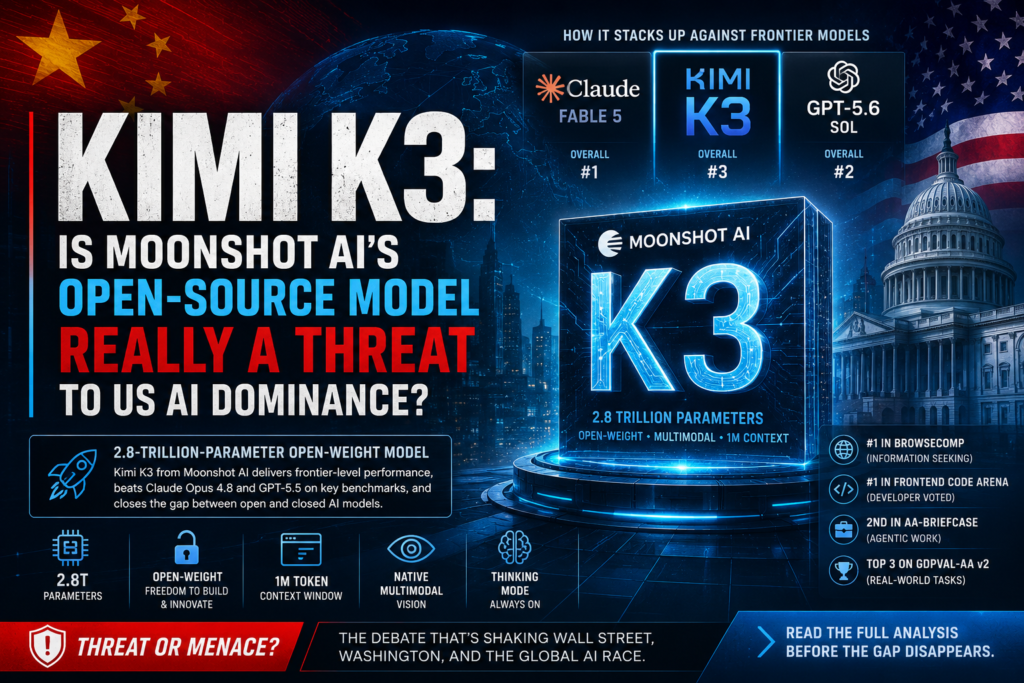
Kimi K3 is not a hypothetical threat — it’s a 2.8-trillion-parameter open-source model from China’s Moonshot AI that already beats Claude Opus 4.8 and GPT-5.5 on several benchmarks, while trailing only Claude Fable 5 and GPT-5.6 Sol overall. Its release on July 16, 2026, rattled Wall Street, reignited the “China AI race” debate in Washington, and forced a blunt question onto every policy desk and product roadmap: is an open-weight model this capable a national security risk, a competitive gift to developers, or both at once?
This guide breaks down what the model actually is, how it stacks up against frontier systems like Claude Fable 5 and GPT-5.6 Sol, why its launch triggered a stock selloff, and what the “threat or menace” debate among figures like David Sacks, Travis Kalanick, and Dean Ball actually means for businesses building on AI today.
What Is Kimi K3?
Kimi K3 is the newest flagship large language model from Moonshot AI, a Beijing-based startup backed by Alibaba. Released on July 16, 2026, it is described by its own maker as the world’s first open 3-trillion-class system and the largest open-weight AI model released to date, with roughly 2.8 trillion total parameters.
Definition: What “Open-Weight” Actually Means
An open-weight AI model is one whose trained parameters are published publicly, letting any developer download, self-host, fine-tune, or modify the system without paying per-token API fees to the original creator. This is different from fully “open source,” which would also require releasing training code and data. The model falls into the open-weight category: Moonshot is publishing the finished model, not the full recipe used to build it.
That distinction matters for the “threat” debate, because open weights mean the capability is portable — once downloaded, it cannot be revoked, rate-limited, or monitored the way an API-based model can.
Core Technical Specs
The parameter count matters less on its own than what it enables. It activates only a small fraction of its total parameters per query — reportedly around 16 of 896 available experts, or about 1.8% of the full pool — through a mixture-of-experts architecture. This keeps inference costs manageable even at massive scale. The model also ships with:
- A 1-million-token context window, enough to process entire codebases or book-length documents in a single pass
- Native multimodal vision, meaning it can read images, screenshots, and diagrams directly
- An always-on “thinking mode” for extended reasoning
- Two custom architectural components, Kimi Delta Attention and Attention Residuals, aimed at long-horizon coding and agentic workflows
Full weights were scheduled for public release on July 27, 2026, roughly ten days after the initial announcement, giving developers worldwide direct access to modify and self-host the system.
Moonshot AI Open-weight AI model China AI model GPT vs Kimi K3
How It Compares to Other Chinese Open Models
This release didn’t emerge in a vacuum. At 2.8 trillion parameters, it’s roughly 75% larger than DeepSeek’s V4 Pro (1.6 trillion parameters) and dwarfs Zhipu AI’s GLM 5 series (744 billion parameters), making it the largest open-source model released by any Chinese lab so far. For a company that had lost significant market share to DeepSeek over the previous eighteen months, this launch represents a genuine comeback moment for Moonshot AI.
How Does It Compare to Frontier Models Like Claude and GPT?
Moonshot AI itself was candid that its new flagship “still trails the most powerful proprietary models,” referring specifically to Claude Fable 5 and GPT-5.6 Sol. But trailing the absolute leaders and being irrelevant are very different things — and the benchmark data shows this release is closer to the frontier than any open-weight model before it.
| Benchmark | Result | How It Compares |
|---|---|---|
| GDPval-AA v2 (real-world tasks, 44 occupations) | Scored 1,687 | 3rd place — behind Claude Fable 5 Max (1,815) and GPT-5.6 Sol Max (1,747.8), ahead of Claude Opus 4.8 (1,600) |
| AA-Briefcase (long-horizon agentic work) | Scored 1,527 | 2nd place overall |
| BrowseComp (long-horizon information seeking) | 91.2 / 100 | State-of-the-art result; ranked #1 |
| Frontend Code Arena (blind developer voting) | 1,679 points | #1 overall, surpassing Claude Fable 5 — a 17-place jump from the prior Kimi K2.6 release |
| Real-world task automation (8-benchmark suite) | 1st in 4 of 8 | Includes Automation Bench and SpreadsheetBench 2 |
| Terminal-Bench 2.1 | Within 0.5 points of GPT-5.6 Sol | Effectively tied for the top spot |
The pattern across nearly every independent evaluation is consistent: the model rarely wins outright against the very best closed systems, but it wins often enough — and loses narrowly enough — that the six-month gap between open and closed models, long assumed to be a fixed law of the AI industry, has nearly closed. Independent analyses from Arena.ai and Vals AI reached a similar conclusion, characterizing Kimi K3 as competitive with flagship frontier systems rather than a step behind them.
Where the Model Falls Short
To be clear-eyed about the comparison, there are weaker spots. It trails noticeably on DeepSWE and FrontierSWE, two benchmarks where Claude Fable 5 and GPT-5.6 Sol maintain a clearer lead. Moonshot has also flagged that its web search capability is currently unstable and explicitly advised against relying on it for now. In other words, this is best understood as frontier-competitive in specific domains — coding, agentic workflows, front-end development, long-context tasks — rather than a universal replacement for every closed model on the market.
Why Did the Release Cause a Wall Street Selloff?
Kimi K3’s release triggered a roughly 1% drop in the Nasdaq, as investors sold off chip stocks like Nvidia on fears that a cheaper open-source alternative could reduce demand for premium AI compute. The timing amplified the reaction: Moonshot’s announcement landed just before Chinese President Xi Jinping addressed the World AI Conference in Shanghai, framing AI progress as a matter of national capability.
This is not the first time this exact pattern has played out. When Chinese lab DeepSeek released its open-source R1 model in January 2025, it produced a nearly identical wave of market anxiety and industry soul-searching about whether US AI labs’ capital-intensive approach could be undercut by cheaper, openly available Chinese alternatives. What’s different this time is the surrounding context: an ongoing US-China tariff dispute, government scrutiny of Anthropic’s national-security warnings, and multiple frontier labs preparing IPOs — all of which raised the stakes for how this release would be interpreted in Washington.
Threat or Menace? The Washington Debate
The reaction split along familiar but increasingly heated lines. Four voices in particular capture the spectrum of opinion.
David Sacks: Regulation, Not China, Is the Real Risk
David Sacks, the Trump administration’s former AI czar and current co-chair of the President’s Council of Advisors on Science and Technology, used the model’s performance to criticize domestic AI policy. He argued that American regulators are hampering competitiveness by restricting new data centers and layering on state rules, framing it as a path toward losing the broader AI race. Sacks also used the moment to criticize Anthropic’s models directly, a jab that reflects the increasingly personal tone of the US AI policy debate.
Travis Kalanick: The Distillation Fairness Argument
Former Uber CEO Travis Kalanick raised a different concern: that Chinese labs are “distilling” — training their models on the outputs of — American systems to accelerate development. His argument was one of reciprocity: if distillation isn’t going to be restricted, it should be allowed in both directions rather than leaving US labs at a disadvantage. It’s worth noting the irony here, since American coding tools have also been built on top of Chinese models, including one built directly on an earlier version of Moonshot’s own architecture.
Dean Ball: The “Full AI Communism” Warning
Perhaps the most striking reaction came from OpenAI’s head of strategic futures, Dean Ball. He credited the new model as genuinely strong, with performance that likely can’t be dismissed as mere distillation, while expressing surprise that Chinese authorities continue to permit open-sourcing of models this capable. Ball’s core warning was structural rather than technical: he suggested that a world dominated by open-weight models could trend toward what he called “full AI communism” — a future where advanced AI is treated as state-provided public infrastructure rather than a commercial product. He went further, predicting that US regulators will eventually manufacture regulatory uncertainty around Chinese open-weight models through soft-law warnings and advisory bulletins, rather than an outright ban, specifically to discourage enterprise adoption.
Shakeel Hashim: The Case Against Panic
Not everyone agreed the reaction was proportionate. Shakeel Hashim, editor of the AI-focused publication Transformer, argued the alarm is largely overblown. His reasoning rests on two points: the model likely lacks dangerous cyber capabilities, and China’s government will eventually face the same incentives Western governments do to restrict open models once they become capable enough to pose real risks.
Is Kimi K3 Actually a National Security Threat?
No public evidence currently shows this model possesses dangerous cyber or bioweapons capabilities beyond existing frontier systems — the “threat” framing right now is more about economic and geopolitical competition than a demonstrated safety failure. The concern raised by critics is less about what the model can do today and more about the trajectory: an open-weight Chinese model that is frontier-competitive today could plausibly be frontier-leading within a few release cycles, at which point questions about misuse, export control evasion, and state-directed AI development become far more urgent.
This distinction matters for anyone trying to make sense of the debate. Kalanick’s and Sacks’s concerns are largely about competitive fairness and domestic regulatory drag. Ball’s concern is structural and philosophical — about what an open-weight-dominant world looks like in five years, not what a single chatbot release does today. Hashim’s rebuttal targets the immediate capability claims specifically, not the longer-term structural argument.
What This Means for Businesses and Developers
Setting the geopolitics aside, this release has immediate, practical implications for anyone building AI-powered products.
- Lower-cost frontier-adjacent performance. With API pricing around $3 per million input tokens and $15 per million output tokens (and cheaper cache-hit rates as low as $0.30), it undercuts many proprietary frontier models while remaining competitive on coding and agentic benchmarks.
- A genuinely useful open-weight option for self-hosting. Once full weights are released, enterprises with strict data residency or compliance requirements can run the model on their own infrastructure rather than depending on a third-party API.
- Strong front-end and coding performance. The #1 ranking on the Frontend Code Arena, ahead of Claude Fable 5, makes it a serious option for teams building UI-heavy applications or automated coding agents.
- Caution warranted on web search and safety review. Given Moonshot’s own warning about unstable web search functionality, and the unresolved questions raised in the “full AI communism” debate, enterprises should treat this like any new frontier-adjacent model: pilot it, red-team it, and evaluate it against your specific compliance requirements before wide deployment.
- Expect regulatory attention. Dean Ball’s prediction — that US regulators will use soft-law warnings rather than outright bans to discourage adoption of Chinese open-weight models — suggests procurement and compliance teams should watch for advisory guidance from federal agencies in the coming months.
A Quick Note on Moonshot AI’s Trajectory
It’s worth remembering that Moonshot AI was, until recently, viewed as a fading player in China’s crowded AI field, having ceded ground to DeepSeek since early 2025. This release reverses that narrative almost overnight. For enterprise buyers, that volatility is itself a data point: the competitive ranking among Chinese labs can shift dramatically within a single product cycle, which argues for evaluating capabilities release-by-release rather than betting long-term on any one lab’s positioning.
Moonshot also operates a consumer-facing chat assistant called Kimi, which has built a substantial user base inside China and, increasingly, abroad. The new flagship model powers that consumer app in addition to being available through developer APIs, which means the release isn’t just a benchmark story — it’s also an immediate upgrade for millions of existing daily users. Early community testing suggests the model can generate playable multiplayer and 3D experiences from a single prompt inside the app, a capability that goes beyond typical text and code generation and hints at where Moonshot intends to differentiate going forward.
The Bigger Pattern: Open-Source Releases as Geopolitical Strategy
Zoom out, and this release fits a broader pattern that has repeated at least three times now in less than eighteen months: a Chinese lab releases an open-weight model that closes the gap with US frontier systems, US markets react with a sell-off in AI infrastructure stocks, and Washington policy figures split between “this proves we need to deregulate” and “this proves we need new safeguards.” DeepSeek’s R1 release set the template in January 2025. Subsequent releases from Zhipu AI’s GLM line and Moonshot’s own earlier model versions kept the pattern going. What makes the current moment different is scale: at 2.8 trillion parameters and genuinely frontier-adjacent benchmark scores, this is the closest an openly downloadable model has come to matching the very best proprietary systems available anywhere in the world.
That pattern matters for how businesses should think about planning around future Chinese open-weight releases. Rather than treating each new model as an isolated event, it’s more useful to treat the underlying trend — steadily narrowing capability gaps between open and closed systems — as the durable signal, and individual benchmark scores as noisy data points along that trend line.
Frequently Asked Questions About Kimi K3
What is Kimi K3? It’s a 2.8-trillion-parameter open-source large language model released by Moonshot AI on July 16, 2026. It is designed for long-horizon coding, agentic workflows, and knowledge work, and is currently the largest open-weight AI model publicly released.
Is Kimi K3 better than Claude or GPT-5.6 Sol? Not overall. It trails Claude Fable 5 and GPT-5.6 Sol on most comprehensive benchmarks, but it outperforms both on specific tasks like front-end code generation and long-horizon information retrieval, and it beats Claude Opus 4.8 and GPT-5.5 across most coding and agentic tests.
When will the full model weights be available? Moonshot AI scheduled the full weight release for July 27, 2026, roughly ten days after the initial announcement.
Why did Kimi K3 cause a stock market reaction? Its strong benchmark performance, combined with open-source availability, raised investor concerns about reduced demand for premium AI compute and chips, contributing to a roughly 1% Nasdaq decline as chip stocks like Nvidia sold off.
Does it pose a national security threat? There is currently no public evidence of dangerous cyber capabilities beyond existing models. The security debate centers more on the long-term trajectory of Chinese open-weight AI development than on demonstrated risks in the current release.
Can I self-host it? Yes, once full weights are released on July 27, 2026, the open-weight license allows any developer to download, self-host, and fine-tune the model, subject to Moonshot’s published usage terms.
The Bottom Line
This model is neither the harmless open-source curiosity some dismiss it as, nor the imminent catastrophe others frame it to be. It’s a genuinely frontier-competitive open-weight model that narrows — without fully closing — the gap between Chinese and American AI development. The more consequential question isn’t really about this single release; it’s about what happens when the next open-weight model closes that remaining gap entirely, and whether policy, procurement, and public opinion will be ready for it.
For now, the practical takeaway is straightforward: evaluate Kimi K3 on its technical merits for your specific use case, watch the regulatory environment as it develops, and treat the “threat or menace” debate as an early signal of a conversation that is only going to get louder.