Physicl-ର ୧୦ ନିୟୁତ ଡଲାରର ‘ସିଡ୍ ରାଉଣ୍ଡ’ (ପ୍ରାରମ୍ଭିକ ପାଣ୍ଠି ସଂଗ୍ରହ) ଏବଂ ‘ସିମ୍-ଟୁ-ରିଆଲ୍ ଗ୍ୟାପ୍’ (Sim-to-Real Gap): ରୋବଟ୍ ପ୍ରଶିକ୍ଷଣ ପାଇଁ ଏହାର ଅର୍ଥ କ’ଣ?
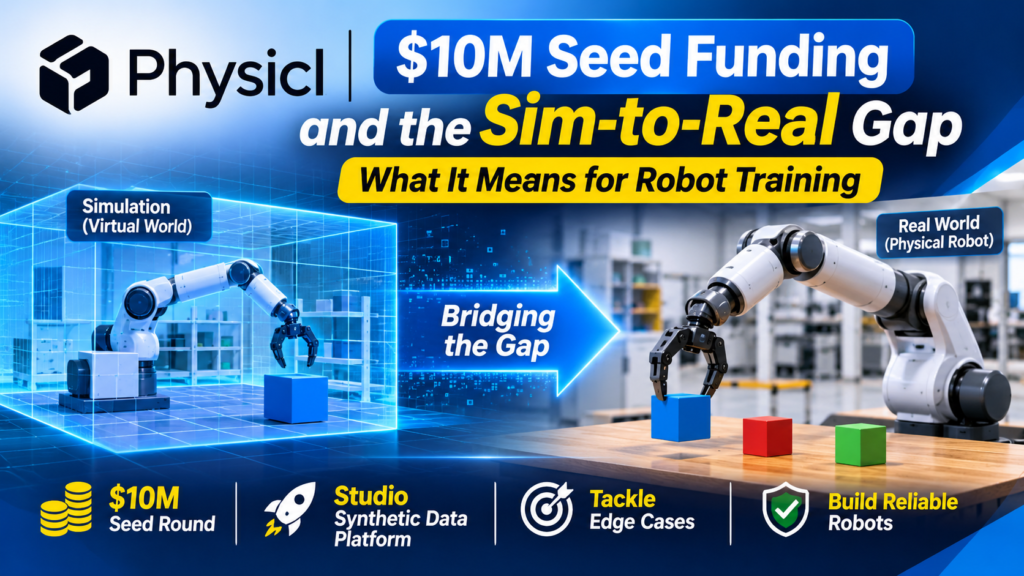
Physicl raised 10 million dollars in seed funding to help robots close the sim-to-real gap, the drop in performance a machine suffers when it moves from a simulated training world into the real one. The round was led by Inovia Capital, with participation from US Venture Partners, and it launched alongside Studio, the company’s first application for generating synthetic training data for physical AI. unite
Here is why this matters beyond one funding announcement. Language models learned from the internet. Robots have no equivalent corpus, so the teams building them are short on the rare, failure-prone examples that decide whether a machine is safe to deploy. Whoever supplies realistic, controllable training data shapes how fast physical AI leaves the lab.
This guide covers what Physicl announced, how the sim-to-real gap works, how Studio fits in, and what robotics and AI teams should do with the news. Each section stands on its own, so you can jump straight to the question you care about.
Quick Answer: What Did Physicl Announce?
Physicl announced a 10 million dollar seed round and the launch of Studio on November 6, 2026. The Paris-based startup builds synthetic training data infrastructure for physical AI. No valuation was disclosed. citybizfourweekmba
Key Facts at a Glance
- Round: 10 million dollar seed
- Lead investor: Inovia Capital, with US Venture Partners participating
- Product: Studio, which ships with 10,000 3D environments and 100,000 object assets mezha
- Founder: Alex de Vigan, formerly CEO of nfinite hyper
- Early customer: SpAItial, a world model builder
- Offices: Paris and the San Francisco Bay Area unite
- Focus: post-training models on difficult edge cases mezha
What Is the Sim-to-Real Gap?
The sim-to-real gap is the difference between how an AI model performs in a simulated environment and how it performs on real hardware in the real world. A robot policy can look flawless in simulation and still fail on a factory floor because the simulation got something subtly wrong.
Every robotics team eventually runs into the sim-to-real gap. Simulation is attractive because it is cheap, fast, and safe. You can run thousands of trials in parallel, crash virtual robots without cost, and generate scenarios that would be dangerous or rare in real life. The catch is that a simulation is only as useful as it is faithful. When it is not faithful, the model learns habits that do not transfer.
Why Do Simulations Fail Robots?
Simulations fail robots when their digital worlds differ from reality in ways the model can exploit or stumble on. The usual culprits include:
- Geometry errors: objects that are slightly the wrong size or shape
- Material mismatches: surfaces with the wrong friction, reflectivity, or deformability
- Lighting and sensor differences: cameras and depth sensors that see the virtual world differently from the real one
- Physics shortcuts: contact, collision, and fluid behavior simplified to keep the simulation fast
- Missing variety: too few unusual layouts, clutter patterns, or object types
Each of these is small on its own. Together they add up to a model that is confident in simulation and brittle in practice.
Why Does the Sim-to-Real Gap Matter to Businesses?
It matters because it sets the cost and the timeline of getting a robot into production. A wide sim-to-real gap forces teams back to physical testing, which is slow and expensive. They end up collecting real-world demonstrations, often through remote operation by human pilots, and then discovering new failure modes only after deployment.
A narrow gap does the opposite. It lets teams trust simulation results, find problems earlier, and spend scarce real-world testing time on the cases that truly need it. For any company building warehouse, home, or industrial robots, shrinking that gap is a direct lever on speed to market.
Why Does Physical AI Have a Data Problem?
Physical AI has a data problem because nothing like the internet exists for the physical world. Physicl argues that physical AI lacks a training corpus comparable to the internet text behind language models or the huge volumes of captioned photos behind image models, which leaves teams short of examples for the failures that can block deployment. unite
The Missing Corpus
A large language model can learn from trillions of words that people already wrote. A robot needs something different: examples of objects, spaces, forces, and consequences, paired with the actions that worked. That data does not sit on the public web. It has to be captured with sensors, produced by human operators, or generated in simulation.
This scarcity is why the field is investing in synthetic data for robots. If real-world collection is slow and costly, generating realistic scenes programmatically becomes the obvious alternative, provided the generated data is accurate enough to trust.
The Edge-Case Problem
Averages are not what stop a robot from shipping. Edge cases are. A gripper that works on 99 percent of objects still fails on the oddly shaped, shiny, or transparent one that shows up on day three. A navigation system that handles ordinary hallways still has to cope with the cluttered one with the glare from a window.
Edge cases are rare by definition, so real-world data collection rarely captures enough of them. That is the gap Physicl is targeting. As described in coverage of the announcement, its plan is to focus on post-training models for difficult edge cases. mezha
Who Is Behind Physicl?
Physicl was founded by Alex de Vigan, who spent roughly a decade running nfinite. That company helped brands and retailers build 3D models of their products for online stores. When generative AI changed what e-commerce imagery needed, de Vigan saw that the same 3D pipeline could serve a different customer: AI systems that need to understand and manipulate physical space. mezha
From Product Renders to Robot Training
The origin story is useful context. A pipeline built to make products look convincing on a shopping page already has to get geometry, materials, and lighting right, because shoppers notice when something looks fake. That same discipline is what a robot training environment needs, only with physics attached.
Physicl says its technology builds on six years of development in 3D infrastructure, simulation, and machine learning, and it reports working with organizations including AWS, NVIDIA, and the Technical University of Munich. The company first appeared publicly in March 2026, when it presented at NVIDIA GTC as a data infrastructure layer for physical AI. citybiz
What Is Studio and How Does It Work?
Studio is Physicl’s first application, a tool for creating 3D scenes that teams can use to generate training data for robots and world models. It is the product that turns the company’s underlying pipeline into something developers can use directly.
Environments and Assets
Studio launches with 10,000 3D environments and 100,000 assets representing different objects. In practice, that gives a team a library to start from instead of building every scene by hand. Coverage of the launch also noted that Studio is in a free beta. mezhascommerce
Controlled Edge Cases
The more important feature is control. Unite.AI described a four-step workflow in which Studio generates controlled edge cases. The idea is that instead of waiting for a rare failure to appear in the real world, a team can request the kind of scenario that breaks its model, generate many variations, and train against them. unite
TechCrunch’s reporting captured the ambition. De Vigan imagines customers feeding trillions of images or millions of hours of LIDAR capture into the platform to turn them into high-quality 3D representations that can generate billions of permutations for model training. TechCrunch
How Does Physicl Try to Close the Sim-to-Real Gap?
Question: How does Physicl try to close the sim-to-real gap?
Direct answer: Physicl tries to narrow the sim-to-real gap by turning incomplete real-world information into physically accurate digital environments, then letting teams generate many controlled variations of the hard cases their models fail on.
Three Moves in the Strategy
- Start from reality. The goal is to transform incomplete real-world information into digital environments with correct geometry, materials, and physics. The closer the starting scene is to the real thing, the less the model has to unlearn. hyper
- Multiply the hard cases. Edge cases are scarce in the real world but cheap to vary in a generated scene. One awkward object can become thousands of awkward objects under different lighting and placement.
- Make it ongoing. Physicl wants to be more than a data provider and sees itself as tooling for continuous synthetic data generation. That framing matters, because a one-off dataset ages quickly while a repeatable workflow keeps up with new failures. TechCrunch
Physicl’s bet is that the sim-to-real gap shrinks when simulation data is both realistic and responsive to what the model gets wrong.
Early Customer: SpAItial and Echo-3
A real customer example shows what this looks like outside a press release. SpAItial, a world model builder, collaborated with Physicl as an early customer to improve the fidelity of its products, the latest of which, Echo-3, was released the week before the announcement. TechCrunch
What a World Model Needs
World models learn how environments behave so that an AI system can reason about space and consequences. SpAItial’s tool generates 3D simulations from 2D imagery, which is why its founder said it needed high-fidelity synthetic data to train effectively. That founder, Matthias Niessner, is also a robotics professor at the Technical University of Munich, and the university is one of the organizations Physicl lists as a collaborator. hyper
The takeaway for readers: world models and robot policies both depend on training data that looks and behaves like reality. The better that data, the less the final model has to guess.
How Does Physicl’s Approach Compare With Other Ways to Reduce the Sim-to-Real Gap?
Teams have several options for building robot training data, and each trades off cost, realism, and coverage. The table compares the main approaches in general terms.
| Approach | Strength | Weakness | Best for |
|---|---|---|---|
| Real-world demonstrations (teleoperation) | Highest realism for the exact task | Slow, expensive, hard to scale | Validating final behavior |
| Hand-built simulation | Full control over setup | Labor-intensive, uneven fidelity | Narrow, well-understood tasks |
| Synthetic data platform (the Physicl model) | Scalable variation of scenes and edge cases | Fidelity must be proven per use case | Edge-case coverage and post-training |
| Generative world models | Can produce diverse scenes from images | Physical accuracy can drift | Exploring environments and scenarios |
No approach wins everywhere. Most mature teams combine them, using real demonstrations to anchor behavior and generated data to widen coverage. The question to ask of any synthetic data for robots is simple: has anyone measured that it improves performance in the real world?
Where Does a 10 Million Dollar Seed Round Fit in the Robotics Funding Race?
It fits as a small, focused bet inside a very large wave of capital. Physical Intelligence, which builds AI software for robots, was reported to be in talks at a 20 billion dollar valuation after raising at 11.5 billion dollars earlier in the year, and Skild AI was valued at 14 billion dollars in January. Those companies build the robot brains. Physicl sells to the teams building them. thenextweb
The Picks-and-Shovels Angle
There is a familiar investment logic here. When many companies race to build physical AI, the suppliers of data, tooling, and simulation can benefit whichever model wins. Even so, Physicl is entering a crowded category of startups that collect, label, or generate data for foundation model builders and robot operators. Standing out will depend on measurable results, not just realistic-looking scenes. artiverse
What Should Skeptics Watch?
A seed round is a promise, not proof. Several questions will determine whether Physicl delivers on its pitch.
- Independent validation. One analysis noted that Physicl’s strongest reported result came from an adviser’s lab. Independent customer benchmarks will carry more weight. scommerce
- Fidelity versus cost. More realism usually means more compute. Teams will ask whether the quality justifies the price at scale.
- Coverage of real failures. Generated edge cases only help if they resemble the failures robots actually meet.
- Beta to production. Studio is in free beta. How it prices and performs once it leaves that stage is still unknown.
No startup has fully closed the sim-to-real gap, and that includes this one. Any claim about the sim-to-real gap should come with a measured before-and-after on a real robot, not just a polished demo.
What Should Robotics and AI Teams Do Next?
If you build or train physical AI systems, treat this announcement as a prompt to audit your own training pipeline. A practical checklist:
- Measure your own sim-to-real gap before buying anything, so you can tell whether new data helps.
- List your top ten real-world failures and check whether your current simulation can reproduce them.
- Trial synthetic data for robots on one narrow task and compare against a real-data baseline.
- Ask vendors for real-world results, not simulation-only metrics.
- Plan for continuous generation, since model failures change as models improve.
- Keep a small real-world test set that never touches training, so your results stay honest.
FAQ: Physicl and the Sim-to-Real Gap
What is Physicl?
Physicl is a Paris-based startup building synthetic training data infrastructure for physical AI. It helps world model developers and robot builders generate realistic 3D environments for training.
How much did Physicl raise, and who invested?
Physicl raised a 10 million dollar seed round. Inovia Capital led it, and US Venture Partners participated.
What is the sim-to-real gap in robotics?
It is the shortfall between a model’s performance in simulation and its performance on real robots. Small differences in geometry, materials, lighting, and physics are usually the cause.
Does Physicl solve the sim-to-real gap?
Not on its own. Physicl aims to narrow the sim-to-real gap by providing more realistic, controllable training scenes, but the company is early and results need independent validation.
Is Studio free to use?
Coverage of the launch describes Studio as being in a free beta. Pricing after that stage has not been widely reported.
What are world models?
World models are AI systems that learn how environments behave, so they can predict and reason about space and objects. They are a key consumer of high-fidelity synthetic data.
Key Takeaways
- Physicl’s 10 million dollar seed round, led by Inovia Capital, targets the data shortage holding back physical AI.
- The sim-to-real gap is the central obstacle: models that excel in simulation often falter in the real world.
- Studio offers 10,000 environments and 100,000 assets aimed at generating controlled edge cases.
- SpAItial’s use of Physicl data for its Echo-3 world model is an early, concrete customer example.
- The category is crowded, so independent, real-world results will decide who wins.
Physicl-ର ୧୦ ନିୟୁତ ଡଲାରର ‘ସିଡ୍ ରାଉଣ୍ଡ’ (ପ୍ରାରମ୍ଭିକ ପାଣ୍ଠି ସଂଗ୍ରହ) ଏବଂ ‘ସିମ୍-ଟୁ-ରିଆଲ୍ ଗ୍ୟାପ୍’ (Sim-to-Real Gap): ରୋବଟ୍ ପ୍ରଶିକ୍ଷଣ ପାଇଁ ଏହାର ଅର୍ଥ କ’ଣ?
Physicl (ଫିଜିକଲ୍) ରୋବଟ୍ଗୁଡ଼ିକୁ ‘ସିମ୍-ଟୁ-ରିଆଲ୍ ଗ୍ୟାପ୍’ (sim-to-real gap) ଦୂର କରିବାରେ ସାହାଯ୍ୟ କରିବା ପାଇଁ ୧୦ ନିୟୁତ ଡଲାରର ପ୍ରାରମ୍ଭିକ ପାଣ୍ଠି (seed funding) ସଂଗ୍ରହ କରିଛି। ‘ସିମ୍-ଟୁ-ରିଆଲ୍ ଗ୍ୟାପ୍’ କହିଲେ, ଏକ ମେସିନ୍ ଯେତେବେଳେ ଏକ ସିମୁଲେଟେଡ୍ (କୃତ୍ରିମ) ପ୍ରଶିକ୍ଷଣ ପରିବେଶରୁ ବାସ୍ତବ ଦୁନିଆକୁ ଆସେ, ସେତେବେଳେ ଏହାର କାର୍ଯ୍ୟଦକ୍ଷତାରେ ଯେଉଁ ହ୍ରାସ ଘଟେ, ତାହାକୁ ବୁଝାଏ। ଏହି ପାଣ୍ଠି ସଂଗ୍ରହ ପ୍ରକ୍ରିୟାର ନେତୃତ୍ୱ ‘Inovia Capital’ ନେଇଥିଲା ଏବଂ ଏଥିରେ ‘US Venture Partners’ ମଧ୍ୟ ଅଂଶଗ୍ରହଣ କରିଥିଲା। ଏହା ସହିତ କମ୍ପାନୀ ନିଜର ପ୍ରଥମ ଆପ୍ଲିକେସନ୍ ‘Studio’ (ଷ୍ଟୁଡିଓ) ମଧ୍ୟ ଲଞ୍ଚ କରିଛି, ଯାହା ‘ଫିଜିକାଲ୍ AI’ (ଭୌତିକ AI) ପାଇଁ ସିନ୍ଥେଟିକ୍ (କୃତ୍ରିମ) ପ୍ରଶିକ୍ଷଣ ଡାଟା ପ୍ରସ୍ତୁତ କରିବାରେ ସାହାଯ୍ୟ କରେ।
କେବଳ ଏକ ପାଣ୍ଠି ସଂଗ୍ରହ ଘୋଷଣା ଠାରୁ ଏହା କାହିଁକି ଅଧିକ ଗୁରୁତ୍ୱପୂର୍ଣ୍ଣ, ତାହା ଏଠାରେ ବୁଝାଯାଇଛି। ଭାଷା ମଡେଲଗୁଡ଼ିକ (Language models) ଇଣ୍ଟରନେଟ୍ରୁ ଶିଖିଥାନ୍ତି। କିନ୍ତୁ ରୋବଟ୍ଗୁଡ଼ିକ ପାଇଁ ସେଭଳି କୌଣସି ବିଶାଳ ତଥ୍ୟ ଭଣ୍ଡାର (corpus) ନାହିଁ। ଫଳସ୍ୱରୂପ, ରୋବଟ୍ ନିର୍ମାଣ କରୁଥିବା ଦଳଗୁଡ଼ିକ ପାଖରେ ସେହି ବିରଳ ଏବଂ ତ୍ରୁଟିପୂର୍ଣ୍ଣ ପରିସ୍ଥିତିଗୁଡ଼ିକର (ଯେଉଁଠାରେ ରୋବଟ୍ ବିଫଳ ହୋଇପାରେ) ତଥ୍ୟର ଅଭାବ ରହିଛି। ଏହି ପରିସ୍ଥିତିଗୁଡ଼ିକ ହିଁ ସ୍ଥିର କରେ ଯେ ଏକ ମେସିନ୍କୁ ବାସ୍ତବ କ୍ଷେତ୍ରରେ ବ୍ୟବହାର କରିବା ସୁରକ୍ଷିତ କି ନୁହେଁ। ଯିଏ ବାସ୍ତବଧର୍ମୀ ଏବଂ ନିୟନ୍ତ୍ରଣଯୋଗ୍ୟ ପ୍ରଶିକ୍ଷଣ ଡାଟା ଯୋଗାଇ ପାରିବ, ସେ ହିଁ ନିର୍ଦ୍ଧାରଣ କରିବ ଯେ ‘ଫିଜିକାଲ୍ AI’ କେତେ ଶୀଘ୍ର ଲାବୋରେଟୋରୀ ବାହାରକୁ ଆସି ବ୍ୟବହାରିକ କ୍ଷେତ୍ରରେ ପ୍ରବେଶ କରିବ।
ଏହି ଗାଇଡ୍ରେ Physicl-ର ଘୋଷଣା, ‘ସିମ୍-ଟୁ-ରିଆଲ୍ ଗ୍ୟାପ୍’ କ’ଣ, ‘Studio’ କିପରି କାମ କରେ ଏବଂ ରୋବୋଟିକ୍ସ ତଥା AI ଦଳଗୁଡ଼ିକ ଏହି ଖବରକୁ ନେଇ କ’ ‘ସିମ୍-ଟୁ-ରିଆଲ୍ ଗ୍ୟାପ୍’ (sim-to-real gap) ହେଉଛି ଏକ AI ମଡେଲ୍ର ସିମୁଲେଟେଡ୍ (କୃତ୍ରିମ) ପରିବେଶରେ କାର୍ଯ୍ୟଦକ୍ଷତା ଏବଂ ବାସ୍ତବ ଦୁନିଆରେ ପ୍ରକୃତ ହାର୍ଡୱେର୍ ଉପରେ ଏହାର କାର୍ଯ୍ୟଦକ୍ଷତା ମଧ୍ୟରେ ଥିବା ପାର୍ଥକ୍ୟ। ଏକ ରୋବୋଟ୍ ପଲିସି (କାର୍ଯ୍ୟ ପଦ୍ଧତି) ସିମୁଲେସନ୍ରେ ତ୍ରୁଟିହୀନ ମନେହୋଇପାରେ, କିନ୍ତୁ କାରଖାନା ଭିତରେ ବିଫଳ ହୋଇପାରେ; କାରଣ ସିମୁଲେସନ୍ରେ କିଛି ସୂକ୍ଷ୍ମ ବିଷୟ ଭୁଲ୍ ରହିଯାଇଥାଏ।
ପ୍ରତ୍ୟେକ ରୋବୋଟିକ୍ସ ଟିମ୍କୁ ଶେଷରେ ଏହି ‘ସିମ୍-ଟୁ-ରିଆଲ୍ ଗ୍ୟାପ୍’ର ସାମ୍ନା କରିବାକୁ ପଡ଼ିଥାଏ। ସିମୁଲେସନ୍ ଆକର୍ଷଣୀୟ ହେବାର କାରଣ ହେଉଛି ଏହା ଶସ୍ତା, ଦ୍ରୁତ ଏବଂ ସୁରକ୍ଷିତ। ଏଥିରେ ଆପଣ ଏକାସାଙ୍ଗରେ ହଜାର ହଜାର ପରୀକ୍ଷଣ କରିପାରିବେ, ବିନା କୌଣସି ଖର୍ଚ୍ଚରେ ଭର୍ଚୁଆଲ୍ ରୋବୋଟ୍ଗୁଡ଼ିକୁ ନଷ୍ଟ (crash) କରିପାରିବେ ଏବଂ ଏପରି ପରିସ୍ଥିତି ସୃଷ୍ଟି କରିପାରିବେ ଯାହା ବାସ୍ତବ ଜୀବନରେ ବିପଜ୍ଜନକ କିମ୍ବା ବିରଳ ହୋଇପାରେ। କିନ୍ତୁ ଅସୁବିଧା ହେଉଛି, ଏକ ସିମୁଲେସନ୍ କେବଳ ସେତେବେଳେ ଉପଯୋଗୀ ହୁଏ ଯେତେବେଳେ ଏହା ବାସ୍ତବତା ସହିତ ସମ୍ପୂର୍ଣ୍ଣ ସମାନ (faithful) ହୋଇଥାଏ। ଯଦି ଏହା ବାସ୍ତବତା ସହ ମେଳ ଖାଏ ନାହିଁ, ତେବେ ମଡେଲ୍ଟି ଏପରି କିଛି ଅଭ୍ୟାସ ଶିଖିଯାଏ ଯାହା ବାସ୍ତବ ପରିସ୍ଥିତିରେ କାମରେ ଆସେ ନାହିଁ।
ସିମୁଲେସନ୍ଗୁଡ଼ିକ ରୋବୋଟ୍ ପାଇଁ କାହିଁକି ବିଫଳ ହୁଅନ୍ତି?
ଯେତେବେଳେ ସିମୁଲେସନ୍ର ଡିଜିଟାଲ୍ ଦୁନିଆ ବାସ୍ତବତାଠାରୁ ଭିନ୍ନ ହୁଏ ଏବଂ ମଡେଲ୍ଟି ସେହି ପାର୍ଥକ୍ୟର ଫାଇଦା ଉଠାଇବାକୁ ଯାଇ କିମ୍ବା ସେଥିରେ ଛନ୍ଦି ହୋଇ ବିଫଳ ହୁଏ, ସେତେବେଳେ ସିମୁଲେସନ୍ ରୋବୋଟ୍ ପାଇଁ ବିଫଳ ସାବ୍ୟସ୍ତ ହୁଏ। ଏହାର ସାଧାରଣ କାରଣଗୁଡ଼ିକ ହେଲା:
ଜ୍ୟାମିତିକ ତ୍ରୁଟି (Geometry errors): ବସ୍ତୁଗୁଡ଼ିକର ଆକାର କିମ୍ବା ଆକୃତିରେ ସାମାନ୍ୟ ପାର୍ଥକ୍ୟ ରହିବା।
ଉପାଦାନଗତ ଅସଙ୍ଗତି (Material mismatches): ପୃଷ୍ଠଭାଗରେ ଘର୍ଷଣ (friction), ଆଲୋକ ପରାବର୍ତ୍ତନ କିମ୍ବା ନମନୀୟତା (deformability) ସମ୍ବନ୍ଧୀୟ ଭୁଲ୍ ତଥ୍ୟ ରହିବା।
ଆଲୋକ ଏବଂ ସେନ୍ସର ଜନିତ ପାର୍ଥକ୍ୟ: କ୍ୟାମେରା ଏବଂ ଡେପ୍ଥ ସେନ୍ସରଗୁଡ଼ ଭୌତିକ AI ର ଏକ ଡାଟା ସମସ୍ୟା ଅଛି କାରଣ ଭୌତିକ ଜଗତ ପାଇଁ ଇଣ୍ଟରନେଟ୍ ପରି କିଛି ନାହିଁ। Physicl ଯୁକ୍ତି କରେ ଯେ ଭୌତିକ AI ରେ ଭାଷା ମଡେଲ ପଛରେ ଇଣ୍ଟରନେଟ୍ ପାଠ୍ୟ କିମ୍ବା ପ୍ରତିଛବି ମଡେଲ ପଛରେ କ୍ୟାପସନଯୁକ୍ତ ଫଟୋର ବିଶାଳ ପରିମାଣ ସହିତ ତୁଳନୀୟ ଏକ ତାଲିମ କର୍ପସ୍ ନାହିଁ, ଯାହା ଦଳଗୁଡ଼ିକୁ ନିୟୋଜନକୁ ଅବରୋଧ କରିପାରୁଥିବା ବିଫଳତା ପାଇଁ ଉଦାହରଣ ଅଭାବରେ ଛାଡ଼ିଦିଏ।
ଏକତ୍ରିତ କରନ୍ତୁ
ନିଖୋଜ କର୍ପସ୍
ଏକ ବଡ଼ ଭାଷା ମଡେଲ ଲୋକମାନେ ପୂର୍ବରୁ ଲେଖିଥିବା କୋଟି କୋଟି ଶବ୍ଦରୁ ଶିଖିପାରିବ। ଏକ ରୋବୋଟ୍ ପାଇଁ କିଛି ଭିନ୍ନ ଆବଶ୍ୟକ: ବସ୍ତୁ, ସ୍ଥାନ, ବଳ ଏବଂ ପରିଣାମର ଉଦାହରଣ, କାମ କରିଥିବା କାର୍ଯ୍ୟ ସହିତ ଯୋଡା। ସେହି ଡାଟା ପବ୍ଲିକ୍ ୱେବରେ ରହେ ନାହିଁ। ଏହାକୁ ସେନ୍ସର ସହିତ କ୍ୟାପଚର କରିବାକୁ ପଡିବ, ମାନବ ଅପରେଟରମାନଙ୍କ ଦ୍ୱାରା ଉତ୍ପାଦିତ, କିମ୍ବା ସିମୁଲେସନରେ ସୃଷ୍ଟି କରିବାକୁ ପଡିବ।
ଏହି ଅଭାବ ଯୋଗୁଁ କ୍ଷେତ୍ର ରୋବୋଟ୍ ପାଇଁ ସିନ୍ଥେଟିକ୍ ଡାଟାରେ ବିନିଯୋଗ କରୁଛି। ଯଦି ବାସ୍ତବ-ବିଶ୍ୱ ସଂଗ୍ରହ ଧୀର ଏବଂ ମହଙ୍ଗା ହୁଏ, ତେବେ ପ୍ରୋଗ୍ରାମାଟିକାଲ୍ ଭାବରେ ବାସ୍ତବବାଦୀ ଦୃଶ୍ୟ ସୃଷ୍ଟି କରିବା ସ୍ପଷ୍ଟ ବିକଳ୍ପ ହୋଇଯାଏ, ଯଦି ସୃଷ୍ଟି ହୋଇଥିବା ଡାଟା ବିଶ୍ୱାସ କରିବା ପାଇଁ ଯଥେଷ୍ଟ ସଠିକ୍ ହୋଇଥାଏ।
ଧାର-କେସ୍ ସମସ୍ୟାରୋବଟ୍କୁ କାର୍ଯ୍ୟକ୍ଷେତ୍ରରେ ନିୟୋଜିତ କରିବାରେ ବାଧା ସୃଷ୍ଟି କରୁଥିବା ମୁଖ୍ୟ କାରଣ ହେଉଛି ‘ଏଜ୍ କେସ୍’ (edge cases) ବା ଅସାଧାରଣ ପରିସ୍ଥିତିଗୁଡ଼ିକ, ନୁହେଁ କି ସାଧାରଣ ହାରାହାରି ସ୍ଥିତି। ଧରାଯାଉ, ଏକ ଗ୍ରିପର୍ (ଯାହା ଜିନିଷ ଧରେ) ୯୯ ପ୍ରତିଶତ ବସ୍ତୁ ଉପରେ ସଠିକ୍ ଭାବେ କାମ କରୁଛି, କିନ୍ତୁ ତୃତୀୟ ଦିନରେ ଯଦି କୌଣସି ଅଦ୍ଭୁତ ଆକୃତିର, ଚକଚକିଆ କିମ୍ବା ସ୍ୱଚ୍ଛ ବସ୍ତୁ ସାମ୍ନାକୁ ଆସେ, ତେବେ ତାହା ବିଫଳ ହୋଇପାରେ। ସେହିପରି, ଏକ ନାଭିଗେସନ୍ ସିଷ୍ଟମ (ଯାହା ରୋବଟକୁ ଚଳାଚଳରେ ସାହାଯ୍ୟ କରେ) ସାଧାରଣ କରିଡରରେ ଭଲ କାମ କରୁଥିଲେ ମଧ୍ୟ, ଯଦି କୌଣସି ସ୍ଥାନରେ ଅନେକ ଜିନିଷ ଅସ୍ତବ୍ୟସ୍ତ ଭାବେ ପଡ଼ିଥାଏ ଏବଂ ଝରକାରୁ ଆସୁଥିବା ତୀବ୍ର ଆଲୋକ ଯୋଗୁଁ ଦେଖିବାରେ ଅସୁବିଧା ହୁଏ, ତେବେ ସେଠାରେ ତାହା ଅସୁବିଧାର ସମ୍ମୁଖୀନ ହୋଇପାରେ।
‘ଏଜ୍ କେସ୍’ ବା ଅସାଧାରଣ ପରିସ୍ଥିତିଗୁଡ଼ିକ ସ୍ୱଭାବତଃ ବହୁତ କମ୍ ଦେଖାଯାଏ, ତେଣୁ ବାସ୍ତବ ଦୁନିଆରୁ ତଥ୍ୟ ସଂଗ୍ରହ କରିବା ସମୟରେ ଏଗୁଡ଼ିକ ଯଥେଷ୍ଟ ପରିମାଣରେ ମିଳିବା କଷ୍ଟକର ହୋଇଥାଏ। ‘Physicl’ (ଫିଜିକଲ୍) ଠିକ୍ ଏହି ଅଭାବକୁ ପୂରଣ କରିବାକୁ ଲକ୍ଷ୍ୟ ରଖିଛି। ଏହାର ଯୋଜନା ହେଉଛି, ମଡେଲଗୁଡ଼ିକୁ ପ୍ରଶିକ୍ଷଣ (training) ଦେବା ପରେ, ସେଗୁଡ଼ିକୁ ଏହି ଜଟିଳ ‘ଏଜ୍ କେସ୍’ ପରିସ୍ଥିତିଗୁଡ଼ିକ ପାଇଁ ପ୍ରସ୍ତୁତ କରିବା।
Physicl ପଛରେ କିଏ ଅଛନ୍ତି?
Physicl କୁ ଆଲେକ୍ସ ଡି ଭିଗାନ୍ (Alex de Vigan) ପ୍ରତିଷ୍ଠା କରିଥିଲେ, ଯିଏ ପାଖାପାଖି ଏକ ଦଶନ୍ଧି ଧରି ‘nfinite’ ନାମକ ଏକ କମ୍ପାନୀ ପରିଚାଳନା କରିଥିଲେ। ସେହି କମ୍ପାନୀ ବିଭିନ୍ନ ବ୍ରାଣ୍ଡ୍ ଏବଂ ଖୁଚୁରା ବ୍ୟବସାୟୀମାନଙ୍କୁ ସେମାନଙ୍କ ଉତ୍ପାଦର 3D ମଡେଲ୍ ତିଆରି କରିବାରେ ସାହାଯ୍ୟ କରୁଥିଲା, ଯାହାକୁ ଅନଲାଇନ୍ ଷ୍ଟୋର୍ରେ ବ୍ୟବହାର କରାଯାଉଥିଲା। ଯେତେବେଳେ ‘ଜେନେରେଟିଭ୍ AI’ (Generative AI) ଇ-କମର୍ସରେ ଚିତ୍ର ବ୍ୟବହାରର ଆବଶ୍ୟକତାକୁ ବଦଳାଇ ଦେଲା, ସେତେବେଳେ ଡି ଭିଗାନ୍ ବୁଝିପାରିଲେ ଯେ ସେହି ସମାନ 3D ପ୍ରଯୁକ୍ତିବିଦ୍ୟା (pipeline) ଅନ୍ୟ ଏକ କ୍ଷେତ୍ରରେ ମଧ୍ୟ କାମରେ ଆସିପାରିବ: ତାହା ହେଉଛି AI ସିଷ୍ଟମ୍, ଯାହାକୁ ଭୌତିକ ଜଗତକୁ ବ ପରିବେଶ ଏବଂ ସମ୍ପଦ (Environments and Assets)
‘ଷ୍ଟୁଡିଓ’ (Studio) ୧୦,୦୦୦ 3D ପରିବେଶ ଏବଂ ବିଭିନ୍ନ ବସ୍ତୁକୁ ପ୍ରତିନିଧିତ୍ୱ କରୁଥିବା ୧,୦୦,୦୦୦ ସମ୍ପଦ (assets) ସହିତ ଆରମ୍ଭ ହୋଇଛି। ବ୍ୟାବହାରିକ ଦୃଷ୍ଟିକୋଣରୁ, ଏହା ଏକ ଦଳକୁ କାମ ଆରମ୍ଭ କରିବା ପାଇଁ ଏକ ‘ଲାଇବ୍ରେରୀ’ ଯୋଗାଇଥାଏ, ଯାହା ଫଳରେ ସେମାନଙ୍କୁ ପ୍ରତ୍ୟେକ ଦୃଶ୍ୟ (scene) ନିଜ ହାତରେ ତିଆରି କରିବାକୁ ପଡ଼େ ନାହିଁ। ଏହି ଲଞ୍ଚ୍ ସମ୍ପର୍କିତ ରିପୋର୍ଟଗୁଡ଼ିକରେ ଏହା ମଧ୍ୟ ଉଲ୍ଲେଖ କରାଯାଇଛି ଯେ ‘ଷ୍ଟୁଡିଓ’ ବର୍ତ୍ତମାନ ଏକ ମାଗଣା ‘ବିଟା’ (beta) ସଂସ୍କରଣରେ ଉପଲବ୍ଧ ଅଛି।
ନିୟନ୍ତ୍ରିତ ‘ଏଜ୍ କେସ୍’ (Controlled Edge Cases)
ଏହାର ଅଧିକ ଗୁରୁତ୍ୱପୂର୍ଣ୍ଣ ବୈଶିଷ୍ଟ୍ୟ ହେଉଛି ‘ନିୟନ୍ତ୍ରଣ’। ‘Unite.AI’ ଏକ ଚାରି-ପର୍ଯ୍ୟାୟ ବିଶିଷ୍ଟ କାର୍ଯ୍ୟ ପ୍ରକ୍ରିୟା (workflow) ବର୍ଣ୍ଣନା କରିଛି, ଯେଉଁଥିରେ ‘ଷ୍ଟୁଡିଓ’ ନିୟନ୍ତ୍ରିତ ‘ଏଜ୍ କେସ୍’ (edge cases) ବା ଜଟିଳ ପରିସ୍ଥିତି ସୃଷ୍ଟି କରିଥାଏ। ଏହାର ମୁଖ୍ୟ ଉଦ୍ଦେଶ୍ୟ ହେଉଛି, ବାସ୍ତବ ଜଗତରେ କୌଣସି ବିରଳ ତ୍ରୁଟି କିମ୍ବା ବିଫଳତା ଘଟିବା ପର୍ଯ୍ୟନ୍ତ ଅପେକ୍ଷା ନକରି, ଏକ ଦଳ ନିଜ ମଡେଲକୁ ବିଫଳ କରୁଥିବା ପରିସ୍ଥିତିଗୁଡ଼ିକୁ ସୃଷ୍ଟି କରିବାକୁ ଅନୁରୋଧ କରିପାରିବେ। ଏହା ସେହି ପରିସ୍ଥିତିର ଅନେକ ଭିନ୍ନ ଭିନ୍ନ ରୂପ (variations) ପ୍ରସ୍ତୁତ କରିବ, ଯାହା ସାହାଯ୍ୟରେ ମଡେଲକୁ ପୁନଃ ପ୍ରଶିକ୍ଷିତ (train) କରାଯାଇପାରିବ।
‘TechCrunch’ ର ରିପୋର୍ଟରେ ଏହି ଲକ୍ଷ୍ୟ ବିଷୟରେ ଉଲ୍ଲେଖ ରହିଛି। ଡି ଭିଗାନ୍ (De Vigan) କଳ୍ପନା କରନ୍ତି ଯେ ଗ୍ରାହକମାନେ ଏହି ପ୍ଲାଟଫର୍ମରେ ଟ୍ରିଲିୟନ୍ ସଂଖ୍ୟକ ଚିତ୍ର କିମ୍ବା ଲକ୍ଷ ଲକ୍ଷ ଘଣ୍ଟାର ‘LIDAR’ ଡାଟା (ଲେଜର ସ୍କାନିଂ ଡାଟା) ପ୍ରଦାନ କରିବେ। ଏହା ସେହି ଡାଟାକୁ ଉଚ୍ଚ-ଗୁଣବତ୍ତା ବିଶିଷ୍ଟ 3D ପରିବେଶରେ ରୂପାନ୍ତରିତ କରିବ, ଯାହା ମଡେଲ୍ ପ୍ରଶିକ୍ଷଣ ପାଇଁ ଅଗଣିତ ସମ୍ଭାବ୍ୟ ପରିସ୍ଥିତି (permutations) ସୃଷ୍ଟି କରିପାରିବ।
‘Physicl’ କିପରି ‘ସିମୁଲେସନ୍-ରୁ-ବାସ୍ତବତା’ (Sim-to-Real) ମଧ୍ୟରେ ଥିବା ବ୍ୟବଧାନକୁ କମ୍ କରିବାକୁ ଚେଷ୍ଟା କରେ?
ପ୍ରଶ୍ନ: ‘Physicl’ କିପରି ‘ସିମୁଲେସନ୍-ରୁ-ବାସ୍ତବତା’ ମଧ୍ୟରେ ଥିବା ବ୍ୟବଧାନକୁ କମ୍ କରିବାକୁ ଚେଷ୍ଟା କରେ?
ସିଧାସଳଖ ଉତ୍ତର: ‘Physicl’ ବାସ୍ତବ ଜଗତ TechCrunch
ଫିଜିକାଲର ବାଜି ହେଉଛି ଯେ ସିମୁଲେସନ ତଥ୍ୟ ବାସ୍ତବବାଦୀ ଏବଂ ମଡେଲ ଯାହା ଭୁଲ କରେ ତାହା ପ୍ରତି ପ୍ରତିକ୍ରିୟାଶୀଳ ହେଲେ ସିମ୍-ଟୁ-ରିଅଲ୍ ବ୍ୟବଧାନ ସଙ୍କୁଚିତ ହୁଏ।
ପ୍ରାରମ୍ଭିକ ଗ୍ରାହକ: SpAItial ଏବଂ Echo-3
ଏକ ପ୍ରକୃତ ଗ୍ରାହକ ଉଦାହରଣ ଦର୍ଶାଏ ଯେ ଏହା ଏକ ପ୍ରେସ୍ ରିଲିଜ୍ ବାହାରେ କିପରି ଦେଖାଯାଏ। SpAItial, ଏକ ବିଶ୍ୱ ମଡେଲ୍ ନିର୍ମାତା, ଏହାର ଉତ୍ପାଦଗୁଡ଼ିକର ବିଶ୍ୱସ୍ତତାକୁ ଉନ୍ନତ କରିବା ପାଇଁ ଏକ ପ୍ରାରମ୍ଭିକ ଗ୍ରାହକ ଭାବରେ Physicl ସହିତ ସହଯୋଗ କରିଥିଲା, ଯାହାର ସଦ୍ୟତମ, Echo-3, ଘୋଷଣାର ଗୋଟିଏ ସପ୍ତାହ ପୂର୍ବରୁ ମୁକ୍ତିଲାଭ କରିଥିଲା।
TechCrunch
ଏକ ବିଶ୍ୱ ମଡେଲ୍ କ’ଣ ଆବଶ୍ୟକ
ବିଶ୍ୱ ମଡେଲ୍ ଶିଖେ ଯେ ପରିବେଶ କିପରି ଆଚରଣ କରେ ଯାହା ଦ୍ୱାରା ଏକ AI ସିଷ୍ଟମ୍ ସ୍ଥାନ ଏବଂ ପରିଣାମ ବିଷୟରେ ଯୁକ୍ତି କରିପାରିବ। SpAItialର ଉପକରଣ 2D ଚିତ୍ରରୁ 3D ସିମୁଲେସନ ସୃଷ୍ଟି କରେ, ଯାହା କାରଣରୁ ଏହାର ପ୍ରତିଷ୍ଠାତା କହିଛନ୍ତି ଯେ ପ୍ରଭାବଶାଳୀ ଭାବରେ ତାଲିମ ଦେବା ପାଇଁ ଏହାକୁ ଉଚ୍ଚ-ବିଶ୍ୱସ୍ତତା ସିନ୍ଥେଟିକ୍ ଡାଟା ଆବଶ୍ୟକ। ସେହି ପ୍ରତିଷ୍ଠାତା, ମାଥିଆସ୍ ନିସ୍ନର, ମ୍ୟୁନିଚ୍ ର ଟେକ୍ନିକାଲ୍ ୟୁନିଭର୍ସିଟିରେ ଜଣେ ରୋବୋଟିକ୍ସ ପ୍ରଫେସର ମଧ୍ୟ, ଏବଂ ବିଶ୍ୱବିଦ୍ୟାଳୟ ହେଉଛି Physicl ଏକ ସହଯୋଗୀ ଭାବରେ ତାଲିକାଭୁକ୍ତ ସଂଗଠନ ମଧ୍ୟରୁ ଗୋଟିଏ।
ହାଇପର
ପାଠକମାନଙ୍କ ପାଇଁ ପଥ: ବିଶ୍ୱ ମଡେଲ୍ ଏକରୋବଟ୍ ପଲିସି (robot policies) ଗୁଡ଼ିକ ଏପରି ଟ୍ରେନିଂ ଡାଟା ଉପରେ ନିର୍ଭର କରନ୍ତି, ଯାହା ବାସ୍ତବତା ପରି ଦେଖାଯାଏ ଏବଂ ଆଚରଣ କରେ। ଡାଟା ଯେତେ ଉନ୍ନତ ହେବ, ଚୂଡ଼ାନ୍ତ ମଡେଲକୁ ସେତେ କମ୍ ଅନୁମାନ (guess) କରିବାକୁ ପଡ଼ିବ।
‘ସିମ୍-ଟୁ-ରିଆଲ୍ ଗ୍ୟାପ୍’ (Sim-to-Real Gap – ଅର୍ଥାତ୍ ସିମୁଲେସନ୍ ଏବଂ ବାସ୍ତବତା ମଧ୍ୟରେ ଥିବା ପାର୍ଥକ୍ୟ) କୁ ହ୍ରାସ କରିବା ପାଇଁ ଅନ୍ୟ ପଦ୍ଧତିଗୁଡ଼ିକ ତୁଳନାରେ ‘Physicl’ ର ଆଭିମୁଖ୍ୟ କିପରି?
ରୋବଟ୍ ଟ୍ରେନିଂ ଡାଟା ପ୍ରସ୍ତୁତ କରିବା ପାଇଁ ଟିମ୍ଗୁଡ଼ିକ ପାଖରେ ଅନେକ ବିକଳ୍ପ ରହିଛି, ଯେଉଁଥିରେ ଖର୍ଚ୍ଚ, ବାସ୍ତବତା (realism) ଏବଂ ବ୍ୟାପକତା (coverage) ମଧ୍ୟରେ ସନ୍ତୁଳନ ରକ୍ଷା କରିବାକୁ ପଡ଼ିଥାଏ। ନିମ୍ନ ସାରଣୀରେ ମୁଖ୍ୟ ପଦ୍ଧତିଗୁଡ଼ିକର ଏକ ସାଧାରଣ ତୁଳନା ଦିଆଯାଇଛି।
ପଦ୍ଧତି | ଶକ୍ତି (Strength) | ଦୁର୍ବଳତା (Weakness) | କେଉଁଥିପାଇଁ ଉପଯୁକ୍ତ
ବାସ୍ତବ ଦୁନିଆର ପ୍ରଦର୍ଶନ (ଟେଲି-ଅପରେସନ୍) | ନିର୍ଦ୍ଦିଷ୍ଟ କାର୍ଯ୍ୟ ପାଇଁ ସର୍ବାଧିକ ବାସ୍ତବତା | ଧୀର, ବ୍ୟୟବହୁଳ, ବ୍ୟାପକ କରିବା କଷ୍ଟକର | ଚୂଡ଼ାନ୍ତ ଆଚରଣକୁ ଯାଞ୍ଚ କରିବା ପାଇଁ
ମାନୁଆଲ୍ (ହାତରେ) ପ୍ରସ୍ତୁତ ସିମୁଲେସନ୍ | ସେଟଅପ୍ ଉପରେ ସମ୍ପୂର୍ଣ୍ଣ ନିୟନ୍ତ୍ରଣ | ଅଧିକ ପରିଶ୍ରମ ସାପେକ୍ଷ, ସଠିକତାରେ ଅସମାନତା | ସୀମିତ ଏବଂ ଭଲ ଭାବରେ ବୁଝାପଡ଼ିଥିବା କାର୍ଯ୍ୟ ପାଇଁ
ସିନ୍ଥେଟିକ୍ (କୃତ୍ରିମ) ଡାଟା ପ୍ଲାଟଫର୍ମ (Physicl ମଡେଲ୍) | ବିଭିନ୍ନ ପରିସ୍ଥିତି ଏବଂ ଜଟିଳ ସ୍ଥିତି (edge cases) ସୃଷ୍ଟି କରିବାର କ୍ଷମତା | ପ୍ରତ୍ୟେକ କ୍ଷେତ୍ର ପାଇଁ ସଠିକତା ପ୍ରମାଣିତ ହେବା ଆବଶ୍ୟକ | ଜଟିଳ ସ୍ଥିତିଗୁଡ଼ିକର କଭରେଜ୍ ଏବଂ ଟ୍ରେନିଂ ପରବର୍ତ୍ତୀ ପର୍ଯ୍ୟାୟ ପାଇଁ
ଜେନେରେଟିଭ୍ ୱାର୍ଲ୍ଡ ମଡେଲ୍ (Generative world models) | ଚିତ୍ରରୁ ବିଭିନ୍ନ ପରିସ୍ଥିତି ସୃଷ୍ଟି କରିପାରେ | ଭୌତିକ ସଠିକତା (physical accuracy) ବିଚ୍ୟୁତ ହୋଇପାରେ | ବିଭିନ୍ନ ପରିବେଶ ଏବଂ ପରିସ୍ଥିତି ଅନୁସନ୍ଧାନ କରିବା ପାଇଁ
କୌଣସି ଗୋଟିଏ ପଦ୍ଧତି ସବୁ କ୍ଷେତ୍ରରେ ଶ୍ରେଷ୍ଠ ନୁହେଁ। ଅଧିକାଂଶ ଅଭିଜ୍ଞ ଟିମ୍ ଏଗୁଡ଼ିକୁ ମିଶାଇ ବ୍ୟବହାର କରନ୍ତି; ଯେପରିକି ଆଚରଣକୁ ସଠିକ୍ ରଖିବା ପାଇଁ ବାସ୍ତବ ପ୍ରଦର୍ଶନର ବ୍ୟବହାର ଏବଂ କଭରେଜ୍ ବଢ ଆର୍ଟିଭର୍ସ (Artiverse)
ସନ୍ଦେହବାଦୀମାନେ କ’ଣ ଧ୍ୟାନ ଦେବା ଉଚିତ୍?
ଏକ ‘ସିଡ୍ ରାଉଣ୍ଡ’ (ଆରମ୍ଭ ପର୍ଯ୍ୟାୟ ପୁଞ୍ଜି ନିବେଶ) କେବଳ ଏକ ପ୍ରତିଶ୍ରୁତି, ପ୍ରମାଣ ନୁହେଁ। ‘Physicl’ (ଫିଜିକଲ୍) ନିଜର ପ୍ରସ୍ତାବ ଅନୁଯାୟୀ ଫଳାଫଳ ଦେଇପାରିବ କି ନାହିଁ, ତାହା ଅନେକ ପ୍ରଶ୍ନ ଉପରେ ନିର୍ଭର କରେ।
ସ୍ୱାଧୀନ ଯାଞ୍ଚ (Independent validation): ଏକ ବିଶ୍ଳେଷଣରୁ ଜଣାପଡ଼ିଛି ଯେ, ‘Physicl’ ର ସବୁଠାରୁ ଭଲ ଫଳାଫଳ ଏହାର ଜଣେ ପରାମର୍ଶଦାତାଙ୍କ ଲାବୋରେଟୋରୀରୁ ଆସିଛି। କିନ୍ତୁ, ସ୍ୱାଧୀନ ଗ୍ରାହକଙ୍କ ଦ୍ୱାରା କରାଯାଇଥିବା ପରୀକ୍ଷଣ ଅଧିକ ଗୁରୁତ୍ୱ ବହନ କରିବ।
scommerce
ସଠିକତା (Fidelity) ବନାମ ଖର୍ଚ୍ଚ: ଅଧିକ ବାସ୍ତବଧର୍ମୀ ପରିବେଶ ପାଇଁ ସାଧାରଣତଃ ଅଧିକ କମ୍ପ୍ୟୁଟେସନାଲ୍ ଶକ୍ତି (compute) ଆବଶ୍ୟକ ହୁଏ। ତେଣୁ, ବ୍ୟାପକ ସ୍ତରରେ ବ୍ୟବହାର କରିବା ସମୟରେ, ଏହାର ଗୁଣବତ୍ତା ମୂଲ୍ୟ ଅନୁଯାୟୀ ଉପଯୁକ୍ତ କି ନାହିଁ, ତାହା ବିଚାର କରିବାକୁ ହେବ।
ବାସ୍ତବ ତ୍ରୁଟିଗୁଡ଼ିକର ଅନ୍ତର୍ଭୁକ୍ତି: କୃତ୍ରିମ ଭାବେ ସୃଷ୍ଟି କରାଯାଇଥିବା ଜଟିଳ ପରିସ୍ଥିତି (edge cases) କେବଳ ସେତେବେଳେ ଉପଯୋଗୀ ହେବ, ଯେତେବେଳେ ସେଗୁଡ଼ିକ ରୋବଟ୍ଗୁଡ଼ିକ ପ୍ରକୃତରେ ସମ୍ମୁଖୀନ ହେଉଥିବା ତ୍ରୁଟି କିମ୍ବା ସମସ୍ୟା ସହିତ ସମାନ ହେବ।
ବିଟା (Beta) ପର୍ଯ୍ୟାୟରୁ ବାସ୍ତବ ବ୍ୟବହାର (Production) ପର୍ଯ୍ୟନ୍ତ: ବର୍ତ୍ତମାନ ‘Physicl’ ଏକ ମାଗଣା ‘ବିଟା’ ପର୍ଯ୍ୟାୟରେ ଅଛି। ଏହି ପର୍ଯ୍ୟାୟ ଶେଷ ହେବା ପରେ ଏହାର ମୂଲ୍ୟ କେତେ ହେବ ଏବଂ ଏହା କିପରି କାର୍ଯ୍ୟ କରିବ, ତାହା ଏପର୍ଯ୍ୟନ୍ତ ଜଣାପଡ଼ିନାହିଁ।
କୌଣସି ଷ୍ଟାର୍ଟଅପ୍ ବର୍ତ୍ତମାନ ସୁଦ୍ଧା ‘ସିମ୍-ଟୁ-ରିଆଲ୍’ (ସିମୁଲେସନ୍ ବା କୃତ୍ରିମ ପରିବେଶରୁ ବାସ୍ତବ ଜଗତକୁ) ଥିବା ବ୍ୟବଧାନକୁ ସମ୍ପୂର୍ଣ୍ଣ ରୂପେ ଦୂର କରିପାରିନାହାନ୍ତି, ଏବଂ ଏଥିରେ ‘Physicl’ ମଧ୍ୟ ଅନ୍ତର୍ଭୁକ୍ତ। ଏହି ବ୍ୟବଧାନ ସମ୍ବନ୍ଧୀୟ ଯେକୌଣସି ଦାବି ସହିତ, କେବଳ ଏକ ଆକର୍ଷଣୀୟ ଡେମୋ (demo) ନୁହେଁ, ବରଂ ଏକ ପ୍ରକୃତ ରୋବଟ୍ ଉପରେ ପରୀକ୍ଷା କରାଯାଇଥିବା ପୂର୍ବ ଓ ପରବର୍ତ୍ତୀ ଫଳାଫଳର ତଥ୍ୟ ରହିବା ଆବଶ୍ୟକ।
ରୋବୋଟିକ୍ସ ଏବଂ AI (କୃତ୍ରିମ ବୁଦ୍ଧିମତ୍ତା) ଦଳଗୁଡ଼ିକ ଆଗକୁ କ’ଣ ରୋବୋଟିକ୍ସରେ ସିମ୍-ଟୁ-ରିଅଲ୍ ବ୍ୟବଧାନ କ’ଣ?
ଏହା ହେଉଛି ସିମୁଲେସନ୍ରେ ଏକ ମଡେଲର କାର୍ଯ୍ୟଦକ୍ଷତା ଏବଂ ବାସ୍ତବ ରୋବୋଟ୍ରେ ଏହାର କାର୍ଯ୍ୟଦକ୍ଷତା ମଧ୍ୟରେ ଅଭାବ। ଜ୍ୟାମିତି, ସାମଗ୍ରୀ, ଆଲୋକ ଏବଂ ପଦାର୍ଥ ବିଜ୍ଞାନରେ ଛୋଟ ପାର୍ଥକ୍ୟ ସାଧାରଣତଃ କାରଣ।
କ’ଣ ଫିଜିକ୍ଲ୍ ସିମ୍-ଟୁ-ରିଅଲ୍ ବ୍ୟବଧାନକୁ ସମାଧାନ କରେ?
ନିଜେ ନୁହେଁ। ଫିଜିକ୍ଲ୍ ଅଧିକ ବାସ୍ତବବାଦୀ, ନିୟନ୍ତ୍ରଣଯୋଗ୍ୟ ତାଲିମ ଦୃଶ୍ୟ ପ୍ରଦାନ କରି ସିମ୍-ଟୁ-ରିଅଲ୍ ବ୍ୟବଧାନକୁ ସଙ୍କୁଚିତ କରିବାକୁ ଲକ୍ଷ୍ୟ ରଖିଛି, କିନ୍ତୁ କମ୍ପାନୀ ପ୍ରାରମ୍ଭିକ ଏବଂ ଫଳାଫଳଗୁଡ଼ିକୁ ସ୍ୱାଧୀନ ବୈଧତା ଆବଶ୍ୟକ।
ଷ୍ଟୁଡିଓ ବ୍ୟବହାର କରିବାକୁ ମୁକ୍ତ କି?
ଲଞ୍ଚର କଭରେଜ୍ ଷ୍ଟୁଡିଓକୁ ଏକ ମାଗଣା ବିଟାରେ ଥିବା ଭାବରେ ବର୍ଣ୍ଣନା କରେ। ସେହି ପର୍ଯ୍ୟାୟ ପରେ ମୂଲ୍ୟ ନିର୍ଦ୍ଧାରଣ ବ୍ୟାପକ ଭାବରେ ରିପୋର୍ଟ କରାଯାଇ ନାହିଁ।
ବିଶ୍ୱ ମଡେଲ୍ କ’ଣ?
ବିଶ୍ୱ ମଡେଲ୍ ହେଉଛି AI ସିଷ୍ଟମ୍ ଯାହା ପରିବେଶ କିପରି ଆଚରଣ କରେ ତାହା ଶିଖେ, ତେଣୁ ସେମାନେ ସ୍ଥାନ ଏବଂ ବସ୍ତୁ ବିଷୟରେ ଭବିଷ୍ୟବାଣୀ ଏବଂ ଯୁକ୍ତି କରିପାରିବେ। ସେମାନେ ଉଚ୍ଚ-ବିଶ୍ଵସ୍ତତା ସିନ୍ଥେଟିକ୍ ତଥ୍ୟର ଏକ ପ୍ରମୁଖ ଗ୍ରାହକ।
ପ୍ରମୁଖ ପଦକ୍ଷେପ
ଫିଜିକ୍ଲ୍ର 10 ମିଲିୟନ ଡି.ଇନୋଭିଆ କ୍ୟାପିଟାଲ ନେତୃତ୍ୱରେ ଓଲାର ସିଡ୍ ରାଉଣ୍ଡ, ଭୌତିକ AI କୁ ପଛରେ ରଖିଥିବା ଡାଟା ଅଭାବକୁ ଲକ୍ଷ୍ୟ କରେ।
ସିମ୍-ଟୁ-ରିଅଲ୍ ବ୍ୟବଧାନ ହେଉଛି କେନ୍ଦ୍ରୀୟ ପ୍ରତିବନ୍ଧକ: ସିମୁଲେସନରେ ଉତ୍କର୍ଷ ହାସଲ କରୁଥିବା ମଡେଲଗୁଡ଼ିକ ପ୍ରାୟତଃ ବାସ୍ତବ ଦୁନିଆରେ ବିଫଳ ହୁଅନ୍ତି।
ଷ୍ଟୁଡିଓ 10,000 ପରିବେଶ ଏବଂ 100,000 ସମ୍ପତ୍ତି ପ୍ରଦାନ କରେ ଯାହା ନିୟନ୍ତ୍ରିତ ଧାର କେସ୍ ସୃଷ୍ଟି କରିବା ପାଇଁ ଲକ୍ଷ୍ୟ ରଖାଯାଇଛି।
ସ୍ପାଏଟିଆଲ୍ ର ଇକୋ-3 ବିଶ୍ୱ ମଡେଲ୍ ପାଇଁ ଫିଜିକ୍ଲ ଡାଟାର ବ୍ୟବହାର ଏକ ପ୍ରାରମ୍ଭିକ, କଂକ୍ରିଟ୍ ଗ୍ରାହକ ଉଦାହରଣ।
ବର୍ଗଟି ବହୁତ ଭିଡ଼, ତେଣୁ ସ୍ୱାଧୀନ, ବାସ୍ତବ-ବିଶ୍ୱ ଫଳାଫଳ କିଏ ଜିତିବ ତାହା ନିର୍ଣ୍ଣୟ କରିବ।