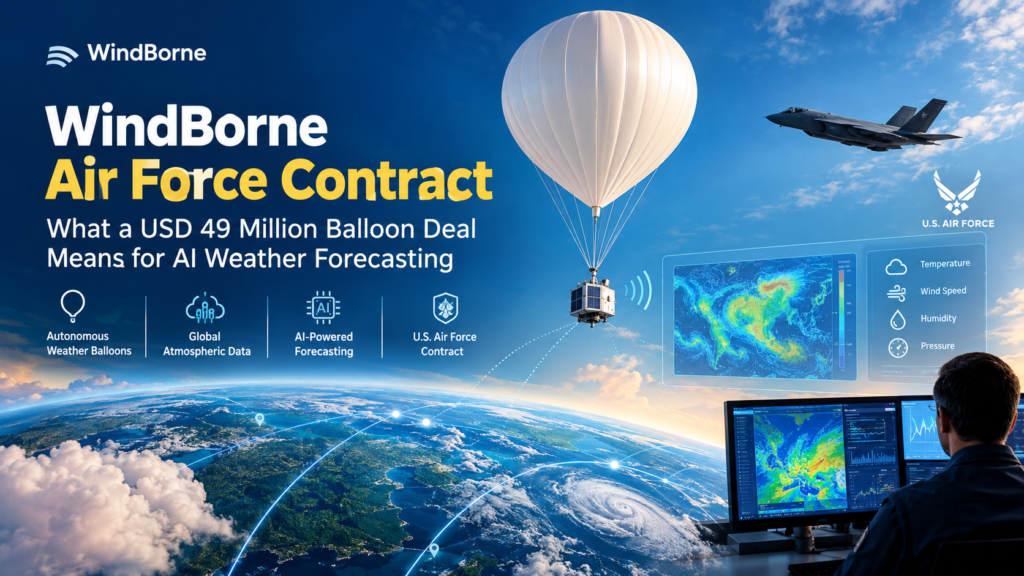
The WindBorne Air Force contract lets the U.S. Air Force buy global atmospheric readings from WindBorne Systems‘ autonomous weather balloons, under a deal worth up to USD 49 million. The Air Force pays only for the data it orders, and so far it has ordered about USD 1.7 million worth. That structure makes the deal less of a guaranteed windfall and more of a signal: the military now treats commercial weather balloon data as infrastructure it can rent on demand.
If you follow AI, defense technology, or weather science, this is one of the more revealing procurement stories of 2026. TechCrunch’s Tim Fernholz reported it on October 12, 2026, and it connects three trends at once: AI models that forecast weather far faster than supercomputer simulations, a new generation of long-endurance balloons, and governments that would rather buy data than build every sensor network themselves. This guide explains what the WindBorne Air Force contract is, how it works, who is behind it, and what it means for founders, analysts, and students, including readers in India.
WindBorne Air Force Contract at a Glance
These are the core facts, as reported by TechCrunch:
- Contract ceiling: up to USD 49 million
- Buyer: the U.S. Air Force
- Seller: WindBorne Systems, a startup based in Redwood City, California
- Product: weather balloon data, meaning atmospheric sensor readings from a fleet of roughly 700 balloons
- Ordering model: the Air Force orders data for specific regions at specific times and pays only for what it orders
- Ordered so far: about USD 1.7 million
- Award type: no competitive bidding; the company says the government found it the only provider that met its needs
- Reported: October 12, 2026
What Is the WindBorne Air Force Contract?
The WindBorne Air Force contract is an agreement under which the U.S. Air Force can purchase weather observations gathered by WindBorne Systems’ balloons, up to a combined value of USD 49 million. It is a ceiling rather than a commitment, which is a crucial distinction for anyone reading the headline number.
Think of it as a standing purchase vehicle. Rather than buying a fixed set of balloons or a fixed volume of data up front, the Air Force can place orders when a particular region and time window matter to its operations. WindBorne’s co-founder and CTO, Andrey Sushko, described the arrangement as largely a way to support continued growth of the balloon constellation, along with research and development work to improve the hardware and performance of the balloons.
It is also the biggest agreement of its kind for the company. WindBorne has worked with the National Weather Service, the Air Force, and the Navy before, but TechCrunch reports that this is the single largest contract it has participated in. The ceiling alone is larger than the USD 37 million Series B round the company announced in August 2026.
Why Was the WindBorne Air Force Contract Awarded Without Competition?
Because, in the company’s account, the government concluded that WindBorne was the only provider able to collect global data in the way its operations required. Sushko framed the sole-source award as exactly that kind of determination. It is worth stressing that this is the company’s characterization; TechCrunch’s report does not quote an Air Force justification.
A sole-source award is a strong endorsement of a young company’s technology. It also means no rival bid tested the price, so outside observers have little to benchmark the deal against.
How Does the WindBorne Air Force Contract Work?
How does the Air Force pay for the data? It pays only as it needs data, placing orders for specific regions at specific times. The USD 49 million figure is the most the contract could be worth, not a sum that has been committed. Orders placed so far total about USD 1.7 million, and WindBorne executives expect more to follow.
That ordering model matters because weather needs are uneven. A mission planner may want dense observations over one ocean basin for a few days and nothing at all for the next month. Paying per order lets the buyer match spending to demand, while the seller keeps a funded reason to expand the fleet.
What Will WindBorne Spend the Money On?
The contract is expected to support growth of the balloon constellation and improvements to the balloons themselves. Sushko said so directly, pointing to hardware and performance research alongside fleet growth.
Separately, WindBorne’s CEO John Dean told TechCrunch in August that the Series B proceeds would go toward computing power, a project to replace the balloons’ satellite communications with a mesh radio network, and a larger go-to-market team for private-sector customers.
Is the WindBorne Air Force Contract Guaranteed Revenue?
No. Only the orders actually placed are firm. At roughly USD 1.7 million ordered against a USD 49 million ceiling, most of the headline value is still potential rather than booked revenue. In practical terms, the WindBorne Air Force contract reduces demand risk without guaranteeing any particular revenue figure. Investors and competitors should read it as proof of government appetite, not as a revenue forecast.
Who Is WindBorne Systems?
WindBorne Systems is a Redwood City, California company that flies long-endurance weather balloons and feeds the readings into its own AI forecasting model. TechCrunch reports that it was founded by a group of Stanford students. It began by building a better weather balloon with the idea of selling the data. After deep-learning weather models arrived around 2022, the team decided it could capture more value by building a forecasting model too.
One note on dates: TechCrunch’s articles give different founding years (2015 in the October story, 2019 in earlier coverage). If you need to cite a founding year, confirm it with the company directly.
How Big Is the WindBorne Systems Balloon Fleet?
It has grown quickly: from about 400 balloons aloft in June 2026 to about 700 by October 2026, according to TechCrunch’s reporting.
| Reported date | Balloons aloft (approx.) | Launch sites | Source article |
|---|---|---|---|
| June 1, 2026 | 400 | 15 | TechCrunch, WeatherMesh 6 launch |
| August 5, 2026 | 600 | 20 | TechCrunch, Series B coverage |
| October 12, 2026 | 700 | Not stated | TechCrunch, Air Force contract |
The numbers are rounded and come from different articles, so treat them as a trend line rather than an audited count. The direction is clear, though: a sole-source contract with room to grow arrives just as the fleet is scaling.
How Much Funding Has WindBorne Systems Raised?
WindBorne Systems raised a USD 37 million Series B in August 2026, valuing the company at USD 250 million after the round. Khosla Ventures and Galvanize co-led the round, with participation from Translink Capital, Lux Capital, and earlier investors. Before that, TechCrunch reported the company had raised about USD 25 million in venture funding, with a reported valuation of USD 85 million in 2024.
Who Buys WindBorne’s Data and Forecasts?
The customers are mostly government agencies today. The U.S. National Weather Service purchases the company’s data. The Air Force and Navy have paid through research partnerships, including work on forecasting models that can run onboard ships that may lose their connection to the outside world. On the commercial side, WindBorne sells forecasts to investment funds and commodity traders who use weather to anticipate prices and business outcomes.
How Do WindBorne’s Weather Balloons Collect Data?
WindBorne’s balloons have no engine; they steer by changing altitude to ride winds that carry them where they need to go. According to TechCrunch, the company adjusts a balloon’s height by bleeding gas or by dropping sand carried as ballast, and the balloon then drifts with whichever air current heads in the desired direction.
Sushko pointed to two ingredients that make this work: good wind and weather models, plus knowledge of how to navigate with them; and a constellation large enough to have balloons in the right places. In his telling, the approach is one of the first times a deep-learning model has driven real operational decisions.
What Was the Typhoon Dolphin Flight?
In August 2026, WindBorne became the first organization to send an unpowered flight system into the eye of a typhoon to collect data. TechCrunch reports the milestone, and WindBorne’s own site references the flight as navigating a balloon into the eye of Typhoon Dolphin. Eyes of storms are hard to observe, and a balloon that can be steered there shows the fleet can chase high-value targets rather than only drift passively.
What Is Coming Next for the Hardware?
WindBorne is starting to deploy sensor packages that can fall into the ocean and keep measuring as floating buoys. It is also working to swap the balloons’ satellite communications for a mesh radio network. Both moves point toward cheaper, denser coverage of remote areas, which is exactly where traditional weather observations are thinnest.
What Is WeatherMesh, and Why Does Data Matter for AI Weather Forecasting?
WeatherMesh is WindBorne’s transformer-based AI forecasting model, and its sixth version, WeatherMesh 6, was released on June 1, 2026. The company says the model beats forecasts from the European Centre for Medium-Range Weather Forecasts (ECMWF), including both traditional and AI products. Those are company-reported results, so independent scrutiny matters.
Here is what the company says changed:
- Cadence: WeatherMesh 6 produces a forecast every hour, compared with every six hours for traditional models.
- Resolution: it reaches 3 kilometers over the continental United States.
- Accuracy framing: WindBorne’s chief product officer, Kai Marshland, summarized it as being about as accurate five days out as a traditional forecast is one day ahead, particularly for surface temperature.
What Is Data Assimilation?
Data assimilation is the work of turning scattered sensor readings into one comprehensive, machine-readable picture of the atmosphere that a model can start from. It is the step where weather forecasting quietly succeeds or fails. TechCrunch notes that ECMWF’s edge is generally attributed to its skill at this task.
Today, most AI weather models still lean on starting datasets produced by ECMWF and the U.S. National Oceanic and Atmospheric Administration (NOAA). WindBorne and others are trying to feed observations into the models directly. WindBorne’s head of AI, Joan Creus-Costa, credits that direct ingestion as the main reason WeatherMesh 6 improved, and said it took a year of tuning and re-architecting to keep the model stable.
Why Does Proprietary Weather Balloon Data Create a Moat?
Because a model trained and updated on observations nobody else has can make forecasts nobody else can match. WindBorne’s CEO has argued that he does not understand the business model of an AI weather company that lacks a data advantage. He also claims that balloon observations deliver more value per data point than satellite observations. That is a company view, but it explains why the WindBorne Air Force contract and the forecasting model are two halves of one strategy: the contract funds the sensors, and the sensors sharpen the model.
Where Does AI Weather Forecasting Stand in 2026?
AI weather forecasting has become one of the most productive applications of deep learning, but it is not a clean replacement for physics-based forecasting yet. Since transformer architectures arrived and ECMWF released a very large weather dataset a few years ago, end-to-end learning on decades of data has made predictions faster and cheaper than supercomputer simulation. TechCrunch calls the field a jagged frontier, with both AI and traditional forecasts still required to understand the weather well. AI models from Google DeepMind and government agencies are increasingly central to cyclone forecasting and hurricane response in the United States.
Three Approaches to Forecasting Compared
Traditional physics models, AI-only models, and data-plus-model systems like WindBorne’s each make different trade-offs.
| Approach | How it works | Strengths | Limitations |
|---|---|---|---|
| Traditional physics-based forecasting | Supercomputers simulate the atmosphere using the laws of physics | Long track record; higher accuracy over longer horizons than most AI models today | Expensive, slow to run, updates less often |
| AI-only forecasting models | Deep-learning models trained on decades of historical weather data | Fast, can run on far cheaper hardware, rapid improvement | Often depend on ECMWF or NOAA data for starting conditions; resolution and long-range skill can lag physics models |
| Data-plus-model systems (WindBorne’s approach) | Own balloon fleet feeds observations directly into an AI model | Proprietary data advantage; hourly forecasts; 3 km resolution over the continental U.S. | Accuracy claims are company-reported; fleet must keep scaling; commercial demand still being proven |
The takeaway: the winners in AI weather forecasting are unlikely to be defined by model architecture alone. Access to fresh, hard-to-get observations may matter at least as much.
Why Does the WindBorne Air Force Contract Matter Beyond One Startup?
Because it shows how governments may buy environmental data in the AI era: as an on-demand service from a commercial fleet. Here is our read on the broader implications:
- Data-as-a-service procurement is arriving in weather. The Air Force can order observations by region and time rather than owning the sensors.
- AI is moving into operations. Steering balloons with a deep-learning model and sending one into a typhoon eye are operational uses, not lab demos.
- Defense buyers want edge-capable forecasting. The Navy research effort on models that run onboard ships with intermittent connectivity points to demand for forecasts that do not depend on a live link to a data center.
- The data moat narrative gets a validation point. A sole-source award is hard to explain without a differentiated dataset.
- The private market remains the harder prize. TechCrunch notes that many earth-observation startups struggled to cross from government to private customers because extracting value requires experience and established workflows. WindBorne’s current commercial push is mostly toward funds that trade on weather-sensitive commodity prices.
Risks and Open Questions About the WindBorne Air Force Contract
The deal is promising, but several uncertainties are worth tracking.
- Ceiling versus actual orders. About USD 1.7 million of a potential USD 49 million has been ordered. Future orders depend on Air Force needs.
- Limited public detail. The reporting we reviewed does not state the contract’s length or which regions have been ordered, so the real pace of spending is hard to forecast.
- Company-reported accuracy. WeatherMesh 6’s superiority claims come from WindBorne’s own benchmarks. Third-party evaluation will matter.
- Aviation safety. TechCrunch reported that a United Airlines jetliner flew into one of the company’s balloons last year, causing minor damage and no injuries; the company says it followed U.S. rules on sensor package size. TechCrunch also reported that WindBorne monitors air traffic and maneuvers balloons around aircraft. As the fleet grows toward and beyond 700 balloons, airspace coordination will draw attention.
- Dependence on upstream data. WeatherMesh still ingests datasets from government weather agencies. Dean says the model would still do quite well without ECMWF’s starting conditions, but that is a claim to test rather than a fact to assume.
- Commercial scaling. Selling to investors and commodity traders is a start, but broad enterprise adoption of weather forecasts has historically been expensive and difficult.
What Does the WindBorne Air Force Contract Mean for India and Odisha?
TechCrunch’s reporting on the WindBorne Air Force contract does not mention India, so any Indian relevance is an implication rather than an announced plan. Still, the technology lines up with problems Indian readers know well.
Odisha’s coastline faces cyclones that form over the Bay of Bengal, and forecasting a storm’s path and intensity depends heavily on observations over open water, where fixed stations barely exist. Steerable balloons, ocean-deployed sensors that float as buoys, and AI models that assimilate such data directly are exactly the kinds of tools that could strengthen forecasting in cyclone-prone regions. Whether any WindBorne-style data partnership reaches national weather agencies such as the India Meteorological Department is an open question, and nothing in the sources we reviewed says it is planned.
For students and freshers, the career angle is concrete. This story rewards a blend of skills that is still rare:
- Machine learning with transformer architectures
- Atmospheric science and data assimilation
- Aerospace and sensor engineering
- Data engineering for large observation streams
Weather and climate are becoming a serious AI application area, and the WindBorne Air Force contract is one more sign that governments will pay for people and companies that can combine those skills.
What Should Founders, Analysts, and Students Take Away?
The practical lessons depend on who you are.
- Founders: pair a proprietary data source with your own model. Data you alone can collect is the clearest moat in AI-heavy sectors.
- Analysts and investors: separate ceilings from orders. Track ordered value, not the headline contract size.
- Policy watchers: note that a sole-source award for commercial data signals a shift toward buying services rather than owning infrastructure.
- Students: build overlapping skills in ML and a physical science. The next wave of AI jobs will sit at those intersections.
Frequently Asked Questions About the WindBorne Air Force Contract
What is the WindBorne Air Force contract?
It is an agreement under which the U.S. Air Force can buy weather data collected by WindBorne Systems’ autonomous balloons, with a ceiling of up to USD 49 million. The Air Force pays only as it orders data for specific regions and times.
How much is the WindBorne Air Force contract worth?
The contract could be worth up to USD 49 million. About USD 1.7 million has been ordered so far, according to TechCrunch.
Was the WindBorne Air Force contract competitively bid?
No. It was awarded without competitive bidding. WindBorne’s CTO said the government determined the company was the only one able to provide the capability in the way required.
How many balloons does WindBorne Systems operate?
TechCrunch reported about 700 balloons flying around the globe in October 2026, up from about 600 in August and about 400 in June.
What is WeatherMesh?
WeatherMesh is WindBorne’s AI weather forecasting model. Version 6, released June 1, 2026, produces hourly forecasts at 3 km resolution over the continental U.S., and the company says it outperforms ECMWF’s forecasts.
Does WindBorne sell only to the military?
No. The National Weather Service buys its data, the Navy works with it through research partnerships, and it sells forecasts to investors and commodity traders.
How do WindBorne’s balloons steer without engines?
They change altitude by bleeding gas or dropping sand ballast, then drift with winds that head the right way.
Conclusion: The Contract Is a Bet on Data, Not Just Balloons
The WindBorne Air Force contract is best understood as a bet that high-quality, proprietary observations will define the next phase of AI weather forecasting. It gives a young company a large, flexible customer and a sole-source stamp of confidence, while leaving real questions about how much of the USD 49 million will be spent, how well the forecasts hold up under independent testing, and whether private customers will follow the government’s lead.
For anyone building in AI, this deal is a clear reminder: models are getting cheaper to build, while hard-to-collect data remains hard to copy. If you want to build skills at the intersection of AI and real-world data, explore the AI training programs, workshops, and learning resources at Kalinga.ai, and follow our coverage of AI infrastructure, policy, and India’s talent pipeline.