India just became the world’s largest market for ChatGPT Images 2.0. Here’s what that tells us about where AI-powered image generation is headed globally — and why the rest of the world hasn’t caught up yet.
What Is ChatGPT Images 2.0?
Definition: ChatGPT Images 2.0 is OpenAI’s latest AI image generation model, integrated directly into ChatGPT. It is designed to handle more complex visual prompts and produce highly detailed outputs — including accurate multi-language text rendering within images, a capability that was a significant weak point of earlier models.
Expansion: Unlike its predecessor, ChatGPT Images 2.0 introduces “thinking” capabilities that allow the model to self-refine outputs, generate multiple visual variations from a single prompt, and better interpret nuanced creative instructions. It supports non-Latin scripts including Hindi and Bengali — a deliberate technical decision that has had immediate consequences for adoption in South and Southeast Asia.
Launched in late April 2026, the model was positioned as a major upgrade in OpenAI’s ongoing race against competitors like Google’s image generation tools. The results so far? A striking story of geographic asymmetry: massive enthusiasm in emerging markets, measured uptake in mature ones.
Why India Became the Largest Market for ChatGPT Images 2.0
India’s Head Start in AI Adoption
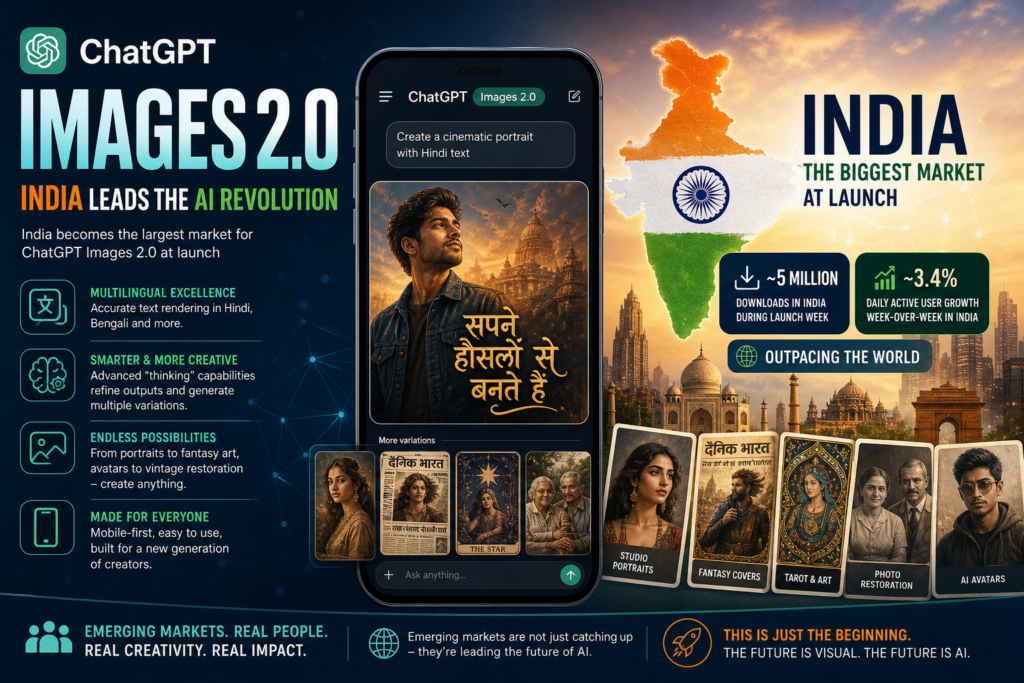
India’s emergence as the single largest market for ChatGPT Images 2.0 during its launch week is not accidental. According to data shared by Sensor Tower with TechCrunch, ChatGPT was downloaded approximately 5 million times in India during the launch week — more than double the roughly 2 million downloads recorded in the United States over the same period.
This is part of a broader pattern. India has consistently been one of the fastest-growing markets for AI consumer apps, driven by a young, mobile-first population, widespread smartphone penetration, and increasing comfort with AI-native tools across both urban and rural areas.
Key stat: Daily active users in India rose approximately 3.4% week-over-week during the ChatGPT Images 2.0 launch window, according to Similarweb data — outpacing global engagement growth of around 1%.
Language Support as a Growth Driver
One of the most consequential features of ChatGPT Images 2.0 is its native support for non-Latin scripts. The model can now accurately render text in Hindi, Bengali, Urdu, and other scripts within generated images. For Indian users, this is transformational.
Previous AI image generation tools frequently garbled Devanagari script or produced phonetically incorrect text — making them practically unusable for creators who wanted images with native-language text. ChatGPT Images 2.0’s improved rendering removes that friction entirely.
This is a meaningful technical differentiator. When an AI image generator can render a user’s name in Hindi on a stylized birthday card, or place a Bengali caption on a portrait, it stops being a novelty and starts being a utility.
Cultural Use Cases Driving Adoption
OpenAI has noted that early adoption patterns in India are driven heavily by personal and expressive use cases rather than professional or commercial ones. Indian users are using ChatGPT Images 2.0 to create:
- Studio-style portraits generated from everyday selfies
- Fantasy newspaper covers featuring themselves as protagonists
- Tarot-style visuals and fashion moodboards
- Cinematic portrait collages blending multiple photos
- Restored versions of older family photographs
- Social media-ready avatars in regional styles
This self-expressive usage pattern suggests that AI image generation in India is filling a gap previously occupied by professional photography studios and photo editing apps — but at a fraction of the cost and with far lower technical barriers.
Global Rollout: Mixed Results Beyond India
Despite the enthusiasm in India and select emerging markets, the global picture for ChatGPT Images 2.0 at launch was notably more subdued.
The Numbers at a Glance
| Metric | Figure | Source |
|---|---|---|
| ChatGPT app download growth (week-over-week) | +11% globally | Sensor Tower |
| Daily active user growth (week-over-week) | ~+1% globally | Sensor Tower |
| Global web traffic increase (week-over-week) | ~+1.6% | Similarweb |
| India daily active user growth (week-over-week) | ~+3.4% | Similarweb |
| India downloads in launch week | ~5 million | Sensor Tower |
| US downloads in launch week | ~2 million | Sensor Tower |
| Pakistan download spike (week-over-week) | Up to +79% | Sensor Tower |
The data paints a clear picture: a meaningful but modest global lift, concentrated heavily in emerging markets. Mature markets like the US and Western Europe showed limited incremental engagement beyond their existing ChatGPT usage baseline.
Why Mature Markets Are Slower to Respond
Several factors explain the muted response in established markets:
Saturation effect. ChatGPT already has deep penetration in the US, UK, and Western Europe. Users in these markets are accustomed to AI image tools and evaluate new features through a higher baseline of expectations. An incremental upgrade — even a technically significant one — generates less behavioral shift among users who already have established workflows.
Competition from specialized tools. Mature markets have a richer ecosystem of dedicated AI image generation platforms — Midjourney, Adobe Firefly, DALL-E 3 (previously standalone), Stable Diffusion, and others. ChatGPT Images 2.0 enters a crowded field where switching costs and established preferences are significant.
Professional vs. personal use. In high-income markets, AI image generation has increasingly been professionalized — used by designers, marketers, and content creators with specific technical requirements. Casual personal use, which is driving India’s surge, is less of a growth driver in markets where professional tools already dominate.
Emerging Markets vs. Mature Markets: A Tale of Two Adoptions
The launch of ChatGPT Images 2.0 illuminates a structural divide in how AI tools propagate globally. Emerging markets aren’t just catching up — in some categories, they’re setting the pace.
Characteristics of emerging market AI adoption:
- New-user driven: Countries like Pakistan, Vietnam, and Indonesia saw download spikes of up to 79% week-over-week — representing genuine first-time user acquisition, not just feature engagement from existing users.
- Mobile-first behavior: Emerging markets access AI tools almost entirely via smartphone apps, making download statistics a reliable proxy for real-world usage.
- Use cases rooted in self-expression: Rather than productivity or professional output, personal visual creation dominates — a market need that aligns well with ChatGPT Images 2.0’s portrait and avatar capabilities.
- Language localization as a moat: For markets where native-language text rendering matters (India, Indonesia, Vietnam), ChatGPT Images 2.0’s multilingual capabilities create a durable competitive advantage.
- Cost sensitivity: AI tools that are free or low-cost relative to professional alternatives have disproportionate appeal in markets where disposable income for software is limited.
Characteristics of mature market AI adoption:
- Feature upgrades drive engagement, not new user acquisition
- Usage is increasingly workflow-integrated and B2B-adjacent
- Expectations around quality and consistency are higher
- Competition from specialized tools is significantly more intense
- Personal creative use is a smaller share of overall AI image tool activity
How ChatGPT Images 2.0 Compares to Google’s AI Image Tools
ChatGPT Images 2.0 did not launch into a vacuum. OpenAI is competing directly with Google’s image generation capabilities, and the India market is a key battleground for both companies.
Google’s earlier image-focused model — referred to as Nano Banana — saw strong early adoption in India as well, with Indian users applying it for local creative uses. The pattern of India leading adoption of new AI image tools is now established enough to be treated as a structural market behavior, not a one-off.
Where ChatGPT Images 2.0 differentiates itself:
- Native “thinking” capabilities that refine outputs iteratively
- Better multi-language text rendering, including Devanagari scripts
- Direct integration into the ChatGPT interface users already rely on daily
- Support for generating multiple visual variations from a single prompt
Where Google maintains competitive advantages:
- Deep integration with Google’s broader ecosystem (Docs, Slides, Search)
- Strong infrastructure for regional language processing globally
- Established brand trust in Indian markets through longstanding localization efforts
Neither company has a definitive lead. The competition is actively shaping how AI image generation capabilities are built, localized, and distributed — with India serving as both proving ground and prize.
What This Means for Marketers and Content Creators
If you are a marketer, content creator, or brand strategist paying attention to AI tools, the ChatGPT Images 2.0 story carries several actionable implications.
AI Image Generation Is Now a Mainstream Consumer Product
The volume of downloads in India — 5 million in a single week — confirms that AI image generation has crossed the threshold from specialist tool to mass-market consumer behavior in certain geographies. Brands targeting Indian consumers need to account for AI-generated visuals as a significant and growing component of user-generated content in their categories.
Multilingual AI Capabilities Are a Strategic Differentiator
ChatGPT Images 2.0’s success in India is inseparable from its multilingual text rendering. For any brand investing in AI-powered content creation at scale, the ability to generate high-quality visuals with accurate native-language text is no longer a nice-to-have — it is a market access requirement in South and Southeast Asia.
Emerging Markets Are Where AI Image Generation Grows Fastest
If you are allocating investment in AI-powered creative tools or building products in this space, the data from ChatGPT Images 2.0’s launch is instructive: the sharpest growth curves are in emerging markets, not mature ones. Pakistan at +79% week-over-week download growth is not an anomaly — it is a signal about where user-acquisition opportunities for AI image tools currently sit.
Personal Creative Use Is an Underserved Market Segment
The dominant use cases in India — portrait restoration, avatar creation, fantasy visuals — represent a form of AI image generation that mainstream professional tools have not optimized for. Platforms that make ChatGPT Images 2.0 easier to discover and use for personal creative expression will capture a significant and fast-growing user segment.
The Road Ahead for ChatGPT Images 2.0
OpenAI’s strategic intent with ChatGPT Images 2.0 is clearly broader than any single geography. The model is part of an escalating competition in AI image generation that will likely see rapid capability improvements from all major players through 2026 and beyond.
What to watch:
Deeper localization. The success of Hindi and Bengali text rendering will almost certainly push OpenAI — and its competitors — to prioritize even more non-Latin script support. Tamil, Telugu, Kannada, Marathi, and other major Indian languages, alongside Southeast Asian scripts, represent the next frontier.
Creator monetization tools. As AI image generation matures from novelty to habit, platforms will begin building monetization pathways for power users — enabling creators to sell or license AI-generated imagery at scale.
Enterprise integration. While consumer adoption is the current story, enterprise use cases for AI image generation — including automated marketing asset creation, product visualization, and brand content at scale — represent the next major growth vector.
Competition intensification. Google, Adobe, Meta, and a growing field of specialized AI image startups are all accelerating investment. The gap between leading and lagging products will narrow quickly, making localization and use-case specificity the primary competitive differentiators.
Regulatory attention. As AI-generated imagery becomes ubiquitous, questions around watermarking, provenance, and content authenticity will move from policy discussion to enforceable regulation in several major markets.
ChatGPT Images 2.0 is, at this stage, a strong opening move in a much longer game. India’s response to it has revealed something important: the global market for AI image generation is not one market at all — it is a mosaic of distinct regional behaviors, cultural contexts, and technical needs. The companies that understand and build for that complexity will define the next phase of this industry.
Frequently Asked Questions
What makes ChatGPT Images 2.0 different from earlier versions? ChatGPT Images 2.0 introduces iterative “thinking” capabilities that allow the model to refine outputs and generate multiple variations. It also significantly improves text rendering within images — particularly for non-Latin scripts including Hindi and Bengali — and handles more complex, multi-element prompts.
Why is India the largest market for ChatGPT Images 2.0? India’s combination of a large, mobile-first user base, widespread ChatGPT adoption, and a strong demand for AI tools that support native-language text rendering makes it the ideal market for ChatGPT Images 2.0’s specific capabilities. Download volumes of approximately 5 million in the launch week confirm India’s position as OpenAI’s leading geography for this product.
How does ChatGPT Images 2.0 compare to Midjourney or Adobe Firefly? ChatGPT Images 2.0 is differentiated primarily by its integration into ChatGPT, its multilingual text rendering, and its iterative refinement capabilities. Midjourney and Adobe Firefly have stronger professional-grade outputs and established creative workflows, but are less accessible for casual personal use and do not natively support South Asian scripts at the same level.
Is global adoption of ChatGPT Images 2.0 growing? Global growth at launch was modest — app downloads rose about 11% week-over-week and daily active users grew roughly 1%. The sharpest growth was concentrated in emerging markets including India, Pakistan, Vietnam, and Indonesia.