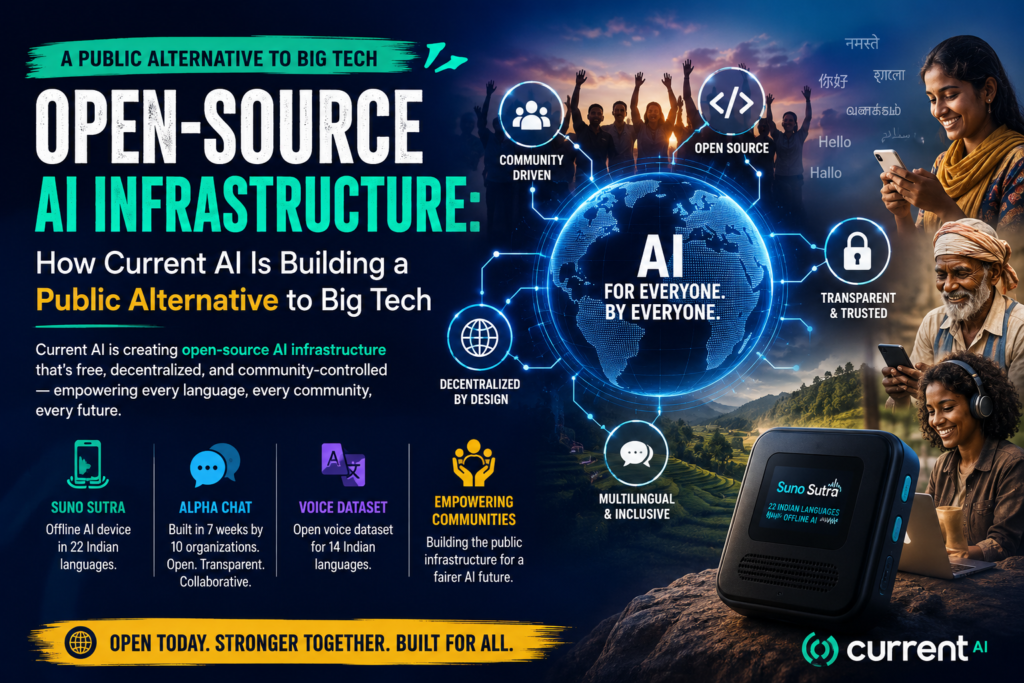
Every major AI system today — ChatGPT, Gemini, Claude — belongs to a private company. Current AI, a nonprofit backed by $400 million in public and philanthropic funding, is building open-source AI infrastructure designed to work like the early World Wide Web: free, decentralized, and controlled by communities rather than corporations.
That single idea explains why a two-year-old nonprofit is suddenly showing up everywhere from the India AI Summit to the AI for Good Summit in Geneva. It also explains why the story matters far beyond Silicon Valley. If you run a business, teach AI skills, or publish content for a global audience, the emergence of public this public AI infrastructure changes the assumptions you’ve been building on.
What Is Open-Source AI Infrastructure?
Open-source AI infrastructure refers to the foundational technology stack — language models, safety tooling, compute, and datasets — that powers AI applications, built and released under open licenses so anyone can inspect, use, or improve it. Unlike proprietary systems from OpenAI, Google, or Anthropic, this infrastructure is meant to function as shared public utility rather than a walled garden owned by a single company.
Current AI, the nonprofit at the center of this movement, was founded in February 2025 by Martin Tisne and is now led by CEO Ayah Bdeir, who previously ran Mozilla’s AI strategy and founded the STEM education company littleBits (acquired by Sphero in 2019). Bdeir frames the mission bluntly: “If AI is truly a transformative technology, if it’s going to change every aspect of everyone’s life, there has to be a public alternative. Like the World Wide Web, available to anyone, for free.”
The comparison to the early web isn’t just branding. It signals a specific architecture: interoperable pieces, no single gatekeeper, and improvements that compound because anyone can build on top of what came before. That’s the definition of public AI infrastructure in practice, not just in slogan.
Why the World Needs Open-Source AI Infrastructure Now
The Language Extinction Problem
Roughly half the world’s spoken languages face extinction within this century, according to United Nations data on Indigenous languages. Because large language models are trained overwhelmingly on English and a handful of other dominant languages, the AI boom risks accelerating that decline instead of slowing it. As Bdeir put it, “with English driving the largest language models and AI systems, a bulk of the world’s languages and, consequently, cultures and communities are left behind.”
This is the core justification for public, this open infrastructure model: without it, entire linguistic communities are excluded from the biggest technological shift of the decade — not because the technology is impossible to build for them, but because there’s no commercial incentive to build it.
Big Tech’s Multilingual Blind Spot
It’s tempting to assume that as commercial AI companies add more language support, the gap closes on its own. Bdeir disputes that framing directly. Big technology firms build multilingual AI models to expand their addressable market, she argues, often without consent or cultural context from the communities whose language data gets absorbed. Her sharpest example: for many Indigenous languages, missionary Bible translations have become de facto training data before the communities themselves ever set rules for how their language could be used.
The distinction matters for anyone evaluating whether this open AI infrastructure model is redundant with what commercial vendors already offer. It isn’t. Market-driven multilingual expansion and consent-driven, community-governed language infrastructure are structurally different projects, even when the surface-level output — an AI that speaks your language — looks similar.
Inside Current AI’s Open-Source AI Infrastructure Stack
Current AI isn’t operating as a think tank issuing white papers. It’s shipping products. Three releases in 2026 illustrate what this open infrastructure looks like when it moves from concept to deployment.
Suno Sutra: Offline AI in 22 Indian Languages
In February, at the India AI Summit, Current AI partnered with Bhashini — the Indian government’s AI language division — to launch Suno Sutra (“listening chronicles” in Hindi). It’s a pocket-sized, offline device that runs AI models across 22 Indian languages without requiring an internet connection. The device is fully open-sourced, meaning developer communities anywhere can build on top of it.
The use case Bdeir describes is telling: a farmer in rural India photographs a dying plant and needs help diagnosing it, but doesn’t speak English and has no reliable internet access. That farmer shouldn’t be locked out of AI assistance because of geography or language. Suno Sutra is a direct answer to that gap, and a clear demonstration of what this open AI stack enables that commercial products, optimized for scale in major languages, tend to skip.
Alpha Chat: Built in Seven Weeks by Ten Organizations
Earlier this month, Current AI launched Alpha Chat at the AI for Good Summit in Geneva — an open-source chatbot assembled in just seven weeks by a coalition of ten organizations, including Hugging Face, Mozilla, and MIT Media Lab. Each contributor supplied one layer of the stack: a language model here, safety tooling there, computing capacity from another partner.
That modular assembly process is itself a proof point for an open AI infrastructure strategy as a strategy. No single organization needed to build (or fund) an entire frontier AI system from scratch. By treating the stack as interoperable public components, ten organizations shipped a working product in under two months — a timeline that would be difficult to match with a closed, single-vendor approach.
The Sakana AI Partnership for Sovereign AI
Current AI has also struck a deal with Sakana AI, a Tokyo-based startup focused on what it calls Sovereign AI — systems built to serve a specific nation’s language and cultural context rather than a global, one-size-fits-all model. The partnership aims to build a shared open-source AI stack supporting Japanese language and culture, while also extending to communities across the Global South that dominant commercial AI systems have largely overlooked.
The Sakana partnership is a useful signal that sovereign AI and an open AI stack aren’t competing philosophies — they’re complementary. Sovereign AI supplies the cultural and linguistic specificity; open infrastructure supplies the shared technical foundation that makes building sovereign systems affordable for smaller nations and organizations.
Who’s Funding This? A $400 Million Public-Private Bet
Current AI operates what Bdeir calls a “public-private partnership,” pooling money from governments, corporations, and philanthropies to fund public interest technology. The French government seeded the nonprofit with $100 million. The Ford Foundation, MacArthur Foundation, Google DeepMind, and Salesforce joined afterward, pushing total committed funding to $400 million.
Bdeir draws a sharp distinction in how that money is treated: “They’re not investors; they’re funders.” There’s no equity stake, no expectation of commercial return, and no product roadmap dictated by shareholder pressure. That funding structure is what allows Current AI to prioritize public AI infrastructure for underserved languages over infrastructure for the largest, most commercially lucrative markets — a prioritization that would be difficult to sustain inside a venture-backed company answering to investors.
The First Grant Cohort: $3.2 Million Across Four Continents
Current AI’s first grant round, announced last month, distributed $3.2 million across four organizations working on different pieces of the same problem.
| Organization | Region | Focus |
|---|---|---|
| Masakhane | Kenya | Building AI datasets across 50+ African languages for health, farming, and education |
| Institute for Worldmaking | Lebanon | Digitizing Arab cultural history into machine-readable, community-controlled databases |
| Portal sem Porteiras | Brazilian Amazon | Offline AI tools built with Indigenous communities, keeping data within the territory |
| African Internet Rights Alliance | Kenya | Developing audit tools to hold AI systems accountable across the continent |
Bdeir is upfront that $3.2 million split four ways won’t single-handedly close the global AI language gap. But she frames scale differently than a typical tech company would: “Scale is not always the measure. That is the Big Tech paradigm.” Her benchmark for success is narrower and more human: an Indigenous elder in the Brazilian Amazon using a tool built in Kenya to pass down ecological knowledge in their own language.
Who Owns the Data in Open-Source AI Infrastructure?
Question: If AI infrastructure is open-source, does that mean the underlying data is public too?
Direct answer: No — and that distinction is central to Current AI’s model. Being open-source refers to the code and model architecture; it doesn’t mean community data becomes a free-for-all resource. Bdeir is explicit about where she draws the line: “It shouldn’t be a company in Silicon Valley trying to make a select few thousand people wealthier.”
Current AI’s approach involves three concrete practices:
- Storing models and data locally, within the community or region that generated them, rather than centralizing everything on a corporate cloud
- Bringing in community experts before any technical development begins, rather than after
- Writing consent protocols directly into the data pipeline, so communities can halt a project at any point if terms aren’t being honored
None of Current AI’s current grantees have fully solved data governance — Bdeir doesn’t pretend otherwise. But she argues the difference is that each project has built the question into its structure, rather than treating complexity as an excuse to let a government or a tech company make the call by default.
Open-Source AI Infrastructure vs. Big Tech AI Models
The comparison below breaks down how public, this open infrastructure differs structurally from the proprietary systems most people already use.
| Dimension | Open-Source AI Infrastructure (Current AI) | Big Tech AI Models |
|---|---|---|
| Ownership | Community and nonprofit-governed | Private corporation |
| Funding source | Government + philanthropic grants | Venture capital / corporate revenue |
| Primary incentive | Public benefit, cultural preservation | Market expansion, shareholder return |
| Language priority | Underserved and endangered languages first | Languages with largest commercial markets first |
| Data storage | Local, community-controlled | Centralized corporate cloud |
| Access model | Free, offline-capable where needed | Often subscription or usage-based |
| Consent process | Built into pipeline, revocable | Typically governed by terms of service |
This isn’t an argument that commercial AI is inferior — proprietary systems remain far ahead on raw capability and scale. The comparison instead shows that this open AI stack is solving a different problem: access and cultural representation, not frontier performance.
Challenges Facing Public Interest AI
Building an open AI stack at this scale comes with real friction:
- Funding sustainability — $400 million is significant, but it’s a fraction of what individual commercial AI labs raise in a single funding round
- Technical parity — open, community-built models still generally lag behind frontier proprietary systems on raw capability benchmarks
- Coordination overhead — assembling a stack from ten different organizations (as with Alpha Chat) requires ongoing alignment that a single company doesn’t need to manage
- Data governance complexity — consent protocols and local data storage are harder to scale across hundreds of language communities than a single centralized policy
- Long-term maintenance — open-source projects can stall once initial grant funding runs out, unlike commercial products with recurring revenue
Bdeir’s own framing — that none of the current grantees have “fully solved” data ownership — suggests Current AI treats these as ongoing tensions to manage rather than problems with a finished solution.
What This Means for Businesses, Educators, and Content Creators
For organizations building AI literacy — whether that’s a company training its workforce or an institute teaching agentic AI engineering to students — the rise of public AI infrastructure is worth tracking for a practical reason: it’s expanding the set of AI systems worth understanding beyond the handful of commercial giants.
A few implications worth noting:
- Multilingual AI models built through initiatives like Current AI’s grant cohort could eventually lower the barrier for reaching non-English-speaking audiences, relevant for anyone doing content strategy or GEO (Generative Engine Optimization) work across multiple markets
- Offline-capable AI infrastructure, like Suno Sutra, points toward deployment models that don’t assume constant connectivity — a real consideration for products aimed at regions with inconsistent internet access
- Open-source stacks assembled from multiple contributors (as with Alpha Chat) offer a template for smaller organizations to participate in AI development without needing frontier-lab-level resources
None of this replaces the dominant commercial AI ecosystem. But it does mean the AI landscape is no longer a two-or-three-company story, and public this open infrastructure model is becoming a legitimate second track worth watching.
How Current AI’s Model Compares to Past Public Tech Efforts
Current AI isn’t the first attempt to build publicly governed technology infrastructure, and comparing it to earlier efforts helps clarify what’s genuinely new here.
Wikipedia proved that a volunteer-governed, non-commercial knowledge base could outcompete commercial encyclopedias on coverage and trust, even without a profit motive. Mozilla’s nonprofit structure showed that an open browser engine could hold market share against corporate competitors for years. Public broadcasting systems in many countries demonstrated that government and philanthropic funding could sustain media infrastructure without advertiser control dictating content.
What’s different with AI is the capital intensity. Training and running large language models requires computing power and engineering talent at a cost scale that dwarfs hosting a wiki or maintaining a browser codebase. That’s precisely why Current AI’s public-private funding model — pooling government money, philanthropic grants, and corporate contributions without giving any single funder control — is structurally important. It’s an attempt to solve a capital problem that earlier public-interest tech movements didn’t face at the same magnitude.
Whether that funding model proves durable over a five- or ten-year horizon is still an open question. Grant-funded nonprofits often struggle to match the recurring revenue that keeps commercial products maintained and updated. Current AI’s bet is that the $400 million committed so far is enough to prove the model works, after which additional government and philanthropic partners are expected to join — similar to how early public broadcasting networks expanded funding once their initial value was demonstrated.
FAQ: Open-Source AI Infrastructure
What is Current AI? Current AI is a nonprofit founded in February 2025 by Martin Tisne, now led by CEO Ayah Bdeir, focused on building public, open-source AI infrastructure as an alternative to proprietary systems from private tech companies.
How much funding does Current AI have? Current AI has $400 million in committed funding, seeded by a $100 million pledge from the French government and joined by the Ford Foundation, MacArthur Foundation, DeepMind, and Salesforce.
What is Suno Sutra? Suno Sutra is an offline, pocket-sized AI device built by Current AI and Bhashini (India’s AI language division) that runs AI in 22 Indian languages without an internet connection.
Is Current AI’s technology actually free to use? Yes. Current AI’s projects, including Suno Sutra and Alpha Chat, are open-sourced and designed for free access, particularly for communities and languages underserved by commercial AI products.
How is an open-source AI stack different from open-source software in general? This open AI stack includes not just code, but model weights, training data governance frameworks, and compute-sharing arrangements — components that go beyond a typical open-source software repository.
Who decides how community data is used in Current AI’s projects? The communities themselves, through consent protocols built into each project’s data pipeline, with the ability to halt data use at any point — a governance model distinct from standard terms-of-service agreements used by commercial AI companies.
The Bottom Line
Current AI is betting that open-source AI infrastructure can do for artificial intelligence what the early web did for information access: remove the gatekeepers, distribute control, and make the technology genuinely available to anyone, regardless of language, geography, or income. With $400 million in funding, working products already in the field, and partnerships spanning India, Japan, Kenya, Lebanon, and Brazil, the nonprofit has moved well past the proposal stage. Whether this open infrastructure project can scale to match the reach of commercial AI remains an open question — but for the roughly half of the world’s languages currently locked out of the AI boom, it’s already the only serious alternative on the table.