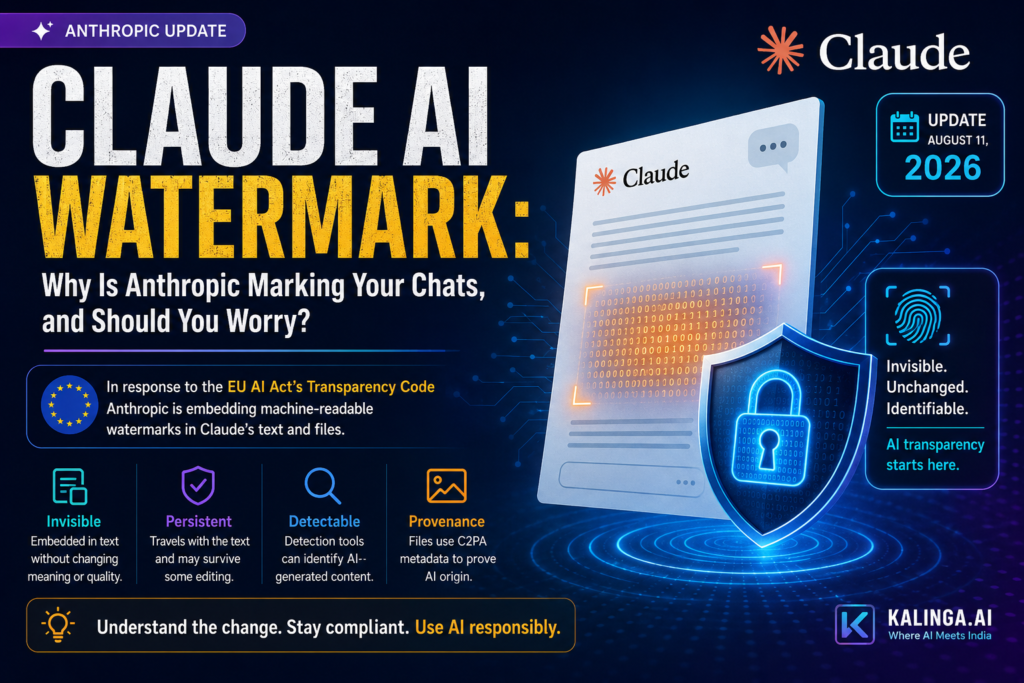
Picture this: you ask Claude to “just tighten up this paragraph” for a college assignment or a client email, paste the polished version in, and move on with your day. Here’s the direct answer , starting this month, that text may carry an invisible Claude AI watermark that can flag it as AI-generated, even after you’ve edited it. Anthropic confirmed the change on August 11, 2026, and it applies to Claude output worldwide, not just in Europe.
If you’re a student, a content professional, or a founder building with AI (like many of us at Kalinga.ai are), this isn’t just a policy footnote. It changes how “AI-assisted” work gets verified from here on out. Let’s break down what this new marking system actually does, why it exists, why some users are furious about it, and what it practically means for anyone using Claude for college, freelancing, or office work in India.
What Is the Claude AI Watermark, Exactly?
Claude AI watermark refers to an imperceptible, machine-readable signal that Anthropic now embeds directly into text generated by supported Claude models. It doesn’t change how the response reads, looks, or sounds , it’s a hidden pattern woven into the text itself that detection tools can later identify as AI-originated.
Anthropic explained the mechanism plainly in its own help documentation, saying that when a supported Claude model generates text, it weaves the watermark directly into the output so <cite index=”8-1″>it won’t be visible and won’t change the meaning, quality, or readability of Claude’s response</cite>. Because the mark lives inside the structure of the text rather than as a visible tag, it travels with the content even when you copy-paste it into a Word document, an email, or a CMS. Anthropic has said the watermark <cite index=”2-1″>will travel with the text when copied and pasted elsewhere, and may persist through some editing</cite>.
Does the watermark work on files too? Yes, but differently. For images and generated files, Anthropic uses <cite index=”2-1″>the C2PA open standard, which is an industry format for digitally signed content provenance metadata</cite> rather than an invisible text pattern.
Why Anthropic Rolled Out the Claude AI Watermark Now
The short answer is regulatory: Europe made it mandatory. This watermarking rollout is Anthropic’s direct response to the EU AI Act’s Transparency Code (formally, Article 50 of the EU AI Act), <cite index=”1-1″>which took effect on August 2, 2026, and requires AI companies to mark AI-generated or AI-edited content in a way other systems can identify</cite>.
What is the EU AI Act’s Transparency Code? It’s a compliance framework under Article 50(2) of the EU AI Act that obligates signatory companies to embed machine-readable markers in synthetic content. <cite index=”6-1″>Anthropic signed this code as a provider of both generative AI models and generative AI systems , two categories with different compliance obligations under the law</cite>.
Anthropic wasn’t acting alone. Multiple major AI labs signed on: <cite index=”5-1″>Google, Meta, Microsoft, Mistral, and OpenAI joined Anthropic on the provider section covering machine-readable marking and detection, with the European Commission counting roughly 190 signatories by the end of July 2026</cite>. This is part of a broader industry shift , platforms are now adopting AI labeling under regulatory and public pressure. AI music platform Suno announced it would tag AI-generated tracks after legal challenges, and newsletter service Substack partnered with detection firm Pangram to flag AI-written content, with Substack’s CEO publicly criticizing what he called “Claudefishing” , a term for passing off AI-generated writing as human-written.
The stakes for non-compliance are real. <cite index=”9-1″>Under Article 50, companies that don’t comply can face fines of up to €15 million or 3% of their total global annual turnover, whichever is higher</cite>. That’s a strong enough incentive for any company doing business in the EU to fall in line, even if it means upsetting some of its own users.
How the Claude AI Watermark Actually Works: Text vs. Files
Not every Claude output is treated the same way. Here’s a side-by-side look at how the marking system splits across content types:
| Content Type | Marking Method | Visible to User? | Survives Editing? |
| Generated text (chat, essays, code comments) | Imperceptible watermark embedded in text | No | Partially , may weaken with heavy paraphrasing |
| Generated files (images: .svg, .png, .jpg) | Signed C2PA provenance metadata | No, but verifiable via metadata tools | Can be lost through re-saving or heavy processing |
| Older Claude models (pre-August 2, 2026) | Being retrofitted; not yet fully marked | N/A | N/A |
| Claude accessed via AWS, Google Cloud, Microsoft Foundry | Same watermarking applies | No | Same as native app |
<cite index=”9-1″>The new marking policy covers every Claude surface , the consumer app, the developer-facing Claude Platform (API), Claude Code, Claude Cowork, and Claude Tag , as well as Claude accessed through AWS, Google Cloud, and Microsoft Foundry</cite>. In other words, there’s no side door: whether you’re chatting on claude.ai, coding with Claude Code, or calling the API from your own app, marked output is marked output.
Does the watermark apply only to EU users? No. <cite index=”9-1″>Anthropic has made clear the marking applies worldwide, not only to people located in Europe</cite> , a decision the company made rather than building a region-locked version just for EU traffic.
One important nuance: this system isn’t retroactive to every model overnight. <cite index=”10-1″>Claude models launched on or after August 2, 2026 support marking at launch, while Anthropic is still working to add marking support to models released before that date</cite>. So content generated by an older Claude model this year may not carry the same watermark as content generated by a model released after the cutoff.
The Backlash: Why Some Claude Users Are Furious
Not everyone is thrilled. Reddit threads on r/Anthropic and r/ClaudeAI have filled up with complaints since the announcement, ranging from mild irritation to outright conspiracy talk.
One widely-discussed post argued that everyday users , not sophisticated cheaters , would bear the brunt of the watermark. The poster framed it as unfairly targeting <cite index=”1-4″>”the student who used Claude to reorganize a paragraph,” “the journalist who asked the AI to summarize a two-hundred-page transcript,” and “the writer who had creative block and asked for synonyms”</cite> , arguing that these ordinary use cases would leave people with what they called a digital mark of AI use.
Another critic went further, calling the policy unethical. The poster argued that because they had supplied <cite index=”1-1″>the instructions, context, decisions, and countless refinements, Claude was merely “the tool,”</cite> and questioned what exactly the watermark was claiming credit for.
Are these complaints universally shared among Claude’s user base? No , and this is where it gets interesting. The Reddit responses to both posts were largely unsympathetic. One reply bluntly told the “unethical” poster that <cite index=”1-1″>the watermark “is not claiming credit” but exists to help detect AI-generated output because of the risks that content can pose in different contexts</cite>. Another commenter pointed out the irony of someone using Claude to write a complaint about Claude watermarking its work.
A more substantive criticism came from a user who flagged a deeper contradiction: an AI company that trained its models on scraped human writing is now watermarking its own outputs to protect authorship signals. That user called it <cite index=”1-1″>”a very sinister direction,” pointing out how ironic it is for an AI to watermark output “given how many of the frontier models came by their training data”</cite> , a jab at how large language models are trained on copyrighted human-created content in the first place.
Despite the loud complaints, general sentiment on the threads leaned supportive. <cite index=”1-1″>One user summed up the majority view bluntly: “There is literally no good argument for why this isn’t a good idea… the only reason you wouldn’t want this is to lie to people.”</cite>
Is the Outrage Over the Claude AI Watermark Justified? A Reality Check
Here’s where nuance matters more than outrage. The core question isn’t whether Anthropic should watermark outputs , it’s who actually gets hurt by it, and that depends heavily on how the output is used afterward.
Should a journalist who asks Claude to summarize a transcript be worried about the watermark? Not really, unless they’re copying that summary verbatim into a published article without disclosure , which is a separate ethical problem that exists with or without a watermark. The same logic applies to a student who asks Claude to “reorganize a paragraph” and then pastes the result directly into a graded essay: submitting AI-written text as your own original academic work is already against most institutional honesty policies, watermark or not.
That said, Anthropic itself has been unusually candid about the system’s limitations , and this is the part most of the outrage skips over:
- A detected watermark is a probabilistic signal, not proof. <cite index=”4-1″>Anthropic states that “a detected mark provides a signal that content was processed by Claude, but is not fully conclusive”</cite>.
- Human writing can pick up a Claude mark too. <cite index=”3-1″>If Claude is used to translate, summarize, or lightly edit text a person originally wrote, the resulting output could still carry a Claude watermark</cite> , even though a human wrote the substance.
- Absence of a mark proves nothing either. <cite index=”3-1″>Unmarked content doesn’t necessarily mean a human wrote it, since heavy editing can weaken a text watermark and short passages may not contain enough material for reliable detection</cite>.
- Older models are exempt for now, and older files can lose their provenance data through routine processing like re-saving or compressing.
The most substantive concern raised by AI commentators isn’t the watermark itself , it’s what happens when institutions treat an imperfect, probabilistic signal as if it were definitive proof. Schools, employers, and platforms downstream may not read Anthropic’s fine print about false positives and false negatives; they may just treat “watermark detected” as equivalent to “caught cheating,” which the system was never designed to guarantee.
What the Claude AI Watermark Means for Students and Professionals in India
For Kalinga.ai’s audience , students, freshers, and young professionals building careers around AI tools , this shift has real, practical implications. Here’s what to actually keep in mind:
- Academic submissions are riskier than ever. If your college or university adopts AI-detection tools that check for Claude’s watermark, pasting AI-written paragraphs directly into assignments carries a higher chance of detection than before , use Claude for outlining, research, and understanding concepts, not for generating submittable final text.
- Freelance and content work needs disclosure norms. If you’re delivering client work , blog posts, marketing copy, code , that was substantially AI-generated, watermark detection makes non-disclosure a bigger professional risk. Build “AI-assisted, human-reviewed” into your workflow and client communication instead of hiding it.
- Editing doesn’t guarantee removal. Don’t assume that lightly rewording AI output erases the mark; Anthropic itself says the mark “may persist through some editing,” so heavy, genuine rewriting is the only reliable way to make text substantively your own.
- The API and Claude Code aren’t loopholes. Developers building products on top of Claude via the API, or using Claude Code for programming work, are covered by the same marking policy , there’s no “developer exemption.”
- Cross-platform use doesn’t help either. Since the watermark applies across AWS, Google Cloud, and Microsoft Foundry access points, switching how you access Claude won’t sidestep the marking.
- This is now an industry norm, not a Claude-only quirk. Google, Meta, Microsoft, Mistral, and OpenAI have all signed similar transparency commitments, so treating watermark-resistance as a long-term strategy across any major AI tool is a losing bet.
Claude AI Watermark vs. Other AI Content Marking Approaches
Anthropic isn’t the only company marking AI content, but the approaches differ. Here’s how Claude’s system compares to a few others in the news around the same period:
| System | Company | Method | Scope |
| Claude’s watermarking system | Anthropic | Invisible text watermark + C2PA metadata for files | Global, all Claude products |
| Suno track marking | Suno | Audio marking on generated tracks | Music platform only |
| Pangram detection partnership | Substack | Third-party AI-text detection integrated into publishing platform | Newsletter/publishing content |
| C2PA provenance (industry standard) | Multiple (Adobe, Google, Microsoft, Meta, etc.) | Signed metadata attached to files | Primarily image/video/file-based content |
The key distinction: Claude’s text watermark is embedded in the writing itself, invisibly, whereas most other industry efforts (including Anthropic’s own file-marking) lean on the C2PA standard, which works through metadata rather than altering the content stream directly.
FAQ: Claude AI Watermark, Answered
Does the Claude AI watermark change how Claude’s responses look or read? No. Anthropic has stated the watermark is imperceptible and does not affect the meaning, quality, or readability of the response , it’s embedded invisibly into the underlying text structure.
Can the watermark be removed by editing the text? Not reliably. Anthropic says the watermark can persist through some editing, though heavy paraphrasing or substantial rewriting may weaken or eliminate it. There’s no guaranteed way to strip it while keeping the AI-generated substance intact.
Is the marking system only active for users in the European Union? No, it applies worldwide. Anthropic chose to roll out the same marking system globally rather than restrict it to EU traffic, even though the policy was triggered by EU regulation.
Does a detected watermark prove someone used AI to cheat? No. Anthropic itself describes a detected mark as a signal, not conclusive proof, since Claude may have only translated, summarized, or lightly edited text a human originally wrote.
Which Claude products are covered by the watermark? All of them , the consumer Claude app, the Claude Platform (API), Claude Code, Claude Cowork, and Claude Tag, including access through AWS, Google Cloud, and Microsoft Foundry.
Are other AI companies doing the same thing as Anthropic? Yes. Google, Meta, Microsoft, Mistral, and OpenAI have all signed the EU’s Code of Practice on Transparency of AI-Generated Content alongside Anthropic, meaning similar marking systems are rolling out across the industry.
Final Word
The Claude AI watermark debate is really a preview of a bigger shift: AI-generated content is about to become far easier to trace, and the norms around disclosing AI assistance , in classrooms, newsrooms, and workplaces , are catching up fast. If you’re building a career around AI tools, the smart move isn’t hiding your AI use; it’s getting genuinely skilled at using it as a starting point, not a finished product.
Want to go deeper on how AI systems like Claude actually work under the hood, and how to use them responsibly in your studies or career? Check out Kalinga.ai’s upcoming AI workshops and training programs for students and young professionals in Odisha.