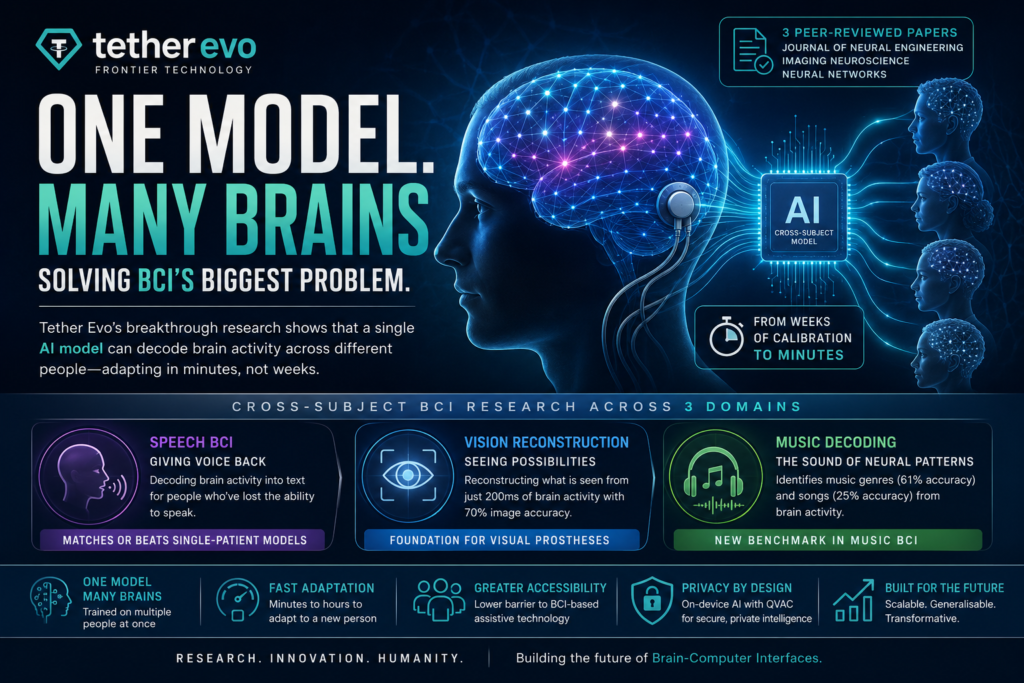
Imagine losing the ability to speak after a stroke, but still being able to “talk” through a device that reads your brain activity directly, and imagine that device working within minutes of being switched on, instead of after weeks of painstaking calibration. That is the real-world promise behind Tether Evo’s newest work in brain-computer interfaces. Tether Evo, the frontier technology division of Tether, has had three peer-reviewed papers accepted at the Journal of Neural Engineering, Imaging Neuroscience, and Neural Networks, and together they show that a single AI model can be trained to read brain activity across different people, instead of being rebuilt from scratch for every new patient.
This matters because every human brain produces slightly different electrical and imaging signals, even when two people are doing the exact same task. Until now, that variability has forced researchers to build and calibrate a new brain-computer interface model for each individual patient. Tether Evo’s research, two of the three papers developed in collaboration with the University of Rome Tor Vergata (UniTOV), tackles this “one brain, one model” bottleneck head-on across three very different domains: speech, vision, and music.
For students and young professionals in Odisha and across India who are tracking where applied AI is headed next, this is a useful case study. It shows how techniques from machine learning, alignment, generalisation, transfer learning, are being applied to one of the hardest data problems in science: the human brain itself.
What Are Brain-Computer Interfaces, and Why Is Cross-Subject Decoding So Difficult?
Brain-computer interface (BCI) is a system that records electrical or imaging signals from the brain and translates them into commands, text, images, or other outputs a computer can use. In practice, this often means implanted electrodes or non-invasive scanners capturing neural activity while a person thinks, speaks, or perceives something, with an AI model decoding what that activity represents. BCIs are already being explored for restoring communication to people who have lost speech, for controlling prosthetic limbs, and for research into vision and memory.
Why does every brain produce different signals? Because implantation location, individual brain anatomy, and each person’s unique learning history all shape how neural activity is expressed, even for the same task like saying a word or recognising an image. Two patients with electrodes in similar regions can still generate signal patterns that look meaningfully different to a decoding model, which is why brain-computer interface systems have traditionally needed patient-specific training.
This is the core challenge Tether Evo’s new research addresses. Instead of accepting that every brain-computer interface has to be trained from zero for each new user, the researchers asked whether a single model could learn the shared structure across many brains and then adapt quickly to a new one.
Tether Evo’s Breakthrough: One Model, Many Brains
Tether Evo specialises in BCI and neuroprosthetics as part of Tether’s broader push into the intersection of biology and machine intelligence, building what it describes as local-first, high-performance systems intended to preserve personal autonomy. Across all three new papers, the researchers used a similar strategy: rather than treating each patient or subject as an isolated case, they trained one model on data from multiple people at once, using a lightweight mathematical realignment step to bring different brains’ signals into a shared representational space.
Neural alignment is the technique of mathematically adjusting brain-signal data from different individuals so that a single AI model can interpret them within a common “coordinate system.” Think of it like translating several regional dialects into one shared language before teaching a single translator, once the signals are aligned, one model can learn patterns that generalise across people rather than memorising the quirks of just one.
Does this actually work as well as models built for a single patient? According to Tether Evo’s published results, the cross-subject models matched or beat the accuracy of today’s single-patient brain-computer interface systems, while adapting to a brand-new person in minutes to hours rather than the lengthy calibration period such systems have traditionally required.
That calibration gap is not a minor detail. Long calibration times are one of the biggest reasons brain-computer interface technology hasn’t moved faster from research labs into real-world clinical use. If a pre-trained model can be fine-tuned for a new patient quickly, the entire pipeline from lab result to usable assistive device gets meaningfully shorter.
Three Papers, Three Domains: Speech, Vision, and Music
Tether Evo’s cross-subject approach wasn’t tested in just one setting. The three accepted papers apply the same underlying alignment idea to three very different kinds of brain activity, which is part of what makes this brain-computer interface research notable, it suggests the technique generalises, not just the model.
Speech BCI: Giving a Voice Back to People Who’ve Lost It
The paper “Cross-subject decoding of human neural data for speech brain computer interfaces,” accepted at the Journal of Neural Engineering, focuses on people who have lost the ability to speak due to ALS (a progressive motor-neuron disease), stroke, or traumatic brain injury. The goal is to let a brain-computer interface read a person’s brain activity and decode it directly into text, effectively restoring communication.
Previously, these speech-decoding systems had to be built separately for every single patient because each person’s neural signals for speech are different. Tether Evo’s paper proposes what it describes as the first cross-subject neural-to-phoneme decoding model trained on invasive recordings from multiple participants who had electrodes implanted in different cortical regions. Rather than isolating each patient’s data, the model leverages shared speech patterns across participants, using a lightweight realignment step plus a new layered decoding network so one decoder can be quickly adapted for each new patient. This is a meaningful step for anyone interested in assistive technology and accessibility-focused AI.
BCI for Vision Reconstruction
The second paper, “A Modular Semantic-Structural Pipeline for Visual Decoding from Primate Spiking Data via Selective Temporal Integration,” accepted at Imaging Neuroscience, moves from speech into vision. Researchers from Tether Evo and UniTOV recorded brain signals from macaques (a type of primate commonly used in neuroscience research) as they viewed thousands of images, then reconstructed what the animals were seeing based purely on that neural activity.
From just 200 milliseconds of neural data, the model correctly picked out the exact image among thousands with 70% accuracy, and it generated a plausible visual reconstruction that captured the shape, colour, and content of what was actually being viewed. The long-term goal here is visual restoration research, laying groundwork for future cortical visual prostheses and closed-loop brain-computer interface systems that could eventually help patients with vision loss.
The Role of BCI in Music
The third paper, “R&B – Rhythm and Brain: Cross Subject Decoding of Music from Human Brain Activity,” accepted at Neural Networks, applies the same cross-subject alignment approach to music perception. Researchers recorded fMRI brain scans (functional MRI, a non-invasive imaging technique that measures blood flow changes linked to brain activity) from five people as they listened to 540 songs spanning 10 genres, then built a model that translates that neural activity into an AI representation of the music itself.
How accurate was the music-decoding brain-computer interface? Using the cross-subject alignment technique, the model identified the correct genre being heard about 61% of the time, compared with just 10% by random chance, and it pinpointed the exact song among 60 candidates roughly 25% of the time, versus under 2% by chance, a new benchmark for this specific decoding task. The results also mapped which brain regions were doing the work, pointing to auditory areas long associated with music perception, and found that classical and jazz produced the most distinctive brain signatures, while genres like metal and disco were more easily confused by the model.
How Does Cross-Subject BCI Compare to Traditional Single-Patient Approaches?
| Factor | Traditional Single-Patient BCI | Tether Evo’s Cross-Subject BCI |
| Training data | Built from scratch per patient | Trained on multiple people at once |
| Calibration time | Weeks of patient-specific tuning | Minutes to hours to adapt to a new person |
| Generalisation | Doesn’t transfer between patients | Uses shared neural patterns across subjects |
| Scalability | Limited, new build for every user | Higher, one base model, fast adaptation |
| Domains tested | Typically one task at a time | Speech, vision, and music in separate papers |
| Peer review status | Varies by lab/study | Accepted at Journal of Neural Engineering, Imaging Neuroscience, and Neural Networks |
This comparison is why cross-subject decoding is being described as one of the biggest open challenges in brain-computer interface research finally showing a workable path forward, rather than simply another performance benchmark.
Why This Matters for the Future of Brain-Computer Interfaces
Calibration time has long been one of the single biggest barriers to real-world brain-computer interface adoption. Every extra week a patient spends calibrating a device is a week they remain without a functioning communication tool, a controllable prosthetic, or a restored sense. Tether Evo’s research suggests that shifting from single-patient models to cross-subject models trained on shared neural structure could meaningfully compress that timeline.
A few reasons this direction matters beyond the three papers themselves:
- Faster deployment: Models that adapt in minutes to hours, rather than weeks, could move brain-computer interface systems from research settings into practical clinical use much sooner.
- Broader accessibility: A model that doesn’t need to be built from zero per patient lowers the resource and expertise barrier to offering BCI-based assistive technology.
- Cross-domain validation: Because the same alignment technique worked for speech, vision, and music, it strengthens the case that this is a generalisable method rather than a one-off result.
- Peer-reviewed rigor: All three papers were accepted at recognised, peer-reviewed venues in neural engineering and neuroscience, which matters for scientific credibility in a field prone to hype.
- Foundation for future prosthetics: The vision-decoding work explicitly points toward future cortical visual prostheses and closed-loop BCIs, suggesting this research is a building block, not an endpoint.
What This Means for AI, Privacy, and On-Device Intelligence
Tether frames this brain-computer interface research within a broader philosophy that “nothing is more private than your own information.” In line with that, Tether has built QVAC, its open-source on-device AI stack, designed so intelligence can run privately and locally on a device rather than depending on centralised cloud infrastructure. This connects to Tether’s wider portfolio of self-owned, decentralised tools spanning technology, wallets, and developer tooling.
For a brain-computer interface, this privacy angle is not incidental, neural data is arguably the most personal data a system can collect, since it’s derived directly from a person’s own brain activity. As BCI systems move from labs into real-world assistive devices, questions about who controls that neural data, and where it’s processed, are likely to become just as important as the underlying decoding accuracy.
Where Does This Fit in the Broader BCI Landscape?
Tether Evo isn’t the only player working on BCI technology. Companies like Neuralink and Synchron have drawn attention for implant-based systems that let paralysed patients control cursors and devices with thought alone, while academic labs around the world continue to publish incremental gains in decoding accuracy. What sets Tether Evo’s contribution apart is not the hardware but the modelling approach: most publicised BCI demos still rely on models trained and calibrated for one specific patient.
Why does a shared, cross-subject model matter more than raw accuracy numbers? Because accuracy alone doesn’t solve the deployment problem. A BCI system that performs brilliantly for one person but takes weeks to rebuild for the next person will always struggle to scale beyond a handful of research participants. Tether Evo’s papers matter precisely because they attack the scalability bottleneck, not just the accuracy ceiling, and they do it across three separate signal types (invasive speech recordings, primate spiking data, and non-invasive fMRI), which is a broader validation than most single-domain BCI studies attempt.
For students following India’s own AI and health-tech research ecosystem, this cross-domain generalisation is the part worth paying attention to. It’s the same underlying lesson from large language models, that a foundation model trained on diverse data can outperform many narrow, task-specific models, now being tested rigorously in neuroscience.
A few practical takeaways for anyone tracking applied AI research in this space:
- Cross-subject BCI models are being validated in peer-reviewed venues, not just company blog posts or investor decks, which adds scientific weight to the claims.
- The same alignment technique generalising across speech, vision, and music suggests the method itself, not just the specific dataset, is the real breakthrough.
- Shorter calibration times could eventually make BCI-based assistive devices realistic for far more patients than today’s small research cohorts.
- Privacy-by-design choices, like Tether’s on-device QVAC stack, are becoming part of the conversation alongside decoding accuracy, since neural data is uniquely sensitive.
- BCI research is increasingly a collaboration between industry labs (like Tether Evo) and universities (like UniTOV), a pattern worth watching for anyone interested in how applied research gets funded and published today.
FAQ: Tether Evo’s Brain-Computer Interface Research
What is Tether Evo? Tether Evo is Tether’s frontier technology division focused on the intersection of biology and machine intelligence, specialising in brain-computer interfaces and neuroprosthetics, with an emphasis on local-first, high-performance systems.
What did Tether Evo’s new research actually prove? It showed that a single AI model, trained with a lightweight neural alignment technique, can learn to decode brain activity across multiple different people, instead of needing a separate model built from scratch for every patient, across three domains: speech, vision, and music.
Why has cross-subject decoding been such a hard problem in brain-computer interface research? Because every person’s brain produces different signals due to variation in implantation location, individual brain anatomy, and personal learning history, even for the same task, which has historically forced patient-specific model training.
How accurate is Tether Evo’s speech brain-computer interface? The paper reports that the cross-subject model matches or beats the performance of existing single-patient speech BCI systems, while adapting to a new person in minutes to hours instead of the usual lengthy calibration process.
What was the accuracy of the vision-reconstruction brain-computer interface? Using just 200 milliseconds of neural data from macaques viewing images, the model correctly identified the exact image among thousands with 70% accuracy and produced a plausible visual reconstruction of what was being seen.
Where were Tether Evo’s brain-computer interface papers published? The three papers were accepted at the Journal of Neural Engineering, Imaging Neuroscience, and Neural Networks, with two developed in collaboration with the University of Rome Tor Vergata (UniTOV).
Who could benefit most from this brain-computer interface research? People who have lost the ability to speak due to ALS, stroke, or brain injury are the most direct beneficiaries of the speech-decoding work, while the vision research lays groundwork for future prosthetics for patients with vision loss.
Keep Exploring AI Research That Matters
Brain-computer interfaces are a reminder that the same alignment and generalisation ideas driving today’s large language models are now reshaping neuroscience and assistive technology too. If you’re a student or young professional in Odisha curious about how applied AI research like this gets built, explore Kalinga.ai’s AI training programs and ongoing coverage of frontier AI breakthroughs.