File Name: faraday-ai-agent-inherent-london-startup.jpg
Title: Faraday AI Agent by Inherent Startup
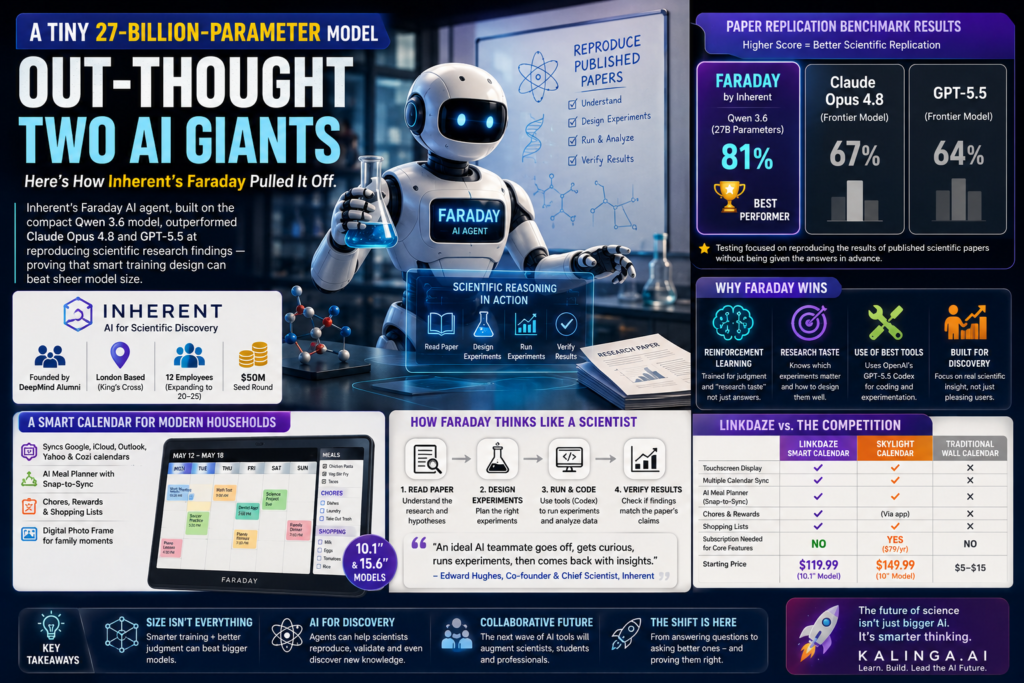
Caption: A tiny 27-billion-parameter model just out-thought two AI giants , here’s how Inherent’s Faraday pulled it off.
Description: This image represents Inherent’s AI agent Faraday, built on the compact Qwen 3.6 model, going up against larger frontier systems like Claude Opus 4.8 and GPT-5.5. It visually ties to the article’s core theme , that smart training design, not sheer model size, helped Faraday outperform bigger rivals at reproducing scientific research findings.
Alt Text: Faraday AI agent by Inherent outperforming larger AI models in scientific research replication
Picture a 27-billion-parameter AI agent walking into a room full of frontier-scale giants , and walking out having out-performed them. That’s essentially what happened when London startup Inherent tested its new Faraday AI agent against Anthropic’s Claude Opus 4.8 and OpenAI’s GPT-5.5 on a scientific reasoning task. Faraday, built on the comparatively small Qwen 3.6 model, reproduced the findings of published scientific papers more effectively than these much larger systems , a result Inherent says came less from brute computing power and more from how the agent was trained to think like a scientist.
If you’re a student or young professional in India tracking where AI research is headed next, this story matters. It’s a signal that the next wave of breakthroughs may not come from simply building bigger models, but from teaching smaller ones better judgment. Let’s unpack what happened, why it matters, and what it tells us about the future of AI research careers.
What Is Inherent, and Why Is Everyone Suddenly Talking About It?
Inherent is an AI research lab founded by alumni of Google DeepMind, based in London. Unlike many AI startups that chase flashy consumer products, Inherent’s stated mission is building AI systems capable of discovering new scientific knowledge , not just answering questions about existing science.
The company had largely stayed out of the spotlight since launching, especially compared to better-funded rivals. That changed when it emerged from stealth with a $50 million seed round and, just weeks later, released Faraday , its first public AI agent.
Who founded Inherent? The startup was co-founded by four Google DeepMind alumni: Edward Hughes (chief scientist), Louis Kirsch, Kaloyan Aleksiev, and Tantum Collins. Hughes has been the company’s public face, explaining Faraday’s design choices and the philosophy behind them in interviews with outlets like TechCrunch.
The team is small , just a dozen employees, all working in person from an office in King’s Cross, London. Inherent plans to grow to roughly 20 to 25 employees by the end of the year, positioning itself to absorb AI talent from bigger labs undergoing internal shifts.
How Does the Faraday AI Agent Actually Work?
Faraday is an AI agent designed to independently reproduce the results of published scientific papers without being told the correct answer in advance. Think of it as an AI intern who reads a research paper, designs experiments to test its claims, and checks whether the original findings hold up , entirely on its own.
This isn’t a random benchmark choice. Paper replication is a classic training exercise for human scientists too. As Hughes put it, many PhD students actually begin their research careers by trying to reproduce someone else’s published work before attempting anything original.
Why does replication matter as a test for AI? Because it forces the agent to demonstrate genuine scientific reasoning rather than pattern-matching to memorized answers. An agent that can only recite known facts will fail at replication , it has to actually design and interpret experiments, much like a real researcher would.
The “Research Taste” Problem
One of Inherent’s more interesting design goals wasn’t just getting Faraday to the right answer , it was teaching the agent research taste: an instinct for which experiments are worth running and how to design them well. Research taste is the intangible judgment that separates a productive scientist from one who runs technically correct but low-value experiments.
Teaching “taste” is notoriously hard to do through explicit rules, so Inherent turned to reinforcement learning (RL) , a training method that rewards an AI system for good outcomes rather than programming it with rigid instructions to follow.
What is reinforcement learning, in plain terms? It’s a training approach where an AI system learns by trial and error, receiving rewards for actions that lead to good outcomes and no reward (or a penalty) for actions that don’t. Over many iterations, the system develops strategies that consistently produce better results , in Faraday’s case, better scientific judgment rather than just correct final answers.
Inherent made a deliberate bet here: rather than training Faraday primarily by studying how science is conducted (i.e., textbooks and methodology), it leaned on RL, wagering this approach would generalize better across many different scientific fields as the agent tackles new kinds of problems in the future.
Faraday vs. Claude Opus 4.8 vs. GPT-5.5: How Did a Smaller Model Win?
This is the part that should catch any investor’s , or AI enthusiast’s , attention. Faraday runs on Qwen 3.6, an open model with just 27 billion parameters. For context, parameters are a rough proxy for a model’s size and, generally, how expensive it was to train. Both Claude Opus 4.8 and GPT-5.5 are frontier-scale systems, widely understood to be dramatically larger than a 27B-parameter model.
Despite this size gap, Faraday reportedly outperformed both larger systems at the paper-replication task, according to Inherent. Hughes was careful to note, however, that beating rival agents wasn’t really the point of the exercise , it was validating how Inherent built its training pipeline in the first place.
| Aspect | Faraday (Inherent) | Claude Opus 4.8 (Anthropic) | GPT-5.5 (OpenAI) |
| Base model | Qwen 3.6 (~27B parameters) | Frontier-scale, larger | Frontier-scale, larger |
| Primary design goal | Scientific paper replication + “research taste” | General-purpose frontier assistant | General-purpose frontier assistant |
| Training emphasis | Reinforcement learning for judgment/taste | Broad pretraining + alignment | Broad pretraining + alignment |
| Coding tool used | OpenAI’s GPT-5.5 Codex (borrowed, not built in-house) | Native coding capability | Native coding capability (Codex) |
| Result in Inherent’s test | Outperformed both on paper-replication task | Underperformed Faraday on this specific task | Underperformed Faraday on this specific task |
It’s worth being precise about what this comparison does and doesn’t show: this is one specific benchmark (scientific paper replication) reported by Inherent itself, not an independent third-party evaluation across general capabilities. Claude Opus 4.8 and GPT-5.5 remain far more capable general-purpose systems overall. What the result does suggest is that smart training design can sometimes close , or even flip , a capability gap on a narrow, well-defined task.
Notably, Inherent didn’t try to build everything from scratch. Rather than developing its own coding tool, Faraday uses OpenAI’s GPT-5.5 Codex to write and execute code during experiments , much the way human scientists rely on existing software instruments instead of building every tool themselves.
Why “Research Taste” Might Matter More Than Raw Accuracy
What is Inherent actually trying to avoid building? According to Hughes, the company is wary of creating agents that simply tell users what they want to hear , a common failure mode in AI systems tuned too heavily for user approval. Instead, Inherent’s north star is an agent that behaves like a genuinely curious research collaborator.
Hughes described his ideal AI teammate as one that comes back and says something like: “I got curious about this, and I went off and did these experiments , what do you think?” That’s a meaningfully different posture than an assistant that only answers exactly what’s asked and nothing more.
This distinction matters because it points to where the AI industry may be heading next:
- From answer-generation to hypothesis-generation , agents that propose their own experiments, not just respond to prompts.
- From size-scaling to training-method innovation , smaller, cheaper models trained smarter rather than simply scaled up.
- From sycophancy to genuine pushback , systems designed to challenge assumptions rather than validate them.
- From isolated tools to compound systems , agents like Faraday borrowing capabilities (e.g., Codex) from other providers rather than reinventing everything.
The London Angle: Talent, “Garden Leave,” and the AI Hub Race
Inherent’s story is also a window into how the UK’s AI talent market works , and where it’s struggling to compete with the US. Hughes has been vocal about London’s advantages, citing the city’s density of AI talent as a reason Inherent chose to build there, pointing to King’s Cross specifically as a neighborhood transformed into a leading AI hub partly due to Google DeepMind’s presence.
What is “garden leave,” and why does it matter for AI hiring? Garden leave is a common UK practice where departing employees are barred from joining or starting a rival company for several months after resigning. Hughes has personally called for ending this practice, noting that American researchers generally don’t face an equivalent restriction , giving US startups a hiring advantage over UK ones when poaching talent from competitors.
Hughes has said this is a personal view rather than an official company position, but he acknowledged being personally affected by the garden-leave restriction before eventually starting Inherent with his co-founders. With reports of unsettled staff at Google DeepMind following leadership changes, Inherent’s ongoing hiring push could make it an attractive landing spot for researchers considering a move , assuming the UK’s garden leave norms don’t slow that transition down.
What This Means for Students and Early-Career Professionals in India
If you’re studying AI, machine learning, or computer science in India, the Faraday story offers a few practical takeaways:
- Model size isn’t destiny. Smaller, well-trained models can outperform giants on specific, well-designed tasks , meaning research careers in training methodology and reinforcement learning remain highly valuable, not just careers in scaling infrastructure.
- “AI scientist” is becoming a real specialization. Roles focused on using AI to accelerate scientific discovery (not just chatbots or coding assistants) are an emerging niche worth watching.
- Reinforcement learning skills are in demand. Understanding RL concepts , reward design, training loops, evaluation methodology , is increasingly relevant beyond robotics and games.
- Compound AI systems are the norm now. Faraday combining its own reasoning with an external coding tool (GPT-5.5 Codex) reflects a broader industry shift toward agents that orchestrate multiple tools rather than doing everything in one model.
FAQ: Faraday, Inherent, and the AI Research Landscape
What is the Faraday AI agent? Faraday is an AI agent built by London startup Inherent, designed to independently reproduce the results of published scientific papers without being told the answers in advance, as a step toward broader scientific discovery capabilities.
What model does Faraday run on? Faraday runs on Qwen 3.6, a comparatively small open model with about 27 billion parameters , far smaller than frontier-scale systems like Claude Opus 4.8 or GPT-5.5.
Did Faraday really beat Claude Opus 4.8 and GPT-5.5? According to Inherent, Faraday outperformed both larger models specifically on the task of reproducing scientific paper findings with “research taste.” This is a single benchmark reported by the company itself, not an independent, comprehensive comparison of overall model capability.
Who founded Inherent, and where is it based? Inherent was founded by four Google DeepMind alumni , Edward Hughes, Louis Kirsch, Kaloyan Aleksiev, and Tantum Collins , and is based in King’s Cross, London.
How much funding has Inherent raised? Inherent raised a $50 million seed round shortly before emerging from stealth and releasing Faraday.
What is “research taste” in AI, and why does it matter? Research taste refers to an AI system’s judgment about which experiments are worth running and how to design them well , a quality Inherent trained into Faraday using reinforcement learning rather than explicit rules, aiming for better generalization across scientific fields.
Keep Exploring AI Breakthroughs with Kalinga.ai
Stories like Faraday’s are a reminder that the AI race isn’t only about who builds the biggest model , it’s about who teaches judgment best. If you want to keep up with developments like this and build practical AI skills of your own, explore Kalinga.ai’s ongoing workshops and resources on AI research trends.
Keyword Categorization
Primary Keyword
- Faraday AI Agent
Secondary Keywords
- Inherent AI
- Faraday AI
- AI scientific research
- AI research agent
LSI / Long-Tail Keywords
- how Faraday AI Agent works
- Faraday AI Agent 27B model
- Faraday AI Agent vs GPT-5.5
- AI agent for scientific paper replication
Meta Title
Faraday AI Agent: Best Science AI Breakthrough 2026
meta description: Faraday, a 27B-parameter AI agent by London startup Inherent, outperformed Claude Opus 4.8 and GPT-5.5 at scientific paper replication.
URL slug: /faraday-ai-agent-inherent-explained