File Name: chimpanzee-stone-throwing-cultural-behavior.jpg
Title: Chimpanzee Stone Throwing Cultural Behavior
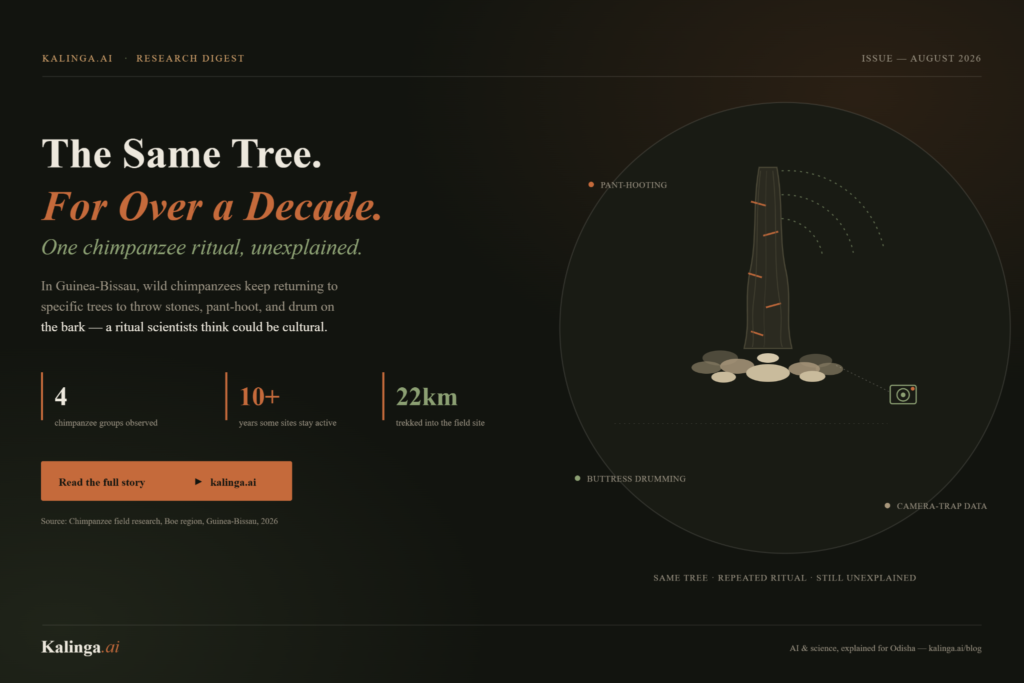
Caption: Why do chimpanzees keep throwing rocks at the same trees? Scientists are investigating a mysterious behavior that may reveal animal culture.
Description:
The landscape graphic should depict a wild western chimpanzee throwing a rock toward a distinctive, scarred tree surrounded by accumulated stones in the savanna-woodland of West Africa. The visual should highlight chimpanzee stone throwing, repeated site use, and the possible connection to animal communication and cultural behavior explored in the article.
Alt Text: Chimpanzee stone throwing at a marked tree shows a possible cultural behavior in West Africa.
Planned Structure
- H2: What Is Accumulative Stone Throwing?
- H2: Why Do Chimpanzees Keep Returning to These Trees?
- H2: Is Chimpanzee Stone Throwing a Cultural Behavior?
- H2: How Scientists Are Studying the Mysterious Ritual
- H2: What Could the Rock-Throwing Behavior Communicate?
- H2: Chimpanzee Stone Throwing vs. Other Stone Tool Use
- H2: Why These Chimpanzee Sites Matter for Human Evolution
- H2: How Bauxite Mining Could Threaten Chimpanzee Cultural Sites
- H2: What Researchers Still Don’t Know
- H2: Frequently Asked Questions About Chimpanzee Stone Throwing
- H2: Why a Pile of Rocks Could Be More Important Than It Looks
5 Focus Keywords
- Primary Keyword: chimpanzee stone throwing
- accumulative stone throwing
- chimpanzee cultural behavior
- chimpanzee communication
- chimpanzee tool use
Why Are Chimpanzees Throwing Rocks at the Same Trees?
Imagine walking through a West African woodland and finding a tree covered in scars, with a pile of rocks gathered around its base. The strange part isn’t the rocks—it is that wild chimpanzees have been repeatedly throwing stones at particular trees and returning to some of the same sites for more than a decade.
Researchers studying western chimpanzees in Guinea-Bissau believe this unusual behavior, known as accumulative stone throwing, could be a form of chimpanzee cultural behavior and communication. The animals often combine the rock throwing with loud pant hoots and rhythmic strikes against the tree, creating a ritual that looks very different from ordinary stone use for finding food.
Scientists still do not know exactly what the behavior means to the chimpanzees.
It could help communicate across a territory, identify important locations, attract or influence other chimpanzees, or have some symbolic significance. New camera-trap and audio recordings are now helping researchers investigate who performs the behavior, who watches, and what happens afterward.
The discovery is fascinating not only because chimpanzees are using rocks in an unusual way, but because it could provide clues about how complex communication, social traditions, and material culture evolved in our own distant past.
What Is Accumulative Stone Throwing?
Accumulative stone throwing is a behavior in which chimpanzees repeatedly throw rocks at particular trees, gradually creating accumulations of stones around those trees.
Unlike throwing a rock to crack a nut or obtain food, this behavior appears to occur in a social and territorial context. Researchers have observed western chimpanzees throwing stones at specific trees, returning to the same locations, and sometimes accompanying the throws with vocalizations and drumming.
The result can be surprisingly durable.
Some sites identified by researchers years ago were still being used during recent fieldwork, meaning individual locations can remain part of chimpanzee activity for more than a decade.
Question: Are chimpanzees randomly throwing rocks?
Evidence suggests they are not simply throwing stones at whatever tree happens to be nearby.
The behavior is associated with specific trees and recurring sites. The limited distribution of these locations is one reason researchers suspect the behavior could be culturally transmitted rather than simply caused by the availability of rocks and suitable trees.
That distinction is important.
If rocks and trees were the only requirements, scientists would expect the behavior to occur much more widely wherever those environmental conditions exist. Instead, accumulative stone throwing has been observed in only four chimpanzee groups in West Africa to date, according to the research described in the source material.
This unusual distribution makes the behavior particularly interesting to scientists studying animal culture.
Why Do Chimpanzees Keep Returning to These Trees?
The repeated use of the same trees is one of the biggest mysteries surrounding chimpanzee stone throwing.
Researchers have found trees with accumulated rocks around their bases and physical marks on their trunks. Those marks can be accompanied by evidence that chimpanzees have repeatedly interacted with the same location.
The behavior also appears to involve more than simply throwing.
Chimpanzees have been observed pant hooting, a loud vocal display that can carry over long distances. They may also repeatedly strike their hands and feet against the tree in a behavior known as buttress drumming.
Together, these actions make the scene look more like a coordinated display than an isolated act of throwing.
Question: Why would a chimpanzee throw a rock at a tree instead of using it as a tool?
Researchers don’t yet have a definitive answer, but the combination of repeated site use, vocalization, drumming, and stone throwing suggests the behavior may have a social or communicative function.
One possibility is that the trees act as important landmarks.
If a chimpanzee repeatedly visits a particular location and produces loud sounds there, the site could potentially help communicate information to other members of the community or neighboring groups.
Another possibility is that the accumulated stones themselves have significance.
The researchers emphasize that they still do not know what these sites mean from the chimpanzees’ perspective. Any explanation about symbolism, territorial marking, or communication therefore remains a hypothesis rather than a confirmed interpretation.
Is Chimpanzee Stone Throwing a Cultural Behavior?
The strongest scientific interest in chimpanzee stone throwing comes from the possibility that it represents culture in a non-human animal.
Culture, in this context, does not mean art, language, or civilization. In animal behavior research, it can refer to behaviors that are socially learned and maintained within particular groups or populations rather than being explained entirely by genetics or the environment.
Definition + Expansion: Animal culture
Animal culture refers to socially learned behaviors that are shared within a group or population and can persist across generations.
Chimpanzees are already known to exhibit group-specific behaviors. Different communities can have different traditions involving tool use, communication, grooming, feeding, and other social activities.
Accumulative stone throwing could represent another example of this phenomenon if researchers can establish that the behavior is socially transmitted and maintained within particular chimpanzee communities.
Question: Why do scientists think this behavior could be cultural?
Researchers point to its limited geographic distribution and the fact that simply having rocks and suitable trees does not appear to guarantee that chimpanzees will create these sites.
That pattern is consistent with the possibility that chimpanzees learn the behavior socially.
However, scientists still need more evidence to establish exactly how the behavior spreads, whether younger chimpanzees learn it from older individuals, and whether different groups have distinct versions of the behavior.
That is why observing the animals directly is so important.
How Scientists Are Studying the Mysterious Ritual
Studying wild chimpanzees can be difficult, particularly when the animals are not accustomed to human observers.
The chimpanzees in the Boé region are unhabituated, meaning they are not used to people closely observing them. If researchers approach them on foot, the animals may simply flee.
So instead of following individual chimpanzees through the forest, scientists are allowing technology to do the watching.
Camera traps provide the eyes
Researchers placed two video cameras at each accumulative stone throwing site.
The cameras can record activity without requiring researchers to be physically present. This makes it possible to observe natural behavior that might otherwise remain hidden.
The team also placed audio-recording equipment around the sites.
The combination is particularly useful because the researchers are interested not only in what chimpanzees do but also in how they sound and how nearby animals respond.
Fieldwork goes beyond cameras
During their expedition, researchers traveled into the savanna-woodland of Boé chimpanzee territory in Guinea-Bissau.
From the village of Béli, the team cycled and hiked approximately 22 kilometers into the landscape to establish a bush camp.
On typical field days, researchers visited between two and five sites, replacing camera batteries and memory cards and checking the equipment.
They also collected additional information, including:
- Tree measurements
- Three-dimensional scans of rocks thrown at trees
- Chimpanzee nests
- Feeding signs
- Vocalizations
- Wildlife sightings
- Evidence of chimpanzee activity
These observations can help researchers connect the physical evidence at each site with the behavior that produced it.
Question: What can the new recordings reveal?
The recordings can help scientists determine the age and sex of the chimpanzee performing the behavior, as well as whether other chimpanzees are nearby and how they respond.
That information could be crucial.
For example, if mostly adult males perform the behavior while other chimpanzees consistently respond in particular ways, that could support one interpretation. If individuals of different ages and sexes participate differently, it could point toward another social function.
The researchers are essentially trying to reconstruct the social context surrounding each stone-throwing event.
What Could Chimpanzee Stone Throwing Communicate?
There is no confirmed single explanation yet.
Researchers have proposed several possibilities, including communication, territorial signaling, and potentially symbolic functions.
The presence of pant hooting and buttress drumming is especially significant because both are already associated with male chimpanzee displays.
This raises an intriguing possibility: accumulative stone throwing may be a modification or extension of an existing social behavior.
1. Territorial signaling
Chimpanzees live in social communities with territories that can overlap or come into contact with neighboring groups.
A conspicuous tree surrounded by stones could potentially function as a landmark.
If chimpanzees repeatedly make loud displays at that location, the site might help communicate information across the landscape.
But researchers have not yet established that these sites function specifically as territorial boundaries.
2. Long-distance communication
Pant hooting is a loud vocal signal capable of traveling over considerable distances.
Combining vocalization with stone throwing and tree drumming could potentially amplify or modify a display.
This is one reason the researchers are recording sound as well as video.
3. Social signaling
The behavior might also have a social function within the chimpanzee community.
Perhaps the identity, age, sex, or social status of the thrower matters. Perhaps nearby chimpanzees respond differently depending on who performs the behavior.
These are precisely the questions the new observations are designed to address.
4. Symbolic meaning
The most intriguing possibility is also the hardest to demonstrate.
Researchers have suggested that the sites might have a symbolic purpose, perhaps functioning as meaningful locations within chimpanzee territories.
But “symbolic” is a strong claim.
Scientists would need substantial behavioral evidence to establish that chimpanzees associate a physical object or location with an abstract meaning.
For now, symbolism remains a possibility rather than a proven explanation.
Chimpanzee Stone Throwing vs. Other Stone Tool Use
Chimpanzees are already famous for their ability to use objects as tools.
Some populations use stones to crack open hard-shelled foods such as nuts. In those cases, the purpose is relatively straightforward: the stone helps access food.
Accumulative stone throwing is different because the apparent goal is not food extraction.
| Behavior | Object Used | Apparent Purpose | Social Context |
| Nut cracking | Stone | Access food | Often individual or social |
| Stick tool use | Stick | Obtain food or other resources | Variable |
| Tree drumming | Hands/feet | Display or communication | Strong social component |
| Pant hooting | Vocal signal | Long-distance communication | Strong social component |
| Accumulative stone throwing | Rocks | Not yet established | Potentially communicative or territorial |
Question: Why is this unusual compared with normal chimpanzee tool use?
Most familiar examples of chimpanzee tool use are connected to practical tasks such as obtaining food.
Accumulated stone throwing appears to place stone use in a social context.
That makes it particularly valuable for researchers interested in the evolution of material culture.
The stones may not be functioning like conventional tools in the narrow sense. Instead, they could be part of a broader behavioral display involving objects, sounds, locations, and social interaction.
That combination is what makes the behavior so unusual.
What Does This Tell Us About Chimpanzee Communication?
Chimpanzees already have sophisticated communication systems involving vocalizations, gestures, facial expressions, body movements, and displays.
The unusual rock-throwing behavior could add another layer to that system.
Consider what happens at one of these sites: a chimpanzee arrives at a particular tree, throws stones, produces loud vocalizations, and may drum against the tree. If another chimpanzee is nearby, it may respond.
In other words, the behavior potentially combines object use, location, sound, movement, and social context.
Question: Could chimpanzees be communicating with objects?
Possibly, but researchers have not established that yet.
The accumulated rocks may simply be a byproduct of repeated throwing. Alternatively, their presence could contribute to the significance of the location.
Determining whether the stones themselves carry meaning will require observations of how chimpanzees behave around the sites over time.
This is where long-term research becomes especially important.
If a site remains active for more than a decade, it provides researchers with a rare opportunity to study how a material tradition persists within a wild chimpanzee population.
Why These Chimpanzee Sites Matter for Human Evolution
Chimpanzees are among our closest living evolutionary relatives.
That makes their behavior especially interesting to researchers trying to understand how some of the foundations of human behavior emerged.
Humans have an extraordinary relationship with objects.
We use tools, create landmarks, leave physical traces, communicate through symbols, and pass traditions between generations. Archaeologists also study stone artifacts and other durable materials to reconstruct the behavior of ancient humans.
Chimpanzee stone throwing offers a fascinating point of comparison.
Question: Can chimpanzee stone throwing explain how human culture evolved?
It cannot provide a direct answer, but it can offer clues about possible evolutionary building blocks.
If wild chimpanzees can socially maintain a behavior involving stones, specific locations, vocalizations, and repeated group traditions, it gives scientists another example of how complex behavioral traditions can emerge without human-level language or technology.
Researchers specifically hope the behavior can contribute to our understanding of the emergence of complex communication and stone tool use during human evolution.
The comparison must still be made carefully.
Modern chimpanzees are not living versions of our human ancestors. They have been evolving along their own path for millions of years.
But their behavior can help researchers test ideas about which abilities may have deeper evolutionary roots.
How Long Can a Chimpanzee Cultural Site Survive?
One of the most striking findings is the persistence of the stone-throwing locations.
Researchers revisited sites that had previously been identified by the Pan African Program and were revisited by their team in 2017.
Many of those sites were still being used during the team’s more recent fieldwork.
That means some locations can remain active for more than a decade.
This creates something unusual in the animal world: a durable physical record of repeated behavior.
Question: Why does a decade-long site matter?
A site that survives for years can preserve evidence of a behavioral tradition even when individual observations are rare.
The stones themselves become part of the landscape.
For researchers, that means the physical environment can provide clues about past chimpanzee activity, while cameras and microphones can reveal the behavior happening in the present.
This combination of archaeology-like evidence and modern behavioral observation is particularly powerful.
It also introduces a conservation concern.
If the habitat disappears, the researchers could lose not only individual animals but also physical evidence of their cultural traditions.
How Bauxite Mining Could Threaten Chimpanzee Cultural Sites
Chimpanzees in Guinea-Bissau face pressures from human activity, including extractive industries.
During their fieldwork, researchers encountered bore holes associated with bauxite mining exploration.
Bauxite is an important mineral resource and mining can create opportunities for economic development. But mining can also transform landscapes, destroy habitat, and create pollution that affects wildlife and local communities.
That creates a difficult conservation challenge.
Question: Why could mining threaten more than chimpanzee habitat?
Mining and other forms of habitat destruction can potentially eliminate places where chimpanzees maintain long-term cultural behaviors.
If a particular tree is an important stone-throwing site and the surrounding habitat is destroyed, the loss is not necessarily limited to one tree.
It could represent the disappearance of a location that has been part of a chimpanzee community’s behavioral tradition for many years.
Researchers describe this broader concern as the potential erasure of primate heritage.
That idea expands conservation beyond protecting animals and forests. It raises a question about whether conservation should also protect the cultural behaviors and physical sites associated with wild primate communities.
Why Primate Culture Matters for Conservation
Conservation has traditionally focused on populations, habitats, food sources, and genetic diversity.
But animals can also have behaviors that are socially learned and locally unique.
If those behaviors disappear, the species may survive biologically while losing part of its behavioral diversity.
Question: Can protecting animal culture strengthen conservation?
Potentially, yes.
Researchers have argued that cultural behaviors can help animals adapt to environmental changes and that recognizing cultural diversity can support conservation strategies.
For chimpanzees, this means protecting habitat could have benefits beyond maintaining population numbers.
It could also preserve the social traditions, communication patterns, and material behaviors that make individual communities distinctive.
In Guinea-Bissau, protecting chimpanzee habitat therefore has the potential to protect both wildlife and the cultural evidence accumulated within that landscape.
What Researchers Still Don’t Know
For all the excitement surrounding accumulative stone throwing, the central mystery remains unsolved.
Scientists still don’t know exactly why chimpanzees do it.
Several questions remain open:
- Which chimpanzees perform the behavior most often?
- Is it primarily performed by adult males?
- Do younger chimpanzees learn it by watching adults?
- Do neighboring chimpanzee communities have different versions of the behavior?
- Do chimpanzees respond when another individual throws stones?
- Do the trees have specific physical or geographic characteristics?
- Do the accumulated stones themselves matter?
- Is the behavior primarily communication, territorial signaling, social display, or something else?
- Could the behavior have more than one function?
Answering those questions will require more observations.
The current camera-trap and audio-recording approach gives researchers an opportunity to collect exactly the kind of evidence they need.
What Makes This Discovery So Fascinating?
The remarkable thing about chimpanzee stone throwing is not simply that an animal can pick up and throw a rock.
Humans have known for a long time that chimpanzees can manipulate objects and use tools.
What makes this behavior different is the apparent combination of repetition, location, social behavior, sound, and durable material traces.
A pile of stones at the base of a tree may look meaningless to a human passerby.
But if the same animals repeatedly return to that location, produce vocal displays, interact with the tree, and maintain the behavior over many years, the stones become evidence of a much larger behavioral story.
And that story could help researchers understand something fundamental: how animals create traditions and attach importance to places and objects.
Frequently Asked Questions About Chimpanzee Stone Throwing
Why do chimpanzees throw rocks at trees?
Scientists do not yet know exactly why chimpanzees throw rocks at particular trees. The behavior may have a communicative, territorial, social, or potentially symbolic function, but researchers need more behavioral evidence before confirming its purpose.
What is accumulative stone throwing?
Accumulative stone throwing is a behavior in which chimpanzees repeatedly throw rocks at specific trees, causing stones to accumulate around the tree bases. The behavior has been observed in a small number of chimpanzee groups in West Africa.
Is chimpanzee stone throwing a form of culture?
Researchers believe accumulative stone throwing may be a cultural behavior because it has a limited distribution and does not appear to occur simply wherever suitable rocks and trees are available. More research is needed to determine how the behavior is learned and maintained.
How long have chimpanzees used some of these stone-throwing sites?
Some sites identified in earlier research and revisited in 2017 were still being used during recent fieldwork. This indicates that certain accumulative stone-throwing locations can remain active for more than a decade.
How are scientists studying chimpanzee stone throwing?
Because the chimpanzees in the study area are not habituated to humans, researchers use camera traps and audio-recording devices rather than closely following the animals. The recordings can help identify the thrower’s age and sex and reveal how nearby chimpanzees respond.
Why is chimpanzee stone throwing important for human evolution?
The behavior could provide clues about the evolutionary roots of complex communication, socially learned traditions, and stone use. Researchers are particularly interested in whether such behaviors can help explain some of the foundations of human material culture.
Why a Pile of Rocks Could Be More Important Than It Looks
A pile of stones underneath a tree might seem like an ordinary feature of the landscape.
For researchers in Guinea-Bissau, however, it could be something much more valuable: a record of chimpanzee behavior that has persisted across years.
The mystery of chimpanzee stone throwing is still far from solved. Scientists have not established whether the behavior primarily communicates, marks territory, expresses social status, or carries a symbolic meaning.
But the evidence already shows that these chimpanzees repeatedly interact with particular trees, use stones in a distinctive social context, and maintain some sites for more than a decade.
That makes the behavior more than an odd animal habit. It could be a window into chimpanzee cultural behavior, the evolution of communication, and the importance of protecting not only endangered animals but also the traditions they carry.
For more fascinating explainers on animal intelligence, emerging science, and discoveries reshaping what we know about the natural world, explore more stories on Kalinga.ai.
SEO Meta Configuration
Keyword Categorization
Primary Keyword:
- chimpanzee stone throwing
Secondary Keywords:
- accumulative stone throwing
- chimpanzee cultural behavior
- chimpanzee communication
- chimpanzee tool use
LSI/Long-Tail Keywords:
- why do chimpanzees throw rocks at trees
- how chimpanzees use stones
- chimpanzee stone throwing cultural behavior
- why chimpanzees repeatedly throw rocks
Meta Title
Chimpanzee Stone Throwing: Ultimate 2026 Science Guid
SEO Meta Description: Discover why chimpanzee stone throwing may be a cultural behavior, as West African chimps return to the same trees for over a decade.
URL Slug: chimpanzee-stone-throwing