Can Odisha Become India’s Next Data Centre Powerhouse?
What happens when a mineral-rich state decides that its next big export should not just be raw materials, but compute, cloud infrastructure and semiconductor capabilities?
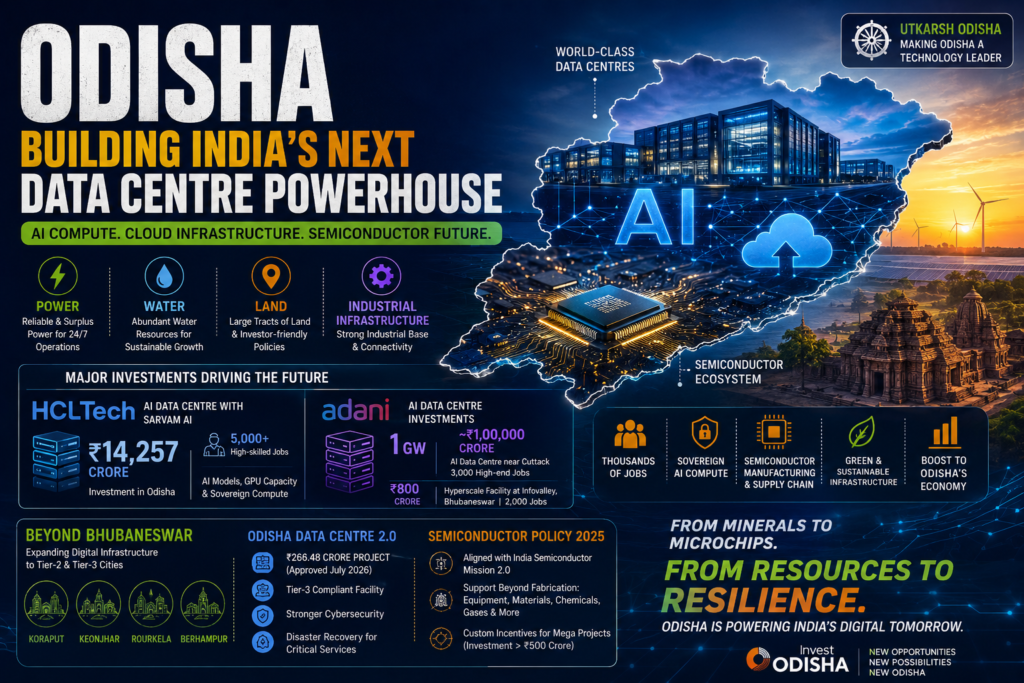
Odisha is betting that its combination of power, water, land, industrial infrastructure and policy incentives can make it a major technology hub in eastern India. The state’s strategy centres on attracting large-scale data centre and AI infrastructure investments while simultaneously building the foundations of a semiconductor supply chain.
At the heart of this ambition is the Odisha data centre strategy, supported by the state’s data centre policy framework, the Invest Odisha programme, proposed sovereign AI infrastructure and major investments from companies including HCLTech and Adani.
But turning infrastructure advantages into a technology powerhouse will require more than announcing large projects.
Fast approvals, skilled talent, reliable infrastructure, cybersecurity, renewable energy and successful project execution will determine whether Odisha can turn its AI and semiconductor ambitions into a durable technology ecosystem.
Why Is Odisha Betting on Data Centres and AI Infrastructure?
Odisha has historically built much of its industrial economy around natural resources, mining and metals. The state’s emerging technology strategy is attempting to build on that industrial base while moving further up the value chain.
Instead of simply extracting minerals, Odisha wants to create an ecosystem where infrastructure, digital services, computing and advanced manufacturing become increasingly important parts of the economy.
What is driving Odisha’s technology strategy?
The answer is a combination of two connected opportunities: AI infrastructure and semiconductors.
The first involves attracting data centres, cloud infrastructure and high-performance computing facilities. The second involves expanding semiconductor capabilities beyond chip fabrication into equipment, materials, chemicals, gases and other parts of the supply chain.
These two tracks are potentially complementary.
Modern AI systems require enormous amounts of computing infrastructure. Data centres require servers, networking equipment and advanced electronics. Semiconductor manufacturing, meanwhile, creates opportunities across the broader electronics ecosystem.
That creates a potential cycle:
Semiconductors → computing hardware → data centres → AI infrastructure → technology jobs and services.
Odisha’s challenge is to build enough of that ecosystem locally for the benefits to extend beyond individual projects.
What Makes Odisha Attractive for Data Centre Investment?
Why would a data centre operator choose Odisha over an established technology hub?
The state’s biggest pitch is not that it already has the largest technology ecosystem. Instead, Odisha is competing on fundamental infrastructure advantages, particularly power, water, land and industrial capacity.
Vishal Kumar Dev, Additional Chief Secretary of Odisha’s Electronics and Information Technology Department, described data centres as the “digital backbone” of the economy and said Odisha is positioning itself as a preferred destination for major investments in the sector.
The state’s geography and industrial history can potentially support this pitch.
Large data centres need significant amounts of electricity and water, suitable land, strong connectivity and reliable infrastructure. They also need regulatory certainty because projects can take years to build and require substantial upfront capital.
Odisha’s policy framework is therefore attempting to reduce some of the barriers that can slow infrastructure projects.
Definition: What is a data centre?
A data centre is a facility that houses computing, storage and networking infrastructure used to run digital services and applications.
Every time someone streams a video, uses a cloud application, accesses an online service or interacts with an AI system, computing infrastructure somewhere has to process that request. At large scale, this requires specialised facilities containing thousands of servers, cooling systems, power equipment and network connections.
AI makes the infrastructure requirement even more significant because training and running large AI models can require powerful GPUs and other specialised computing hardware.
How Is Odisha’s Data Centre Policy Supporting the Push?
The state’s Odisha State Data Centre Policy 2022, amended in 2026, forms an important part of the government’s strategy.
The original policy focused on creating the basic conditions for attracting data centre investments through fiscal incentives and business-friendly policies. The 2026 amendment places greater emphasis on building a unified data governance architecture and expanding digital infrastructure beyond the state capital.
The state’s data centre policy is also connected to its wider digital-government ambitions.
Odisha currently has more than 600 government applications, according to the information provided by the state government, creating a significant need for reliable computing, storage and digital infrastructure.
The policy’s longer-term direction includes moving some infrastructure toward tier-2 and tier-3 cities.
That could have an important economic effect.
If digital infrastructure is concentrated only in major metropolitan areas, technology investment can reinforce existing geographic inequalities. Distributing infrastructure across Odisha could instead create opportunities for smaller cities to participate in the state’s digital economy.
Key elements of Odisha’s approach include:
- Fiscal incentives for eligible data centre projects.
- Support for large-scale cloud and AI infrastructure.
- Expansion of government digital infrastructure.
- Greater focus on tier-2 and tier-3 cities.
- Single-window clearances for major projects.
- Development of sovereign AI computing capabilities.
- Stronger cybersecurity and disaster-recovery infrastructure.
- Potential integration of renewable energy into future facilities.
Eligible data centre projects can receive a 20% fixed capital investment subsidy, excluding land costs, subject to the stated cap of ₹25 crore per unit.
For capital-intensive infrastructure projects, incentives such as these can influence where companies decide to deploy new capacity.
The ₹14,257 Crore HCLTech Anchor Deal
What is the biggest announced technology investment at the centre of Odisha’s AI infrastructure push?
One of the most significant commitments is HCLTech’s proposed investment of approximately ₹14,257 crore in Odisha.
Under an MoU signed in July 2026, HCLTech is working with the Odisha government and Sarvam AI on an AI data centre within the proposed Odisha Sovereign AI Park.
The planned infrastructure is intended to support indigenous foundation models and large language models alongside GPU computing capacity.
That makes the proposal particularly relevant to India’s sovereign AI ambitions.
Rather than treating a data centre simply as a facility for conventional cloud applications, the proposed infrastructure is expected to serve government bodies, research institutions, startups and enterprises.
In other words, the objective is to build computing infrastructure that can become a shared foundation for an AI ecosystem.
The project is also expected to create more than 5,000 direct high-skilled jobs, alongside indirect employment across the surrounding technology ecosystem.
Why does the HCLTech investment matter?
The significance of the proposed investment goes beyond its headline value.
A large AI data centre can create demand for:
- Cloud and infrastructure engineers
- AI and machine learning professionals
- Data centre technicians
- Network engineers
- Cybersecurity specialists
- Electrical and power engineers
- Cooling and facilities specialists
- AI researchers
- Data engineers
- Operations and support professionals
That creates the possibility of a broader technology cluster forming around the infrastructure.
HCLTech also plans to establish a global delivery centre in Bhubaneswar, strengthening the city’s potential role as an AI and digital engineering hub.
If these projects progress as planned, the combination of computing infrastructure and technology services could create a stronger foundation for startups, GCCs and enterprise technology operations.
What Is Adani Planning in Odisha?
HCLTech is not the only major company associated with Odisha’s data centre ambitions.
The state has also cleared an Adani Group proposal for a 1 GW AI data centre near Cuttack, representing an estimated investment of approximately ₹1 lakh crore.
The proposed project is expected to generate around 3,000 high-end jobs.
The scale is notable because 1 GW represents an enormous amount of potential power capacity for computing infrastructure. AI data centres are becoming increasingly power-intensive as organisations deploy larger numbers of GPUs and other accelerators.
Adani has also been allotted land at Infovalley in Bhubaneswar for a hyperscale facility involving an investment of about ₹800 crore, with approximately 2,000 direct and indirect jobs expected from that project.
These proposals illustrate why the Odisha data centre story is attracting attention.
The state is attempting to position itself not simply as a location for one large facility, but as a destination where multiple forms of digital infrastructure can develop.
However, announced investments and operational capacity are not the same thing.
The real economic impact will depend on whether proposed projects reach construction, become operational and maintain high utilisation over time.
Why Bhubaneswar May Not Be the Whole Story
It would be easy to assume that Odisha’s technology ambitions begin and end with Bhubaneswar.
The state’s plans suggest otherwise.
Officials have discussed developing smaller edge data centres in Koraput and Keonjhar, with longer-term ambitions involving Rourkela and Berhampur.
This is significant because edge infrastructure can bring computing resources closer to where data is generated or consumed.
Definition: What is an edge data centre?
An edge data centre is a smaller computing facility located closer to users, devices or data sources than a centralised hyperscale facility.
For applications requiring low latency,meaning very little delay between a request and a response,placing computing infrastructure closer to users can be useful. Edge facilities can support applications such as smart infrastructure, industrial systems, government services and certain AI workloads.
Odisha’s distributed approach could therefore complement large hyperscale facilities rather than compete with them.
Question → Direct Answer: Why develop data centres outside Bhubaneswar?
Because distributed digital infrastructure can extend the benefits of computing investment beyond the state capital.
Developing facilities in cities such as Rourkela, Berhampur, Koraput and Keonjhar could support local government services, industrial applications and technology employment while reducing the concentration of digital infrastructure in one urban centre.
That also fits the state’s wider objective of building a statewide digital ecosystem.
Odisha State Data Centre 2.0: Building the Government Backbone
The private-sector investment story is only one side of Odisha’s infrastructure push.
The state itself is upgrading its digital backbone.
In July 2026, the Odisha government approved the establishment of Odisha State Data Centre 2.0 at a cost of ₹266.48 crore.
The project is expected to involve migration of existing government applications, stronger cybersecurity and a disaster-recovery facility for critical government services.
Why does this matter for AI?
AI applications depend on reliable underlying infrastructure.
A government cannot meaningfully deploy AI across departments if the systems containing its data are fragmented, poorly connected or difficult to secure.
The state’s data centre upgrade therefore creates a potential foundation for future applications such as:
- Odia-language citizen services
- AI-assisted government workflows
- Digital document processing
- Public-service chatbots
- Government knowledge systems
- Data analytics
- Disaster-response systems
- Automated administrative workflows
According to Odisha government officials, upgrading the state’s e-governance infrastructure to a tier-3 compliant facility is an immediate priority.
The broader ambition is to combine this government infrastructure with private investment, sovereign AI computing and local-language AI tools.
Why Sovereign AI Compute Matters
What does sovereign AI compute mean for Odisha?
Sovereign AI compute refers to computing infrastructure that gives an organisation or country greater control over where AI workloads are processed and how the underlying infrastructure is managed.
For governments and regulated organisations, that can be strategically important.
Instead of depending entirely on overseas cloud providers or external AI platforms, institutions can potentially deploy sensitive workloads on infrastructure under domestic or organisational control.
The proposed Odisha Sovereign AI Park is therefore more than a conventional data centre concept.
It is intended to support indigenous foundation models and LLMs, along with the GPU infrastructure needed to train and run them.
This could give Odisha a role in India’s emerging sovereign AI infrastructure layer.
The opportunity is especially relevant as governments, banks, healthcare organisations and large enterprises explore AI applications involving sensitive information.
But sovereign infrastructure alone does not guarantee data security.
Security also depends on access controls, encryption, monitoring, software security, identity management, governance and the people operating the systems.
The Semiconductor Track: Odisha Wants More Than Data Centres
Data centres are only half of Odisha’s technology strategy.
The state is simultaneously trying to develop a semiconductor ecosystem.
In 2026, Odisha’s Cabinet approved a third amendment to its Semiconductor Manufacturing & Fabless Policy 2025, aligning the state’s approach with the India Semiconductor Mission 2.0.
The revised strategy expands support beyond semiconductor fabrication.
That means the state is looking at the broader supply chain, including:
- Semiconductor equipment manufacturing
- Semiconductor-grade chemicals
- Industrial gases
- Materials
- Input suppliers
- Supporting manufacturing capabilities
- Other semiconductor supply-chain businesses
For mega projects involving investments above ₹500 crore in equipment, input supply chains or raw materials, Odisha plans customised incentives subject to approval.
This is an important shift in thinking.
Building a semiconductor ecosystem does not necessarily mean constructing a giant chip fabrication plant first.
A successful semiconductor cluster needs suppliers, materials, equipment, logistics, utilities, engineering talent and supporting businesses.
Why Are Data Centres and Semiconductors Connected?
Can Odisha’s semiconductor ambitions strengthen its data centre ambitions?
Potentially, yes.
Data centres require vast quantities of computing hardware. That hardware depends on semiconductors and advanced electronic components.
At the same time, semiconductor companies benefit from industrial ecosystems with reliable power, water, logistics, engineering talent and supporting suppliers.
This creates an opportunity for the two sectors to develop alongside each other.
The relationship can be visualised like this:
| Sector | Infrastructure Needed | Potential Odisha Opportunity |
| AI data centres | Power, water, land, GPUs, networks | Hyperscale and sovereign AI compute |
| Cloud infrastructure | Servers, connectivity, storage | Enterprise and government cloud |
| Semiconductors | Materials, chemicals, equipment, utilities | Supply-chain manufacturing |
| AI startups | Compute, talent, funding | Access to local infrastructure |
| Government AI | Secure compute and data | Sovereign public-sector applications |
| Digital engineering | Skilled workforce and connectivity | GCCs and technology delivery centres |
The state is essentially trying to create an ecosystem where these industries reinforce one another.
What Is Odisha Doing to Build the Semiconductor Ecosystem?
Odisha government officials have already looked outside the state to understand what a semiconductor ecosystem requires.
An Odisha government delegation led by E&IT Minister Mukesh Mahaling visited semiconductor facilities in Gujarat, including CG Semi, Kaynes Semicon, Micron and Tata Electronics.
The purpose was to study the broader ecosystem surrounding semiconductor manufacturing.
That distinction matters.
A semiconductor facility does not exist in isolation. It needs an ecosystem of suppliers, specialised materials, equipment, skilled workers, logistics providers and supporting industrial infrastructure.
Odisha’s policy expansion toward equipment, chemicals, gases and materials indicates that the state is attempting to attract those supporting industries as well.
If successful, that could make semiconductor investment less dependent on a single flagship project.
Instead, the state could gradually develop a network of companies that serve multiple customers.
The Biggest Challenge: Infrastructure Is Necessary, But Not Sufficient
Can cheap or abundant infrastructure alone make Odisha a technology powerhouse?
No.
Power, water and land are essential advantages, but they are only the starting point.
A major data centre or semiconductor facility also requires skilled employees, reliable connectivity, predictable regulation, fast approvals, cybersecurity, logistics and specialised engineering capabilities.
This is where Odisha’s strategy faces its biggest test.
Large infrastructure investments can create thousands of jobs, but many of those jobs require specialised skills that may not be immediately available locally.
The state will therefore need strong talent-development programmes if it wants more of the value created by these projects to remain within Odisha.
The talent challenge
The emerging ecosystem could require professionals in:
- AI engineering
- Machine learning
- Cloud computing
- Data engineering
- Cybersecurity
- Semiconductor engineering
- Electrical engineering
- Electronics manufacturing
- Data centre operations
- Cooling and power management
- Network infrastructure
- Chip design
- Industrial automation
For students and young professionals in Odisha, this could create a significant opportunity.
But the opportunity will not automatically translate into employment.
Educational institutions, industry and government will need to align training with the actual skills required by companies operating these facilities.
Power, Water and Sustainability Will Become Increasingly Important
Data centres are not ordinary office buildings.
They can consume substantial electricity and require sophisticated cooling infrastructure.
As AI workloads grow, the power requirements of computing facilities are becoming an increasingly important consideration.
Odisha’s surplus power is therefore one of its strongest competitive advantages,but it also creates a sustainability question.
Can Odisha expand computing infrastructure without creating an unsustainable energy footprint?
The state’s stated plans include integrating renewable energy into future green data centres.
That could become an important differentiator as companies and governments increasingly evaluate the environmental impact of AI infrastructure.
A successful long-term strategy will need to balance three goals:
More compute + reliable infrastructure + lower environmental impact.
Water management will also matter because cooling systems can require significant water resources depending on their design.
Odisha’s water availability may help attract projects, but responsible resource management will become increasingly important as infrastructure scales.
Cybersecurity Will Be Just as Important as Compute
A data centre can contain enormous amounts of valuable information.
A sovereign AI facility could be even more sensitive if it hosts government datasets, enterprise information or domestic AI models.
That makes cybersecurity a foundational requirement.
Odisha officials have highlighted the need for a resilient state cybersecurity framework alongside the expansion of digital infrastructure.
This includes more than defending against external attacks.
Organisations also need protection against insider threats, misconfigured systems, unauthorised access, software vulnerabilities and data leakage.
As AI agents become more capable of accessing databases and performing actions, identity and permission systems will become even more important.
The state therefore has an opportunity to treat cybersecurity as an ecosystem-level capability rather than simply an IT department function.
Odisha Data Centre Strategy vs Semiconductor Strategy
The two parts of Odisha’s technology push have different requirements, even though they can reinforce one another.
| Factor | Odisha Data Centre Strategy | Semiconductor Strategy |
| Main objective | Build computing and cloud infrastructure | Build manufacturing and supply-chain capabilities |
| Key requirements | Power, water, land, connectivity | Materials, equipment, chemicals, utilities |
| Major opportunity | AI and cloud workloads | Semiconductor ecosystem |
| Workforce | Cloud, AI, networking, facilities | Electronics, materials, chip and manufacturing skills |
| Government support | Data centre incentives and clearances | Capital and customised incentives |
| Geographic potential | Bhubaneswar plus tier-2/3 cities | Industrial clusters and specialised facilities |
| Strategic value | Sovereign compute and digital services | Domestic electronics capability |
The two strategies should therefore be viewed as complementary rather than interchangeable.
One creates the computing infrastructure needed by the digital economy.
The other attempts to strengthen the hardware and industrial ecosystem supporting that economy.
What Could Odisha’s Technology Ecosystem Look Like in the Future?
If the state’s plans progress successfully, Odisha could develop several interconnected technology hubs rather than a single technology city.
Bhubaneswar could become a centre for AI, digital engineering, GCCs, startups and enterprise technology.
Cuttack could host large-scale AI infrastructure through proposed data centre investments.
Rourkela and Berhampur could participate in a distributed digital infrastructure network.
Koraput and Keonjhar could potentially host smaller edge facilities.
At the same time, semiconductor-related manufacturing could develop around industrial locations where power, water, land and logistics are suitable.
That would create a more distributed technology economy.
The advantage of this model is that it could connect Odisha’s existing industrial strengths with emerging digital industries.
The risk is fragmentation.
Multiple projects without sufficient connectivity, talent or supporting businesses may become isolated facilities rather than components of a larger ecosystem.
What Could Make or Break Odisha’s Data Centre Ambitions?
The state has many of the ingredients required for a strong infrastructure story.
But several factors will determine the outcome.
1. Project execution
Announcements involving thousands of crores are significant, but construction and operationalisation are what ultimately create economic value.
2. Speed of approvals
Large infrastructure projects can lose momentum when regulatory processes become slow or unpredictable. Odisha’s single-window approach will therefore be important.
3. Talent development
The state needs enough AI, cloud, semiconductor, engineering and cybersecurity professionals to support the growing ecosystem.
4. Connectivity
Data centres require strong network infrastructure and reliable links to customers, cloud platforms and other computing facilities.
5. Renewable energy
As AI computing expands, access to reliable and increasingly clean power can become a competitive advantage.
6. Ecosystem development
The biggest long-term benefit may come not from one giant facility but from the suppliers, startups, service providers and skilled workforce that develop around it.
7. Policy consistency
Investors need confidence that incentives and regulatory frameworks will remain competitive as projects scale.
Why This Matters for Students and Young Professionals in Odisha
The most interesting part of Odisha’s technology push may ultimately be its effect on the state’s workforce.
For years, students from Odisha seeking careers in AI, cloud computing and advanced technology have often looked toward Bengaluru, Hyderabad, Pune, Mumbai, Delhi-NCR and other established technology centres.
Large AI infrastructure projects could gradually change that equation.
If data centres, GCCs, semiconductor companies, startups and digital engineering operations grow together, Odisha could create more high-skilled technology opportunities locally.
What skills should students start building?
A student preparing for this emerging ecosystem can focus on:
- Python and programming fundamentals
- Cloud computing
- Linux and networking
- AI and machine learning
- Data engineering
- Cybersecurity
- GPU and AI infrastructure basics
- DevOps and infrastructure automation
- Electronics and embedded systems
- Semiconductor fundamentals
- Communication and problem-solving skills
The important point is that the opportunity extends beyond becoming an AI researcher.
Someone who understands cloud infrastructure, GPU deployment, networking, power systems, cybersecurity or data centre operations can also become part of the AI economy.
The Bigger Question: Can Odisha Turn Infrastructure Into an Ecosystem?
Odisha has a compelling starting proposition.
It has land, power, water, industrial experience and policy support. It is also pursuing large investments in AI infrastructure and expanding its semiconductor policy beyond fabrication into the wider supply chain.
But infrastructure alone does not create a technology hub.
The state’s next challenge is to connect these investments.
A hyperscale data centre needs suppliers and skilled workers. Those workers need universities and training institutions. Startups need access to computing resources. Semiconductor manufacturers need supporting suppliers. Government AI systems need secure digital infrastructure.
When these pieces begin interacting, the economic value can multiply.
That is the difference between a collection of large projects and an actual technology ecosystem.
Odisha’s Data Centre Bet Is Bigger Than Data Centres
The Odisha data centre strategy is ultimately part of a much larger industrial transition.
The state is attempting to move from being primarily a supplier of raw materials and industrial capacity toward becoming a participant in India’s digital and semiconductor economy.
Its proposed AI data centres could provide computing capacity.
Its sovereign AI plans could provide domestic infrastructure for sensitive workloads.
Its semiconductor policy could attract equipment, materials and supply-chain companies.
Its Bhubaneswar technology ambitions could create an anchor for GCCs and digital engineering.
And its plans for tier-2 and tier-3 cities could spread the benefits beyond the capital.
But the final outcome will depend on execution.
The next decade will show whether Odisha can convert its traditional strengths,power, land, water and industrial infrastructure,into a new advantage in compute, AI and semiconductors.
If it can, the state may not simply become eastern India’s next data centre destination.
It could become one of India’s more important emerging technology infrastructure hubs.
FAQ: Odisha Data Centres, AI and Semiconductors
What is Odisha’s data centre strategy?
Odisha’s data centre strategy aims to attract large-scale cloud, AI and digital infrastructure investments by leveraging the state’s power, water, land, industrial infrastructure and policy incentives. The strategy also includes upgrading government data infrastructure and expanding digital facilities toward tier-2 and tier-3 cities.
What is the biggest AI infrastructure investment proposed in Odisha?
One of the largest announced commitments is HCLTech’s approximately ₹14,257 crore investment, linked to an AI data centre being developed with the Odisha government and Sarvam AI within the proposed Odisha Sovereign AI Park. The planned infrastructure is intended to support foundation models, LLMs and GPU computing.
What is Adani’s proposed AI data centre investment in Odisha?
Odisha has cleared an Adani Group proposal for a 1 GW AI data centre near Cuttack, representing an estimated investment of around ₹1 lakh crore and potentially creating approximately 3,000 high-end jobs. Adani has also been allotted land at Infovalley in Bhubaneswar for a separate hyperscale facility involving an estimated ₹800 crore investment.
Why are semiconductors part of Odisha’s technology strategy?
Semiconductors are part of Odisha’s strategy because modern computing infrastructure depends on advanced electronics and chips. The state has expanded its semiconductor policy to support equipment manufacturing, semiconductor-grade chemicals, gases, materials and other supply-chain segments, rather than focusing only on chip fabrication.
Will Odisha’s data centre growth create technology jobs?
Large data centre and AI infrastructure projects can create demand for AI engineers, cloud professionals, network engineers, cybersecurity specialists, data centre technicians and other skilled workers. The HCLTech-linked project alone is expected to create more than 5,000 direct high-skilled jobs, according to the information provided by the Odisha government and project announcements.
Why is Bhubaneswar important to Odisha’s AI ambitions?
Bhubaneswar is emerging as an anchor for Odisha’s AI and digital engineering ecosystem. Alongside planned data centre infrastructure, HCLTech has announced plans for a global delivery centre in the city, which could help attract GCCs, startups and technology services.
Final Takeaway
Odisha’s AI and semiconductor ambitions are built on a simple proposition: use the state’s traditional infrastructure strengths to power its next-generation digital economy. The opportunity is substantial, but turning proposed investments into a lasting technology ecosystem will depend on execution, talent, connectivity, cybersecurity and sustainable infrastructure.
For students and professionals watching India’s AI boom, Odisha is a state worth watching closely,not just for the data centres it plans to build, but for the technology ecosystem that could grow around them.