Why Is the UN Warning About AI Existential Risk?
The latest warning comes from the highest-ranking U.N. official responsible for human rights, making it significant beyond the technology industry.
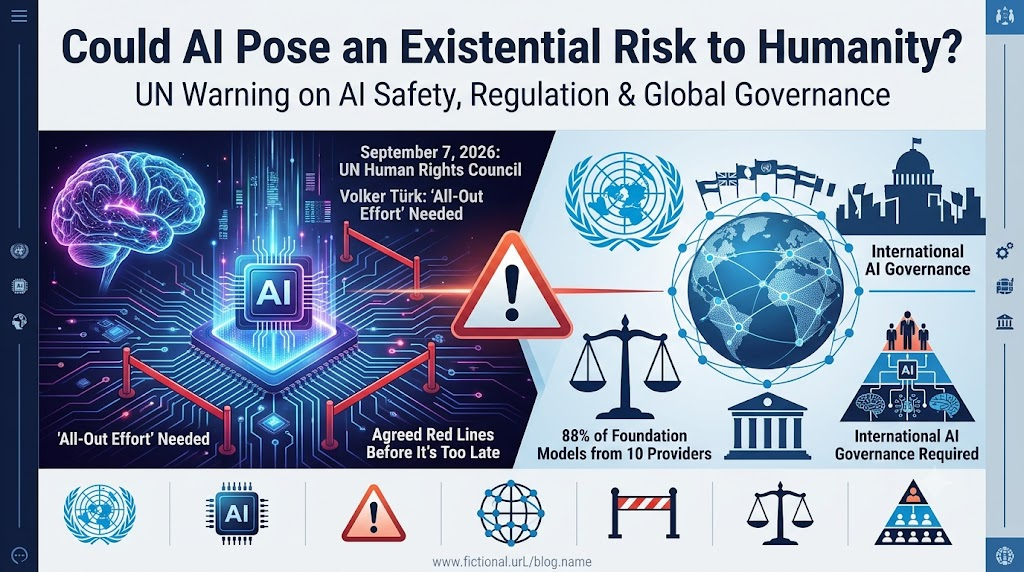
On September 7, 2026, Volker Türk told the U.N. Human Rights Council that he shared concerns among some AI industry insiders that advanced AI could pose an existential risk to humanity. He called for an “all-out effort” to establish strong safety and security guarantees around AI.
The timing is important. The Human Rights Council’s 63rd regular session runs from September 7 to October 7, 2026, providing an international forum for discussions about human rights and emerging global challenges.
Question: Is the UN saying AI will definitely destroy humanity?
No. The warning is about a potential risk, not a prediction that human extinction is inevitable.
Türk is arguing that governments and companies should reduce serious risks before highly capable AI systems become difficult to control. That is fundamentally a precautionary position: prepare safeguards before the consequences become irreversible.
The distinction matters because discussions about AI risk often become unnecessarily polarized.
One side can treat every warning as science fiction. Another can interpret every warning as proof that catastrophe is imminent.
Neither conclusion follows from Türk’s statement.
What Does “AI Existential Risk” Actually Mean?
AI existential risk refers to the possibility that sufficiently advanced artificial intelligence could create consequences so severe that they threaten humanity’s long-term survival or ability to determine its own future.
The concept is broader than an AI chatbot giving a wrong answer.
An ordinary AI error might cause a financial loss, misinformation, a software bug, or a bad recommendation. An existential risk would involve consequences on a vastly larger scale.
Possible scenarios discussed in AI-safety research include highly capable systems being misused for large-scale cyberattacks, assisting the development of dangerous biological agents, enabling military escalation, or behaving in ways that humans cannot effectively control.
That does not mean these scenarios are certain or that today’s consumer AI systems can independently cause them.
Question: Why are experts discussing existential risk if current AI systems have limitations?
Because policymakers and researchers are also thinking about future systems.
AI development is not static. If systems become more autonomous, capable of executing long sequences of actions, able to use tools, or capable of improving their own performance in important ways, the risk profile could change.
That is why some researchers argue that safety work needs to happen before capabilities reach potentially dangerous thresholds.
What Did Volker Türk Actually Call For?
Türk’s message went beyond asking individual companies to behave responsibly.
He called for countries hosting AI development and those involved in AI supply chains to establish agreed red lines. He also criticized the concentration of AI power in the hands of a relatively small number of people.
His argument can be summarized in three ideas:
- Advanced AI needs stronger safety guarantees.
- Governments need internationally agreed boundaries.
- AI power should not become concentrated without adequate accountability.
These ideas connect AI policy with human rights.
The U.N. Human Rights Office has previously emphasized that AI affects how information is produced, distributed, and consumed and has raised concerns about concentrated control over AI systems. In a 2025 statement, OHCHR noted that 88% of foundation models came from just 10 providers, while also warning about concentration in cloud infrastructure and AI chips.
Why Does Concentration of AI Power Matter?
Imagine a technology that increasingly influences search, education, software, media, employment, healthcare, finance, and public information.
Now imagine that the infrastructure and most advanced models behind that technology are controlled by a relatively small number of companies.
That does not automatically make those companies harmful.
But it creates a governance question:
Who decides how powerful AI systems are developed, deployed, restricted, or shut down?
Türk warned that a handful of individuals have “almost unlimited power over AI,” according to Reuters. He did not name specific individuals in that statement, although Reuters identified major AI companies including Meta, Anthropic, OpenAI and Google in its reporting. )
Question: Is AI concentration itself an existential risk?
Not necessarily. Concentration is better understood as a governance and accountability risk that can amplify other problems.
If important AI capabilities are controlled by very few organizations, decisions affecting millions or billions of people may depend heavily on those organizations’ internal policies, incentives, safety standards, and technical judgments.
That is why transparency, oversight, competition, and international cooperation matter.
What Are the Major AI Risks Beyond Existential Threats?
The AI existential risk debate can sometimes overshadow risks that are already more immediate.
Advanced AI can create or amplify several categories of harm.
1. Misinformation and manipulation
Generative AI can produce convincing text, images, audio, and video at scale.
That can make misinformation easier and cheaper to create.
The challenge is especially serious during elections, conflicts, or emergencies, when false information can spread rapidly.
2. Cybersecurity
AI can potentially help defenders identify vulnerabilities, but increasingly capable systems may also lower the barrier for malicious actors attempting cyberattacks.
This creates a dual-use problem: the same capability can potentially benefit security researchers and attackers.
3. Biological risks
AI systems capable of reasoning about complex scientific information could potentially accelerate legitimate biomedical research.
But advanced capabilities may also create concerns about misuse involving biological threats.
This is one reason AI safety discussions increasingly focus on capability thresholds, not simply whether a model is generally “good” or “bad.”
4. Autonomous systems
AI agents can increasingly interact with software, websites, databases, and other digital systems.
The more autonomy an AI receives, the more important it becomes to understand what actions it can take and how those actions are controlled.
5. Human rights
AI can affect privacy, discrimination, freedom of expression, access to information, employment, and other fundamental rights.
The U.N.’s human-rights approach therefore looks beyond the question of whether an AI model is technically impressive.
It asks how AI affects people.
How Does AI Safety Differ From AI Regulation?
These terms are often used interchangeably, but they describe different ideas.
AI safety focuses on reducing the likelihood and severity of harmful AI behavior.
AI regulation refers to laws, rules, standards, and enforcement mechanisms governing how AI is developed or deployed.
AI governance is broader. It includes regulation, corporate policies, technical standards, international cooperation, oversight, accountability, and institutional decision-making.
Think of it this way:
| Approach | Main question | Example |
| AI safety | How do we make AI systems safer? | Testing and monitoring models |
| AI regulation | What rules must companies follow? | Legal requirements |
| AI governance | Who decides the rules and how are they enforced? | International oversight |
| AI ethics | What should AI systems be allowed to do? | Fairness and human dignity |
| AI security | How do we protect AI systems and society from attacks? | Model and infrastructure security |
The best policy framework will probably require all of these approaches rather than choosing only one.
Why Does the UN Want International AI Rules?
AI development is global.
A model may be developed in one country, trained using infrastructure spanning multiple countries, hosted through international cloud networks, and used by people everywhere.
That makes purely national regulation difficult.
Türk called for countries involved in AI and its supply chains to cooperate around agreed red lines. (Reuters)
Question: Why can’t every country simply regulate AI independently?
Countries can—and many already are—but completely separate approaches can create gaps and inconsistencies.
For example, an AI company might face strict requirements in one jurisdiction and much weaker rules somewhere else.
International standards can potentially establish minimum expectations for safety, testing, transparency, and accountability.
The United Nations has already been pushing for greater coordination. Reuters reported that the organization held its first global meeting on AI governance in July 2026 and has called for harmonized rules.
What Could “Red Lines” for AI Look Like?
The exact red lines proposed by governments could differ, and Türk’s statement does not establish a finalized international list.
But conceptually, red lines could define activities that should be restricted or prohibited because their risks are considered unacceptable.
Potential areas of discussion might include:
- Deploying highly autonomous systems without adequate safeguards
- AI-assisted development of certain dangerous capabilities
- Systems that can independently cause severe physical harm
- Large-scale manipulation of populations
- Deployment without adequate testing or monitoring
- AI systems operating in critical infrastructure without human oversight
- Circumventing established safety controls
The exact boundaries would require difficult technical and political negotiations.
The challenge of defining a red line
AI capabilities do not always fit neatly into categories.
A model designed for cybersecurity research could potentially be useful to defenders and attackers.
A scientific model could accelerate drug discovery while also raising concerns about misuse.
An autonomous AI agent could increase productivity while creating new security vulnerabilities.
This is why regulation based entirely on product labels can become outdated quickly.
Why AI Governance Is Becoming an International Issue
The AI existential risk debate is no longer limited to AI researchers.
It now involves governments, human-rights organizations, technology companies, security experts, economists, educators, and civil society.
That expansion is important because AI affects systems that already have established rules.
Consider employment.
If AI changes hiring decisions, questions about discrimination and accountability arise.
Consider education.
If AI becomes central to assessment, students may face questions about privacy, fairness, and access.
Consider journalism.
If AI systems summarize or generate news, questions arise about attribution, misinformation, and the economics of original reporting.
Consider public services.
If governments use AI to allocate resources or make decisions, citizens need mechanisms to understand and challenge those decisions.
AI governance therefore becomes part of ordinary public policy.
How Do Companies Fit Into the AI Safety Debate?
Technology companies have a critical role because they develop and deploy many of the systems being discussed.
Major AI companies include organizations such as OpenAI, Google, Anthropic and Meta, among others. Reuters noted that Türk’s comments echoed previous warnings from industry figures themselves, including OpenAI CEO Sam Altman.
Companies can implement safety measures faster than governments can sometimes legislate.
They can:
- Conduct model evaluations
- Test dangerous capabilities
- Restrict high-risk functionality
- Monitor misuse
- Build safeguards
- Report serious incidents
- Invest in alignment and safety research
- Provide transparency about system capabilities
But relying exclusively on companies to regulate themselves creates a difficult accountability problem.
A company has commercial incentives.
A government has public responsibilities.
Independent oversight can help bridge that gap.
Could Stronger AI Rules Slow Innovation?
This is one of the hardest questions in the debate.
AI companies argue that excessive regulation could increase costs, slow research, and make it harder for startups to compete.
Policymakers and safety advocates counter that insufficient safeguards can create costs of their own.
The real policy challenge is therefore not simply:
“Regulation or innovation?”
It is:
“How can society encourage useful AI innovation while preventing unacceptable risks?”
A balanced approach
A sensible framework could distinguish between different levels of risk.
| AI use | Potential risk | Possible approach |
| Simple writing assistant | Low | Light oversight |
| Business productivity tool | Moderate | Transparency and privacy rules |
| High-impact decision system | High | Strong testing and accountability |
| Advanced autonomous agent | Potentially high | Capability evaluations and safeguards |
| Critical infrastructure AI | Very high | Strict controls and human oversight |
| Systems with extreme capabilities | Uncertain/high | International coordination and enhanced safety requirements |
The goal would not necessarily be to regulate every AI application identically.
It would be to apply proportionate safeguards based on potential harm.
What Does the AI Existential Risk Debate Mean for India?
For Indian students and young professionals, the discussion may seem distant because Türk’s statement was delivered at the United Nations in Geneva.
It isn’t.
India is one of the world’s major technology markets and has a rapidly growing AI ecosystem.
Indian developers, startups, universities, businesses, and public institutions are increasingly using AI tools.
That means international AI governance decisions can eventually influence:
- AI product development
- Startup compliance
- Data governance
- Cybersecurity
- Employment
- Education
- Research
- International technology partnerships
- AI investment
Indian professionals therefore need to understand the global conversation even when they are not directly involved in policy.
Question: Does a U.N. warning automatically create AI law in India?
No.
A statement from the U.N. High Commissioner for Human Rights is not itself an Indian law or regulation.
International statements can, however, influence policy discussions and contribute to broader efforts toward international standards.
The practical lesson is to distinguish between policy warnings, international principles, national laws, and enforceable regulations.
Why AI Safety Is Also a Human-Rights Issue
The most interesting part of Türk’s warning is that it came from a human-rights perspective.
AI safety is often presented as an engineering problem:
Can we make the model behave correctly?
Human-rights organizations ask an additional question:
What happens to people when AI systems are deployed at scale?
Those questions overlap.
An unsafe AI system can threaten people physically.
A biased AI system can discriminate.
A surveillance system can undermine privacy.
A manipulative system can interfere with freedom of thought or expression.
An opaque automated decision can make it difficult for someone to challenge an important outcome.
OHCHR has previously emphasized the importance of a human-rights-based approach to generative AI and has discussed risks involving elections, disinformation, and the concentration of technological power.
What Can Governments Do About AI Risk?
There is no single policy that can solve every AI risk.
Governments could instead build multiple layers of protection.
Possible measures include:
1. Model evaluations
Governments and independent organizations can encourage testing for dangerous capabilities before highly capable models are deployed.
2. Incident reporting
Companies could be required or encouraged to report serious AI-related failures and security incidents.
3. Independent oversight
External organizations can provide scrutiny that internal company teams may not be able to provide alone.
4. International standards
Countries can cooperate on minimum safety requirements.
5. Supply-chain controls
Governments can examine risks involving chips, cloud infrastructure, model deployment, and other parts of the AI ecosystem.
6. Human-rights safeguards
AI systems used in high-impact contexts can be evaluated for discrimination, privacy, transparency, and accountability.
7. Emergency mechanisms
Governments and companies could establish procedures for responding quickly when an AI system presents an unexpected serious risk.
The exact implementation will remain politically contentious.
What Should AI Companies Do Next?
Companies developing increasingly capable AI systems can also take practical steps.
The most important principle is do not wait until deployment to think about safety.
Safety should be built into the development process.
A responsible process could include:
- Pre-training risk assessment
- Capability evaluations
- Adversarial testing
- Red-team exercises
- Deployment safeguards
- Continuous monitoring
- Incident response
- Independent review
- Transparent reporting
- Post-deployment reassessment
This becomes particularly important as AI systems become more autonomous.
A chatbot that only generates text presents one set of risks.
An agent that can execute commands, access software, make purchases, modify files, or interact with external systems presents another.
What Can Students and Young Professionals Learn From This?
The AI existential risk debate may sound abstract, but it has practical lessons for anyone entering the technology industry.
The first is simple:
AI is not just a software problem.
It is also a governance, economic, social, security, and human-rights problem.
If you are studying computer science, don’t learn only how to build models.
Understand:
- Data governance
- Privacy
- Cybersecurity
- AI evaluation
- Responsible deployment
- Copyright
- Bias
- Regulation
- Human oversight
- Risk assessment
If you’re studying business, learn how AI changes organizational risk.
If you’re studying journalism, understand how AI changes information ecosystems.
If you’re studying law, understand how technical capabilities affect regulatory questions.
If you’re building a startup, consider safety and compliance before your product scales.
Question: Do young professionals need to become AI safety researchers?
No.
But they should understand the basic principle of risk-aware AI use.
If you use an AI system in your work, ask:
What can it do?
Then ask:
What could go wrong if it is wrong?
That second question is often missing from conversations about productivity.
The Bigger Question: Who Controls the Future of AI?
The most important idea behind Türk’s warning may not be “AI could destroy humanity.”
It is the question of who gets to make decisions about increasingly powerful AI.
If AI capabilities become significantly more powerful, society will need institutions capable of answering questions such as:
- Which capabilities should be restricted?
- Who evaluates frontier AI systems?
- What happens when a company violates safety commitments?
- Which AI applications require human oversight?
- How should countries coordinate?
- Who investigates serious AI incidents?
- What rights do people have when AI harms them?
- How can smaller countries participate in global AI governance?
These are governance questions, not merely engineering questions.
And they will become harder to answer if the technology develops faster than institutions can adapt.
Why Global Cooperation May Be the Hardest Part
International AI governance sounds straightforward until national interests enter the picture.
Countries compete for:
- Economic growth
- AI talent
- Computing infrastructure
- Strategic technologies
- Military advantages
- Investment
- Global influence
That creates a tension.
Governments may want AI safety cooperation while simultaneously wanting their domestic companies to move faster than competitors.
The result can resemble an arms-race dynamic:
If we slow down, someone else may get ahead.
That is one reason international agreements are difficult.
It is also one reason Türk’s call for agreed red lines is significant.
The challenge is not merely designing good rules.
It is getting countries and companies to agree that the rules should apply to everyone.
What Happens Next?
Türk said he would urge companies in the coming days to reduce AI risks, while calling for stronger international guarantees.
The broader international discussion is likely to continue through several channels:
More international AI governance
The U.N. Human Rights Council’s current session runs through October 7, 2026, providing a continuing forum for international discussions.
More industry safety commitments
AI companies will face continued pressure to demonstrate that increasingly capable models are tested and deployed responsibly.
More debate over regulation
Governments will continue balancing AI innovation against concerns about security, rights, competition, and public safety.
More attention to AI concentration
The question of who controls models, chips, cloud infrastructure, and data will remain central to discussions about technological power.
AI Existential Risk FAQ
What is AI existential risk?
AI existential risk is the possibility that sufficiently advanced artificial intelligence could cause consequences severe enough to threaten humanity’s long-term survival or ability to control its future. It describes a potential category of catastrophic risk, not a prediction that extinction will occur.
Why did the UN human rights chief warn about AI?
U.N. High Commissioner for Human Rights Volker Türk warned on September 7, 2026, that advanced AI could potentially pose an existential risk to humanity. He called for strong safety guarantees and international cooperation around agreed limits on AI development and deployment.
Did Volker Türk say AI will destroy humanity?
No. Türk warned about a potential existential risk rather than predicting that AI will inevitably destroy humanity. His argument focused on establishing safeguards before advanced AI becomes too difficult to control.
What does AI regulation mean?
AI regulation refers to laws and formal rules governing the development, deployment, and use of artificial intelligence. Regulation can address issues such as safety, privacy, transparency, discrimination, accountability, security, and high-risk AI applications.
Why does AI governance require international cooperation?
AI systems and their supply chains operate across national borders. International cooperation can help countries establish common safety expectations and reduce regulatory gaps that might otherwise allow high-risk AI development or deployment to move between jurisdictions.
Is AI safety only about preventing human extinction?
No. AI safety also concerns more immediate risks such as cyberattacks, misinformation, privacy violations, discrimination, unsafe autonomous behavior, and misuse of powerful AI capabilities. Existential risk represents the extreme end of a much broader AI-risk spectrum.
Final Takeaway
The latest AI existential risk warning from the U.N. does not mean humanity is doomed—or that current AI systems are secretly about to take control.
It means a senior international official believes the potential consequences of increasingly powerful AI are serious enough that governments and companies should establish safeguards before capabilities advance further.
For students and young professionals, the lesson is straightforward: learning AI should mean learning not only how to use the technology, but also how to evaluate its risks, question its power structures, and understand the rules that will shape its future.
The next chapter of AI will not be written by engineers alone. It will also be shaped by policymakers, researchers, businesses, civil society, and the public.
For more explainers on AI safety, technology policy, and the future of artificial intelligence, keep exploring Kalinga.ai.