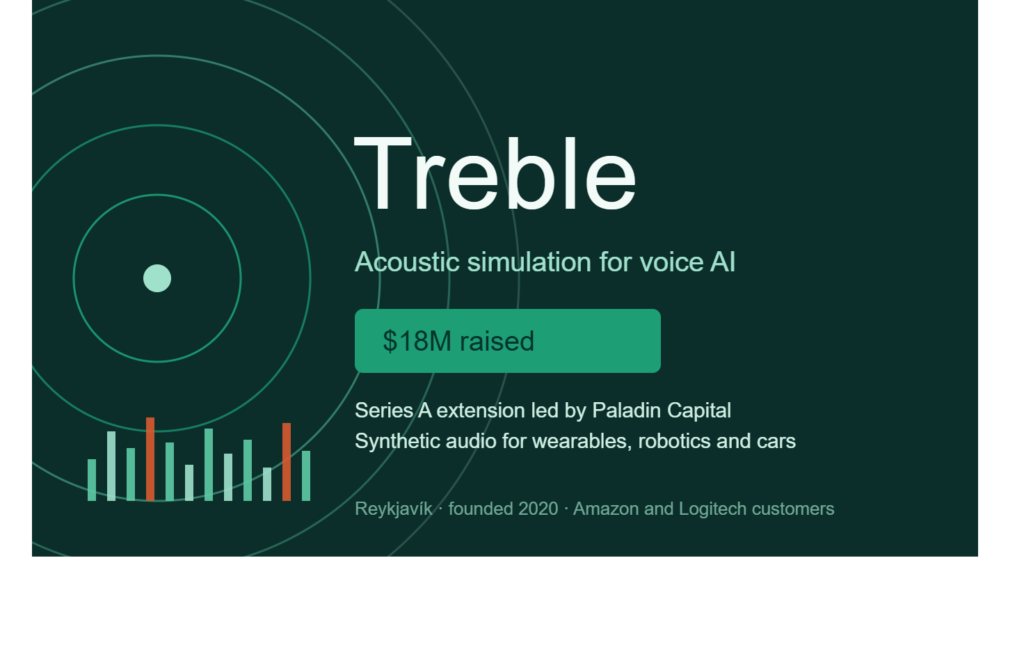
Why Treble Raised $18 Million for Voice Simulation
Imagine building a voice assistant that works perfectly in a quiet lab but struggles the moment you use it in a crowded restaurant.
That gap between controlled testing and real-world sound is exactly the problem Iceland-based startup Treble is targeting with its voice simulation platform. The company has raised $18 million in an extension of its Series A funding, led by Paladin Capital Group, to expand its simulation technology for voice AI, consumer hardware, robotics and other physical AI applications.
Treble was founded in 2020 by acoustic engineers Finnur Pind and Jesper Pedersen. The Reykjavík-based company says its technology can generate synthetic audio, evaluate AI systems under different acoustic conditions and help hardware companies virtually test how devices perform before building or modifying physical prototypes.
The company had previously received $12 million in 2024, taking its total funding to more than $40 million after the latest round. TechCrunch reports that Amazon and Logitech are among Treble’s customers.
The bigger idea is simple: as more AI systems learn to hear, developers need better ways to create, test and reproduce the sounds those systems encounter.
What Is the Treble Voice Simulation Platform?
Definition + Expansion
Treble voice simulation platform — a simulation infrastructure designed to generate realistic acoustic conditions, create synthetic audio data and test voice and audio AI systems without relying entirely on physical recordings and real-world testing.
Treble’s technology is built around acoustic simulation: using models of sound propagation and physical environments to reproduce how sound behaves. Its current platform includes a cloud-based SDK designed for synthetic audio generation, virtual prototyping and evaluation of audio machine-learning systems.
This matters because voice AI does not operate in a vacuum.
A speech recognition model may encounter background conversations, reverberation, competing voices, different distances between a speaker and microphone, device orientation and other acoustic variables. Testing every possible combination by recording them physically can become expensive and difficult to scale.
Treble’s approach is to simulate many of those conditions digitally.
What problem does Treble solve?
Treble is addressing a fundamental challenge in audio AI: AI systems need representative sound data and realistic testing environments to work reliably outside controlled conditions.
The company says its platform can generate physically accurate synthetic audio data for applications such as speech enhancement, noise suppression and model training. It also evaluates voice AI models under different conditions and provides feedback to developers.
In other words, the platform is not simply trying to make an AI voice sound more natural.
It is focused on helping engineers understand how AI systems hear and respond to sound in the physical world.
Why Synthetic Audio Data Matters for Voice AI
Voice AI has moved far beyond basic voice assistants.
Speech recognition now appears in customer-service systems, meeting applications, wearable devices, smart glasses and other products where microphones must capture speech in environments that are rarely quiet.
That creates a data problem.
Synthetic audio data is computer-generated sound designed to represent particular acoustic conditions, allowing developers to create training or testing examples without recording every situation manually.
For example, developers could theoretically simulate different combinations of:
- Background noise
- Multiple speakers
- Room reverberation
- Speaker and microphone positions
- Device orientation
- Acoustic environments
- Different sound sources
- Moving speakers or receivers
Treble’s platform is designed to use physics-based acoustic simulation to produce this kind of data. Its website describes the Treble SDK as a Python-based interface for scalable, high-fidelity simulations that can support synthetic data generation and virtual prototyping.
Why isn’t ordinary recorded data enough?
Recorded data remains important, but recording every possible acoustic scenario is difficult to scale.
A physical recording captures one particular combination of environment, speaker, microphone, background sound and positioning. Simulation can instead allow engineers to vary parameters and reproduce scenarios systematically.
Treble co-founder Finnur Pind told TechCrunch that the company sees audio AI as fundamentally a data challenge and believes accurate physics simulation can provide an alternative way to create sound data.
That distinction is important.
The objective is not necessarily to replace recordings altogether. Instead, simulation can give AI developers another tool for creating controlled, repeatable and potentially large-scale acoustic datasets.
How Treble Tests Voice AI Models in Realistic Conditions
Training a speech model is only one part of building a voice AI product.
The next question is whether the model continues to work when the environment becomes difficult.
How can voice AI testing become more realistic?
The Treble voice simulation platform can reproduce different acoustic conditions so developers can evaluate how speech systems behave when the sound environment changes.
For example, a speech-recognition system may perform well when one person speaks directly into a microphone in a quiet room. Its performance can be much harder to understand when several people are talking, the speaker is farther away or the room produces significant reverberation.
A simulation environment allows developers to test those variables systematically.
Treble also partnered with Hugging Face earlier in 2026 to launch a benchmark for speech recognition models across realistic conditions, according to TechCrunch.
Benchmarks are useful because they give developers a consistent way to compare model behavior.
Instead of asking only, “Does this model recognize speech?”, engineers can ask more specific questions:
- Does it recognize speech with background noise?
- How does it respond when several people are speaking?
- What happens when the speaker is farther from the microphone?
- How does room acoustics affect recognition?
- Does performance change when the device moves?
These questions become increasingly important as voice interfaces move away from stationary computers and phones.
From Voice Models to Smart Glasses and Wearables
One of the most interesting parts of Treble’s strategy is that it is not limiting its technology to software models.
The company also works on hardware design and testing from a voice and acoustics perspective.
For headphone and speaker manufacturers, virtual prototyping can help engineers understand how a product is likely to perform acoustically before relying entirely on physical prototypes. Treble says its technology can also help evaluate how devices such as smart speakers understand commands depending on their positioning.
That becomes particularly relevant for smart glasses.
AI glasses have microphones, speakers, processors and sensors packed into a very small physical space. Their microphones must capture useful speech while the device itself may be moving with the wearer.
Why are smart glasses difficult for voice AI?
Smart glasses operate in constantly changing acoustic environments.
A wearer could be walking through a street, sitting in a restaurant, attending a seminar or talking to someone nearby. The device has to distinguish relevant sounds from everything else happening around it.
Treble has expanded into simulation testing for smart glasses and other AI devices. The company has also described its SDK as capable of modeling moving talkers, head movement and rotating devices.
This is where acoustic simulation becomes more than a laboratory convenience.
It can become part of the engineering workflow for devices that need to understand the physical world through sound.
The “Superhuman Hearing” Idea
Treble co-founder Finnur Pind told TechCrunch that he is particularly interested in the next generation of headphones and smart glasses that could provide what he described as “superhuman hearing.”
The concept is easier to understand through an everyday example.
Imagine sitting in a crowded restaurant and wanting to focus on a person sitting two metres away while reducing surrounding conversations. Or imagine attending a seminar where you want to hear a particular speaker while reducing distracting sounds around you.
The hardware and AI would need to identify, separate and enhance particular sound sources.
That requires more than a good speech model.
It requires understanding the acoustic environment around the user.
What does this mean for future wearable AI?
The future of voice-enabled wearables may depend on systems that understand not just what someone said, but where the sound came from and which sounds matter.
That could make acoustic simulation increasingly relevant during product development.
Treble’s role is to provide tools for engineers to model those conditions before relying entirely on real-world testing.
Why Treble Is Moving Into Physical AI
The Treble voice simulation platform is also being positioned for a broader category known as physical AI.
Definition + Expansion
Physical AI refers to AI systems that interact with or operate in the physical world, including robots, autonomous vehicles, drones and other intelligent machines.
These systems cannot rely exclusively on visual information.
Sound can provide additional information about what is happening around a machine. A robot, for example, may need to interpret speech, detect acoustic events or understand how sounds behave within its environment.
Treble says it wants to increase its focus on physical AI applications involving robotics, automotive and drone companies.
Why does sound matter for robotics?
A robot operating in the real world encounters changing environments.
A warehouse may have machinery running in the background. A service robot may hear people speaking from different directions. A vehicle may need to process cabin audio while passengers are talking.
Simulation can give developers a way to test such scenarios before deploying systems in physical environments.
This connects Treble’s voice AI work with a much larger trend: AI systems increasingly need to understand physical environments rather than simply process text or images.
Treble’s Acoustic Simulation Approach vs Traditional Testing
The Treble voice simulation platform sits between software-based AI development and traditional physical product testing.
Here is the basic difference:
| Approach | How it works | Main advantage | Main limitation |
| Physical recording | Engineers capture real sounds in real environments | Directly reflects real-world conditions | Can be expensive and difficult to scale |
| Synthetic audio | Software generates audio examples | Allows controlled and repeatable data generation | Quality depends on how accurately conditions are modeled |
| Physical prototype testing | Engineers test hardware in real environments | Measures actual device behavior | Iterations can take time and resources |
| Acoustic simulation | Engineers model sound and environments digitally | Enables virtual testing and rapid iteration | Simulation still needs accurate models and inputs |
| Hybrid workflow | Combines simulation, synthetic data and physical tests | Can connect development and validation workflows | Requires integration across tools and processes |
Treble’s proposition is not simply to eliminate physical testing.
Instead, its platform can provide a virtual layer between model development, hardware design and real-world validation.
Treble’s website describes its technology as combining wave-based and geometrical acoustics and supporting virtual prototyping and synthetic audio generation.
That approach can be useful when developers need to explore many possible acoustic conditions before building or testing every physical version.
What the $18 Million Funding Means for Treble
Treble has now raised more than $40 million in total, following the latest $18 million Series A extension and its $12 million investment in 2024. Paladin Capital Group led the latest round, while existing investors including KOMPAS VC, Frumtak Ventures, the European Innovation Council and Omega ehf participated.
Why are investors interested in acoustic infrastructure?
The investment thesis is tied to the expanding number of products that need to understand sound.
Francois Ruether, VP at Paladin Capital Group, told TechCrunch that the firm’s thesis is that infrastructure for understanding sound becomes increasingly valuable as more products depend on audio across voice AI, wearables, robotics and physical AI.
The important word here is infrastructure.
Treble is not trying to become another general-purpose voice assistant. Its opportunity is to provide underlying tools that other companies can use while developing their own AI models and products.
According to TechCrunch, Treble’s customers include Amazon and Logitech.
The company says customers retain ownership of their models, products and development workflows while using its simulation infrastructure, according to Paladin’s Ruether.
Why Acoustic Simulation Could Become AI Infrastructure
The AI industry has traditionally focused heavily on compute, models and data.
But physical AI introduces another requirement: the ability to model the real world accurately enough to test intelligent systems before deployment.
For visual AI, that may involve simulated environments and computer-generated images.
For audio AI, it can involve acoustic simulation.
The Treble voice simulation platform is targeting this layer for sound.
What could Treble’s infrastructure enable?
Potential development workflows include:
- Generate synthetic audio for training or testing.
- Create difficult acoustic scenarios that may be expensive to reproduce physically.
- Evaluate speech and audio models under controlled conditions.
- Virtually prototype audio hardware before manufacturing iterations.
- Test wearable devices under different positions and movements.
- Support robotics, automotive and drone development where sound is part of the environment.
Treble’s own product materials describe applications spanning machine learning, AI, smart glasses, automotive acoustics and audio hardware.
This makes the company’s $18 million funding significant beyond the headline number.
The broader question is whether simulation becomes a standard part of the engineering stack for AI systems that interact with sound.
What Students and AI Professionals Should Learn From Treble
For students and young professionals entering AI, the Treble story offers an important lesson.
AI is not only about building larger models.
A successful AI product also depends on the systems around the model: data generation, evaluation, hardware integration, testing and deployment.
The Treble voice simulation platform is an example of a startup building infrastructure around one of those less visible problems.
What skills are becoming relevant?
If you are interested in voice AI, robotics or physical AI, useful areas to explore include:
- Speech recognition and speech processing
- Machine learning evaluation
- Synthetic data generation
- Audio signal processing
- Acoustics
- Python-based AI tooling
- Computer simulation
- Embedded and wearable systems
- Robotics
- Human-computer interaction
The intersection is particularly interesting because audio AI sits between several disciplines.
A person working on voice technology may need to understand machine learning, but also microphones, signal processing, acoustic environments and hardware constraints.
That is why companies building simulation infrastructure can become important even when they are not developing a headline AI model themselves.
What Could Come Next for Treble?
Treble’s latest funding gives the company more room to expand beyond its existing voice and audio applications.
Its stated areas of interest include robotics, automotive and drones, alongside wearables such as smart glasses.
Its SDK developments also point toward more detailed simulation of moving talkers, head movements and rotating devices, which are particularly relevant to wearable and mobile audio systems.
Could simulation replace real-world testing?
Not completely.
Real-world testing remains necessary because physical products ultimately have to work in physical environments. Simulation is better understood as a complementary engineering tool that can help teams explore scenarios, generate data and identify issues before or alongside physical validation.
Treble’s own terms also note that simulation output depends on input data and configuration choices, which reinforces the importance of treating simulation as an engineering tool rather than an automatic guarantee of real-world performance.
The more useful question is therefore not whether simulation eliminates reality.
It is whether simulation can make development cycles more efficient by allowing engineers to test more scenarios earlier.
The Bigger Voice AI Trend
The Treble voice simulation platform arrives as voice interfaces are expanding into more parts of everyday technology.
Voice is becoming a primary interaction method for some AI devices, while smart glasses, headphones and other wearables increasingly depend on microphones to understand users.
That creates a feedback loop:
More voice-enabled products → more acoustic complexity → more testing requirements → greater demand for simulation and synthetic data.
Treble is betting that this loop creates a new infrastructure category.
Its latest funding does not prove that acoustic simulation will become a dominant layer of AI infrastructure. But it does show that investors and technology companies are paying attention to the engineering problems created when AI moves from screens into the physical world.
And that may be the most interesting part of the story.
The next generation of AI will not only need to generate, reason and see.
It will increasingly need to hear.
FAQ: Treble Voice Simulation Platform
What is the Treble voice simulation platform?
The Treble voice simulation platform is an acoustic simulation infrastructure designed to help developers generate synthetic audio, evaluate audio AI systems and virtually prototype hardware. Treble uses physics-based acoustic simulation to model sound conditions that can be difficult or expensive to reproduce entirely through physical testing.
How much funding did Treble raise in September 2026?
Treble raised $18 million in an extension of its Series A funding, led by Paladin Capital Group with participation from existing investors including KOMPAS VC, Frumtak Ventures, the European Innovation Council and Omega ehf. The company had previously raised $12 million in 2024, bringing its total funding to more than $40 million.
What is synthetic audio data?
Synthetic audio data is computer-generated sound created to represent particular acoustic conditions. In AI development, it can be used for applications such as speech enhancement, noise suppression and model training, potentially allowing engineers to generate controlled scenarios without recording every situation physically. Treble says its platform supports physically accurate synthetic audio generation.
How can acoustic simulation help voice AI?
Acoustic simulation can help developers reproduce different environments and sound conditions when testing voice AI. This can include background noise, reverberation, competing voices, speaker positioning and other variables that affect how an AI system receives audio.
Does Treble only work with voice AI?
No. Treble’s technology is also aimed at audio hardware, smart glasses, consumer electronics, automotive applications, robotics and drones. The company says it wants to expand its focus on physical AI, where machines interact with the real world and may need to process sound.
Why is voice simulation becoming important for AI?
Voice AI is moving into more complex environments, including wearables, smart glasses, robotics and other physical devices. As those systems encounter changing acoustic conditions, developers need scalable ways to generate data and evaluate performance. Acoustic simulation provides one approach for testing those conditions before or alongside real-world validation. keep exploring kalinga.ai for more.