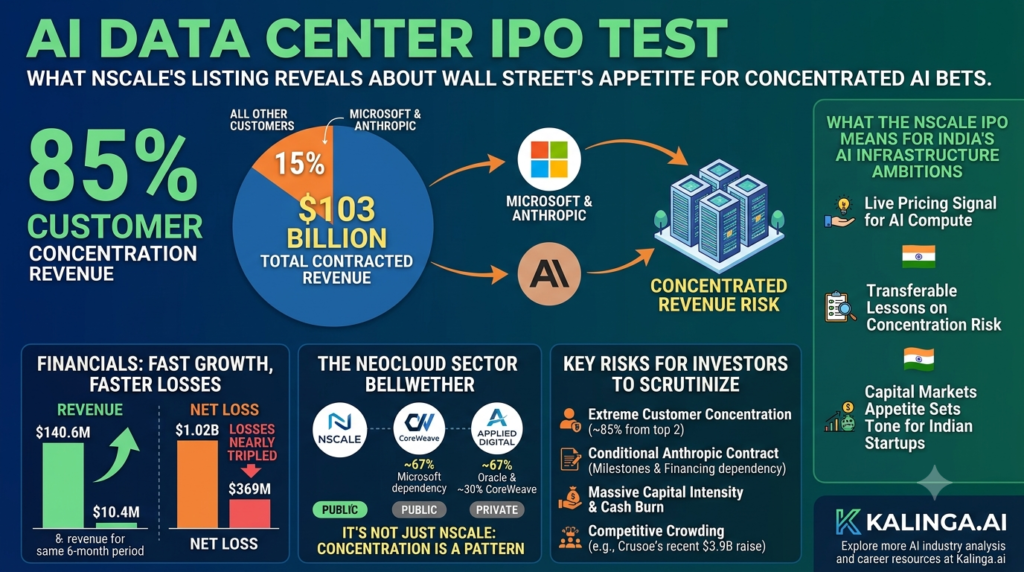
Nscale’s upcoming Wall Street debut is the biggest AI data center IPO test of 2026, and the answer to whether investors will buy in comes down to one number: roughly 85% of the company’s contracted revenue flows from just two customers, Microsoft and Anthropic. That concentration is the story, not just for Nscale, but for every neocloud operator racing toward a public listing this cycle.
For anyone tracking AI infrastructure investing, the Nscale IPO is a live case study in how the entire “neocloud” category, specialized AI compute providers like CoreWeave, Crusoe, Nebius, and Lambda, has quietly built itself around a handful of hyperscaler and AI-lab relationships. This piece breaks down what Nscale actually is, what its filing discloses, why the concentration risk matters, and what it signals for India’s own AI infrastructure ambitions.
What Is Nscale, and Why Does This AI Data Center IPO Matter?
Nscale is a British AI data center developer that operates compute infrastructure in Norway, Portugal, Texas, and West Virginia. The company was spun out of Australian cryptocurrency mining firm Arkon Energy roughly two years ago and has since pivoted entirely toward supplying GPU capacity for AI workloads.
Definition: A neocloud is a specialized cloud infrastructure company, distinct from legacy hyperscalers like AWS or Azure, built specifically to provide large-scale GPU compute for AI training and inference, typically financed through long-term supply contracts with a small number of anchor customers.
Expansion: This business model is precisely why the Nscale IPO matters as a bellwether. Unlike a diversified cloud provider serving thousands of customers, a neocloud’s revenue, and therefore its stock valuation, is only as durable as its handful of anchor contracts. When Nscale lists on the NYSE, public shareholders will effectively be buying exposure to the health of Microsoft’s and Anthropic’s AI compute demand, not a broad-based enterprise cloud business.
Nscale’s Contract Book: The Core of the AI Data Center IPO Story
According to Nscale’s IPO filing with the SEC, the company has amassed more than $103 billion worth of contracts since its 2024 spin-out. Two deals account for the overwhelming majority of that figure:
| Customer | Contract Value | Term | Notable Condition |
| Microsoft | $43.8 billion | Through 2033 | Long-term compute supply agreement |
| Anthropic | $44.6 billion | Multi-year | Contingent on Nscale securing financing; Anthropic can cancel if Nscale misses milestones the filing calls “stringent” |
| All other customers | ~$14.6 billion (combined) | Varies | Remaining ~15% of contracted revenue |
That table is the crux of any serious analysis of this AI data center IPO: two contracts representing roughly 85% of total contracted value, with one of them explicitly conditional on financing and performance milestones Nscale itself describes as demanding.
How Neocloud Companies Like Nscale Actually Get Built
Question: Where does the money for a company like Nscale actually come from before it ever reaches a stock exchange? Direct answer: Neoclouds are typically financed in three overlapping layers, venture and growth equity from investors betting on the AI compute boom, debt secured against the anchor contracts themselves, and the contracts’ own upfront commitments, which lenders treat almost like collateral because they’re signed by creditworthy hyperscalers and AI labs.
This financing structure explains why Nscale’s story reads the way it does. Venture investors, including Nvidia, provided early capital. Debt providers extended convertible notes partly because Microsoft’s and Anthropic’s names sat on the contract book. And now, a public listing is the next rung on the ladder, a way to raise fresh equity capital to keep building data centers in Norway, Portugal, Texas, and West Virginia without diluting existing shareholders through another private round.
The problem is that each layer of this financing stack ultimately traces back to the same two counterparties. If Microsoft’s or Anthropic’s compute demand changes, it doesn’t just affect Nscale’s revenue statement, it can affect the collateral value lenders assumed when they extended debt, and the growth story equity investors bought into. That’s the chain reaction Sona Asset Management’s research is pointing at when it warns about sector-wide interconnectedness.
The Customer Concentration Problem Behind This AI Data Center IPO
Why Microsoft and Anthropic Dependency Is a Red Flag for Investors
Question: Why does customer concentration matter so much in an AI data center IPO? Direct answer: Because a neocloud’s revenue is not diversified the way a traditional business is, if one anchor customer scales back, delays a milestone, or renegotiates terms, the impact on total revenue is immediate and disproportionate, and public investors have almost no way to hedge against that single point of failure.
In Nscale’s case, the risk is compounded by the Anthropic agreement’s structure. The deal isn’t unconditional; it depends on Nscale successfully raising financing, and Anthropic retains a contractual right to walk away if Nscale fails to meet specific build-out milestones. For a company preparing to raise $3 billion in a public offering at an expected $35 billion valuation, a conditional mega-contract sitting inside the revenue base is the kind of detail that sophisticated investors will scrutinize line by line.
It’s Not Just Nscale, Concentration Is a Pattern Across Neocloud Stocks
The Nscale IPO doesn’t exist in isolation. A recent analysis by credit hedge fund Sona Asset Management found that many AI infrastructure providers share this same dependency structure:
- CoreWeave generates roughly 67% of its revenue from Microsoft alone.
- Applied Digital derives about 67% of its revenue from Oracle, plus another 30% from CoreWeave.
- Nscale derives approximately 85% of its contracted value from Microsoft and Anthropic combined.
Sona’s research noted that this interconnectedness isn’t inherently a red flag, anchor-tenant financing has funded data center buildouts for years, but it does mean a single strategic shift by one major AI lab or hyperscaler could ripple through the entire neocloud sector at once. That systemic angle is what elevates the Nscale IPO from a single-company story to an AI infrastructure investing story.
Comparing the Major Neocloud Players
No analysis of this AI data center IPO is complete without seeing Nscale alongside its closest private and public peers. The table below lines up the four companies most frequently cited alongside Nscale in coverage of the neocloud sector.
| Company | Status | Primary Anchor Customer(s) | Reported Concentration | Recent Valuation Signal |
| Nscale | Preparing NYSE IPO | Microsoft, Anthropic | ~85% of contracted value | Targeting $35B IPO valuation |
| CoreWeave | Already public | Microsoft | ~67% of revenue | Public since 2025 |
| Applied Digital | Already public | Oracle, CoreWeave | ~67% (Oracle) + 30% (CoreWeave) | Public data center builder |
| Crusoe | Private | Diversified AI/cloud clients | Not fully disclosed | $30.9B valuation after $3.9B raise |
Expansion: The pattern across this table is unmistakable, nearly every major neocloud, public or private, has built its growth story on a small number of hyperscaler or AI-lab relationships. Crusoe is the closest thing to an exception in terms of disclosed diversification, but even there, the company hasn’t published a customer breakdown as detailed as Nscale’s IPO filing. That makes Nscale’s disclosures unusually transparent, and unusually exposed to scrutiny, compared to peers that haven’t yet had to open their books to public shareholders.
Nscale’s Financials: Fast Growth, Faster Losses
Any AI data center IPO has to be judged on the numbers behind the contracts, not just the contracts themselves. Nscale’s reported financials for the six months ended June 30 show a company scaling revenue quickly while burning cash even faster.
| Metric | Six Months Ended June 30 (Current Year) | Same Period, Prior Year | Change |
| Revenue | $140.6 million | $10.4 million | Up sharply |
| Net Loss | $1.02 billion | $369 million | Losses nearly tripled |
Definition + Expansion: A net loss that outpaces revenue growth by this margin is typical for early-stage infrastructure buildouts, data centers require enormous upfront capital before contracted revenue is fully recognized, but it also means Nscale is not yet close to profitability, and its ability to keep building depends on continued access to capital markets and lender confidence.
That capital dependency is already playing out. Earlier this month, Nvidia, one of Nscale’s major investors, agreed to provide $1 billion in convertible debt as part of a larger $3.1 billion financing package. Nscale was previously valued at $14.6 billion when it raised a $2 billion Series C round led by Aker ASA and 8090 Industries, meaning the company is now seeking a valuation more than double that level in its public debut.
Why This AI Data Center IPO Is a Test for the Whole Sector
Nscale’s board includes high-profile names, former Meta executives Sheryl Sandberg and Nick Clegg, and former OpenAI executive Fidji Simo, which signals the seriousness with which the company is approaching its Wall Street debut. But star-studded governance doesn’t offset structural revenue risk.
Here’s what makes this AI data center IPO a genuine test of investor appetite:
- Concentrated revenue base: ~85% of contracted value tied to two customers, one of which has walk-away rights.
- Massive capital intensity: Net losses of over $1 billion in six months, funded partly through convertible debt from an existing investor.
- Competitive crowding: Nscale competes directly with CoreWeave, Nebius, Lambda, and Crusoe, the latter raised $3.9 billion at a $30.9 billion valuation just last week, showing how much private capital is chasing the same category.
- Valuation ambition: Nscale is targeting a $35 billion valuation while raising $3 billion, a premium multiple on $140.6 million in six-month revenue.
- Contract conditionality: The Anthropic agreement’s financing contingency and milestone-based cancellation clause introduce execution risk directly into the revenue backlog.
If Nscale prices well and trades steadily after listing, it could open the door for CoreWeave-style neocloud IPOs to keep coming. If it stumbles, public markets may signal that they’re no longer willing to underwrite concentrated AI infrastructure bets at premium multiples, a signal every AI data center IPO candidate after Nscale will have to reckon with.
What the Nscale IPO Means for India’s AI Infrastructure Ambitions
For India’s growing AI ecosystem, the Nscale IPO is worth watching closely for three reasons. First, it’s a live pricing signal for how public markets value AI compute infrastructure, a category India is actively trying to build domestically as part of its own data center and AI sovereignty push. Second, the customer-concentration lesson is directly transferable: Indian data center operators and cloud providers courting a small number of anchor hyperscaler or AI-lab contracts face the same structural risk Nscale is now disclosing to public investors. Third, capital markets appetite for this listing will shape how easily Indian AI infrastructure startups can eventually raise growth capital or pursue their own public listings, since global investor sentiment toward the category rarely stays siloed by geography.
For students, freshers, and professionals building careers in India’s AI and cloud infrastructure space, this is also a useful real-world lesson in how AI business models actually get financed, and why “who are your top two customers” is often a more important interview or analysis question than “how fast is your revenue growing.”
Lessons for Indian AI Infrastructure Startups and Investors
India’s data center pipeline has grown substantially over the past two years, with hyperscalers, sovereign cloud initiatives, and homegrown operators all racing to add GPU capacity. Nscale’s filing offers a template, and a warning, for anyone building in this space domestically:
- Anchor contracts accelerate growth but concentrate risk. Signing a marquee hyperscaler or AI-lab customer can unlock financing quickly, but it also makes the business dependent on a single relationship’s health.
- Milestone-based contracts cut both ways. Nscale’s Anthropic deal shows how a large headline contract value can still carry real cancellation risk if build-out milestones slip, a structure increasingly common in India’s own data center supply agreements.
- Capital intensity doesn’t disappear with scale. Nscale’s losses grew even as revenue grew, a reminder that data center economics reward patient, well-capitalized players over those chasing rapid top-line growth alone.
- Public market appetite sets the tone for private rounds. How investors price this listing will influence how Indian AI infrastructure companies are valued in their next funding rounds, since global capital increasingly treats the category as a single asset class.
None of this means concentrated anchor-customer models are a mistake, they’ve funded some of the fastest data center buildouts in history. But Nscale’s filing is a useful reminder that scale and revenue growth headlines can mask structural fragility underneath, a lesson that applies just as much to India’s AI infrastructure ambitions as it does to a British neocloud listing in New York.
Frequently Asked Questions
What is Nscale, and where does it operate? Nscale is a British AI data center developer with facilities in Norway, Portugal, Texas, and West Virginia. It was spun out of crypto miner Arkon Energy and now focuses exclusively on supplying AI compute capacity.
How much is the Nscale IPO expected to raise, and at what valuation? Nscale is seeking to raise $3 billion in its NYSE listing at an expected valuation of around $35 billion.
Why is customer concentration a concern in this AI data center IPO? About 85% of Nscale’s more than $103 billion in contracts comes from just two customers, Microsoft and Anthropic, meaning any disruption to either relationship would materially affect the company’s revenue base.
Is the Anthropic contract guaranteed? No. The agreement is contingent on Nscale securing financing, and Anthropic can cancel the deal if Nscale fails to meet milestones the filing describes as stringent.
Are other AI infrastructure companies facing the same concentration risk? Yes. CoreWeave derives about 67% of revenue from Microsoft, and Applied Digital gets roughly 67% from Oracle and 30% from CoreWeave, according to research from Sona Asset Management.
How is Nscale funding its growth? Through a mix of equity and debt, including a recent $1 billion convertible debt commitment from Nvidia as part of a $3.1 billion financing package, alongside its prior $2 billion Series C round.
Final Take on the Nscale IPO
Every AI data center IPO from this point forward will be measured against how Nscale performs once it starts trading. With $103 billion in contracts, triple-digit revenue growth, and a client list anchored by Microsoft and Anthropic, Nscale looks like an AI infrastructure success story on paper, but the concentration, conditionality, and cash burn underneath that headline are exactly what Wall Street will be pricing in.
Want more breakdowns of the deals, funding rounds, and infrastructure shifts shaping the AI economy, with a lens on what they mean for India’s talent and startup pipeline? Explore more AI industry analysis and career resources at Kalinga.ai.