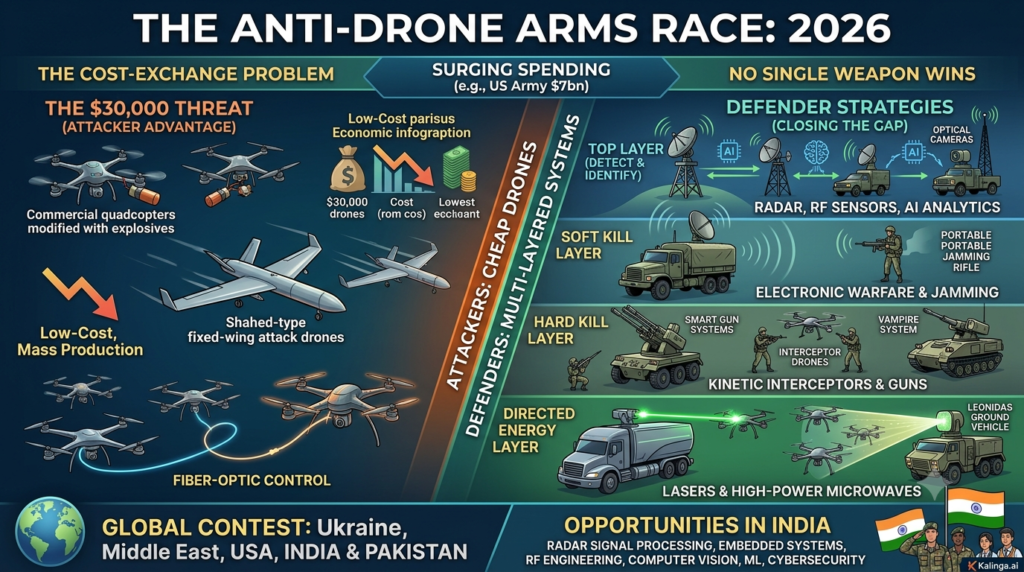
The anti-drone arms race is the contest between cheap, mass-produced attack drones and the sensors, jammers, lasers, microwaves and interceptors built to stop them, and as of October 2026 the attackers still hold the cost advantage. Defenders are closing the gap quickly, though, with low-cost interceptor drones, electronic warfare and directed-energy weapons replacing million-dollar missiles as the first line of defense.
A $30,000 drone built from commercial parts can now force a multimillion-dollar air defense system to fire. That imbalance has turned a niche security problem into one of the biggest procurement races in modern defense. This guide explains how the anti-drone arms race works, why the economics are so lopsided, which technologies are changing the math, and what it all means for India.
Key Takeaways
- The core problem is cost, not capability. Modern air defenses can stop cheap drones, but doing it with missiles is financially unsustainable.
- Layered defense is now the standard. Sensors, jamming, guns, interceptor drones and directed energy each handle a different slice of the threat.
- Spending is surging. The US Army alone awarded contracts worth up to $7 billion for counter-drone capabilities in September 2026.
- The race is global. Ukraine, the Gulf states, the United States, India and Pakistan are all adapting in real time.
- No single weapon wins. Every countermeasure invites a counter-countermeasure, such as fiber-optic drones that ignore jamming.
What Is the Anti-Drone Arms Race?
Definition: The anti-drone arms race is the ongoing cycle in which drone makers improve range, autonomy, speed and resistance to interference, while defenders develop new ways to detect, track and destroy those drones at a lower cost per engagement.
Expansion: It is not a single competition between two countries. It plays out across battlefields, airports, stadiums and military bases at the same time. Attackers range from state militaries launching Shahed-type one-way attack drones to hobbyists who modify commercial quadcopters. Defenders range from air force fighter pilots to police officers carrying portable jamming rifles. Because the threat is so varied, the market for counter-drone systems has become crowded with established arms makers and fast-moving startups.
Why It Is Called an Arms Race
The label is earned by the action-reaction pattern. When defenders learned to jam the radio links that steer drones, attackers moved to autonomous navigation and fiber-optic control. When missiles proved too expensive, defenders built interceptor drones. Each move forces a response, and each response gets tested within weeks, not years.
The concern is not new. A 2019 Wall Street Journal report described an anti-drone arms race emerging after drone-linked disruptions at Gatwick airport, where three days of disruption in December 2018 pushed the airport to buy military-grade equipment. What changed since then is scale: the threat moved from a few incidents to thousands of drones launched in sustained campaigns.
Drones vs. Counter-Drone Systems: Who Is Ahead?
Question: Who is winning the anti-drone arms race right now?
Direct answer: Attackers still win on cost, while defenders are winning more individual engagements. An attacker can lose most of its drones and still succeed strategically if the defender burns through expensive interceptors faster than they can be replaced. A recent analysis in Inside Unmanned Systems made this point directly: even when the defender wins tactically, the attacker can win strategically if the exchange ratio is unfavorable enough and attack volume is sustained.
The Cost-Exchange Problem: Why Cheap Drones Beat Expensive Missiles
The cost-exchange ratio compares what the attacker spends to launch a weapon against what the defender spends to stop it. It is the single most important number in the anti-drone arms race, because it decides who runs out of money or ammunition first.
Definition: A cost-exchange ratio is the price of the defensive shot divided by the price of the target it destroys. A ratio far above 1 favors the attacker.
Expansion: A Shahed-136 is commonly estimated at roughly $30,000 to $35,000. A PAC-3 Patriot interceptor costs about $4 million, which works out to a ratio of around 133 to 1 in the attacker’s favor, according to a March 2026 analysis from Migflug. At that rate, a campaign of Shahed launches drains magazines and budgets faster than drones can be replaced.
The Numbers Side by Side
The figures below are approximate and come from public reporting and analyst estimates. Actual unit costs vary by contract, variant and production volume.
| Defensive option | Approx. cost per shot | Typical role | Cost-exchange vs. a ~$35K drone |
|---|---|---|---|
| PAC-3 Patriot interceptor | ~$4 million | Missiles, aircraft, drones | Strongly favors attacker (~133:1) |
| AMRAAM air-to-air missile | ~$1 million | Fighter jets vs. drones | Strongly favors attacker |
| AIM-9 Sidewinder | ~$500,000 | Fighter jets vs. drones | Favors attacker |
| APKWS guided rocket | ~$35,000 | Air-launched and ground-launched | Roughly even |
| Interceptor drone | Low thousands of dollars | Short-range kinetic intercept | Favors defender |
| Jamming or spoofing | Very low per engagement | Radio-controlled drones | Favors defender |
The APKWS and AMRAAM figures come from remarks by former US Air Force Chief of Staff David Allvin, cited by Inside Unmanned Systems. Ukraine’s interceptor drones are described there as costing only low thousands of dollars each.
Why It Matters Beyond Money
Money is only part of the story. Interceptor stocks are finite, and factories take months or years to rebuild them. Reports on the RAF’s operations in the Middle East described an F-35B pilot firing two ASRAAM missiles to down a pair of Shahed-type drones over Jordan, a trade that likely cost ten times or more the production cost of both targets. DefenseScoop reported in April 2026 that Iran’s cheap drones were being met by expensive, hard-to-scale allied counter systems in a conflict defined by munition attrition.
For this reason, the anti-drone arms race is as much a manufacturing and logistics race as a technology race. Whoever can build cheap interceptors in large numbers gains the edge.
How Counter-Drone Systems Work: The Layered Defense
No single tool stops every drone. The US Army’s Brig. Gen. Matt Ross, who leads Joint Interagency Task Force 401, described the goal as a layered defense that can detect, track, identify, mitigate and capture drones, built from multiple interoperable systems rather than one system of systems. That layered approach is the template across modern drone defense.
Layer 1: Detect, Track and Identify
Defense starts with seeing the threat. Radar, radio-frequency detectors, acoustic sensors and electro-optical cameras feed data into a command-and-control system. AI-assisted analytics increasingly classify what is flying and whether it is hostile. Commercial press materials on the sector describe platforms that combine these sensors and coordinate responses within seconds, with minimal human involvement. Detection matters because a drone you cannot find is a drone you cannot stop, and small drones are hard to spot against clutter.
Layer 2: Soft Kill (Jamming, Spoofing, Cyber Takeover)
Soft-kill methods disrupt a drone without destroying it. Jammers cut the radio link between operator and aircraft or block satellite navigation. Spoofing feeds false signals. Some companies go further: Sentrycs, now part of Ondas, builds protocol-based systems using what it calls Cyber over RF, designed to take control of a drone through its own communication protocol. In early October 2026, Ondas Sentinel announced a non-kinetic system meant to push drone defenses out to about 10 kilometers.
Soft kill is cheap and reusable, which makes it attractive in cities and around airports where debris is a concern. Its weakness is that autonomous drones and fiber-optic drones do not rely on radio links that can be jammed.
Layer 3: Hard Kill (Guns, Rockets and Interceptor Drones)
Hard-kill options physically destroy the target. These include machine guns with smart fire control, guided rockets like APKWS, missiles and, increasingly, interceptor drones. Interceptor drones are the breakout technology of the current phase of the anti-drone arms race. Ukraine has pushed fixed-wing interceptors that cost low thousands of dollars, and reports indicate that Ukrainian teams carried interceptors to the Gulf to help counter Iranian Shahed attacks. According to Wikipedia’s summary of recent reporting, the P1-SUN interceptor, which uses a fiber-optic cable to resist electronic warfare, was filmed in October 2026 intercepting a Russian Geran-5 drone.
Layer 4: Directed Energy (Lasers and High-Power Microwaves)
Directed-energy weapons promise nearly unlimited magazines at very low cost per shot. Lasers burn or disable a target. High-power microwaves can knock out the electronics of several drones at once, which is valuable against swarms. At the AUSA exhibition in Washington on October 13, 2026, General Dynamics showed the Leonidas Ground Vehicle, a mobile high-power microwave counter-drone system developed with Epirus, alongside its M-SHORAD Increment 4 air defense vehicle. Boeing demonstrated a laser drone shootdown as far back as 2015, so the concept is not new, but fielding it at scale is.
Comparing the Four Layers
| Layer | Examples | Strength | Weakness |
|---|---|---|---|
| Detection | Radar, RF sensors, cameras | Early warning, targeting data | Small drones hide in clutter |
| Soft kill | Jamming, spoofing, cyber takeover | Cheap, reusable, low collateral risk | Fails against autonomous or fiber-optic drones |
| Hard kill | Guns, rockets, interceptor drones | Works on any drone type | Consumes ammunition, uses magazines |
| Directed energy | Lasers, high-power microwaves | Very low cost per shot | Weather limits, power needs, range |
Where the Anti-Drone Arms Race Is Being Fought Right Now
Ukraine and Russia: The Laboratory
Ukraine and Russia are the main test bed. Russia’s sustained Shahed-type campaign against Ukrainian infrastructure forced Ukraine to invent cheap defenses at speed, from portable jamming rifles to interceptor drones. Ukrainian companies such as Kvertus have exhibited counter-drone guns and backpack-portable jammers at defense shows in the Gulf. Products that begin as battlefield improvisation are now export items.
The Middle East: The Expensive Lesson
At the start of the 2026 Iran war, the US and Gulf states were not prepared for Shahed swarms, and some drones slipped through, according to the summary of reporting on interceptor drones. The result was a scramble: the UAE, Qatar, Kuwait and Saudi Arabia reportedly sought Ukrainian interceptors, and the US began deploying Merops drone systems to the region. The lesson was blunt. Buying hardware alone was not enough, because operators also need training, doctrine and a steady supply of interceptors.
The United States: Protecting the Homeland
The anti-drone arms race has a domestic front too. In June 2025, President Trump signed executive orders aimed at strengthening US defenses against hostile drones, including a federal task force to prepare for events like the 2026 FIFA World Cup and the 2028 Los Angeles Olympics. Reuters noted that the FAA receives more than 100 drone-sighting reports near airports each month.
In September 2026, the Army awarded contracts worth up to $7 billion to ten companies under an indefinite-delivery vehicle that supports the Pentagon’s drone and counter-drone marketplace and its Domestic Shield program for protecting installations and critical infrastructure. Sentrycs also won counter-drone contracts for venues linked to the World Cup, and the US Navy selected L3Harris’s VAMPIRE system for littoral counter-drone defense.
South Asia: India and Pakistan
South Asia offers a different view of the same contest. Reuters reported in May 2025 that India and Pakistan, which together spent more than $96 billion on defense the previous year, were locked in a drone arms race after their clashes. Analysts quoted by Reuters said each side may see drone strikes as a way to apply pressure without triggering uncontrollable escalation.
One finding stood out. Indian officials told Reuters that Cold War-era anti-aircraft guns, linked to modern radar and communications networks built by state-run Bharat Electronics, proved surprisingly effective against drones. India also fielded Israeli HAROP loitering munitions. The report flagged a dependency: India still relies on China-made magnets and lithium for drone batteries.
The Money and Policy Behind the Race
Three forces are pushing the anti-drone arms race forward at the same time.
- Procurement. Governments are buying integrated systems that combine radar, radio-frequency detection, AI analytics, jammers and hard-kill interceptors, according to industry commentary on the market. North America is the largest market, while Europe, the Middle East and Asia-Pacific are expanding purchases.
- Patents. An IAM analysis reported a 27% surge in anti-drone patent filings, with China rising to the top of that field.
- Export rules. The Trump administration moved to ease controls on armed-drone exports by reclassifying some drones below 800 kilometers per hour for case-by-case review. Arms control advocates warned that wider sales could fuel the global arms race.
Policy matters because regulation can lag technology. Rules for where defenders can legally jam or shoot down a drone, particularly in civilian airspace, vary and remain a constraint for airports and city police.
What Comes Next in the Anti-Drone Arms Race
Expect five trends over the next two years.
- Cheaper interceptors at scale. The shift from missiles to interceptor drones and guided rockets will accelerate, because the cost-exchange ratio demands it.
- Fiber-optic and autonomous drones. These resist jamming, which pushes defenders back toward hard kill and directed energy.
- AI-driven detection and response. Systems will classify threats and recommend or trigger responses faster than a human operator can.
- Civilian infrastructure defense. Airports, stadiums and power plants will buy more counter-drone systems, as the World Cup contracts show.
- Export competition. Ukrainian, Israeli, American, European and Chinese suppliers will compete for the same buyers.
The pattern is familiar from earlier arms races: each advantage proves temporary.
What the Anti-Drone Arms Race Means for India
India has three reasons to pay close attention. First, it has already experienced drone-driven pressure on its western border, and the 2025 experience showed that low-cost, networked defenses can work. Second, India’s domestic industry is moving: reporting on Sentrycs mentions a plan with Mahindra Group to develop and manufacture counter-drone systems for the Indian market, and Bharat Electronics already supplies the networks behind India’s air defenses. Third, the dependency on Chinese magnets and lithium is a strategic gap that domestic manufacturing must close.
For students and young professionals, the opportunity is practical. Counter-drone systems need engineers in radar signal processing, embedded systems, computer vision, RF engineering, machine learning and cybersecurity. Defense startups, public-sector firms and private manufacturers are all hiring for these skills, and AI-based detection is one of the fastest-growing areas.
Frequently Asked Questions
What is the anti-drone arms race? It is the ongoing competition between drone makers and defenders, where each side keeps improving to defeat the other. The defining feature is cost: cheap drones force defenders to find equally cheap ways to stop them.
Why are drones so hard to defend against? They are small, cheap, numerous and can fly low. A defender must detect, identify and stop each one, while the attacker only needs a few to get through.
What is the most cost-effective counter-drone weapon? Interceptor drones, jamming and directed energy currently offer the best cost per engagement. Missiles like the PAC-3 are effective but cost far more than the drones they stop.
Can lasers and microwaves replace missiles? Not yet. They offer very low cost per shot, but weather, power requirements and range limits mean they complement missiles rather than replace them.
Are counter-drone systems used outside the military? Yes. Airports, police forces and stadium operators use them. Contracts tied to the 2026 FIFA World Cup show how venues now buy counter-drone systems for major events.
Why does the anti-drone arms race matter for ordinary people? Drones already disrupt flights and threaten crowded events, and the technology built for war tends to spread into civilian security. The rules that govern jamming and shootdowns in public airspace are still being written.
Will the anti-drone arms race ever end? Probably not. Like earlier arms races, it will continue as long as each side can find a cheaper or smarter way to beat the other.
Conclusion: The Race Is About Economics
The anti-drone arms race will not be settled by one breakthrough. It will be decided by whichever side can produce cheap, effective and scalable tools faster, and by how well defenders combine detection, jamming, interceptors and directed energy into a layered system. The 2026 evidence is clear on one point: spending a million dollars to stop a $30,000 drone is a losing strategy, and every major military is now rebuilding its defenses around that reality.
If you want to understand the AI, sensing and automation skills behind these systems, explore the AI learning resources, workshops and explainers at Kalinga.ai, where we break down fast-moving technology for students, freshers and young professionals across India.