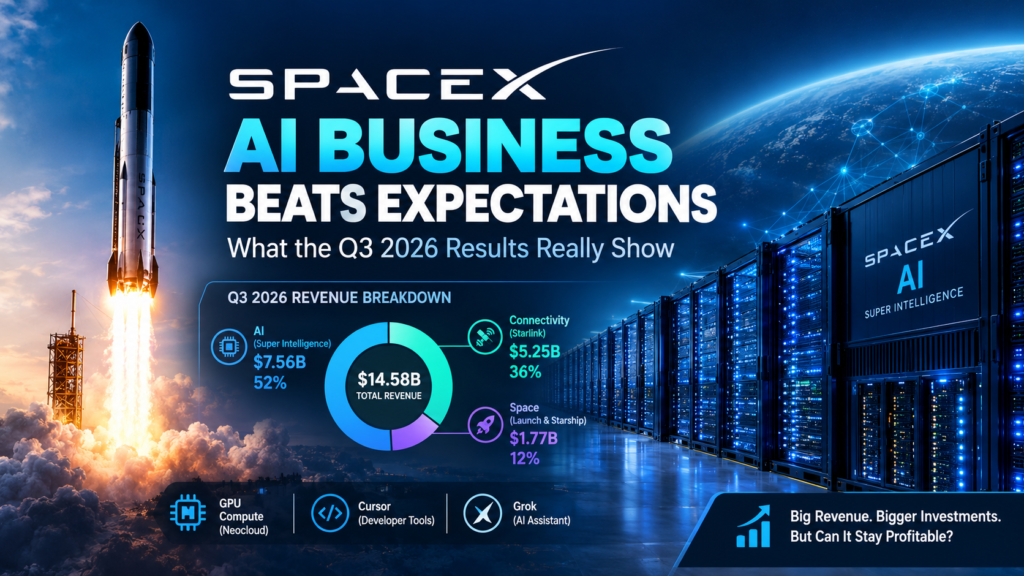
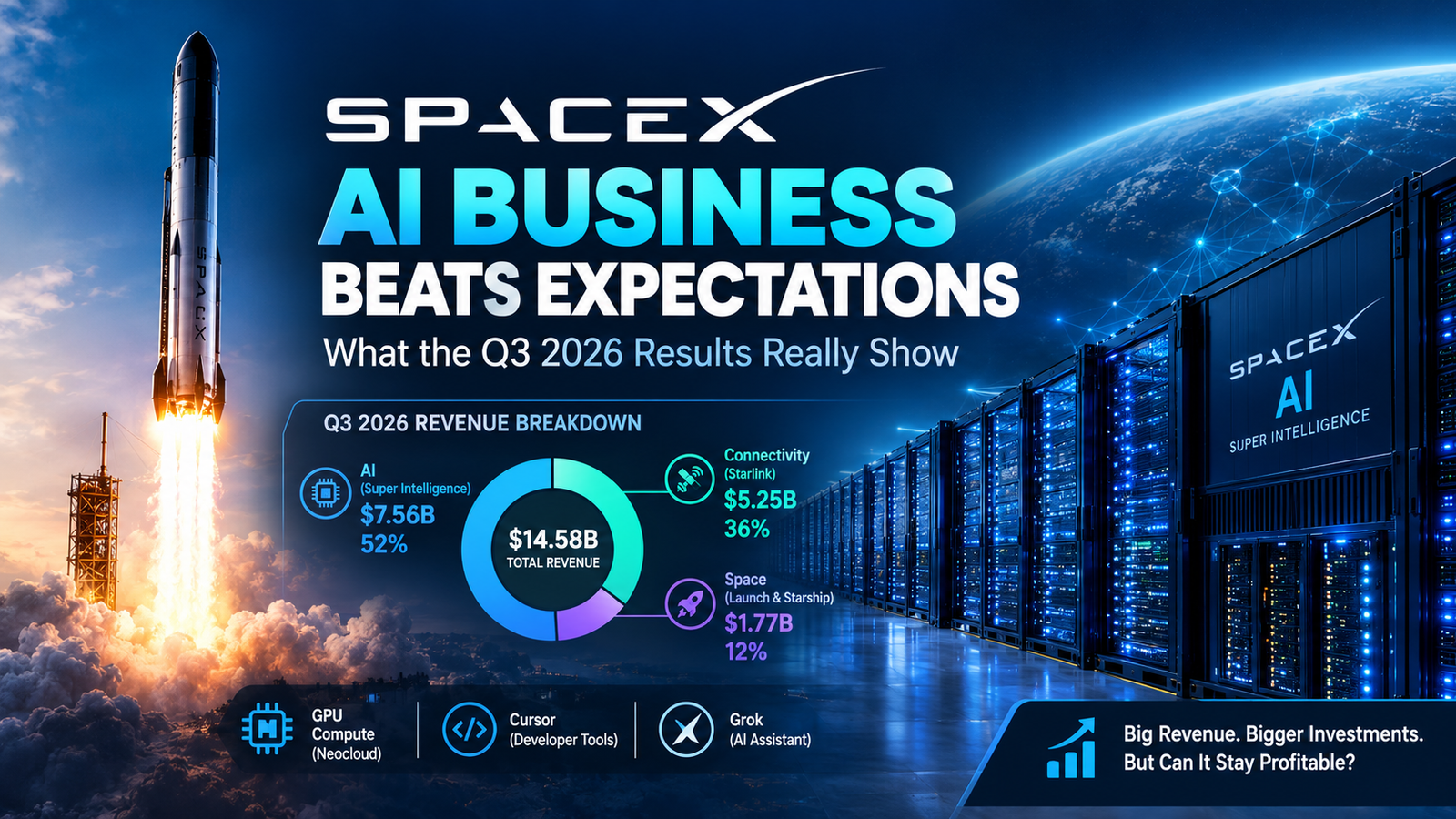
A company famous for landing rockets now earns more from artificial intelligence than from space. The SpaceX AI business brought in about USD 7.6 billion of revenue in the third quarter of 2026, beating forecasts and making up roughly 52% of group sales. The AI unit also swung to a profit of USD 431 million, which helped SpaceX report USD 4.4 billion in net income, more than double what analysts expected. This guide explains what drove those numbers, where the money really comes from, and which risks still deserve attention. SpaceX beats Q3 forecasts across all three segments as AI revenue tops $7.5 billion +2
Key Takeaways
- AI is now the largest segment. It accounts for roughly 52% of total revenue. investinglive
- Every segment beat estimates. AI revenue was USD 7.56 billion, connectivity USD 5.25 billion and space USD 1.77 billion, each above consensus. Axios
- The profit is real but flattered by timing. The AI profit would have been higher without USD 1.2 billion of one-time stock compensation tied to the Cursor acquisition. TechCrunch
- Compute rental drives the growth. The SpaceX AI business earns most of its money by renting data-center capacity to developers such as Anthropic, Google and Reflection AI, not from its own models. U.S. News & World Report
- Spending is enormous. Capital expenditure hit USD 19.6 billion in the quarter, with more than USD 16.4 billion going to AI. CNBC
- One strong quarter is not a track record. Cumulative net results for the first nine months were still a loss of USD 413 million. beingguru
What Is the SpaceX AI Business?
Definition
The SpaceX AI business is the division of SpaceX that builds and sells artificial intelligence products and the computing infrastructure behind them. It spans xAI’s Grok chatbot, the social platform X, and a rapidly growing data-center operation. SpaceX now reports the segment under the name “Super Intelligence.” U.S. News & World Report
How it got here
The segment is young. SpaceX acquired Musk’s AI company xAI in February 2026 and listed on Nasdaq on June 12, 2026. In the third quarter, it also closed a USD 60 billion purchase of the AI coding startup Cursor. That means the quarterly numbers mix organic growth with acquired revenue, which matters when you judge how repeatable they are. WikipediaCNBC
Why it behaves like a cloud company
Despite the Grok branding, the money does not mainly come from chatbot subscriptions. Reuters notes that SpaceX earns most of its AI revenue by renting data-center capacity, a business closer to a cloud provider’s than an AI lab’s. In practice, the SpaceX AI business works more like a “neocloud,” a newer type of cloud company built around GPU capacity, than like a pure model developer. That distinction shapes everything from margins to risk. U.S. News & World Report
How Did the SpaceX AI Business Perform in Q3 2026?
Did the SpaceX AI business beat expectations? Yes. AI revenue of USD 7.56 billion topped consensus of USD 6.47 billion, and other outlets cite slightly lower consensus figures of around USD 6.3 billion. By either measure, the beat was large. Axios
The segment scorecard
| Segment | Q3 2026 revenue | Analyst expectation | Result |
|---|---|---|---|
| AI (Super Intelligence) | USD 7.56 billion | USD 6.47 billion | Beat |
| Connectivity (Starlink) | USD 5.25 billion | USD 4.9 billion | Beat |
| Space (launch and Starship) | USD 1.77 billion | USD 1.46 billion | Beat |
| Total | USD 14.58 billion | About USD 13 billion | Beat |
Figures from Axios, citing S&P Capital IQ consensus. Other outlets report slightly different consensus numbers. Total revenue was about USD 9 billion higher than the same quarter in 2025. Axios
Profitability
The SpaceX AI business earned a profit of USD 431 million in the quarter. The space division, by contrast, lost USD 7 million. The AI figure is notable because the unit was loss-making a quarter earlier: it lost USD 1.26 billion in the second quarter despite fast revenue growth. The swing suggests that new compute capacity is being sold at healthy prices once it goes live. CNBCthenextweb
Where the Revenue Comes From
The neocloud engine
The biggest driver is the SpaceX neocloud: GPU capacity leased to outside customers. The company says it now has 1.7 gigawatts of compute. Inside the SpaceX AI business, this is the part that scales fastest, because capacity that comes online can be leased almost immediately. At its Memphis-area data centers, SpaceX says it can bring 200,000 Nvidia Grace Blackwell systems online every month through the end of the year. Customers named in reporting include Anthropic, Alphabet’s Google and Reflection AI. SpaceX’s AI business is beating expectations +2
Cursor and Grok
The segment also includes Cursor and Grok. Together with the neocloud, they produced the USD 7.5 billion in segment revenue. Cursor adds a product with an established developer user base. Grok remains the more uncertain piece: Reuters points out that SpaceX’s own AI software has been overshadowed by rivals OpenAI, Anthropic and Google. TechCrunchU.S. News & World Report
Starlink as the funding engine
Connectivity is still the financial backbone. Starlink grew to 13.6 million consumer subscribers, and Musk predicts AI agents will increase demand for connectivity. Critics argue that using Starlink profits to bankroll AI and Starship is unsustainable over the long run, so how soon the AI segment can fund itself is a central question for investors. TechCrunchU.S. News & World Report
How the SpaceX AI Business Compares With an AI Lab and a Cloud Provider
The table below is a simplified comparison to show where the segment sits. It is a general framing, not a precise audit of any company.
| Dimension | Typical frontier AI lab | Hyperscale cloud provider | SpaceX AI segment |
|---|---|---|---|
| Main revenue source | Subscriptions and API usage | Cloud services and long-term contracts | Compute leasing, plus Cursor and Grok |
| Key customers | Consumers and developers | Enterprises and governments | Outside AI developers such as Anthropic, Google and Reflection AI |
| Revenue visibility | Moderate; usage can shift quickly | High; multi-year commitments | Mixed; one Q2 analyst note flagged 90-day termination clauses in leases |
| Capital intensity | High | Very high | Very high; USD 16.4 billion of AI capex in one quarter |
| Parent-company support | Usually investors or partners | Self-funded from cash flow | Starlink cash flow and public capital markets |
The key point: the segment has a cloud company’s capital bill but, according to at least one analyst note on the second quarter, leasing agreements that customers can terminate on 90 days’ notice. That combination is what makes the growth impressive and the risk real. longportapp
Growth Trajectory: From Q2 to Q3
AI revenue was USD 2.56 billion in the second quarter. Wall Street expected about USD 6.3 billion for the third quarter, and the actual result of USD 7.56 billion nearly tripled the prior quarter. That sequential jump is the strongest evidence that the SpaceX AI business is scaling quickly. CNBC
The market’s reaction also changed. After the second-quarter report, the stock fell as much as 11% even though revenue nearly doubled, because spending alarmed investors. After the third-quarter report, shares climbed about 8% in extended trading. Reuters put the move at about 3%, so the exact figure depends on when you measure. The direction is clear: investors are more willing to accept the spending now that revenue is arriving faster. thenextwebCNBC
Can the SpaceX AI Business Justify Its Spending?
Short answer: Not yet proven, but the third quarter moved the argument in its favor.
Capital expenditure was USD 19.6 billion, of which more than USD 16.4 billion went to AI. Analysts viewed that as in line with expectations, with AI capex slightly below the roughly USD 16.9 billion forecast. The outlay is still larger than the quarter’s USD 14.6 billion of revenue, which keeps the payback question open. CNBCinvestinglive
Management’s argument, reported after the second quarter, was that each AI investment pays for itself within a year. The honest read is that the SpaceX AI business has shown faster revenue conversion than analysts modeled, but one quarter cannot confirm a payback period. Fresh funding needs add to the picture: SpaceX is reportedly in talks to raise up to USD 40 billion to buy more Nvidia chips. thenextwebCNBC
What Musk Is Promising for the SpaceX AI Business
The revenue forecast
Musk predicted that annual recurring revenue will reach somewhere between USD 500 billion and USD 1 trillion by the end of 2027. Compared with a quarterly AI run rate of roughly USD 30 billion annualized, that is an extraordinary leap. Treat it as a stated ambition, not a forecast grounded in the reported numbers. TechCrunch
The infrastructure bottleneck
Musk’s more concrete argument concerns constraints. He said the limit on deploying superintelligence is increasingly power, cooling and infrastructure rather than chips. SpaceX is applying metal-casting capabilities developed for its rocket business to make components and obtain turbines more quickly. It is also continuing work on a second data-center project, Colossus II. If that vertical integration works, it could become a genuine cost and speed advantage over competitors that buy from outside suppliers. SpaceX’s AI business is beating expectations +2
Three Risks Facing the SpaceX AI Business
1. Contract visibility
If customers can leave on short notice, revenue can fall as quickly as it rose. The 90-day clause was reported for second-quarter agreements, so check whether newer contracts differ. Customer concentration compounds the issue, since a handful of AI developers account for much of the leasing demand.
2. Spending outpacing cash generation
Capital expenditure for the first half of 2026 reached USD 28.5 billion, more than four times a year earlier. Add a third quarter at USD 19.6 billion and the company is committing capital at a historic pace. When cloud vendors guide capex well above expectations but orders do not keep pace, markets tend to question returns. bgovlongportapp
3. Earnings quality
Several things make the profit harder to read than the headline suggests. The AI figure absorbed a one-time stock-compensation charge, the quarter included a major acquisition, and the year-to-date result remains a loss. A single profitable quarter is encouraging, not conclusive.
What to Watch Next
- Capacity coming online: progress on the 1.7 GW neocloud and Colossus II
- Contract terms: whether lease durations lengthen and termination rights tighten
- Customer mix: whether Cursor and Grok revenue grows relative to compute leasing
- Capex versus revenue: whether AI spending per quarter stabilizes
- Funding: the outcome of the reported chip-financing talks
- Starship progress: its role in future Starlink and orbital data-center plans
Frequently Asked Questions
Is the SpaceX AI business profitable?
Yes, in the most recent quarter. It posted a USD 431 million profit in Q3 2026, after a loss of about USD 1.26 billion in Q2. The profit would have been higher without the one-time Cursor-related stock compensation, but the nine-month company-wide result is still a loss.
How does the SpaceX AI business compare with Starlink?
AI is now larger. It generated USD 7.56 billion in Q3 against USD 5.25 billion for connectivity. In Q2, Starlink led with USD 4.29 billion versus roughly USD 2.56 billion for AI, so the ranking flipped within a single quarter. longportapp
Who are the customers behind the growth?
Reporting names Anthropic, Google and Reflection AI as compute customers. Cursor and Grok supply additional revenue. U.S. News & World Report
Does SpaceX still make money from rockets?
Yes, but it is the smallest segment. Space revenue was USD 1.77 billion in Q3, and the division posted a small operating loss as spending on Starship continues.
Conclusion: Can the SpaceX AI Business Sustain Its Growth?
The SpaceX AI business has moved from a side project to the center of the company’s story in under a year. Its third-quarter 2026 performance marked a significant turning point, with revenue beating expectations, the AI segment returning to profitability, and quarterly sales nearly tripling compared with the previous quarter. The rapid expansion reflects growing demand for AI computing capacity and the company’s ability to bring new data-center infrastructure online. However, these results also raise an important question: can SpaceX turn its impressive revenue growth into sustainable, long-term profitability?
One of the biggest advantages of the SpaceX AI business is its neocloud model. Instead of relying primarily on subscriptions to its own AI products, the company generates much of its revenue by leasing computing capacity to external customers. As AI developers train increasingly capable models and deploy AI agents, their demand for powerful graphics processing units (GPUs) and supporting infrastructure could continue to rise. This creates an opportunity for SpaceX to establish itself as a major computing provider alongside traditional cloud companies. Its broader ecosystem, which includes Grok, Cursor, and its data-center operations, could also provide additional sources of revenue as these businesses develop.
Nevertheless, revenue growth alone does not guarantee financial strength. The company’s substantial capital expenditure remains a central concern. Building AI data centers requires enormous investments in computing hardware, electricity, cooling systems, networking equipment, and physical infrastructure. These facilities must generate enough recurring revenue to cover operating costs, financing requirements, and the eventual replacement of aging hardware. If computing demand slows, customers reduce their spending, or competitors offer lower prices, the returns on these investments could fall short of expectations.
Customer concentration and contract terms also deserve attention. When a large share of revenue comes from a relatively small group of AI developers, losing even one major customer could have a meaningful financial impact. Longer contracts with predictable payments would improve revenue visibility, while short termination periods could leave the business exposed to sudden changes in customer demand. Investors should therefore look beyond headline revenue figures and examine the quality, duration, and diversification of the contracts supporting that growth.
Another important factor is whether the company can balance its AI ambitions with its established space and connectivity operations. Starlink provides a significant connectivity business, while rocket launches and future space projects remain central to SpaceX’s broader strategy. These operations create opportunities for long-term integration, but they also compete for management attention and capital. The ability to allocate resources efficiently across these businesses could influence how much financial flexibility the company retains during periods of heavy investment.
The next reporting periods will be especially important. Readers and investors should monitor whether AI revenue continues to grow, whether operating profits improve after accounting for acquisition-related expenses, and whether capital spending begins to generate stronger cash returns. Changes in customer concentration, contract duration, computing capacity utilization, and funding requirements will also help reveal whether the current growth rate is sustainable. Management’s ambitious revenue targets should be assessed against measurable operating results rather than treated as guaranteed outcomes.
Ultimately, the SpaceX AI business has demonstrated that it can scale quickly and compete for a larger share of the AI infrastructure market. Its latest results strengthen the case for its growth strategy, but they do not yet settle the question of long-term profitability. The real test will be whether the company can convert its expanding infrastructure and customer relationships into consistent earnings and durable cash flow without relying indefinitely on enormous new investments.
For now, the third-quarter performance is an encouraging milestone rather than a final verdict. The next phase will depend on execution, customer demand, disciplined spending, and the returns generated by each new wave of computing capacity.
This article is for informational purposes only and does not constitute financial advice.