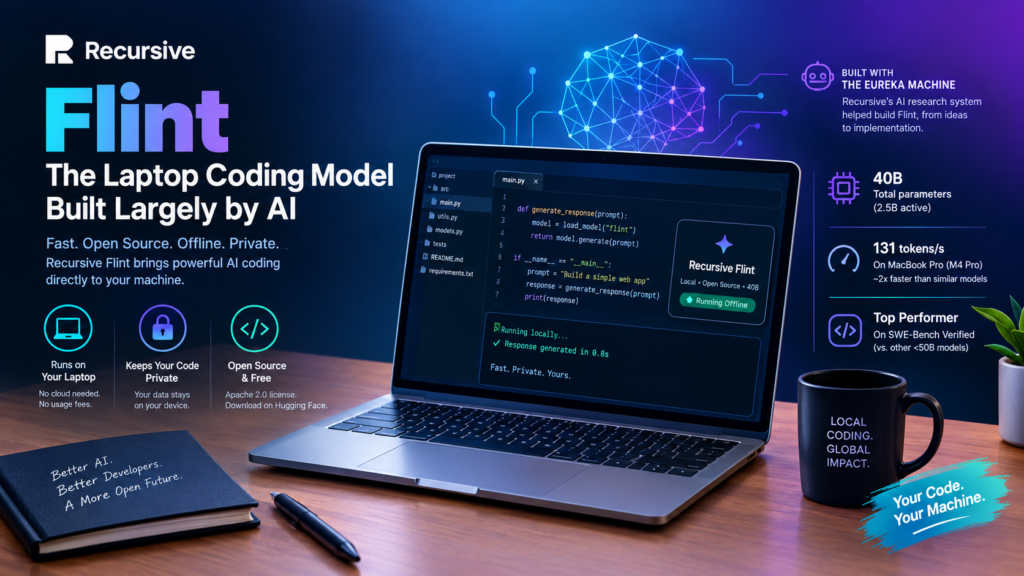
Recursive’s Flint is a free, open-source laptop coding model that you can download and run on your own machine, and the company says an AI research system did much of the work of building it. It matters for two reasons. It brings credible coding help to local hardware without cloud usage fees, and it is an early public test of recursive self-improvement, the idea that AI can build better AI, which then builds better AI still.
Developers have spent the past few years renting coding assistants by the token. Flint, released by Recursive on October 21, 2026, offers a different deal: download it once, run it offline, and keep your source code on your own disk.
This analysis covers what Flint is, how its numbers compare with other local models, what Recursive’s automated research system contributed, and what to watch next. The facts come from TechCrunch’s launch coverage unless noted otherwise. The performance figures are Recursive’s own, so treat them as vendor-reported until independent results arrive.
Key Takeaways
- Flint is a 40-billion-parameter mixture-of-experts model that activates only 2.5 billion parameters at a time, which is why it fits on ordinary hardware.
- Recursive reports about 131 tokens per second on a MacBook Pro with an M4 Pro chip, roughly double what similar models managed on the same machine.
- On SWE-Bench Verified, Flint outperformed other models under 50 billion parameters, according to the company’s testing.
- Recursive’s automated research system, the Eureka Machine, helped with nearly every stage of development, and a small team finished the model in under four months.
- Flint is a practical laptop coding model for private, offline work, although it needs more step-by-step guidance than the large paid assistants.
What Is Flint?
Definition: Flint is a coding model from the AI startup Recursive. It is the company’s first model, and it is designed to run on a personal computer instead of a cloud server.
Expansion: Calling Flint a laptop coding model is literal rather than promotional. The weights are free to download on Hugging Face under the Apache 2.0 license, an open-source license that allows free use and modification. Because the model runs on your own computer, you can use it offline, keep your code private, and avoid the usage fees that cloud AI services charge based on how much text the model processes.
Who Built Flint?
Recursive is an AI startup founded last year, and its stated goal is to build AI that can improve itself. It emerged from stealth in May with $650 million in funding at a $4.65 billion valuation, backed by investors including GV, Nvidia and AMD Ventures. Richard Socher, Salesforce’s former chief scientist, is the CEO.
According to the company, a small team built Flint from scratch in under four months, with heavy help from its own research system. That timeline is one of the most interesting claims in the launch, and it is covered in the Eureka Machine section below.
Flint at a Glance
| Attribute | Detail |
|---|---|
| Developer | Recursive (CEO Richard Socher) |
| Release date | October 21, 2026 |
| Model type | Mixture-of-experts coding model |
| Total parameters | 40 billion |
| Active parameters per task | 2.5 billion |
| License | Apache 2.0 |
| Where to download | Hugging Face |
| Price | Free |
| Development time | Under four months, small team |
| Reported speed (MacBook Pro, M4 Pro) | About 131 tokens per second |
How Can a 40-Billion-Parameter Model Run on a Laptop?
Short answer: Flint uses only a small slice of itself for any given task. The computing work per step is therefore closer to that of a 2.5-billion-parameter model than a 40-billion-parameter one.
Parameters are the numerical settings a model learns during training, and they are the usual shorthand for model size. Flint has 40 billion of them, but only 2.5 billion are active at any moment. That design, combined with aggressive compression, turns a 40-billion-parameter system into a laptop coding model instead of a data-center tenant.
There is one caveat. Sparse activation cuts the compute, but the full set of weights still has to be stored and loaded. TechCrunch’s report doesn’t list Flint’s minimum memory requirements, so check Recursive’s model page before you download. For reference, Wired’s reviewer ran Flint on a Mac with 48GB of memory.
What Is a Mixture-of-Experts Model?
Definition: A mixture-of-experts (MoE) model contains many specialized sub-networks, called experts, plus a routing mechanism that decides which experts handle each piece of input.
Expansion: Only the selected experts do work at any moment, so speed and energy use track the active parameters rather than the total. The trade-off is that every expert’s weights still need to be stored. That is why compression matters as much as the architecture itself.
Why Does Low-Bit Training Matter?
Definition: Low-bit training means a model’s numbers are trained and stored at reduced numerical precision, which makes the file smaller and the math cheaper.
Expansion: Recursive says its low-bit approach shrank Flint by 71% with almost no loss in quality. Compression usually costs some accuracy, so a near-lossless reduction of that size is a major reason a model this capable can fit on consumer hardware. According to the company, the Eureka Machine contributed this technique.
How Fast Is Flint on Real Hardware?
Short answer: Fast. In Recursive’s tests, Flint generated about 131 tokens per second on a MacBook Pro with Apple’s M4 Pro chip, and it topped 150 tokens per second on Nvidia’s RTX Spark.
A token is a chunk of text, typically a word or part of one. The comparison that stands out is on the MacBook Pro. Similar models, including Google’s Gemma 4 and Nvidia’s Nemotron 3.5 Lightning, managed 58 to 69 tokens per second on the same machine. That puts Flint at roughly twice their speed.
For a laptop coding model, speed is part of usability, not a vanity metric. Coding workflows are loops: the model drafts, you run the code, the error goes back in, and the model tries again. Every round trip gets quicker when generation is quicker, and agent-style tools that chain many model calls together feel the difference most. That is editorial analysis rather than a figure from the launch, but it explains why tokens per second deserves attention.
Flint vs. Other Local Models: Reported Numbers
| Model | Maker | Reported size | Local hardware | Speed on MacBook Pro M4 Pro |
|---|---|---|---|---|
| Flint | Recursive | 40B total, 2.5B active | Ordinary laptop | About 131 tokens/s |
| Gemma 4 | Not stated in source | Same laptop | 58 to 69 tokens/s (range for similar models) | |
| Nemotron 3.5 Lightning | Nvidia | Not stated in source | Same laptop | 58 to 69 tokens/s (range for similar models) |
| Muse Spark Open | Meta | 816B parameters | Macs with at least 1 TB of memory | Not reported |
| Qwen3.8 27B | Alibaba | 27B parameters | Not stated in source | Not reported; scored higher than Flint on Recursive’s six-test average |
The Meta comparison shows how different the “local model” category can be. Muse Spark Open, an open model for Macs released a week before Flint, uses 816 billion parameters and needs at least a terabyte of memory. Flint is far smaller by design.
How Good Is Flint at Coding?
Short answer: Good for its size, according to the vendor’s benchmarks and one early hands-on review. Neither is the final word yet.
What Do the Benchmarks Say?
Definition: SWE-Bench Verified is a benchmark that measures how well AI can fix real-world software bugs.
Expansion: Flint outperformed other models under 50 billion parameters on that test. On Recursive’s own average across six tests, only one model, Alibaba’s Qwen3.8 27B, scored higher than Flint.
Two cautions apply. The six-test average is Recursive’s own composite, so its choice of tests matters. And benchmark leaderboards shift quickly as new models land. Independent replication is the next milestone for this laptop coding model.
What Did Hands-On Testing Find?
Wired’s Will Knight tested Flint on a Mac with 48GB of memory and used it to build several small programs, including a to-do list app and a tool that searches the web for research. He found that smaller coding models often hit errors or ran slowly compared with Claude or Codex, but Flint handled his requests every time.
That is a positive signal, and it is also a small sample. Small apps are a friendly test, and large, messy codebases stress models in different ways.
Where Does Flint Fall Short?
Recursive acknowledged that Flint needs more guidance than the big paid coding assistants. The company suggests breaking large tasks into smaller steps. In practice, that likely means:
- Asking for one function or module at a time instead of a whole feature.
- Supplying the relevant files and context explicitly.
- Running tests after each step rather than at the end.
- Keeping a human review pass on anything that ships.
Those four tips are my own practical translation, not instructions from Recursive.
What Is the Eureka Machine?
Definition: The Eureka Machine is Recursive’s automated research system. It comes up with ideas, runs experiments, and uses the results to decide what to try next.
Expansion: According to the company’s launch video, it contributed to nearly every part of building Flint, from pre-training to post-training and inference. Humans oversee the process. This is closer to a tireless junior research team than to an autonomous scientist.
What Did the Eureka Machine Contribute?
Recursive credits the system with several concrete results:
- A sparser model shape. This is the architecture choice that keeps most of the model idle for any one task.
- Low-bit training. The technique that shrank Flint by 71% with almost no loss in quality.
- Custom kernels. Specialized programs that speed up the underlying computations.
Recursive didn’t say how much researcher time the system saved, which makes “largely built by AI” a claim you can’t yet measure. It isn’t alone in leaning on AI for research, though. OpenAI said last month that by mid-August its AI agents were logging 3.1 workdays for every one worked by a human researcher.
Is Flint Really Recursive Self-Improvement?
Short answer: Not yet in the full sense, and Recursive doesn’t claim otherwise.
Definition: Recursive self-improvement is the idea that AI can build better AI, which in turn builds even better AI. It is one of the most debated ideas in the industry. Some researchers fear that AI improving itself could slip out of human control.
Expansion: Recursive’s version is more limited today. It is an AI research assistant overseen by people that produced a model small enough for a laptop. Socher told Wired that the longer-term goal is full recursive self-improvement, with humans overseeing the process and able to stop it if something goes wrong. The company says each new model should make the Eureka Machine a better researcher, helping it build the next model faster.
So Flint is best read as the first data point in a longer experiment. It shows that an automated research loop can contribute to a competitive model. It doesn’t show that the loop can run unattended or compound indefinitely.
Local vs. Cloud: When Does a Laptop Coding Model Make Sense?
Short answer: A laptop coding model makes sense when privacy, offline access or cost predictability matters more than maximum capability.
| Factor | Local (Flint) | Cloud coding assistant |
|---|---|---|
| Cost model | Free download, runs on hardware you own | Usage fees based on how much text is processed |
| Privacy | Code stays on your machine | Code is sent to a provider’s servers |
| Offline use | Yes | No |
| Handling large tasks | Needs smaller steps and more guidance, per Recursive | Large paid assistants need less guidance |
| Speed | About 131 tokens/s on an M4 Pro MacBook Pro, per Recursive | Depends on provider and load |
| Customization | Apache 2.0 allows free modification | Limited to what the provider exposes |
The table shows that this isn’t a simple “better or worse” comparison. It is a trade of raw capability for control.
Who Should Try Flint First?
- Developers with sensitive or proprietary code who can’t send it to a third-party server.
- Engineers who work offline or on unreliable connections.
- Teams trying to control usage costs who want a predictable baseline for routine tasks.
- Tinkerers and researchers who want an open-source coding model they can inspect, fine-tune and modify under Apache 2.0.
- Anyone studying AI-assisted model development, since Flint is a rare public output of an automated research pipeline.
If you need the strongest possible results on large, multi-step tasks with minimal supervision, a larger cloud assistant is still the safer choice, based on Recursive’s own guidance.
What Flint Signals About the AI Industry
Three signals stand out. These are interpretations, not reported facts.
Small, efficient models are closing in on usable. Flint’s 40 billion parameters sit against Meta’s 816 billion for Muse Spark Open. Two very different strategies for local AI are now shipping within a week of each other, and Flint’s strategy is the one that fits on a typical laptop.
Automated research is becoming normal. Recursive’s pitch is built around its Eureka Machine, and OpenAI’s reported figure on agent workdays points the same direction. Recursive has said its $410 million compute deal with Amazon Web Services was less about headcount and more about agent count. The scarce resource in AI labs may be shifting from researchers to compute and well-supervised agents.
Open licensing is a distribution strategy. Releasing Flint free under Apache 2.0 makes it easy to try and hard to ignore. For a young company, adoption and goodwill are valuable even when the model itself isn’t the revenue line.
Taken together, these signals suggest the laptop coding model category is moving from novelty toward contender status, though that is an editorial judgment rather than a measured fact.
How to Evaluate a Laptop Coding Model on Your Own Projects
A benchmark can’t tell you whether a laptop coding model fits your codebase. A short, structured trial can.
- Check memory fit first. Confirm the model’s memory needs against your machine using Recursive’s model page, since the launch coverage doesn’t list them.
- Measure speed yourself. Vendor numbers come from specific chips. Your tokens per second may differ.
- Start with a real but small task. Pick a bug or feature from your own repository rather than a toy example.
- Break work into steps. Follow Recursive’s own advice and test whether smaller prompts improve results.
- Compare against your current assistant. Run the same tasks through both and note where the local model needs extra guidance.
- Review everything. Treat generated code like a pull request from a new teammate.
Risks and Open Questions
The biggest open question is whether independent testing will confirm the vendor’s claims about this laptop coding model. Beyond that:
- Vendor-reported benchmarks. The speed figures and the six-test average come from Recursive’s own tests.
- “Largely built by AI” is unverified. The company hasn’t said how much time or effort the Eureka Machine saved.
- Limited hands-on evidence. The early review is positive, but it covered small programs.
- Hardware requirements. The launch coverage doesn’t spell out minimum memory, which affects who can run it.
- Oversight at scale. Recursive’s long-term goal involves humans able to stop the process. How that works as automation deepens is a question the industry hasn’t settled.
Frequently Asked Questions
Is Flint free to use?
Yes. Flint is free to download on Hugging Face under the Apache 2.0 license, which allows free use and modification.
Can Flint work offline?
Yes. Because Flint runs on your own computer instead of a company’s cloud servers, a downloaded laptop coding model doesn’t need a connection to answer prompts.
What is the best laptop coding model right now?
There is no single best laptop coding model for every machine. On Recursive’s six-test average, only Alibaba’s Qwen3.8 27B scored higher than Flint. Flint also led other sub-50-billion-parameter models on SWE-Bench Verified and ran about twice as fast as similar models on an M4 Pro MacBook Pro, per the company. Test candidates on your own hardware and tasks.
How is Flint different from Meta’s Muse Spark Open?
Size and hardware. Flint has 40 billion parameters with 2.5 billion active at a time. Muse Spark Open uses 816 billion parameters and needs at least a terabyte of memory.
Does Flint replace paid coding assistants?
Not for every task. As a laptop coding model, Flint competes on privacy, cost and speed rather than on handling the largest jobs unaided. Recursive itself says it needs more guidance than the big paid assistants.
Is Flint proof that AI can improve itself?
No. It shows an automated research system, overseen by people, contributing to a competitive model. Full recursive self-improvement remains a longer-term goal.
Bottom Line
Flint is a credible laptop coding model with a bigger story attached. The practical story is simple: a free, fast, open-source coding model that runs on your own hardware, keeps your code private and removes per-token fees, with the caveat that it works best when you give it smaller steps.
The larger story is about how the model was made. If the Eureka Machine’s contributions hold up under outside scrutiny, Flint will be remembered less for its benchmark scores than as an early public checkpoint for automated AI research. If you try this laptop coding model, run it on your own projects, measure it against your current tools, and let your results, not the launch numbers, decide.