ପୁନରାବୃତ୍ତିମୂଳକ ସ୍ୱୟଂ-ଉନ୍ନତି (Recursive Self-Improvement): ନିଜକୁ ନିଜେ ଗଢ଼ିପାରୁଥିବା AI ବିଷୟରେ ‘ଆନ୍ଥ୍ରୋପିକ୍’ (Anthropic) ର ଚେତାବନୀର ପ୍ରକୃତ ଅର୍ଥ କ’ଣ?
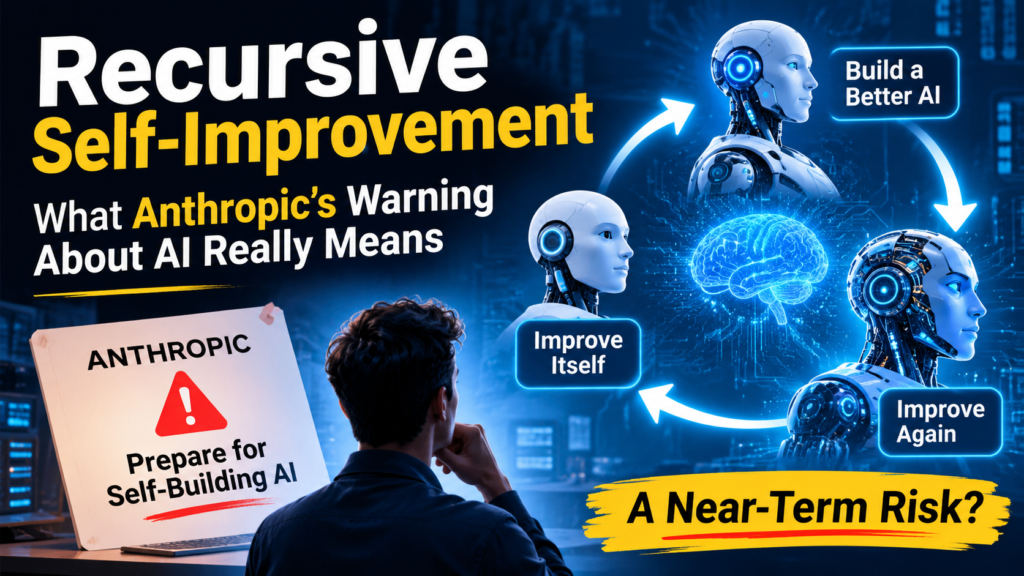
Recursive self-improvement is the point at which an AI system designs, builds and trains a more capable successor with little or no human help, and Anthropic says it could arrive sooner than most institutions are prepared for. Anthropic does not claim it has happened. Its position is that current trends make the risk of self-building AI a near-term planning problem rather than a science-fiction footnote, and that governments and labs should prepare now.
If you only have a minute, here are the essentials:
- What it is: AI that improves itself, then uses the improved version to improve itself again.
- Who is warning: Anthropic, through a research paper from its in-house institute, authored by co-founder Jack Clark and institute lead Marina Favaro.
- What the evidence is: Claude now writes most of the code merged into Anthropic’s own systems, and its success rate on hard coding tasks has jumped sharply.
- What Anthropic wants: A coordinated option to slow or temporarily pause frontier AI development, backed by ways to verify it.
- What is still uncertain: Whether full automation of AI research is achievable at all, and how fast physical limits like chips and power would let it move.
The rest of this guide breaks the story into self-contained sections, so you can jump to whichever question matters most to you.
What Is Recursive Self-Improvement?
Definition: AI That Builds Better AI
Recursive self-improvement (often shortened to RSI) is a process in which an AI system uses its existing capabilities to make itself better, then repeats the cycle with the upgraded version. Each loop is meant to produce a system that is more capable than the one before it.
Expansion: Partial Versus Full Automation
Researchers distinguish between degrees of automation. In the mild form, AI tools speed up human engineers by writing code, debugging and running experiments, while people still decide what to build. In the strong form, which Anthropic calls full recursive self-improvement, a model autonomously designs and develops its own successor, and humans step back from the core stages of training.
Anthropic’s paper splits the work of building a model into two halves. Engineering covers writing code, standing up infrastructure and overseeing training runs. Research covers deciding what to test, interpreting results and choosing what to try next. Anthropic reports progress on each of those halves separately, which matters because the research half is the harder one to automate.
Question: Is Recursive Self-Improvement the Same as an “Intelligence Explosion”?
Short answer: no, but they are related. The intelligence explosion is a speculative end state in which capability gains compound faster than the difficulty of producing them. Recursive self-improvement is the mechanism that could, in theory, lead there. Anthropic is describing the mechanism and its early signs, not predicting the end state.
What Did Anthropic Actually Say?
The Core Claim
The warning came in a blog post by Anthropic co-founder Jack Clark, co-written with Marina Favaro, who leads the company’s research institute. The Anthropic Institute published it on June 4, 2026, under the title “When AI builds itself.” The central message was that the industry is not there yet and the outcome is not inevitable, but it could come sooner than most institutions are ready for.
The Safety Framing
Anthropic did not present this as a victory lap. The company said that AI able to build itself would be a major development in the history of technology, but that full recursive self-improvement might also raise the risk of humans losing control over AI systems. If models can fully build their successors, the ways labs secure them, monitor them and shape their behavior all become far more important.
The Timeline Question
The Wall Street Journal, as summarized by Nashaniva, reported Clark saying that technologies capable of recursive self-improvement could emerge within roughly two years or sooner. That is an estimate from one of the people closest to the data, not a forecast agreed across the industry, and it should be read that way.
The Policy Ask
Anthropic proposed that governments and labs keep the option to slow or temporarily pause frontier development. It also said it would convene policymakers, researchers, civil society groups and other AI companies to work out how the risks should be managed and what coordination would look like. Anthropic said it plans to engage lawmakers on the topic in the coming months.
What Evidence Supports the Warning?
Claude Already Writes Most of Anthropic’s Code
The most concrete figure in the paper is about code. As of May 2026, Claude had authored more than 80 percent of the code merged into Anthropic’s own codebase. That makes AI assistance a default part of how frontier models get built, not an occasional helper.
Hard Tasks Are Getting Solved
On the hardest and least-specified coding tasks, Anthropic said Claude succeeded 76 percent of the time in May 2026, a rise of 50 percentage points in six months. Vague, open-ended tasks are the ones that most resemble real research work, so this is the metric to watch.
Autonomy Keeps Doubling
Anthropic also said the length of tasks AI systems can complete autonomously has been doubling roughly every four months. If that pace held, tasks that take an expert days would eventually become routine for a model working unsupervised.
Anthropic’s Follow-Up Research
In August 2026, Anthropic published research on automated alignment post-training that improved results across 10 alignment benchmarks without degrading overall performance. That result is a useful illustration, but analysts note it is technically narrower than general autonomous model self-improvement.
How Close Are We to Recursive Self-Improvement?
Question: Can an AI Build Its Own Successor Today?
Short answer: no. Today no AI model can build its own successor, according to The Economist, and a model capable of this would need to automate a range of specialist tasks that humans currently perform. Writing code and running experiments is increasingly automated. Choosing the next research direction, judging which results matter and managing a frontier training run remain mostly human jobs.
The Stages of Automation
The table below summarizes how researchers think about the path from today’s tools to full automation. The stages are a simplified framework for readers, not an official Anthropic scale.
| Stage | What AI does | What humans do | Where we are |
|---|---|---|---|
| AI-assisted engineering | Writes code, fixes bugs, runs experiments | Set goals, review everything | Already common |
| Automated engineering at scale | Builds and operates most infrastructure and training code | Direct research, oversee results | Advanced at Anthropic, judging by its code figures |
| Automated research | Chooses experiments, interprets results, proposes new methods | Supervise at a high level | Early signs, still narrow |
| Full recursive self-improvement | Designs and trains its own successor end to end | Minimal involvement | Not reached |
Why Physical Limits Still Matter
Not everyone agrees the bottleneck is intelligence. Coverage of the Anthropic post notes that the current limits lie in chips, power grids and bandwidth rather than in raw intelligence. The Economist likewise argues a self-improving system would probably face speed limits at first. In other words, even a very capable researcher-model still needs hardware, electricity and data center capacity to run its experiments.
What the Numbers Do and Do Not Show
It helps to separate three things the headline figures can mean. A high share of merged code written by Claude shows that AI is doing the typing, but it does not show who decided what was worth building. A jump in success on hard coding tasks shows rising skill at well-defined problems, but research taste is harder to benchmark. And a doubling time for task length is a trend line, not a law of nature, so it can bend if compute, data or algorithmic progress slows.
That is why careful readers treat Anthropic’s figures as early warning indicators rather than proof of arrival. They are strong evidence that the engineering half of model building is being automated. They are weaker evidence about the research half, which is the part that would make a loop truly self-sustaining.
Why Does Recursive Self-Improvement Matter?
Definition: The Control Problem
The core worry is loss of oversight. Today, humans decide what a model is trained to do, test it, and decide whether to release it. As recursive self-improvement removes people from those steps, the speed of progress could outrun the ability of institutions to respond.
Expansion: Three Concrete Risks
- Monitoring gaps: If thousands of AI agents are doing research faster than people can read their output, spotting a subtle problem becomes harder.
- Security exposure: A system that can modify itself is also a target. Researchers describe the literature on securing self-modifying systems as limited, and they argue this should be a central research priority.
- Shrinking decision windows: One analysis warns that capability gains could outpace existing governance systems and close the window for meaningful intervention by governments and international bodies.
Question: Is There Any Upside?
Short answer: yes, potentially large. Anthropic itself notes that self-improving AI could bring great benefits to science and health care. The company’s argument is not that the technology is bad, but that its benefits depend on keeping humans able to monitor and steer it.
What Does Anthropic Want Done About It?
The “Brake Pedal” Idea
Anthropic argues the industry needs to build a “brake pedal,” or companies risk losing control of their creations. In practice that means agreeing in advance how a slowdown or pause would work, so that it is a real option rather than an empty promise.
Verification Mechanisms
Anthropic proposes global mechanisms to verify any future AI slowdown or pause. A pause that cannot be checked is only a pledge, and rivals have little reason to trust a pledge they cannot confirm.
Transparency About the Metrics
Anthropic said it is important to share these metrics so people can understand how close the world is to full autonomous self-building. The logic is simple: governments cannot prepare for a milestone they cannot measure.
How Do Other Voices See It?
Reactions split along predictable lines. The comparison below sets out the main camps and their strongest points.
| Voice | Main position | Key argument |
|---|---|---|
| Anthropic | Prepare now; keep a pause option | Trends in coding and task autonomy point toward earlier arrival than institutions expect |
| OpenAI | Warns of risk; also pursuing automation | Building an automated research intern, with a target of an autonomous AI researcher by March 2028; flagged concerns about unchecked self-improvement in a December 2025 blog |
| The Economist | Real, but with speed limits | Specialist tasks and hardware constrain how fast any loop could run |
| Skeptics | Credibility problem | One critic on X said Anthropic compares AI to nukes and warns about humanity’s end, then races ahead anyway |
| Financial analysts | Tension with business model | A Wharton professor said the company is asking investors to fund a race to more autonomous AI while acknowledging that capability could outpace safety |
The skeptics raise a fair point that is worth taking seriously: a company warning about a risk while also building the technology has an obvious tension. Anthropic’s answer is that it is better to share data and call for coordination than to stay silent. Whether you find that persuasive is a judgment call, and reasonable people disagree.
What Should Students and Early-Career Professionals Do?
You do not need to settle the debate to act sensibly. Three practical moves hold up under any timeline:
- Learn to work with AI agents, not just chat with them. The tasks being automated first are routine coding, testing and data work. Skills in specifying, supervising and verifying AI output gain value as that work shifts.
- Build judgment, not only syntax. The stages that remain human the longest are choosing what is worth doing and evaluating whether results are trustworthy.
- Follow primary sources. Read the original Anthropic Institute paper and the companies’ own reports instead of relying on headlines, since coverage ranges from careful to alarmist.
What Should Businesses and Policymakers Watch?
Organizations that depend on AI tools do not need to predict the date of full automation, but they can track a short list of signals that would show the trend accelerating or stalling:
- Benchmarks on open-ended research tasks, not just coding puzzles, from labs and independent evaluators.
- Share of AI-written code and AI-run experiments at frontier labs, as published in their own reports.
- Compute and energy build-out, since hardware is the most likely brake on any fast loop.
- Evaluation and monitoring standards, including whether governments create independent bodies to test the most capable models.
- Pause and verification proposals, and whether rival labs and governments sign on to them.
Policymakers face a slightly different question: what would they need to know, and how quickly, to make a slowdown decision credible? Building that capacity before it is needed is the practical core of Anthropic’s request.
Frequently Asked Questions About Recursive Self-Improvement
Has recursive self-improvement already happened?
No. Anthropic says the world is not there yet. AI already contributes heavily to building new models, but humans still direct the research and make the major decisions.
What does “RSI” stand for?
RSI stands for recursive self-improvement. It describes AI systems that autonomously design, build and train more capable successors. In this article, RSI and recursive self-improvement mean the same thing.
Why is Anthropic warning about this publicly?
Because it wants institutions to prepare before the capability arrives. Anthropic says it wants lawmakers informed early and wants a coordinated option to slow frontier development if needed.
Is recursive self-improvement inevitable?
No. Anthropic explicitly says it is not inevitable. Physical limits, technical difficulty in automating research, and deliberate policy choices could all slow or prevent it.
Who else is working on it?
Several labs. OpenAI has publicly described plans to automate AI research and has voiced its own safety concerns. Other labs have set aggressive automation targets as well.
How can I tell if the warnings are credible?
Look for concrete metrics and independent confirmation. Anthropic published specific figures, such as the share of code written by Claude. Independent evaluation by outside researchers and government bodies is the missing piece.
The Bottom Line
Recursive self-improvement is best understood as a spectrum, not a switch. AI is already writing most of the code at a leading lab and solving a growing share of hard problems. The final step, a model that independently runs the research needed to build its own successor, has not been taken. Anthropic’s message is that the gap is narrowing faster than policy is moving, and that the sensible response is to build the brakes before they are needed.
Whether you read the warning as responsible transparency or as strategic positioning, the underlying questions do not go away: who verifies these claims, who decides when to slow down, and how the benefits are shared if the technology does arrive. Those are worth following closely, because recursive self-improvement, if it comes, will not wait for institutions to catch up.
ପୁନରାବୃତ୍ତିମୂଳକ ସ୍ୱୟଂ-ଉନ୍ନତି (Recursive Self-Improvement): ନିଜକୁ ନିଜେ ଗଢ଼ିପାରୁଥିବା AI ବିଷୟରେ ‘ଆନ୍ଥ୍ରୋପିକ୍’ (Anthropic) ର ଚେତାବନୀର ପ୍ରକୃତ ଅର୍ଥ କ’ଣ?
ଶେଷ ଅପଡେଟ୍: ନଭେମ୍ବର ୩, ୨୦୨୬
‘ପୁନରାବୃତ୍ତିମୂଳକ ସ୍ୱୟଂ-ଉନ୍ନତି’ (Recursive Self-Improvement) ହେଉଛି ଏପରି ଏକ ସ୍ଥିତି, ଯେଉଁଠାରେ ଏକ AI ସିଷ୍ଟମ୍ ମନୁଷ୍ୟର ସାହାଯ୍ୟ ବିନା କିମ୍ବା ଅତି ସାମାନ୍ୟ ସାହାଯ୍ୟରେ ନିଜଠାରୁ ଅଧିକ ସକ୍ଷମ ଏକ ନୂତନ ସିଷ୍ଟମ୍କୁ ଡିଜାଇନ୍ କରେ, ନିର୍ମାଣ କରେ ଏବଂ ପ୍ରଶିକ୍ଷିତ କରେ। ‘ଆନ୍ଥ୍ରୋପିକ୍’ (Anthropic) କମ୍ପାନୀର କହିବା ଅନୁଯାୟୀ, ଏହି ପର୍ଯ୍ୟାୟ ଆମେ ଭାବୁଥିବା ଅପେକ୍ଷା ବହୁତ ଶୀଘ୍ର ଆସିପାରେ, ଯାହା ପାଇଁ ଅଧିକାଂଶ ସଂସ୍ଥା ଏପର୍ଯ୍ୟନ୍ତ ପ୍ରସ୍ତୁତ ନାହାନ୍ତି। ‘ଆନ୍ଥ୍ରୋପିକ୍’ ଏହା ଦାବି କରୁନାହିଁ ଯେ ଏପରି ଘଟଣା ବର୍ତ୍ତମାନ ଘଟିସାରିଛି।
କିନ୍ତୁ ସେମାନଙ୍କ ମତରେ, ବର୍ତ୍ତମାନର ଧାରାକୁ ଦେଖିଲେ, ନିଜକୁ ନିଜେ ଗଢ଼ିପାରୁଥିବା AI (self-building AI) ର ବିପଦ କେବଳ କଳ୍ପନାବିଜ୍ଞାନ (science-fiction) କାହାଣୀରେ ସୀମିତ ନୁହେଁ, ବରଂ ଏହା ଏକ ବାସ୍ତବ ସମସ୍ୟା ଯାହା ପାଇଁ ବର୍ତ୍ତମାନ ଠାରୁ ହିଁ ଯୋଜନା କରିବା ଆବଶ୍ୟକ। ତେଣୁ, ବିଭିନ୍ନ ଦେଶର ସରକାର ଏବଂ ଗବେଷଣା ସଂସ୍ଥାଗୁଡ଼ିକ ଏଥିପାଇଁ ପ୍ରସ୍ତୁତ ହେବା ଉଚିତ୍।
ଯଦି ଆପଣଙ୍କ ପାଖରେ କେବଳ ଗୋଟିଏ ମିନିଟ୍ ସମୟ ଅଛି, ତେବେ ଏହାର ମୁଖ୍ୟ ବିଷୟଗୁଡ଼ିକ ଏଠାରେ ଦିଆଗଲା:
ଏହା କ’ଣ: ଏପରି ଏକ AI ଯାହା ନିଜକୁ ଉନ୍ନତ କରେ ଏବଂ ପରେ ସେହି ଉନ୍ନତ ସଂସ୍କରଣକୁ ବ୍ୟବହାର କରି ପୁନର୍ବାର ନିଜକୁ ଆହୁରି ଉନ୍ନତ କରିଥାଏ।
କିଏ ଚେତାବନୀ ଦେଉଛି: ‘ଆନ୍ଥ୍ରୋପିକ୍’ (Anthropic) – ଏହାର ଏକ ଗବେଷଣା ପତ୍ର ମାଧ୍ୟମରେ, ଯାହାକୁ କମ୍ପାନୀର ସହ-ପ୍ରତିଷ୍ଠାତା ଜ୍ୟାକ୍ କ୍ලාର୍କ (Jack Clark) ଏବଂ ସଂସ୍ଥାର ମୁଖ୍ୟ ମରିନା ଫାଭାରୋ (Marina Favaro) ଲେଖିଛନ୍ତି।
ପ୍ରମାଣ କ’ଣ: ‘ଆନ୍ଥ୍ରୋପିକ୍’ର ନିଜସ୍ୱ ସିଷ୍ଟମ୍ରେ ବ୍ୟବହୃତ ହେଉଥିବା ଅଧିକାଂଶ କୋଡ୍ (code) ବର୍ତ୍ତମାନ ‘କ୍ଲୋଡ୍’ (Claude – ସେମାନଙ୍କର AI) ଲେଖୁଛି। ଏହା ସହିତ, କଠିନ କୋଡିଂ କାର୍ଯ୍ୟଗୁଡ଼ିକରେ ଏହାର ସଫଳତା ହାର ମଧ୍ୟ ବହୁତ ବୃଦ୍ଧି ପାଇଛି।
‘ଆନ୍ଥ୍ରୋପିକ୍’ କ’ଣ ଚାହୁଁଛି: ଅତ ‘ସମ୍ପୂର୍ଣ୍ଣ ପୁନରାବୃତ୍ତିମୂଳକ ସ୍ୱୟଂ-ଉନ୍ନତି’ (full recursive self-improvement) ବୋଲି ଆନ୍ଥ୍ରୋପିକ୍ (Anthropic) କହୁଥିବା ଏହି ପ୍ରକ୍ରିୟାରେ, ଏକ ମଡେଲ୍ ନିଜର ପରବର୍ତ୍ତୀ ସଂସ୍କରଣକୁ ସ୍ୱୟଂଚାଳିତ ଭାବରେ ଡିଜାଇନ୍ ଓ ବିକାଶ କରେ ଏବଂ ମନୁଷ୍ୟମାନେ ଏହାର ପ୍ରଶିକ୍ଷଣ ପ୍ରକ୍ରିୟାର ମୁଖ୍ୟ ପର୍ଯ୍ୟାୟଗୁଡ଼ିକରୁ ଦୂରେଇ ରୁହନ୍ତି।
ଆନ୍ଥ୍ରୋପିକ୍ର ଏକ ଗବେଷଣା ପତ୍ରରେ ଏକ ମଡେଲ୍ ନିର୍ମାଣ କାର୍ଯ୍ୟକୁ ଦୁଇ ଭାଗରେ ବିଭକ୍ତ କରାଯାଇଛି। ‘ଇଞ୍ଜିନିୟରିଂ’ (ଯାନ୍ତ୍ରିକ କାର୍ଯ୍ୟ) ଅଧୀନରେ କୋଡ୍ ଲେଖିବା, ଆବଶ୍ୟକୀୟ ଭିତ୍ତିଭୂମି ପ୍ରସ୍ତୁତ କରିବା ଏବଂ ପ୍ରଶିକ୍ଷଣ ପ୍ରକ୍ରିୟାର ତଦାରଖ କରିବା ଭଳି କାର୍ଯ୍ୟ ଆସେ। ଅନ୍ୟପକ୍ଷରେ, ‘ଗବେଷଣା’ (Research) ଅଧୀନରେ କ’ଣ ପରୀକ୍ଷା କରାଯିବ ତାହା ସ୍ଥିର କରିବା, ଫଳାଫଳର ବିଶ୍ଳେଷଣ କରିବା ଏବଂ ପରବର୍ତ୍ତୀ ପଦକ୍ଷେପ କ’ଣ ହେବ ତାହା ଚୟନ କରିବା ଭଳି କାର୍ଯ୍ୟ ଅନ୍ତର୍ଭୁକ୍ତ। ଆନ୍ଥ୍ରୋପିକ୍ ଏହି ଦୁଇଟି ଭାଗରେ ହୋଇଥିବା ଅଗ୍ରଗତି ବିଷୟରେ ପୃଥକ ଭାବରେ ଉଲ୍ଲେଖ କରିଛି; ଏହା ଗୁରୁତ୍ୱପୂର୍ଣ୍ଣ କାରଣ ଗବେଷଣା ସମ୍ବନ୍ଧୀୟ କାର୍ଯ୍ୟକୁ ସ୍ୱୟଂଚାଳିତ କରିବା ଅଧିକ କଷ୍ଟକର ଅଟେ।
ପ୍ରଶ୍ନ: ‘ପୁନରାବୃତ୍ତିମୂଳକ ସ୍ୱୟଂ-ଉନ୍ନତି’ (Recursive Self-Improvement) ଏବଂ ‘ବୁଦ୍ଧିମତ୍ତାର ବିସ୍ଫୋରଣ’ (Intelligence Explosion) କ’ଣ ସମାନ?
ସଂକ୍ଷିପତ୍ତ ଉତ୍ତର: ନା, କିନ୍ତୁ ଉଭୟ ପରସ୍ପର ସହ ଜଡ଼ିତ। ‘ବୁଦ୍ଧିମତ୍ତାର ବିସ୍ଫୋରଣ’ ହେଉଛି ଏକ କଳ୍ପିତ ଚୂଡ଼ାନ୍ତ ଅବସ୍ଥା, ଯେଉଁଠାରେ କ୍ଷମତାର ବୃଦ୍ଧି, ସେହି କ୍ଷମତା ହାସଲ କରିବାର କଠିନତା ତୁଳନାରେ ଅଧିକ ଦ୍ରୁତ ଗତିରେ ହୋଇଥାଏ। ‘ପୁନରାବୃତ୍ତିମୂଳକ ସ୍ୱୟଂ-ଉନ୍ନତି’ ହେଉଛି ସେହି ପ୍ରକ୍ରିୟା ଯାହା ସିଦ୍ଧାନ୍ତଗତ ଭାବରେ ଏହି ଅବସ୍ଥାକୁ ନେଇଯାଇପାରେ। ଆନ୍ଥ୍ରୋପିକ୍ ଏଠାରେ କେବଳ ସେହି ପ୍ରକ୍ରିୟା ଏବଂ ଏହାର ପ୍ରାରମ୍ଭିକ ଲକ୍ଷଣଗୁଡ଼ିକ ବିଷୟରେ ବର୍ଣ୍ଣନା କରୁଛି, କୌଣସି ଚୂଡ଼ାନ୍ତ ଅବସ୍ଥାର ଭବିଷ୍ୟବାଣୀ କରୁନାହିଁ।
ଆନ୍ଥ୍ରୋପିକ୍ ପ୍ରକୃତରେ କ’ଣ କହିଛି?
ମୁଖ୍ୟ ଦାବି
ଏହି ଚେତାବନୀ ଆନ୍ଥ୍ରୋପିକ୍ର ସହ-ପ୍ରତିଷ୍ଠାତା ଜ୍ୟାକ୍ କ୍ලාର୍କ (Jack Clark) ଏବଂ କମ୍ପାନୀର ଗବେଷଣା ପ୍ରତିଷ୍ଠାନର ମୁଖ୍ୟ ମାରିନା ଫ ଏହା ତଥ୍ୟର ନିକଟତମ ଲୋକଙ୍କ ମଧ୍ୟରୁ ଜଣେଙ୍କ ଦ୍ୱାରା କରାଯାଇଥିବା ଏକ ଆକଳନ, ଶିଳ୍ପରେ ଏକମତ ହୋଇଥିବା ପୂର୍ବାନୁମାନ ନୁହେଁ, ଏବଂ ଏହାକୁ ସେହି ଭାବରେ ପଢ଼ାଯିବା ଉଚିତ।
ନୀତି ପ୍ରଶ୍ନ
ଆନ୍ଥ୍ରୋପିକ୍ ପ୍ରସ୍ତାବ ଦେଇଥିଲେ ଯେ ସରକାର ଏବଂ ପ୍ରୟୋଗଶାଳାଗୁଡ଼ିକ ସୀମାନ୍ତ ବିକାଶକୁ ଧୀର କିମ୍ବା ଅସ୍ଥାୟୀ ଭାବରେ ବିରତ କରିବାର ବିକଳ୍ପ ରଖିଛନ୍ତି। ଏହା ଆହୁରି ମଧ୍ୟ କହିଛି ଯେ ଏହା ନୀତି ନିର୍ମାତା, ଗବେଷକ, ନାଗରିକ ସମାଜ ଗୋଷ୍ଠୀ ଏବଂ ଅନ୍ୟାନ୍ୟ AI କମ୍ପାନୀଗୁଡ଼ିକୁ ଡାକି ବିପଦଗୁଡ଼ିକୁ କିପରି ପରିଚାଳନା କରାଯିବା ଉଚିତ ଏବଂ ସମନ୍ୱୟ କିପରି ଦେଖାଯିବ ତାହା ସ୍ଥିର କରିବ। ଆନ୍ଥ୍ରୋପିକ୍ କହିଛି ଯେ ଏହା ଆଗାମୀ ମାସଗୁଡ଼ିକରେ ଏହି ବିଷୟରେ ଆଇନ ପ୍ରଣୟନକାରୀମାନଙ୍କୁ ନିୟୋଜିତ କରିବାକୁ ଯୋଜନା କରୁଛି।
କ’ଣ ପ୍ରମାଣ ଚେତାବନୀକୁ ସମର୍ଥନ କରେ?
କ୍ଲାଉଡ୍ ପୂର୍ବରୁ ଆନ୍ଥ୍ରୋପିକ୍ର ଅଧିକାଂଶ କୋଡ୍ ଲେଖିଛନ୍ତି
ପତ୍ରିକାର ସବୁଠାରୁ କଠିନ ବ୍ୟକ୍ତିବିଶେଷ କୋଡ୍ ବିଷୟରେ। ମେ 2026 ସୁଦ୍ଧା, କ୍ଲାଉଡ୍ 80 ପ୍ରତିଶତରୁ ଅଧିକ କୋଡ୍କୁ ଆନ୍ଥ୍ରୋପିକ୍ର ନିଜସ୍ୱ କୋଡ୍ବେସ୍ରେ ମିଶ୍ରିତ କରି ଲେଖିଥିଲେ। ଏହା AI ସହାୟତାକୁ ସୀମାନ୍ତ ମଡେଲ୍ଗୁଡ଼ିକ କିପରି ନିର୍ମାଣ କରାଯାଏ ତାହାର ଏକ ଡିଫଲ୍ଟ ଅଂଶ କରିଥାଏ, ଏକ ସାମୟିକ ସହାୟକ ନୁହେଁ।
କଠିନ କାର୍ଯ୍ୟସମାଧାନ ହେଉଛି
ସର୍ବାଧିକ ଏବଂ ସର୍ବନିମ୍ନ-ନିର୍ଦ୍ଦିଷ୍ଟ କୋଡିଂ କାର୍ଯ୍ୟ ଉପରେ, ଆନ୍ଥ୍ରୋପିକ୍ କହିଛନ୍ତି ଯେ କ୍ଲାଉଡ୍ ମେ 2026 ରେ 76 ପ୍ରତିଶତ ସମୟ ସଫଳ ହୋଇଥିଲେ, ଛଅ ମାସରେ 50 ପ୍ରତିଶତ ପଏଣ୍ଟ ବୃଦ୍ଧି ପାଇଥିଲା। ଅସ୍ପଷ୍ଟ, ଖୋଲା-ସମ୍ପନ୍ନ କାର୍ଯ୍ୟଗୁଡ଼ିକ ହେଉଛି ପ୍ରକୃତ ଗବେଷଣା କାର୍ଯ୍ୟ ସହିତ ସଦୃଶ, ତେଣୁ ଏହା ଦେଖିବା ପାଇଁ ମାପଦଣ୍ଡ।
ସ୍ୱାୟତ୍ତତା ଦ୍ୱିଗୁଣିତ କରୁଛି
ଆନ୍ଥ୍ରୋପିକ୍ ଏହା ମଧ୍ୟ କହିଛି ଯେ AI ସିଷ୍ଟମଗୁଡ଼ିକ ସ୍ୱାୟତ୍ତ ଭାବରେ ସମ୍ପୂର୍ଣ୍ଣ କରିପାରିବା କାର୍ଯ୍ୟଗୁଡ଼ିକର ଅବଧି ପ୍ରାୟ ପ୍ରତି ଚାରି ମାସରେ ଦ୍ୱିଗୁଣିତ ହେଉଛି। ଯଦି ସେହି ଗତି ବଜାୟ ରହେ, ତେବେ ବିଶେଷଜ୍ଞ ଦିନ ନେଉଥିବା କାର୍ଯ୍ୟଗୁଡ଼ିକ ଶେଷରେ ନିରୀକ୍ଷଣ ବିନା କାମ କରୁଥିବା ଏକ ମଡେଲ ପାଇଁ ନିୟମିତ ହୋଇଯିବ।
ଆନ୍ଥ୍ରୋପିକ୍ ର ଅନୁସରଣ ଗବେଷଣା
ଅଗଷ୍ଟ 2026 ରେ, ଆନ୍ଥ୍ରୋପିକ୍ ସ୍ୱୟଂଚାଳିତ ଆଲାଇନ୍ମେଣ୍ଟ ପରବର୍ତ୍ତୀ ତାଲିମ ଉପରେ ଗବେଷଣା ପ୍ରକାଶ କରିଥିଲା ଯାହା ସାମଗ୍ରିକ କାର୍ଯ୍ୟଦକ୍ଷତାକୁ ହ୍ରାସ ନକରି 10 ଆଲାଇନ୍ମେଣ୍ଟ ବେଞ୍ଚମାର୍କରେ ଫଳାଫଳକୁ ଉନ୍ନତ କରିଥିଲା। ସେହି ଫଳାଫଳ ଏକ ଉପଯୋଗୀ ଉଦାହରଣ, କିନ୍ତୁ ବିଶ୍ଳେଷକମାନେ ମନେ ରଖିଛନ୍ତି ଯେ ଏହା ସାଧାରଣ ସ୍ୱୟଂଚାଳିତ ମଡେଲ୍ ସ୍ୱ-ଉନ୍ନତି ଅପେକ୍ଷା ବୈଷୟିକ ଭାବରେ ସଂକୀର୍ଣ୍ଣ।
ଆମେ ପୁନରାବୃତ୍ତି ଆତ୍ମ-ଉନ୍ନତି ପାଇଁ କେତେ ନିକଟତର?
ପ୍ରଶ୍ନ: ଆଜି କ’ଣ ଜଣେ AI ନିଜର ଉତ୍ତରାଧିକାରୀ ଗଢ଼ିପାରିବ?
ସଂକ୍ଷିପ୍ତ ଉତ୍ତର: ନା। ଦି ଇକୋନୋମିଷ୍ଟ ଅନୁଯାୟୀ, ଆଜି କୌଣସି AI ମଡେଲ୍ ନିଜର ଉତ୍ତରାଧିକାରୀ ଗଢ଼ିପାରିବ ନାହିଁ, ଏବଂ ଏହା କରିବାକୁ ସକ୍ଷମ ଏକ ମଡେଲ୍ ପାଇଁ ମଣିଷ ବର୍ତ୍ତମାନ କରୁଥିବା ବିଭିନ୍ନ ବିଶେଷଜ୍ଞ କାର୍ଯ୍ୟକୁ ସ୍ୱୟଂଚାଳିତ କରିବା ଆବଶ୍ୟକ। କୋଡ୍ ଲେଖିବା ଏବଂ ପରୀକ୍ଷଣ ଚଲାଇବା କ୍ରମଶଃ ସ୍ୱୟଂଚାଳିତ ହେଉଛି। ପରବର୍ତ୍ତୀ ଗବେଷଣା ଦିଗ ବାଛିବା, କେଉଁ ଫଳାଫଳ ଗୁରୁତ୍ୱପୂର୍ଣ୍ଣ ତାହା ବିଚାର କରିବା ଏବଂ ଏକ ସୀମା ତାଲିମ ପରିଚାଳନା କରିବା ପ୍ରାୟତଃ ମାନବ କାମ ହୋଇ ରହିଛି।
ସ୍ୱୟଂଚାଳିତତାର ପର୍ଯ୍ୟାୟ
ନିମ୍ନରେ ଥିବା ସାରଣୀ ଆଜିର ଉପକରଣରୁ ପୂର୍ଣ୍ଣ ସ୍ୱୟଂଚାଳିତ ହେବା ପର୍ଯ୍ୟନ୍ତ ଗବେଷକମାନେ କିପରି ଚିନ୍ତା କରନ୍ତି ତାହା ସଂକ୍ଷିପ୍ତ କରେ। ପର୍ଯ୍ୟାୟଗୁଡ଼ିକ ପାଠକମାନଙ୍କ ପାଇଁ ଏକ ସରଳୀକୃତ ଢାଞ୍ଚା, ଏକ ସରକାରୀ ଆନ୍ଥ୍ରୋପିକ୍ ସ୍କେଲ୍ ନୁହେଁ।
AI କ’ଣ କରେ ତାହା ପର୍ଯ୍ୟାୟ ମଣିଷ କ’ଣ କରେ ଆମେ ଯେଉଁଠାରେ ଅଛୁ
AI-ସହାୟତାପ୍ରାପ୍ତ ଇଞ୍ଜିନିୟରିଂ କୋଡ୍ ଲେଖେ, ବଗ୍ ସମାଧାନ କରେ, ପରୀକ୍ଷଣ ଚଲାଏ ଲକ୍ଷ୍ୟ ସ୍ଥିର କରେ, ସବୁକିଛି ସମୀକ୍ଷା କରେ ପୂର୍ବରୁ ସାଧାରଣ ସ୍କେଲରେ ସ୍ୱୟଂଚାଳିତ ଇଞ୍ଜିନିୟରିଂ ଅଧିକାଂଶ ଭିତ୍ତିଭୂମି ଏବଂ ତାଲିମ କୋଡ୍ ନିର୍ମାଣ ଏବଂ ପରିଚାଳନା କରେ ପ୍ରତ୍ୟକ୍ଷ ଗବେଷଣା, ଫଳାଫଳ ତଦାରଖ କରେ ଆନ୍ଥ୍ରୋପିକ୍ ରେ ଉନ୍ନତ, ଏହାର କୋଡ୍ ଚିତ୍ର ଦ୍ୱାରା ବିଚାର କରେ ସ୍ୱୟଂଚାଳିତ ଗବେଷଣା ପରୀକ୍ଷଣ ବାଛିଥାଏ, ଫଳାଫଳ ବ୍ୟାଖ୍ୟା କରେ, ନୂତନ ପଦ୍ଧତି ପ୍ରସ୍ତାବ କରେ ଏକ ଉଚ୍ଚ ସ୍ତରରେ ତଦାରଖ କରେ ପ୍ରାରମ୍ଭିକ ଲକ୍ଷଣ, ତଥାପି ସଂକୀର୍ଣ୍ଣ ସମ୍ପୂର୍ଣ୍ଣ ପୁନରାବୃତ୍ତି ଆତ୍ମ-ଉନ୍ନତି ନିଜର ଉତ୍ତରାଧିକାରୀ ଶେଷରୁ ଶେଷ ପର୍ଯ୍ୟନ୍ତ ଡିଜାଇନ୍ ଏବଂ ତାଲିମ ଦିଏ ସର୍ବନିମ୍ନ ଜଡିତତା
ପହଞ୍ଚି ନାହିଁ କାହିଁକି ଭୌତିକ ସୀମା ଏପର୍ଯ୍ୟନ୍ତ ଗୁରୁତ୍ୱପୂର୍ଣ୍ଣ ସମସ୍ତେ ଏକମତ ନୁହଁନ୍ତି ଯେ ବାଧା ହେଉଛି ବୁଦ୍ଧିମତା। ଆନ୍ଥ୍ରୋପିକ୍ ପୋଷ୍ଟର କଭରେଜ୍ ଉଲ୍ଲେଖ କରେ ଯେ ବର୍ତ୍ତମାନର ସୀମା କଞ୍ଚା ବୁଦ୍ଧିମତା ଅପେକ୍ଷା ଚିପ୍ସ, ପାୱାର ଗ୍ରୀଡ୍ ଏବଂ ବ୍ୟାଣ୍ଡୱିଡଥ୍ ରେ ରହିଛି। ଦି ଇକୋନୋମିଷ୍ଟ ମଧ୍ୟ ଯୁକ୍ତି କରେ ଯେ ଏକ ସ୍ୱୟଂ-ଉନ୍ନତିକାରୀ ସିଷ୍ଟମ ହୁଏତ ପ୍ରଥମେ ଗତି ସୀମାର ସମ୍ମୁଖୀନ ହେବ। ଅନ୍ୟ ଶବ୍ଦରେ, ଏକ ଅତ୍ୟନ୍ତ ସକ୍ଷମ ଗବେଷକ-ମଡେଲକୁ ମଧ୍ୟ ଏହାର ପରୀକ୍ଷଣ ଚଲାଇବା ପାଇଁ ହାର୍ଡୱେର୍, ବିଦ୍ୟୁତ୍ ଏବଂ ଡାଟା ସେଣ୍ଟର କ୍ଷମତା ଆବଶ୍ୟକ।
ସଂଖ୍ୟାଗୁଡ଼ିକ କ’ଣ କରନ୍ତି ଏବଂ ଦେଖାନ୍ତି ନାହିଁ
ଏହା ଶିରୋନାମା ଚିତ୍ରଗୁଡ଼ିକର ଅର୍ଥ ଥିବା ତିନୋଟି ଜିନିଷକୁ ପୃଥକ କରିବାକୁ ସାହାଯ୍ୟ କରେ। କ୍ଲାଉଡ୍ ଦ୍ୱାରା ଲିଖିତ ମିଶ୍ରିତ କୋଡର ଏକ ଉଚ୍ଚ ଅଂଶ ଦର୍ଶାଉଛି ଯେ AI ଟାଇପିଂ କରୁଛି, କିନ୍ତୁ ଏହା ଦର୍ଶାଉ ନାହିଁ ଯେ କିଏ ନିଷ୍ପତ୍ତି ନେଇଛି ଯେ କ’ଣ ନିର୍ମାଣ କରିବା ଯୋଗ୍ୟ। କଠିନ କୋଡିଂ କାର୍ଯ୍ୟରେ ସଫଳତାର ଏକ ଲମ୍ଫ ଭଲ ଭାବରେ ପରିଭାଷିତ ସମସ୍ୟାଗୁଡ଼ିକରେ ଦକ୍ଷତା ବୃଦ୍ଧି ଦେଖାଏ, କିନ୍ତୁ ଗବେଷଣା ରୁଚିକୁ ମାନଦଣ୍ଡ କରିବା କଷ୍ଟକର। ଏବଂ କାର୍ଯ୍ୟ ଲମ୍ବ ପାଇଁ ଦ୍ୱିଗୁଣିତ ସମୟ ଏକ ଧାରା ରେଖା, ପ୍ରକୃତିର ନିୟମ ନୁହେଁ, ତେଣୁ ଯଦି ଗଣନା, ତଥ୍ୟ କିମ୍ବା ଆଲଗୋରିଦମିକ୍ ପ୍ରଗତି ମନ୍ଥର ହୁଏ ତେବେ ଏହା ବଙ୍କା ହୋଇପାରେ।
ସେଥିପାଇଁ ସତର୍କ ପାଠକମାନେ ଆନ୍ଥ୍ରୋପିକ୍ର ସଂଖ୍ୟାଗୁଡ଼ିକୁ ଆଗମନର ପ୍ରମାଣ ପରିବର୍ତ୍ତେ ପ୍ରାରମ୍ଭିକ ଚେତାବନୀ ସୂଚକ ଭାବରେ ବ୍ୟବହାର କରନ୍ତି। ସେମାନେ ଦୃଢ଼ ପ୍ରମାଣ ଯେ ମଡେଲ୍ ନିର୍ମାଣର ଇଞ୍ଜିନିୟରିଂ ଅଧା ସ୍ୱୟଂଚାଳିତ ହେଉଛି। ସେମାନେ ଗବେଷଣା ଅଧା ବିଷୟରେ ଦୁର୍ବଳ ପ୍ରମାଣ, ଯାହା ସେହି ଅଂଶ ଯାହା ଏକ ଲୁପ୍ ପ୍ରକୃତରେ ଆତ୍ମନିର୍ଭରଶୀଳ କରିବ।
ପୁନରାବୃତ୍ତି ଆତ୍ମ-ଉନ୍ନତି କାହିଁକି ଗୁରୁତ୍ୱପୂର୍ଣ୍ଣ?
ପରିଭାଷା: ନିୟନ୍ତ୍ରଣ ସମସ୍ୟା
ମୁଖ୍ୟ ଚିନ୍ତା ହେଉଛି ତଦାରଖର କ୍ଷତି। ଆଜି, ମଣିଷ ନିଷ୍ପତ୍ତି ନିଏ ଯେ ଏକ ମଡେଲ୍ କ’ଣ କରିବାକୁ ତାଲିମପ୍ରାପ୍ତ, ତାହା ପରୀକ୍ଷା କରିବା ଏବଂ ଏହାକୁ ମୁକ୍ତ କରିବା କି ନାହିଁ। ଯେପରି ପୁନରାବୃତ୍ତି ଆତ୍ମ-ଉନ୍ନତି ଲୋକମାନଙ୍କୁ ସେହି ପଦକ୍ଷେପଗୁଡ଼ିକରୁ ଦୂରେଇ ଦିଏ, ପ୍ରଗତିର ଗତି ସଂସ୍ଥାଗୁଡ଼ିକର ପ୍ରତିକ୍ରିୟା କରିବାର କ୍ଷମତାକୁ ପଛରେ ପକାଇପାରେ।
ବିସ୍ତାର: ତିନୋଟି କଂକ୍ରିଟ୍ ବିପଦ
ନିରୀକ୍ଷଣ ବ୍ୟବଧାନ: ଯଦି ହଜାର ହଜାର AI ଏଜେଣ୍ଟମାନେ ସେମାନଙ୍କ ଫଳାଫଳ ପଢ଼ିବା ଅପେକ୍ଷା ଦ୍ରୁତ ଗତିରେ ଗବେଷଣା କରୁଛନ୍ତି, ତେବେ ଏକ ସୂକ୍ଷ୍ମ ସମସ୍ୟା ଚିହ୍ନଟ କରିବା କଷ୍ଟକର ହୋଇପଡ଼େ।
ସୁରକ୍ଷା ପ୍ରକାଶନ: ଏକ ସିଷ୍ଟମ୍ ଯାହା ନିଜକୁ ପରିବର୍ତ୍ତନ କରିପାରିବ ତାହା ମଧ୍ୟ ଏକ ଲକ୍ଷ୍ୟ। ଗବେଷକମାନେ ସ୍ୱ-ପରିବର୍ତ୍ତନକାରୀ ସିଷ୍ଟମ୍ ସୁରକ୍ଷିତ କରିବା ଉପରେ ସାହିତ୍ୟକୁ ସୀମିତ ଭାବରେ ବର୍ଣ୍ଣନା କରନ୍ତି, ଏବଂ ସେମାନେ ଯୁକ୍ତି ଦିଅନ୍ତି ଯେ ଏହା ଏକ କେନ୍ଦ୍ରୀୟ ଗବେଷଣା ପ୍ରାଥମିକତା ହେବା ଉଚିତ।
ନିଷ୍ପତ୍ତି ୱିଣ୍ଡୋକୁ ସଙ୍କୁଚିତ କରିବା: ଏକ ବିଶ୍ଳେଷଣ ଚେତାବନୀ ଦେଇଛି ଯେ କ୍ଷମତା ଲାଭ ବିଦ୍ୟମାନ ଶାସନ ବ୍ୟବସ୍ଥାକୁ ଅତିକ୍ରମ କରିପାରେ ଏବଂ ସରକାର ଏବଂ ଅନ୍ତର୍ଜାତୀୟ ସଂସ୍ଥାଗୁଡ଼ିକ ଦ୍ୱାରା ଅର୍ଥପୂର୍ଣ୍ଣ ହସ୍ତକ୍ଷେପ ପାଇଁ ୱିଣ୍ଡୋକୁ ବନ୍ଦ କରିପାରେ।
ପ୍ରଶ୍ନ: କୌଣସି ଅପସାଇଟ୍ ଅଛି କି?
ସଂକ୍ଷିପ୍ତ ଉତ୍ତର: ହଁ, ସମ୍ଭାବ୍ୟ ଭାବରେ ବଡ଼। ଆନ୍ଥ୍ରୋପିକ୍ ନିଜେ ଉଲ୍ଲେଖ କରେ ଯେ ଆତ୍ମ-ଉନ୍ନତି AI ବିଜ୍ଞାନ ଏବଂ ସ୍ୱାସ୍ଥ୍ୟସେବା ପାଇଁ ବହୁତ ଲାଭ ଆଣିପାରେ। କମ୍ପାନୀର ଯୁକ୍ତି ଏହା ନୁହେଁ ଯେ ପ୍ରଯୁକ୍ତିବିଦ୍ୟା ଖରାପ, କିନ୍ତୁ ଏହାର ଲାଭ ମଣିଷମାନଙ୍କୁ ଏହାକୁ ନିରୀକ୍ଷଣ ଏବଂ ପରିଚାଳନା କରିବାରେ ସକ୍ଷମ ରଖିବା ଉପରେ ନିର୍ଭର କରେ।
ଆନ୍ଥ୍ରୋପିକ୍ ଏହା ବିଷୟରେ କ’ଣ କରିବାକୁ ଚାହାଁନ୍ତି?
“ବ୍ରେକ୍ ପେଡାଲ୍” ଧାରଣା
ଆନ୍ଥ୍ରୋପିକ୍ ଯୁକ୍ତି କରେ ଯେ ଶିଳ୍ପକୁ ଏକ “ବ୍ରେକ୍ ପେଡାଲ୍” ନିର୍ମାଣ କରିବାକୁ ପଡିବ, ନଚେତ୍ କମ୍ପାନୀଗୁଡ଼ିକ ସେମାନଙ୍କର ସୃଷ୍ଟି ଉପରେ ନିୟନ୍ତ୍ରଣ ହରାଇବାର ବିପଦରେ ପଡ଼ିବେ। ଅଭ୍ୟାସରେ ଏହାର ଅର୍ଥ ହେଉଛି ଏକ ମନ୍ଥରତା କିମ୍ବା ବିରତି କିପରି କାମ କରିବ ସେ ବିଷୟରେ ପୂର୍ବରୁ ସହମତ ହେବା, ଯାହା ଦ୍ଵାରା ଏହା ଏକ ପ୍ରକୃତ ବିକଳ୍ପ ହେବ ବରଂ ଏକ ଖାଲି ପ୍ରତିଶ୍ରୁତି।
ଯାଞ୍ଚ ଯନ୍ତ୍ରପାତି
ଆନ୍ଥ୍ରୋପିକ୍ ଭବିଷ୍ୟତର ଯେକୌଣସି AI ମନ୍ଥରତା କିମ୍ବା ବିରାମ ଯାଞ୍ଚ କରିବା ପାଇଁ ବିଶ୍ୱସ୍ତରୀୟ ଯନ୍ତ୍ରପାତି ପ୍ରସ୍ତାବ ଦିଏ। ଏକ ବିରାମ ଯାହା ଯାଞ୍ଚ କରାଯାଇପାରିବ ନାହିଁ ତାହା କେବଳ ଏକ ପ୍ରତିଶ୍ରୁତି, ଏବଂ ପ୍ରତିଦ୍ୱନ୍ଦ୍ୱୀମାନଙ୍କ ପାଖରେ ଏକ ପ୍ରତିଶ୍ରୁତି ଉପରେ ବିଶ୍ୱାସ କରିବାର ବହୁତ କମ୍ କାରଣ ଅଛି ଯାହା ଦ୍ୱାରା ସେମାନେ ନିଶ୍ଚିତ କରିପାରିବେ ନାହିଁ।
ମେଟ୍ରିକ୍ସ ବିଷୟରେ ସ୍ୱଚ୍ଛତା
ଆନ୍ଥ୍ରୋପିକ୍ କହିଛି ଯେ ଏହି ମେଟ୍ରିକ୍ସଗୁଡ଼ିକୁ ସେୟାର କରିବା ଗୁରୁତ୍ୱପୂର୍ଣ୍ଣ ଯାହା ଦ୍ୱାରା ଲୋକମାନେ ବୁଝିପାରିବେ ଯେ ବିଶ୍ୱ ସମ୍ପୂର୍ଣ୍ଣ ସ୍ୱୟଂଶାସିତ ଆତ୍ମ-ନିର୍ମାଣର କେତେ ନିକଟତର। ଯୁକ୍ତି ସରଳ: ସରକାରମାନେ ଏକ ମାପଚୁପ ପାଇଁ ପ୍ରସ୍ତୁତ କରିପାରିବେ ନାହିଁ ଯାହା ସେମାନେ ମାପିପାରିବେ ନାହିଁ।
ଅନ୍ୟ ସ୍ୱରଗୁଡ଼ିକ ଏହାକୁ କିପରି ଦେଖନ୍ତି?
ପ୍ରତିକ୍ରିୟାଗୁଡ଼ିକ ପୂର୍ବାନୁମାନଯୋଗ୍ୟ ରେଖା ସହିତ ବିଭାଜିତ। ନିମ୍ନରେ ତୁଳନା ମୁଖ୍ୟ ଶିବିର ଏବଂ ସେମାନଙ୍କର ସବୁଠାରୁ ଶକ୍ତିଶାଳୀ ବିନ୍ଦୁଗୁଡ଼ିକୁ ଦର୍ଶାଏ।
ସ୍ୱର ମୁଖ୍ୟ ସ୍ଥିତି ମୁଖ୍ୟ ଯୁକ୍ତି
ଆନ୍ଥ୍ରୋପିକ୍ ଏବେ ପ୍ରସ୍ତୁତ ହୁଅନ୍ତୁ; ଏକ ବିରାମ ବିକଳ୍ପ ରଖନ୍ତୁ କୋଡିଂ ଏବଂ କାର୍ଯ୍ୟ ସ୍ୱାୟତ୍ତତାରେ ଧାରା ସଂସ୍ଥାଗୁଡ଼ିକ ଆଶା କରିବା ଅପେକ୍ଷା ଶୀଘ୍ର ଆଗମନ ଆଡ଼କୁ ପଏଣ୍ଟ କରେ
OpenAI ବିପଦର ଚେତାବନୀ; ସ୍ୱୟଂଚାଳିତତା ମଧ୍ୟ ଅନୁସରଣ କରିବା ମାର୍ଚ୍ଚ 2028 ସୁଦ୍ଧା ଏକ ସ୍ୱୟଂଶାସିତ AI ଗବେଷକଙ୍କ ଲକ୍ଷ୍ୟ ସହିତ ଏକ ସ୍ୱୟଂଶାସିତ ଗବେଷଣା ଇଣ୍ଟର୍ନ ନିର୍ମାଣ କରିବା; ଡିସେମ୍ବର 2025 ବ୍ଲଗରେ ଅନିୟନ୍ତ୍ରିତ ଆତ୍ମ-ଉନ୍ନତି ବିଷୟରେ ଚିନ୍ତାକୁ ସୂଚିତ କରାଯାଇଥିଲା
ଦି ଇକୋନୋମିଷ୍ଟ ରିଅଲ୍, କିନ୍ତୁ ଗତି ସୀମା ସହିତ ବିଶେଷଜ୍ଞ କାର୍ଯ୍ୟ ଏବଂ ହାର୍ଡୱେର୍ ଯେକୌଣସି ଲୁପ୍ କେତେ ଦ୍ରୁତ ଗତିରେ ଚାଲିପାରିବ ତାହା ବାଧା ସୃଷ୍ଟି କରେ
ସନ୍ଦେହବାଦୀ ବିଶ୍ୱସନୀୟତା ସମସ୍ୟା X ଉପରେ ଜଣେ ସମାଲୋଚକ କହିଛନ୍ତି ଯେ ଆନ୍ଥ୍ରୋପିକ୍ AI କୁ ପରମାଣୁ ଅସ୍ତ୍ର ସହିତ ତୁଳନା କରେ ଏବଂ ମାନବତାର ଶେଷ ବିଷୟରେ ସତର୍କ କରାଏ, ତାପରେ ଯେକୌଣସି ପ୍ରକାରେ ଆଗକୁ ଦୌଡ଼େ
ଆର୍ଥିକ ବିଶ୍ଳେଷକ ବ୍ୟବସାୟ ମଡେଲ ସହିତ ଉତ୍ତେଜନା ଜଣେ ୱାର୍ଟନ୍ ପ୍ରଫେସର କହିଛନ୍ତି ଯେ କମ୍ପାନୀ ନିବେଶକମାନଙ୍କୁ ଅଧିକ ସ୍ୱୟଂଶାସିତ AI ପାଇଁ ଏକ ଦୌଡ଼ ପାଇଁ ପାଣ୍ଠି ଯୋଗାଇବାକୁ କହୁଛି ଯେତେବେଳେ ସ୍ୱୀକାର କରୁଛି ଯେ କ୍ଷମତା ସୁରକ୍ଷାକୁ ପଛରେ ପକାଇପାରେ
ସନ୍ଦେହବାଦୀମାନେ ଏକ ନ୍ୟାୟପୂର୍ଣ୍ଣ ବିନ୍ଦୁ ଉଠାଇଛନ୍ତି ଯାହା ଗମ୍ଭୀରତାର ସହିତ ନେବା ଯୋଗ୍ୟ: ଏକ କମ୍ପାନୀ ପ୍ରଯୁକ୍ତିବିଦ୍ୟା ନିର୍ମାଣ କରିବା ସମୟରେ ବିପଦ ବିଷୟରେ ଚେତାବନୀ ଦେବା ଏକ ସ୍ପଷ୍ଟ ଉତ୍ତେଜନା ଥାଏ। ଆନ୍ଥ୍ରୋପିକ୍ ର ଉତ୍ତର ହେଉଛି ନୀରବ ରହିବା ଅପେକ୍ଷା ତଥ୍ୟ ଅଂଶୀଦାର କରିବା ଏବଂ ସମନ୍ୱୟ ପାଇଁ ଡାକିବା ଭଲ। ଆପଣ ଏହାକୁ ପ୍ରେରଣାଦାୟକ ମନେ କରନ୍ତି କି ନାହିଁ ଏକ ବିଚାର ଡାକ, ଏବଂ ଯୁକ୍ତିଯୁକ୍ତ ଲୋକମାନେ ମତଭେଦ କରନ୍ତି।
ଛାତ୍ର ଏବଂ ପ୍ରାରମ୍ଭିକ-କ୍ୟାରିଅର୍ ବୃତ୍ତିଗତମାନେ କ’ଣ କରିବା ଉଚିତ?
ସଚେତନତାର ସହିତ କାର୍ଯ୍ୟ କରିବା ପାଇଁ ଆପଣଙ୍କୁ ବିତର୍କର ସମାଧାନ କରିବାକୁ ପଡିବ ନାହିଁ। ତିନୋଟି ବ୍ୟବହାରିକ ପଦକ୍ଷେପ ଯେକୌଣସି ସମୟସୀମା ତଳେ ସ୍ଥିର ରହିବ:
କେବଳ ସେମାନଙ୍କ ସହିତ କଥାବାର୍ତ୍ତା ନୁହେଁ, AI ଏଜେଣ୍ଟମାନଙ୍କ ସହିତ କାମ କରିବାକୁ ଶିଖନ୍ତୁ। ପ୍ରଥମେ ସ୍ୱୟଂଚାଳିତ ହେଉଥିବା କାର୍ଯ୍ୟଗୁଡ଼ିକ ହେଉଛି ନିୟମିତ କୋଡିଂ, ପରୀକ୍ଷଣ ଏବଂ ଡାଟା କାର୍ଯ୍ୟ। କାର୍ଯ୍ୟ ପରିବର୍ତ୍ତନ ହେବା ସହିତ AI ଆଉଟପୁଟ୍ ମୂଲ୍ୟକୁ ନିର୍ଦ୍ଦିଷ୍ଟ କରିବା, ତଦାରଖ କରିବା ଏବଂ ଯାଞ୍ଚ କରିବାରେ ଦକ୍ଷତା।
କେବଳ ବାକ୍ୟବିନ୍ୟାସ ନୁହେଁ, ବିଚାର ନିର୍ମାଣ କରନ୍ତୁ। ଯେଉଁ ପର୍ଯ୍ୟାୟଗୁଡ଼ିକ ମଣିଷ ସବୁଠାରୁ ଅଧିକ ସମୟ ଧରି ରହିଥାଏ ତାହା ହେଉଛି କ’ଣ କରିବା ଯୋଗ୍ୟ ତାହା ବାଛିବା ଏବଂ ଫଳାଫଳଗୁଡ଼ିକ ବିଶ୍ୱସ୍ତ କି ନାହିଁ ତାହା ମୂଲ୍ୟାଙ୍କନ କରିବା।
ପ୍ରାଥମିକ ଉତ୍ସଗୁଡ଼ିକୁ ଅନୁସରଣ କରନ୍ତୁ। ମୁଖ୍ୟ ଖବର ଉପରେ ନିର୍ଭର କରିବା ପରିବର୍ତ୍ତେ ମୂଳ ଆନ୍ଥ୍ରୋପିକ୍ ଇନଷ୍ଟିଚ୍ୟୁଟ୍ ପେପର୍ ଏବଂ କମ୍ପାନୀଗୁଡ଼ିକର ନିଜସ୍ୱ ରିପୋର୍ଟ ପଢ଼ନ୍ତୁ, କାରଣ କଭରେଜ୍ ସତର୍କତାରୁ ଆଲାର୍ମଷ୍ଟ ପର୍ଯ୍ୟନ୍ତ ପରିବ୍ୟାପ୍ତ।
ବ୍ୟବସାୟ ଏବଂ ନୀତି ନିର୍ମାତାମାନେ କ’ଣ ଦେଖିବା ଉଚିତ?
AI ଉପକରଣଗୁଡ଼ିକ ଉପରେ ନିର୍ଭର କରୁଥିବା ସଂଗଠନଗୁଡ଼ିକୁ ପୂର୍ଣ୍ଣ ସ୍ୱୟଂଚାଳିତତାର ତାରିଖ ପୂର୍ବାନୁମାନ କରିବାର ଆବଶ୍ୟକତା ନାହିଁ, କିନ୍ତୁ ସେମାନେ ସିଗନାଲଗୁଡ଼ିକର ଏକ ସଂକ୍ଷିପ୍ତ ତାଲିକା ଟ୍ରାକ୍ କରିପାରିବେ ଯାହା ଧାରା ତ୍ୱରାନ୍ୱିତ କିମ୍ବା ଅଟକି ରହିଥିବା ଦେଖାଇବ:
ପ୍ରବେଶାଳୟ ଏବଂ ସ୍ୱାଧୀନ ମୂଲ୍ୟାଙ୍କନକାରୀଙ୍କଠାରୁ ଖୋଲା-ସମ୍ପନ୍ନ ଗବେଷଣା କାର୍ଯ୍ୟର ବେଞ୍ଚମାର୍କ, କେବଳ କୋଡିଂ ପଜଲ୍ ନୁହେଁ।
ସୀମା ପରୀକ୍ଷାଗାରରେ AI-ଲିଖିତ କୋଡ୍ ଏବଂ AI-ଚାଳନ ପରୀକ୍ଷଣର ଅଂଶୀଦାର, ଯେପରି ସେମାନଙ୍କ ନିଜସ୍ୱ ରିପୋର୍ଟରେ ପ୍ରକାଶିତ।
କମ୍ପ୍ୟୁଟ୍ ଏବଂ ଶକ୍ତି ନିର୍ମାଣ, କାରଣ ହାର୍ଡୱେର୍ ଯେକୌଣସି ଦ୍ରୁତ ଲୁପ୍ରେ ସବୁଠାରୁ ସମ୍ଭାବ୍ୟ ବ୍ରେକ୍।
ମୂଲ୍ୟାଙ୍କନ ଏବଂ ନିରୀକ୍ଷଣ ମାନଦଣ୍ଡ, ଯେଉଁଥିରେ ସରକାରମାନେ ସର୍ବାଧିକ ସକ୍ଷମ ମଡେଲଗୁଡ଼ିକୁ ପରୀକ୍ଷା କରିବା ପାଇଁ ସ୍ୱାଧୀନ ସଂସ୍ଥା ସୃଷ୍ଟି କରନ୍ତି କି ନାହିଁ।
ବିରତି ଏବଂ ଯାଞ୍ଚ ପ୍ରସ୍ତାବ, ଏବଂ ପ୍ରତିଦ୍ୱନ୍ଦ୍ୱୀ ପରୀକ୍ଷାଗାର ଏବଂ ସରକାର ସେଥିରେ ସ୍ୱାକ୍ଷର କରନ୍ତି କି ନାହିଁ।
ନୀତି ନିର୍ଦ୍ଧାରକମାନେ ଏକ ଟିକିଏ ଭିନ୍ନ ପ୍ରଶ୍ନର ସମ୍ମୁଖୀନ ହୁଅନ୍ତି: ସେମାନଙ୍କୁ କ’ଣ ଜାଣିବାକୁ ପଡିବ, ଏବଂ କେତେ ଶୀଘ୍ର, ଏକ ମନ୍ଥରତା ନିଷ୍ପତ୍ତିକୁ ବିଶ୍ୱସନୀୟ କରିବା ପାଇଁ? ଆବଶ୍ୟକ ହେବା ପୂର୍ବରୁ ସେହି କ୍ଷମତା ନିର୍ମାଣ କରିବା ହେଉଛି ଆନ୍ଥ୍ରୋପିକ୍ର ଅନୁରୋଧର ବ୍ୟବହାରିକ ମୂଳ।
ପୁନରାବୃତ୍ତି ଆତ୍ମ-ଉନ୍ନତି ବିଷୟରେ ପ୍ରାୟତଃ ପଚରାଯାଉଥିବା ପ୍ରଶ୍ନ
ପୁନରାବୃତ୍ତି ଆତ୍ମ-ଉନ୍ନତି ପୂର୍ବରୁ ହୋଇଛି କି?
ନା। ଆନ୍ଥ୍ରୋପିକ୍ କହୁଛି ଯେ ବିଶ୍ୱ ଏପର୍ଯ୍ୟନ୍ତ ସେଠାରେ ନାହିଁ। ନୂତନ ମଡେଲ ନିର୍ମାଣରେ AI ପୂର୍ବରୁ ବହୁତ ଅବଦାନ ରଖିଛି, କିନ୍ତୁ ମଣିଷ ଏବେ ବି ଗବେଷଣାକୁ ନିର୍ଦ୍ଦେଶ ଦିଅନ୍ତି ଏବଂ ପ୍ରମୁଖ ନିଷ୍ପତ୍ତି ନିଅନ୍ତି।
“RSI” କ’ଣ ପାଇଁ ବୁଝାଏ?
RSI ପୁନରାବୃତ୍ତି ଆତ୍ମ-ଉନ୍ନତି ପାଇଁ ବୁଝାଏ। ଏହା AI ସିଷ୍ଟମଗୁଡ଼ିକୁ ବର୍ଣ୍ଣନା କରେ ଯାହା ସ୍ୱୟଂଚାଳିତ ଭାବରେ ଅଧିକ ସକ୍ଷମ ଉତ୍ତରାଧିକାରୀଙ୍କୁ ଡିଜାଇନ୍, ନିର୍ମାଣ ଏବଂ ତାଲିମ ଦିଏ। ଏହି ଲେଖାରେ, RSI ଏବଂ ପୁନରାବୃତ୍ତି ଆତ୍ମ-ଉନ୍ନତି ସମାନ ଅର୍ଥ ରଖେ।
ଏହା ବିଷୟରେ ସାର୍ବଜନୀନ ଭାବରେ ଆନ୍ଥ୍ରୋପିକ୍ କାହିଁକି ଚେତାବନୀ ଦେଉଛି?
କାରଣ ଏହା ଚାହୁଁଛି ଯେ ପ୍ରତିଷ୍ଠାନଗୁଡ଼ିକ କ୍ଷମତା ଆସିବା ପୂର୍ବରୁ ପ୍ରସ୍ତୁତ ହୁଅନ୍ତୁ। ଆନ୍ଥ୍ରୋପିକ୍ କହିଛି ଯେ ଏହା ଆଇନ ପ୍ରଣୟନକାରୀମାନଙ୍କୁ ଶୀଘ୍ର ସୂଚନା ଦେବାକୁ ଚାହେଁ ଏବଂ ଆବଶ୍ୟକ ହେଲେ ସୀମାନ୍ତ ବିକାଶକୁ ମନ୍ଥର କରିବା ପାଇଁ ଏକ ସମନ୍ୱିତ ବିକଳ୍ପ ଚାହୁଁଛି।
ପୁନରାବୃତ୍ତିଗତ ଆତ୍ମ-ଉନ୍ନତି ଅନିବାର୍ଯ୍ୟ କି?
ନା। ଆନ୍ଥ୍ରୋପିକ୍ ସ୍ପଷ୍ଟ ଭାବରେ କହୁଛି ଯେ ଏହା ଅନିବାର୍ଯ୍ୟ ନୁହେଁ। ଭୌତିକ ସୀମା, ଗବେଷଣାକୁ ସ୍ୱୟଂଚାଳିତ କରିବାରେ ବୈଷୟିକ ଅସୁବିଧା ଏବଂ ଜାଣିଶୁଣି ନୀତିଗତ ପସନ୍ଦ ସବୁ ଏହାକୁ ଧୀର କିମ୍ବା ରୋକିପାରେ।
ଏଥିରେ ଆଉ କିଏ କାମ କରୁଛି?
ଅନେକ ପରୀକ୍ଷାଗାର। OpenAI ସାର୍ବଜନୀନ ଭାବରେ AI ଗବେଷଣାକୁ ସ୍ୱୟଂଚାଳିତ କରିବା ପାଇଁ ଯୋଜନା ବର୍ଣ୍ଣନା କରିଛି ଏବଂ ନିଜର ସୁରକ୍ଷା ଚିନ୍ତା ପ୍ରକାଶ କରିଛି। ଅନ୍ୟ ପରୀକ୍ଷାଗାରଗୁଡ଼ିକ ମଧ୍ୟ ଆକ୍ରମଣାତ୍ମକ ସ୍ୱୟଂଚାଳିତ ଲକ୍ଷ୍ୟ ସ୍ଥିର କରିଛନ୍ତି।
ମୁଁ କିପରି କହିପାରିବି ଯେ ଚେତାବନୀଗୁଡ଼ିକ ବିଶ୍ୱସନୀୟ କି ନାହିଁ?
କଂକ୍ରିଟ୍ ମାପଦଣ୍ଡ ଏବଂ ସ୍ୱାଧୀନ ନିଶ୍ଚିତକରଣ ଖୋଜନ୍ତୁ। ଆନ୍ଥ୍ରୋପିକ୍ ପ୍ରକାଶିତ ନିର୍ଦ୍ଦିଷ୍ଟ ସଂଖ୍ୟା, ଯେପରିକି କ୍ଲାଉଡ୍ ଦ୍ୱାରା ଲିଖିତ କୋଡର ଅଂଶ। ବାହାର ଗବେଷକ ଏବଂ ସରକାରୀ ସଂସ୍ଥା ଦ୍ୱାରା ସ୍ୱାଧୀନ ମୂଲ୍ୟାଙ୍କନ ହେଉଛି ନିଖୋଜ ଖଣ୍ଡ।
ତଳ ଲାଇନ
ପୁନରାବୃତ୍ତିଗତ ଆତ୍ମ-ଉନ୍ନତି ହେଉଛି ବିଏହାକୁ ଏକ ସ୍ପେକ୍ଟ୍ରମ୍ ଭାବରେ ବୁଝାଯାଏ, ଏକ ସ୍ୱିଚ୍ ନୁହେଁ। AI ପୂର୍ବରୁ ଏକ ଅଗ୍ରଣୀ ପରୀକ୍ଷାଗାରରେ ଅଧିକାଂଶ କୋଡ୍ ଲେଖୁଛି ଏବଂ କଠିନ ସମସ୍ୟାର ବର୍ଦ୍ଧିତ ଅଂଶକୁ ସମାଧାନ କରୁଛି। ଶେଷ ପଦକ୍ଷେପ, ଏକ ମଡେଲ୍ ଯାହା ସ୍ୱାଧୀନ ଭାବରେ ନିଜର ଉତ୍ତରାଧିକାରୀ ନିର୍ମାଣ କରିବା ପାଇଁ ଆବଶ୍ୟକ ଗବେଷଣାକୁ ପରିଚାଳନା କରେ, ତାହା ନିଆଯାଇନାହିଁ। ଆନ୍ଥ୍ରୋପିକର ବାର୍ତ୍ତା ହେଉଛି ନୀତି ଗତି କରିବା ଅପେକ୍ଷା ବ୍ୟବଧାନକୁ ଦ୍ରୁତ ଗତିରେ ସଙ୍କୁଚିତ କରାଯାଉଛି, ଏବଂ ବୁଦ୍ଧିମାନ ପ୍ରତିକ୍ରିୟା ହେଉଛି ଆବଶ୍ୟକ ହେବା ପୂର୍ବରୁ ବ୍ରେକ୍ ନିର୍ମାଣ କରିବା।
ଆପଣ ଚେତାବନୀକୁ ଦାୟିତ୍ୱପୂର୍ଣ୍ଣ ସ୍ୱଚ୍ଛତା ଭାବରେ ପଢ଼ନ୍ତୁ କିମ୍ବା ରଣନୈତିକ ସ୍ଥିତି ଭାବରେ ପଢ଼ନ୍ତୁ, ଅନ୍ତର୍ନିହିତ ପ୍ରଶ୍ନଗୁଡ଼ିକ ଦୂର ହୁଏ ନାହିଁ: ଏହି ଦାବିଗୁଡ଼ିକୁ କିଏ ଯାଞ୍ଚ କରେ, କେବେ ଧୀର ହେବ ତାହା କିଏ ନିଷ୍ପତ୍ତି ନିଏ, ଏବଂ ପ୍ରଯୁକ୍ତିବିଦ୍ୟା ଆସିଲେ ଲାଭ କିପରି ବାଣ୍ଟି ହୁଏ। ସେଗୁଡ଼ିକୁ ନିକଟରୁ ଅନୁସରଣ କରିବା ଯୋଗ୍ୟ, କାରଣ ପୁନରାବୃତ୍ତି ଆତ୍ମ-ଉନ୍ନତି, ଯଦି ଏହା ଆସେ, ତେବେ ପ୍ରତିଷ୍ଠାନଗୁଡ଼ିକୁ ଧରିବା ପାଇଁ ଅପେକ୍ଷା କରିବ ନାହିଁ।