RoboWorld 2026: ଉତ୍ପାଦନ କ୍ଷେତ୍ରରେ ‘ଫିଜିକାଲ୍ AI’ (Physical AI) ବିଷୟରେ ‘ହ୍ୟୁମାନଏଡ୍ ପାଭିଲିୟନ୍’ (Humanoid Pavilion) କ’ଣ ସୂଚାଏ?
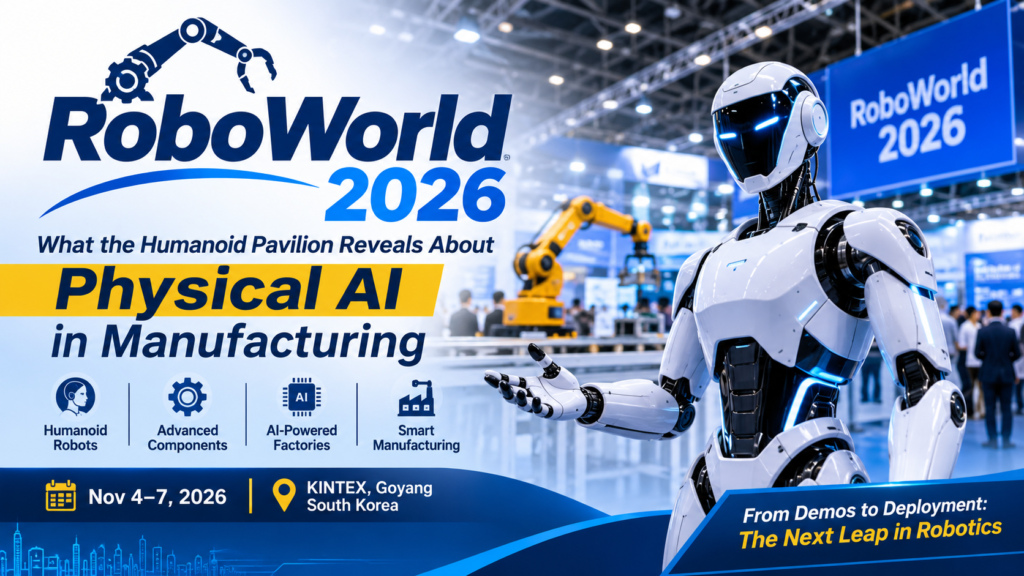
RoboWorld 2026 is South Korea’s largest robotics exhibition, running November 4-7 at KINTEX in Goyang, and its clearest message is that humanoid robots are now being judged on factory reliability rather than stage performance. The event brings together 402 companies from 17 countries across 1,198 booths, and it introduces a dedicated humanoid pavilion that shows complete robots next to the actuators, reducers, sensors, controllers, and AI software that make them work.
If you only have thirty seconds, here is the short version. The robots that dance get the crowds, but the booths that matter are the ones answering harder questions: Can this machine work a full shift? What happens when it falls? Where does its training data come from? RoboWorld 2026 turns those questions into a live case study of how physical AI is moving from demo to deployment.
This guide breaks down what is on display, who is showing it, and what builders, students, and operators in India can learn from it.
Key takeaways:
- The exhibition runs November 4-7, 2026, in Halls 3-5 of KINTEX Exhibition Center 1 in Goyang, near Seoul.
- A new humanoid pavilion covers the full supply chain, from finished robots to individual components.
- Physical AI and “manufacturing AX” (AI transformation of factories) are the two organizing themes.
- Exhibitors are emphasizing endurance, safety, and data pipelines over spectacle.
- Dexterous robot hands and bimanual teleoperation are among the most concrete technical demonstrations.
What Is RoboWorld 2026?
RoboWorld 2026 is an annual international robotics trade exhibition held at KINTEX in Goyang, South Korea, from November 4 to 7, 2026, organized around physical AI, humanoid robots, and AI-driven manufacturing.
The name appears in several spellings across media coverage, including RobotWorld and Robo World, but they all refer to the same Korean exhibition. This year’s edition is notable for its scale and its focus. Organizers and event announcements describe more than 400 exhibitors, a conference with 36 sessions, and special pavilions for humanoids, food-tech, and healthcare robotics.
Quick facts at a glance
- Dates: November 4-7, 2026
- Venue: KINTEX Exhibition Center 1, Halls 3-5, Goyang, Gyeonggi Province
- Exhibitors: 402 companies from 17 countries
- Booths: 1,198
- Conference: International Robot Business Conference, November 4-5, with 36 sessions
- New for 2026: A humanoid pavilion covering complete robots and components
According to South Korea’s Ministry of Trade, Industry and Resources, as cited in opening-day coverage, those numbers make this the country’s largest robot show. Earlier pre-event reporting cited a slightly lower exhibitor count, so the final figure of 402 is the one to trust.
Why Does RoboWorld 2026 Matter for Physical AI?
This exhibition matters because it shows physical AI, meaning AI that perceives its surroundings and carries out real tasks, being tested against factory conditions instead of conference-stage conditions.
Physical AI is the idea that intelligence should live inside machines that move, grip, lift, and sort. Software-only AI can write an email or summarize a report. Physical AI has to handle a slippery object, a changing floor layout, or a night shift with different lighting than the day shift.
That is why this exhibition is a useful signal. South Korea has the world’s highest robot density in manufacturing, at 1,220 industrial robots per 10,000 manufacturing workers according to 2024 International Federation of Robotics data. When a country with that much factory automation puts humanoids at the center of its flagship robot show, it is telling you where it expects the next wave of automation to land.
What Is the Humanoid Pavilion at RoboWorld 2026?
The humanoid pavilion is a new dedicated hall at this year’s exhibition that displays complete humanoid robots alongside the core components and software that power them.
Most robotics shows treat humanoids as a single attraction. This pavilion treats them as an ecosystem. According to event announcements and Seoul Economic Daily’s preview, the pavilion covers:
- Complete humanoid robots
- Actuators, the motors and drive units that move joints
- Reducers, the gear systems that control speed and torque
- Sensors and controllers
- Batteries
- AI software
Why the supply-chain view is the real story
A humanoid is only as dependable as its weakest component. Putting actuators, reducers, and sensors in the same pavilion as finished robots lets buyers and engineers compare the whole stack in one walk. It also exposes an uncomfortable truth of the industry: many humanoid makers still depend on a small number of specialized suppliers for parts like reducers.
Rainbow Robotics illustrates the point. A company representative told Aju Press that Rainbow produces almost everything in-house, including every motor, with the main exception of some reducers in the actuators. The company builds some reducers itself, is developing the rest, and still buys certain units from Korean and Japanese suppliers. In-house production, the representative explained, lowers cost and speeds repairs, because one broken robot waiting for an imported part can stall an entire production line.
Who Is Exhibiting at RoboWorld 2026?
Exhibitors span Korean humanoid makers, global component suppliers, automation vendors, and research institutes.
The mix matters because it spans the entire path from research lab to factory floor. Highlights reported so far include:
- Rainbow Robotics, showing its RBY mobile humanoid line, with its HUBO lineage on display
- Neuromeka, presenting its EIR and NAMI platforms and its Physical Skill Foundation technology
- Tesollo, demonstrating compact robot hands and a bimanual teleoperation setup
- Booster Robotics and PAXINI, among the international participants
- Unitree, whose G1 humanoids performed a synchronized dance routine
- Robotis, whose AI Sapiens humanoids performed on stage
- Aei Robot, showing the ALICE biped and the EDIE pet robot
- DN Solutions, exhibiting a machining center paired with collaborative robot solutions
- IL Group and IL Robotics, showing industrial and entertainment humanoids
- ETRI, the national research institute, hosting a physical AI technology showcase on November 5
How do the exhibitors compare?
The table below compares the robots and technologies that coverage highlighted, focusing on what each one actually demonstrated.
| Exhibitor | Product or technology | What it demonstrated | What it signals |
|---|---|---|---|
| Rainbow Robotics | RB-Y1 mobile humanoid | AI-based flower sorting, wheeled base | Wheels over legs for safer factory work |
| Aei Robot | ALICE biped | Walking all day; upper body lifting 20-30 kg | Endurance matters more than a short demo |
| Tesollo | DG-5F-S hand, DG-5F-M hands | 15- and 20-degree-of-freedom hands; bimanual teleoperation | Dexterity is the bottleneck in manipulation |
| Neuromeka | Physical Skill Foundation | Handling unfamiliar objects and changing environments | Generalization is the next AI frontier |
| Unitree | G1 humanoid | Synchronized dance performance | Strong hardware platform, researcher-friendly |
| Robotis | AI Sapiens | Stage performance | Showmanship still draws visitors |
| ETRI | Humanoid foundation model | Ten physical AI technologies on November 5 | Public research feeding private deployment |
What Is Physical AI Doing on the Factory Floor?
Physical AI on the factory floor means robots that use perception and learned behavior to adapt to variation, instead of repeating a fixed motion.
Traditional industrial robots are superb at repetition. They weld the same seam or place the same part thousands of times. The trouble starts when conditions change. Humanoids and mobile manipulators promise flexibility, but flexibility is exactly what is hardest to prove.
The demo-versus-deployment gap
Humanoids Daily’s coverage frames the practical questions well: how reliably a robot handles variation, how much operator support it needs, and how it connects to the equipment already on the factory floor. A demonstration answers none of these by itself.
| Dimension | Stage demo | Factory deployment |
|---|---|---|
| Duration | Minutes | Full shifts, day after day |
| Environment | Controlled, rehearsed | Variable lighting, layouts, and parts |
| Failure handling | Reset and retry | Safety certification and fall protection |
| Data | Scripted motions | Continuous workplace data for retraining |
| Integration | Standalone | Connected to existing machines and software |
Aei Robot’s team made this point directly at the exhibition. Walking for a moment and walking all day, one engineer noted, are completely different problems. Even the same factory presents different conditions at night than during the day, which is why the company is building a system to collect workplace data and train its robots to adapt.
Why Is Rainbow Robotics Choosing Wheels Over Legs?
Rainbow Robotics puts its working humanoids on wheels because a wheeled base is safer and more stable on a factory floor than two legs that can fall.
This is one of the most instructive stories at the show. Rainbow’s lineage runs back to the HUBO humanoid unveiled by KAIST professor Oh Jun-ho’s lab in 2004. Rainbow was incorporated in 2011 when the lab began selling the robot, and the company is now a subsidiary of Samsung Electronics. Its DRC-HUBO won the DARPA Robotics Challenge in 2015 as Team KAIST’s entry.
Today the company’s practical product is the RB-Y1, a mobile humanoid with a wheeled base. According to the company, it has sold nearly 200 units worldwide. The next-generation RB-Y2 is slated to pursue safety certification and begin mass production by summer 2027.
What the company is candid about
Rainbow’s representative acknowledged that the RB-Y1’s AI-based flower sorting still makes mistakes, and that improving it requires more data from real workplaces. The company plans to focus on manufacturing until about 2030 while testing robots with the farm machinery maker Daedong, Samsung Medical Center, and the bakery chain Sungsimdang.
That candor is a useful signal for anyone evaluating humanoid vendors. A company that tells you what its robot still gets wrong is usually easier to trust than one that shows only highlights.
What Do the Robot Hands and Teleoperation Demos Show?
The hand and teleoperation demos at the exhibition show that dexterous manipulation, not walking, is the capability that decides whether a humanoid is useful.
A humanoid that cannot grip reliably is just an expensive mannequin. Tesollo’s exhibition program is a good example of where the industry is focusing. According to Humanoids Daily, the company plans to demonstrate 15- and 20-degree-of-freedom versions of its compact DG-5F-S humanoid hand, bin picking and sorting with a three-finger gripper, and a bimanual setup where an operator’s hand movements are transferred to two DG-5F-M hands.
Why teleoperation matters for AI training
Teleoperation, where a human controls a robot remotely, is not only a control method. It is also a data-collection method. Every successful remote-controlled grasp can become training data for an autonomous model. This connects directly to the data theme running through the whole exhibition.
ETRI, the Electronics and Telecommunications Research Institute, is building exactly this kind of resource. Its ROJI-Hub robot learning data hub holds more than 1.4 million video records covering 140,000 robot tasks, such as stacking cups and moving objects. ETRI planned to present ten physical AI technologies, including a humanoid foundation model, at its Physical AI Playground showcase on November 5.
What Is Manufacturing AX, and Why Is It a Core Theme?
Manufacturing AX, short for AI transformation, is the practice of turning factory data into robot and equipment actions using AI, and it is one of the two central themes of the exhibition.
Beyond individual robots, the exhibition looks at systems that combine collaborative robots, autonomous mobile robots, machine vision, and manufacturing software. Seoul Economic Daily described the goal as translating factory data into movements by robots and equipment. The exhibition also features digital twin-based robot simulation and sim-to-real technology, which transfers skills learned in a virtual environment to a physical robot.
DN Solutions offers a concrete example. It is showing its DVF 5000 machining center together with collaborative robot solutions, plus digital-twin and smart-manufacturing technologies. This is the unglamorous but economically important side of physical AI: not a robot that dances, but a production line that adapts.
What Is on the International Robot Business Conference Agenda?
The International Robot Business Conference runs November 4-5 alongside the exhibition, with 36 sessions organized into three tracks.
- Manufacturing AX: AI adoption in production, with representatives from Qualcomm and Advantech scheduled to speak
- Humanoid with Physical AI: Robot intelligence and embodied systems, with a speaker from NVIDIA
- Mobility: Robots in industrial and service environments
The speaker lineup reflects where the industry sees value. Chipmakers and edge-computing companies appear in the factory track because robots need onboard compute, and an AI platform leader appears in the humanoid track because training and simulation tools are central to making humanoids useful.
Platform or Finished Product: Two Business Models on Display
A platform sells open hardware that customers build on, while a finished product bundles hardware, software, and AI into a complete robot.
Aju Press captured an instructive contrast. An Aei Robot engineer described Unitree as selling hardware that researchers can freely work on inside, which makes it a platform. Aei Robot, by comparison, treats everything inside the robot, including software and the AI model, as one product and sells the finished result.
Neither model is inherently better. Platforms spread quickly because researchers and startups can experiment. Finished products can be easier for a factory manager to adopt because there is one vendor accountable for the whole system. Buyers at the show are effectively comparing these two philosophies side by side.
What Does RoboWorld 2026 Mean for India and Odisha?
RoboWorld 2026 offers Indian students, freshers, and manufacturers a practical roadmap: the skills and questions that matter are about data, safety, and integration, not just robot hardware.
For learners in Odisha and across India, three lessons stand out.
- Data pipelines are a career path. Aei Robot, Rainbow, and ETRI all emphasize collecting real workplace data. Skills in data labeling, video annotation, simulation, and dataset management are directly useful in robotics.
- Simulation is a skill, not a luxury. Digital twins and sim-to-real work let teams train robots without risking hardware. This is accessible to students with a laptop and open-source tools.
- Integration beats invention. Many factories need engineers who can connect cobots, vision systems, and software to existing equipment. That is a strong opportunity for graduates from mechanical, electrical, electronics, and computer science backgrounds.
For Indian manufacturers considering automation, the exhibition’s practical lesson is to ask vendors about shift-length endurance, fall and safety handling, and how a robot connects to existing machines before asking about price or headline features.
How Should You Evaluate Humanoid Claims After RoboWorld 2026?
Evaluate humanoid claims by asking what the robot does over a full shift, how it fails, and what data improves it.
Use this checklist when you read coverage of the exhibition or visit a robotics booth:
- Endurance: How long can it run continuously, and has it been tested over hours rather than minutes?
- Safety: What happens if it falls, and does the vendor pursue safety certification?
- Payload: What can it lift, and for how long? One exhibitor cited 20-30 kg for an upper-body redesign.
- Dexterity: Can its hands handle unfamiliar objects, or only rehearsed ones?
- Data: Where does its training data come from, and how does it improve from real workplaces?
- Integration: Does it connect to existing machines, or does it need a custom cell?
- Honesty: Does the vendor tell you where the robot still makes mistakes?
Frequently Asked Questions About RoboWorld 2026
When and where is RoboWorld 2026 held?
RoboWorld 2026 runs November 4-7, 2026, at KINTEX Exhibition Center 1 in Goyang, Gyeonggi Province, South Korea, in Halls 3-5.
How many companies are exhibiting?
A total of 402 companies from 17 countries are exhibiting across 1,198 booths, according to figures reported from South Korea’s Ministry of Trade, Industry and Resources.
What is new this year?
The headline addition is a humanoid pavilion that shows complete humanoid robots together with actuators, reducers, sensors, controllers, batteries, and AI software.
Are humanoid robots ready for factories?
Some are entering practical use, but the evidence at RoboWorld 2026 is mixed. Wheeled mobile humanoids such as Rainbow’s RB-Y1 have sold in the hundreds, while exhibitors openly say legged robots still need work on endurance, safety, and data before they can be fully dependable workers.
What is physical AI?
Physical AI is artificial intelligence embedded in machines that perceive their surroundings and carry out physical tasks, such as sorting, lifting, and assembling.
Conclusion: The Real Signal From RoboWorld 2026
The most valuable takeaway from RoboWorld 2026 is not a single robot. It is the shift in the questions being asked. Dancing humanoids still draw crowds, but the serious conversations are about reducers, safety certification, shift-length endurance, and workplace data. The humanoid pavilion makes that shift visible by putting every layer of the stack in one place.
RoboWorld 2026: ଉତ୍ପାଦନ କ୍ଷେତ୍ରରେ ‘ଫିଜିକାଲ୍ AI’ (Physical AI) ବିଷୟରେ ‘ହ୍ୟୁମାନଏଡ୍ ପାଭିଲିୟନ୍’ (Humanoid Pavilion) କ’ଣ ସୂଚାଏ?
RoboWorld 2026 ହେଉଛି ଦକ୍ଷିଣ କୋରିଆର ସବୁଠାରୁ ବଡ଼ ରୋବୋଟିକ୍ସ ପ୍ରଦର୍ଶନୀ, ଯାହା ନଭେମ୍ବର ୪ ରୁ ୭ ତାରିଖ ପର୍ଯ୍ୟନ୍ତ ଗୋୟାଙ୍ଗ (Goyang) ସ୍ଥିତ KINTEX ଠାରେ ଅନୁଷ୍ଠିତ ହେଉଛି। ଏହାର ମୁଖ୍ୟ ବାର୍ତ୍ତା ହେଉଛି ଯେ, ବର୍ତ୍ତମାନ ହ୍ୟୁମାନଏଡ୍ (ମଣିଷ ଆକୃତିର) ରୋବୋଟ୍ଗୁଡ଼ିକୁ କେବଳ ମଞ୍ଚ ଉପରେ ସେମାନଙ୍କ ପ୍ରଦର୍ଶନ ଆଧାରରେ ନୁହେଁ, ବରଂ କାରଖାନାରେ ସେଗୁଡ଼ିକ କେତେ ନିର୍ଭରଯୋଗ୍ୟ ଭାବରେ କାମ କରିପାରିବେ, ସେହି ଆଧାରରେ ବିଚାର କରାଯାଉଛି। ଏହି କାର୍ଯ୍ୟକ୍ରମରେ ୧୭ଟି ଦେଶର ୪୦୨ଟି କମ୍ପାନୀ ଅଂଶଗ୍ରହଣ କରିଛନ୍ତି ଏବଂ ଏଥିପାଇଁ ୧,୧୯୮ଟି ବୁଥ୍ (ଷ୍ଟଲ୍) ପ୍ରସ୍ତୁତ କରାଯାଇଛି। ଏଥିରେ ଏକ ସ୍ୱତନ୍ତ୍ର ‘ହ୍ୟୁମାନଏଡ୍ ପାଭିଲିୟନ୍’ ରହିଛି, ଯେଉଁଠାରେ ସମ୍ପୂର୍ଣ୍ଣ ରୋବୋଟ୍ଗୁଡ଼ିକ ସହିତ ସେଗୁଡ଼ିକୁ କାର୍ଯ୍ୟକ୍ଷମ କରୁଥିବା ବିଭିନ୍ନ ଉପାଦାନ ଯେପରିକି ଆକ୍ଚୁଏଟର୍ (actuators), ରିଡ୍ୟୁସର୍ (reducers), ସେନ୍ସର, କଣ୍ଟ୍ରୋଲର୍ ଏବଂ AI ସଫ୍ଟୱେର୍ଗୁଡ଼ିକୁ ପ୍ରଦର୍ଶିତ କରାଯାଇଛି।
ଯଦି ଆପଣଙ୍କ ପାଖରେ ମାତ୍ର ୩୦ ସେକେଣ୍ଡ ସମୟ ଅଛି, ତେବେ ଏହାର ସାରାଂଶ ଏଠାରେ ଦିଆଗଲା: ଯେଉଁ ରୋବୋଟ୍ଗୁଡ଼ିକ ନାଚନ୍ତି, ସେଗୁଡ଼ିକ ଦର୍ଶକଙ୍କୁ ଆକର୍ଷିତ କରନ୍ତି; କିନ୍ତୁ ପ୍ରକୃତ ଗୁରୁତ୍ୱପୂର୍ଣ୍ଣ ବୁଥ୍ଗୁଡ଼ିକ ସେହି ସ୍ଥାନରେ ଅଛି ଯେଉଁଠାରେ କଠିନ ପ୍ରଶ୍ନଗୁଡ଼ିକର ଉତ୍ତର ଦିଆଯାଉଛି: ଯେପରିକି, ଏହି ଯନ୍ତ୍ରଟି କ’ଣ ଏକ ପୂର୍ଣ୍ଣ ସିଫ୍ଟ (କାର୍ଯ୍ୟ ସମୟ) ପାଇଁ କାମ କରିପାରିବ? ଯଦି ଏହା ତଳେ ପଡ଼ିଯାଏ, ତେବେ କ’ଣ ହେବ? ଏହାର ଟ୍ରେନିଂ ଡାଟା (ପ୍ରଶିକ୍ଷଣ ତଥ୍ୟ) କେଉଁଠାରୁ ଆସିଛି? RoboWorld 2026 ଏହି ପ୍ରଶ୍ନଗୁଡ଼ିକୁ ଏକ ଜୀବନ୍ତ ଉଦାହରଣ (case study) ଭାବରେ ଉପସ୍ଥାପନ କରେ, ଯାହା ଦର୍ଶାଏ ଯେ କିପରି ‘ଫିଜିକାଲ୍ AI’ କେବଳ ଏକ ପ୍ରଦର୍ଶନ (demo) ସ୍ତରରୁ ବାହାରି ବାସ୍ତବ କାର୍ଯ୍ୟକ୍ଷେତ୍ରରେ (deployment) ବ୍ୟବହାର ହେବା ଆଡ଼କୁ ଅଗ୍ରସର ହେଉଛି।
ଏହି ଗାଇଡ୍ରେ କ’ଣ ପ୍ରଦର୍ଶିତ ହେଉଛି, କେଉ ବିଭିନ୍ନ ଗଣମାଧ୍ୟମରେ ଏହି ପ୍ରଦର୍ଶନୀର ନାମ ‘RobotWorld’ ଏବଂ ‘Robo World’ ଭଳି ଭିନ୍ନ ଭିନ୍ନ ବନାନରେ ଉଲ୍ଲେଖ କରାଯାଇଛି, କିନ୍ତୁ ଏଗୁଡ଼ିକ ସମସ୍ତେ ସେହି ଗୋଟିଏ କୋରିଆନ୍ ପ୍ରଦର୍ଶନୀକୁ ହିଁ ବୁଝାନ୍ତି। ଚଳିତ ବର୍ଷର ଆୟୋଜନ ଏହାର ବିଶାଳ ପରିସର ଏବଂ ନିର୍ଦ୍ଦିଷ୍ଟ ଲକ୍ଷ୍ୟ ପାଇଁ ଉଲ୍ଲେଖନୀୟ ଅଟେ। ଆୟୋଜକଙ୍କ ସୂଚନା ଅନୁଯାୟୀ, ଏଥିରେ ୪୦୦ରୁ ଅଧିକ ପ୍ରଦର୍ଶନକାରୀ ଅଂଶଗ୍ରହଣ କରୁଛନ୍ତି। ଏଥିରେ ୩୬ଟି ଅଧିବେଶନ ବିଶିଷ୍ଟ ଏକ ସମ୍ମିଳନୀ ରହିଛି ଏବଂ ହ୍ୟୁମାନଏଡ୍ (ମାନବୀୟ ରୋବଟ୍), ଖାଦ୍ୟ-ପ୍ରଯୁକ୍ତି (food-tech) ତଥା ସ୍ୱାସ୍ଥ୍ୟସେବା କ୍ଷେତ୍ରରେ ବ୍ୟବହୃତ ରୋବଟ୍ଗୁଡ଼ିକ ପାଇଁ ସ୍ୱତନ୍ତ୍ର ପ୍ରଦର୍ଶନ କ୍ଷେତ୍ର (pavilions) ରହିଛି।
ଏକ ନଜରରେ କିଛି ମୁଖ୍ୟ ତଥ୍ୟ:
ତାରିଖ: ନଭେମ୍ବର ୪-୭, ୨୦୨୬
ସ୍ଥାନ: KINTEX ଏକ୍ସିବିସନ୍ ସେଣ୍ଟର ୧, ହଲ୍ ୩-୫, ଗୋୟାଙ୍ଗ (Goyang), ଗ୍ୟୋଙ୍ଗଗି (Gyeonggi) ପ୍ରଦେଶ
ପ୍ରଦର୍ଶନକାରୀ: ୧୭ଟି ଦେଶର ୪୦୨ଟି କମ୍ପାନୀ
ବୁଥ୍ ସଂଖ୍ୟା: ୧,୧୯୮
ସମ୍ମିଳନୀ: ‘ଇଣ୍ଟରନ୍ୟାସନାଲ୍ ରୋବଟ୍ ବିଜନେସ୍ କନଫରେନ୍ସ’ (International Robot Business Conference), ନଭେମ୍ବର ୪-୫, ଯେଉଁଥିରେ ୩୬ଟି ଅଧିବେଶନ ରହିଛି।
୨୦୨୬ ପାଇଁ ନୂତନ ଆକର୍ଷଣ: ଏକ ‘ହ୍ୟୁମାନଏଡ୍ ପାଭିଲିୟନ୍’ (humanoid pavilion), ଯେଉଁଠାରେ ସମ୍ପୂର୍ଣ୍ଣ ରୋବଟ୍ ଏବଂ ସେଗୁଡ଼ିକର ବିଭିନ୍ନ ଅଂଶ ପ୍ରଦର୍ଶିତ ହେବ।
ଦକ୍ଷିଣ କୋରିଆର ବାଣିଜ୍ୟ, ଶିଳ୍ପ ଏବଂ ସମ୍ବଳ ମନ୍ତ୍ରଣାଳୟର ତଥ୍ୟ ଅନୁଯାୟୀ (ଯାହା ଉଦ୍ଘାଟନୀ ଦିବସର ରିପୋର୍ଟରେ ଉଲ୍ଲେଖ କରାଯାଇଛି), ଏହି ସଂଖ୍ୟାଗୁଡ଼ିକ ଏହାକୁ ଦେଶର ସବୁଠାରୁ ବଡ଼ ରୋବଟ୍ ପ୍ରଦର୍ଶନୀରେ ପରିଣତ କରିଛି। ଇଭେଣ୍ଟ ପୂର୍ବରୁ ଆସିଥିବା ରିପୋର୍ଟରେ ପ୍ରଦର୍ଶନକାରୀଙ୍କ ସଂଖ୍ୟା କିଛିଟା କମ୍ ଦର୍ଶାଯାଇଥିଲା, ତେଣୁ ୪୦୨ର ଚୂଡ଼ାନ୍ତ ସଂଖ୍ୟାକୁ ହିଁ ପ୍ରକୃତ ତଥ୍ୟ ଭାବରେ ଗ୍ରହଣ କରାଯିବା ଉଚିତ୍।
‘ଫିଜିକାଲ୍ AI’ (Physical AI) ପାଇଁ ‘RoboWorld 2026’ କାହିଁକି ଗୁରୁତ୍ୱପୂର୍ଣ୍ଣ?
ଏହି ପ୍ରଦର୍ଶନୀ ଗୁରୁତ୍ୱପୂର୍ଣ୍ଣ କାରଣ ଏଠାରେ ‘ଫିଜିକାଲ୍ AI’ ପ୍ରଦର୍ଶିତ ହେଉଛି। ଏହାର ଅର୍ଥ ହେଉଛି, ଏଠାରେ ଥିବା AI କେବ ଯେତେବେଳେ କାରଖାନାଗୁଡ଼ିକରେ ବ୍ୟାପକ ସ୍ୱୟଂଚାଳିତ ବ୍ୟବସ୍ଥା (automation) ଥିବା ଏକ ଦେଶ, ନିଜର ପ୍ରମୁଖ ରୋବୋଟ୍ ପ୍ରଦର୍ଶନୀର କେନ୍ଦ୍ରବିନ୍ଦୁରେ ‘ହ୍ୟୁମାନଏଡ୍’ (ମନୁଷ୍ୟାକୃତି ବିଶିଷ୍ଟ ରୋବୋଟ୍) ମାନଙ୍କୁ ରଖେ, ସେତେବେଳେ ଏହା ସ୍ପଷ୍ଟ ହୋଇଯାଏ ଯେ ସେହି ଦେଶ ଆଗାମୀ ସମୟରେ ସ୍ୱୟଂଚାଳିତ ବ୍ୟବସ୍ଥାର ପରବର୍ତ୍ତୀ ପର୍ଯ୍ୟାୟ କେଉଁ କ୍ଷେତ୍ରରେ କାର୍ଯ୍ୟକାରୀ ହେବ ବୋଲି ଆଶା କରୁଛି।
‘ରୋବୋୱାର୍ଲ୍ଡ (RoboWorld) ୨୦୨୬’ ରେ ଥିବା ‘ହ୍ୟୁମାନଏଡ୍ ପାଭିଲିୟନ୍’ (Humanoid Pavilion) କ’ଣ?
ଏହି ପ୍ରଦର୍ଶନୀରେ ‘ହ୍ୟୁମାନଏଡ୍ ପାଭିଲିୟନ୍’ ନାମକ ଏକ ସ୍ୱତନ୍ତ୍ର ବିଭାଗ ରହିଛି। ଏଠାରେ ସମ୍ପୂର୍ଣ୍ଣ ହ୍ୟୁମାନଏଡ୍ ରୋବୋଟ୍ଗୁଡ଼ିକ ସହିତ ସେଗୁଡ଼ିକୁ ପରିଚାଳିତ କରୁଥିବା ମୁଖ୍ୟ ଉପାଦାନ ଏବଂ ସଫ୍ଟୱେର୍ଗୁଡ଼ିକୁ ପ୍ରଦର୍ଶିତ କରାଯାଇଛି।
ସାଧାରଣତଃ ଅନ୍ୟ ରୋବୋଟିକ୍ସ ପ୍ରଦର୍ଶନୀଗୁଡ଼ିକରେ ହ୍ୟୁମାନଏଡ୍ଗୁଡ଼ିକୁ କେବଳ ଏକ ଆକର୍ଷଣ ଭାବରେ ଉପସ୍ଥାପନ କରାଯାଏ, କିନ୍ତୁ ଏହି ପାଭିଲିୟନ୍ରେ ସେଗୁଡ଼ିକୁ ଏକ ‘ଇକୋସିଷ୍ଟମ୍’ (ପାରସ୍ପରିକ ନିର୍ଭରଶୀଳ ବ୍ୟବସ୍ଥା) ଭାବରେ ଦର୍ଶାଯାଇଛି। କାର୍ଯ୍ୟକ୍ରମ ସମ୍ବନ୍ଧୀୟ ଘୋଷଣା ଏବଂ ‘ସିଓଲ୍ ଇକୋନୋମିକ୍ ଡେଲି’ (Seoul Economic Daily) ର ରିପୋର୍ଟ ଅନୁଯାୟୀ, ଏହି ପାଭିଲିୟନ୍ରେ ନିମ୍ନଲିଖିତ ଜିନିଷଗୁଡ଼ିକ ଅନ୍ତର୍ଭୁକ୍ତ:
ସମ୍ପୂର୍ଣ୍ଣ ହ୍ୟୁମାନଏଡ୍ ରୋବୋଟ୍
ଆକ୍ଚୁଏଟର୍ (Actuators) – ଏଗୁଡ଼ିକ ହେଉଛି ମୋଟର ଏବଂ ଡ୍ରାଇଭ୍ ୟୁନିଟ୍, ଯାହା ରୋବୋଟ୍ର ବିଭିନ୍ନ ଅଙ୍ଗ ବା ଗଣ୍ଠି (joints) କୁ ଗତି କରାଏ।
ରିଡ୍ୟୁସର୍ (Reducers) – ଏଗୁଡ଼ିକ ହେଉଛି ଗିଅର୍ ସିଷ୍ଟମ୍, ଯାହା ଗତି (speed) ଏବଂ ଟର୍କ (torque) କୁ ନିୟନ୍ତ୍ରଣ କରେ।
ସେନ୍ସର୍ ଏବଂ କଣ୍ଟ୍ରୋଲର୍
ବ୍ୟାଟେରୀ
AI (କୃତ୍ରିମ ବୁଦ୍ଧିମତ୍ତା) ସଫ୍ଟୱେର୍
‘ସପ୍ଲାଏ ଚେନ୍’ (ଯୋଗାଣ ଶୃଙ୍ଖଳା) ଦୃଷ୍ଟିକୋଣରୁ ଏହା କାହିଁକି ଏକ ଗୁରୁତ୍ୱପୂର୍ଣ୍ଣ ବିଷୟ?
ଏକ ହ୍ୟୁମାନଏଡ୍ ରୋବୋଟ୍ର ନିର୍ଭରଯୋଗ୍ୟତା ତା’ର ସବୁଠାରୁ ଦୁର୍ବଳ ଉପାଦାନ ଉପରେ ନିର୍ଭର କରେ। ଯଦି ଆକ୍ଚୁଏଟର୍, ରିଡ୍ୟୁସର୍ ଏକମ୍ପାନୀ ନିଜେ କିଛି ‘ରିଡ୍ୟୁସର’ (ଯନ୍ତ୍ରାଂଶ) ନିର୍ମାଣ କରେ, ଅନ୍ୟଗୁଡ଼ିକର ବିକାଶ କରୁଛି ଏବଂ କିଛି ନିର୍ଦ୍ଦିଷ୍ଟ ଉପାଦାନ କୋରିଆନ୍ ଓ ଜାପାନୀ ଯୋଗାଣକାରୀଙ୍କଠାରୁ କିଣିଥାଏ। ପ୍ରତିନିଧି ଜଣକ ବୁଝାଇଲେ ଯେ, ନିଜ କାରଖାନାରେ ଉତ୍ପାଦନ କରିବା ଦ୍ୱାରା ଖର୍ଚ୍ଚ କମିଥାଏ ଏବଂ ମରାମତି କାର୍ଯ୍ୟ ତ୍ୱରାନ୍ୱିତ ହୁଏ; କାରଣ ଯଦି ଗୋଟିଏ ରୋବଟ୍ ଖରାପ ହୋଇଯାଏ ଏବଂ ବିଦେଶରୁ ଆସୁଥିବା କୌଣସି ଯନ୍ତ୍ରାଂଶକୁ ଅପେକ୍ଷା କରି ରହେ, ତେବେ ସମ୍ପୂର୍ଣ୍ଣ ଉତ୍ପାଦନ ପ୍ରକ୍ରିୟା ବାଧାପ୍ରାପ୍ତ ହୋଇପାରେ।
‘ରୋବୋୱାର୍ଲ୍ଡ (RoboWorld) ୨୦୨୬’ରେ କେଉଁମାନେ ଅଂଶଗ୍ରହଣ କରୁଛନ୍ତି?
ଏଠାରେ କୋରିଆର ହ୍ୟୁମାନଏଡ୍ (ମଣିଷ ସଦୃଶ ରୋବଟ୍) ନିର୍ମାତା, ବିଶ୍ୱସ୍ତରୀୟ ଯନ୍ତ୍ରାଂଶ ଯୋଗାଣକାରୀ, ସ୍ୱୟଂଚାଳିତ ପ୍ରଣାଳୀ (automation) ବିକ୍ରେତା ଏବଂ ବିଭିନ୍ନ ଗବେଷଣା ସଂସ୍ଥା ଅଂଶଗ୍ରହଣ କରୁଛନ୍ତି।
ଏହି ବିବିଧତା ଗୁରୁତ୍ୱପୂର୍ଣ୍ଣ, କାରଣ ଏହା ଗବେଷଣାଗାରଠାରୁ ଆରମ୍ଭ କରି କାରଖାନା ପର୍ଯ୍ୟନ୍ତ ସମଗ୍ର ପ୍ରକ୍ରିୟାକୁ ଅନ୍ତର୍ଭୁକ୍ତ କରେ। ବର୍ତ୍ତମାନ ସୁଦ୍ଧା ସାମ୍ନାକୁ ଆସିଥିବା କିଛି ମୁଖ୍ୟ ଆକର୍ଷଣ ହେଲା:
‘ରେନବୋ ରୋବୋଟିକ୍ସ’ (Rainbow Robotics) ନିଜର ‘RBY’ ମୋବାଇଲ୍ ହ୍ୟୁମାନଏଡ୍ ଶ୍ରେଣୀକୁ ପ୍ରଦର୍ଶିତ କରୁଛି, ଯେଉଁଥିରେ ସେମାନଙ୍କର ପୂର୍ବତନ ‘HUBO’ ମଡେଲ୍ର ବୈଶିଷ୍ଟ୍ୟ ମଧ୍ୟ ଦେଖିବାକୁ ମିଳୁଛି।
‘ନ୍ୟୁରୋମେକା’ (Neuromeka) ନିଜର ‘EIR’ ଓ ‘NAMI’ ପ୍ଲାଟଫର୍ମ ଏବଂ ‘ଫିଜିକାଲ୍ ସ୍କିଲ୍ ଫାଉଣ୍ଡେସନ୍’ (Physical Skill Foundation) ପ୍ରଯୁକ୍ତିବିଦ୍ୟା ଉପସ୍ଥାପନ କରୁଛି।
‘ଟେସୋଲୋ’ (Tesollo) କମ୍ପାକ୍ଟ ରୋବୋଟିକ୍ ହାତ ଏବଂ ଦୁଇ ହାତ ବିଶିଷ୍ଟ ଟେଲି-ଅପରେସନ୍ (ଦୂରରୁ ନିୟନ୍ତ୍ରିତ) ବ୍ୟବସ୍ଥା ପ୍ରଦର୍ଶନ କରୁଛି।
‘ବୁଷ୍ଟର ରୋବୋଟିକ୍ସ’ (Booster Robotics) ଏବଂ ‘ପାକ୍ସିନି’ (PAXINI) ମଧ୍ୟ ଏହି ଆନ୍ତର୍ଜାତୀୟ ପ୍ରଦର୍ଶନୀରେ ସାମିଲ ଅଛନ୍ତି।
‘ୟୁନିଟ୍ରି’ (Unitree) ର ‘G1’ ହ୍ୟୁମାନଏଡ୍ଗୁଡ଼ିକ ଏକ ସମନ୍ୱିତ ନୃତ୍ୟ ପରିବେଷଣ କରିଛନ୍ତି।
‘ରୋବୋଟିସ୍’ (Robotis) ର ‘AI Sapiens’ ହ୍ୟୁମାନଏଡ୍ଗୁଡ଼ିକ ମଞ୍ଚ ଉପରେ ନିଜର କଳା ପ୍ରଦର୍ଶନ କରିଛନ୍ତି।
‘ଏଆ ଦୁଇ ହାତ ବ୍ୟବହାର କରି ଟେଲି-ଅପରେସନ୍ (ଦୂରରୁ ନିୟନ୍ତ୍ରଣ) | ବସ୍ତୁ ପରିଚାଳନା କ୍ଷେତ୍ରରେ ‘ଦକ୍ଷତା’ (Dexterity) ଏକ ମୁଖ୍ୟ ଆହ୍ୱାନ ଅଟେ।
ନିଉରୋମେକା (Neuromeka) | ଶାରୀରିକ ଦକ୍ଷତା ଭିତ୍ତିଭୂମି | ଅପରିଚିତ ବସ୍ତୁ ଏବଂ ପରିବର୍ତ୍ତନଶୀଳ ପରିବେଶ ସହ କାର୍ଯ୍ୟ କରିବା | ବିଭିନ୍ନ ପରିସ୍ଥିତିରେ ନିଜକୁ ଖାପ ଖୁଆଇ ପାରିବା (Generalization) ହେଉଛି AI କ୍ଷେତ୍ରର ପରବର୍ତ୍ତୀ ବଡ଼ ଲକ୍ଷ୍ୟ।
ୟୁନିଟ୍ରି (Unitree) | G1 ହ୍ୟୁମାନଏଡ୍ (ମଣିଷ ଆକୃତିର ରୋବଟ୍) | ସମନ୍ୱିତ ନୃତ୍ୟ ପ୍ରଦର୍ଶନ | ଶକ୍ତିଶାଳୀ ହାର୍ଡୱେର୍ ପ୍ଲାଟଫର୍ମ, ଯାହା ଗବେଷକମାନଙ୍କ ପାଇଁ ବ୍ୟବହାର କରିବା ସହଜ।
ରୋବୋଟିସ୍ (Robotis) | AI ସାପିଏନ୍ସ (AI Sapiens) | ମଞ୍ଚ ପ୍ରଦର୍ଶନ | ଆକର୍ଷଣୀୟ ପ୍ରଦର୍ଶନ ଶୈଳୀ ଏବେ ମଧ୍ୟ ଦର୍ଶକଙ୍କୁ ଆକର୍ଷିତ କରେ।
ETRI | ହ୍ୟୁମାନଏଡ୍ ଫାଉଣ୍ଡେସନ୍ ମଡେଲ୍ | ନଭେମ୍ବର ୫ ତାରିଖରେ ଦଶଟି ‘ଫିଜିକାଲ୍ AI’ (Physical AI) ପ୍ରଯୁକ୍ତିବିଦ୍ୟାର ପ୍ରଦର୍ଶନ | ସର୍ବସାଧାରଣ ଗବେଷଣା ଯାହା ବ୍ୟବସାୟିକ ପ୍ରୟୋଗରେ ସହାୟକ ହୁଏ।
କାରଖାନା ପରିସରରେ ‘ଫିଜିକାଲ୍ AI’ (Physical AI) କ’ଣ କରୁଛି?
କାରଖାନା ପରିସରରେ ‘ଫିଜିକାଲ୍ AI’ର ଅର୍ଥ ହେଉଛି ଏପରି ରୋବଟ୍, ଯେଉଁଗୁଡ଼ିକ କେବଳ ଏକ ନିର୍ଦ୍ଦିଷ୍ଟ ଗତିବିଧିକୁ ବାରମ୍ବାର ଦୋହରାନ୍ତି ନାହିଁ; ବରଂ ପରିବେଶରେ ହେଉଥିବା ପରିବର୍ତ୍ତନ ଅନୁଯାୟୀ ନିଜକୁ ଖାପ ଖୁଆଇବା ପାଇଁ ନିଜର ଇନ୍ଦ୍ରିୟଜନିତ ଅନୁଭବ (perception) ଏବଂ ଶିଖିଥିବା ଆଚରଣର ବ୍ୟବହାର କରନ୍ତି।
ପାରମ୍ପାରିକ ଶିଳ୍ପ ରୋବଟଗୁଡ଼ିକ କୌଣସି କାର୍ଯ୍ୟକୁ ବାରମ୍ବାର ସଠିକ୍ ଭାବରେ କରିବାରେ ଅତ୍ୟନ୍ତ ଦକ୍ଷ। ଉଦାହରଣ ସ୍ୱରୂପ, ସେଗୁଡ଼ିକ ହଜାର ହଜାର ଥର ଗୋଟିଏ ସ୍ଥାନରେ ୱେଲ୍ଡିଂ କରିପାରନ୍ତି କିମ୍ବା ଗୋଟିଏ ନିର୍ଦ୍ଦିଷ୍ଟ ଅଂଶକୁ ସଠିକ୍ ସ୍ଥାନରେ ରଖିପାରନ୍ତି। କିନ୍ତୁ ଯେତେବେଳେ ପରିସ୍ଥିତି ବଦଳିଯାଏ, ସେତେବେଳେ ସମସ୍ୟା ସୃଷ୍ଟି ହୁଏ। ହ୍ୟୁମାନଏଡ୍ (ମଣିଷ ଆକୃତିର ରୋବଟ୍) ଏବଂ ଗତିଶୀଳ ରୋବଟଗୁଡ଼ିକ କାର୍ଯ୍ୟରେ ନମନୀୟତା (flexibility) ଆଣିବାର ପ୍ରତିଶ୍ରୁତି ଦିଅନ୍ତି, କିନ୍ତୁ ବାସ୍ତବରେ ଏହି ନମନୀୟତାକୁ ପ୍ରମାଣିତ କରିବା ସବୁଠାରୁ କଷ୍ଟକର କାର୍ଯ୍ୟ।
ପ୍ରଦର୍ଶନ (Demo ରେନବୋର ବଂଶ 2004 ମସିହାରେ KAIST ପ୍ରଫେସର ଓହ ଜୁନ୍-ହୋଙ୍କ ଲ୍ୟାବ ଦ୍ୱାରା ଉନ୍ମୋଚିତ HUBO ହ୍ୟୁମାନୋଇଡ୍ ସହିତ ଜଡିତ। 2011 ମସିହାରେ ଲ୍ୟାବ ରୋବୋଟ୍ ବିକ୍ରୟ ଆରମ୍ଭ କରିବା ସମୟରେ ରେନବୋକୁ ସାମିଲ କରାଯାଇଥିଲା, ଏବଂ କମ୍ପାନୀ ବର୍ତ୍ତମାନ Samsung Electronics ର ଏକ ସହାୟକ କମ୍ପାନୀ। ଏହାର DRC-HUBO 2015 ରେ ଟିମ୍ KAIST ର ପ୍ରବେଶ ଭାବରେ DARPA ରୋବୋଟିକ୍ସ ଚ୍ୟାଲେଞ୍ଜ ଜିତିଥିଲା।
ଆଜି କମ୍ପାନୀର ବ୍ୟବହାରିକ ଉତ୍ପାଦ ହେଉଛି RB-Y1, ଏକ ଚକିଆ ଆଧାର ସହିତ ଏକ ମୋବାଇଲ୍ ହ୍ୟୁମାନୋଇଡ୍। କମ୍ପାନୀ ଅନୁଯାୟୀ, ଏହା ବିଶ୍ୱବ୍ୟାପୀ ପ୍ରାୟ 200 ୟୁନିଟ୍ ବିକ୍ରି କରିଛି। ପରବର୍ତ୍ତୀ ପିଢ଼ିର RB-Y2 ସୁରକ୍ଷା ପ୍ରମାଣପତ୍ର ଅନୁସରଣ କରିବା ଏବଂ 2027 ଗ୍ରୀଷ୍ମ ସୁଦ୍ଧା ବହୁଳ ଉତ୍ପାଦନ ଆରମ୍ଭ କରିବାକୁ ସ୍ଥିର କରାଯାଇଛି।
କମ୍ପାନୀ କ’ଣ ସ୍ପଷ୍ଟ?
ରେନବୋର ପ୍ରତିନିଧି ସ୍ୱୀକାର କରିଛନ୍ତି ଯେ RB-Y1 ର AI-ଆଧାରିତ ଫୁଲ ସଜାଡ଼ିବା ଏପର୍ଯ୍ୟନ୍ତ ଭୁଲ କରେ, ଏବଂ ଏହାକୁ ଉନ୍ନତ କରିବା ପାଇଁ ପ୍ରକୃତ କାର୍ଯ୍ୟସ୍ଥଳରୁ ଅଧିକ ତଥ୍ୟ ଆବଶ୍ୟକ। କମ୍ପାନୀ ପ୍ରାୟ 2030 ପର୍ଯ୍ୟନ୍ତ ଉତ୍ପାଦନ ଉପରେ ଧ୍ୟାନ ଦେବାକୁ ଯୋଜନା କରୁଛି ଯେତେବେଳେ ଫାର୍ମ ମେସିନାରୀ ନିର୍ମାତା ଡାଏଡୋଙ୍ଗ, Samsung ମେଡିକାଲ୍ ସେଣ୍ଟର ସହିତ ରୋବୋଟ୍ ପରୀକ୍ଷା କରୁଛି।
, ଏବଂ ବେକେରୀ ଶୃଙ୍ଖଳା ‘ସୁଙ୍ଗସିମଡାଙ୍ଗ’ (Sungsimdang) ।
ଏହି ସ୍ପଷ୍ଟବାଦିତା ହ୍ୟୁମାନଏଡ୍ (ମାନବୀୟ ଆକୃତିର ରୋବଟ୍) ପ୍ରସ୍ତୁତକାରୀଙ୍କୁ ମୂଲ୍ୟାଙ୍କନ କରୁଥିବା ବ୍ୟକ୍ତିଙ୍କ ପାଇଁ ଏକ ଉପଯୋଗୀ ସଙ୍କେତ ଅଟେ। ଯେଉଁ କମ୍ପାନୀ ନିଜ ରୋବଟର ତ୍ରୁଟି ବା ସୀମାବଦ୍ଧତା ବିଷୟରେ ଖୋଲାଖୋଲି ଭାବେ କୁହେ, ସେହି କମ୍ପାନୀ ଉପରେ ଭରସା କରିବା ସହଜ ହୋଇଥାଏ; ଅପେକ୍ଷାକୃତ ସେହି କମ୍ପାନୀ ତୁଳନାରେ ଯେଉଁମାନେ କେବଳ ନିଜର ସଫଳତା ବା ଭଲ ଦିଗଗୁଡ଼ିକୁ ହିଁ ପ୍ରଦର୍ଶନ କରନ୍ତି।
ରୋବଟ୍ ହାତ ଏବଂ ଟେଲି-ଅପରେସନ୍ (ଦୂରରୁ ପରିଚାଳନା) ପ୍ରଦର୍ଶନଗୁଡ଼ିକ କ’ଣ ଦର୍ଶାଏ?
ପ୍ରଦର୍ଶନୀରେ ଥିବା ରୋବଟ୍ ହାତ ଏବଂ ଟେଲି-ଅପରେସନ୍ ପ୍ରଦର୍ଶନଗୁଡ଼ିକରୁ ଜଣାପଡ଼େ ଯେ, ଏକ ହ୍ୟୁମାନଏଡ୍ ରୋବଟ୍ କେତେ ଉପଯୋଗୀ, ତାହା ଏହାର ଚାଲିବା କ୍ଷମତା ଉପରେ ନୁହେଁ, ବରଂ ନିପୁଣତାର ସହ ବିଭିନ୍ନ ଜିନିଷକୁ ଧରିବା ବା ପରିଚାଳନା କରିବା କ୍ଷମତା ଉପରେ ନିର୍ଭର କରେ।
ଯେଉଁ ହ୍ୟୁମାନଏଡ୍ ରୋବଟ୍ ନିର୍ଭରଯୋଗ୍ୟ ଭାବେ କୌଣସି ଜିନିଷକୁ ଧରିପାରେ ନାହିଁ, ତାହା କେବଳ ଏକ ମହଙ୍ଗା ‘ପୁତ୍ତଳିକା’ (mannequin) ସଦୃଶ ଅଟେ। ‘ଟେସୋଲୋ’ (Tesollo) ର ପ୍ରଦର୍ଶନୀ କାର୍ଯ୍ୟକ୍ରମଟି ଶିଳ୍ପକ୍ଷେତ୍ର ବର୍ତ୍ତମାନ କେଉଁ ବିଷୟ ଉପରେ ଧ୍ୟାନ କେନ୍ଦ୍ରିତ କରୁଛି, ତାହାର ଏକ ଉତ୍ତମ ଉଦାହରଣ। ‘ହ୍ୟୁମାନଏଡ୍ସ ଡେଲି’ (Humanoids Daily) ଅନୁଯାୟୀ, ଏହି କମ୍ପାନୀ ନିଜର ‘DG-5F-S’ ହ୍ୟୁମାନଏଡ୍ ହାତର ବିଭିନ୍ନ ସଂସ୍କରଣ (ଯେଉଁଥିରେ ୧୫ ଏବଂ ୨୦ ଡିଗ୍ରୀ-ଅଫ୍-ଫ୍ରିଡମ୍ ବା ଗତିଶୀଳତା ରହିଛି) ପ୍ରଦର୍ଶନ କରିବାକୁ ଯୋଜନା କରିଛି।
ଏଥିସହ, ତିନି-ଆଙ୍ଗୁଠି ବିଶିଷ୍ଟ ଗ୍ରିପର୍ (ଧରିବା ଯନ୍ତ୍ର) ସାହାଯ୍ୟରେ ବିଭିନ୍ନ ସାମଗ୍ରୀକୁ ବାଛିବା ଓ ସଜାଡ଼ିବା, ଏବଂ ଏକ ‘ବାଇମାନୁଆଲ୍’ (ଉଭୟ ହାତ ବ୍ୟବହାର ହେଉଥିବା) ବ୍ୟବସ୍ଥା ମଧ୍ୟ ପ୍ରଦର୍ଶିତ ହେବ, ଯେଉଁଠାରେ ଜଣେ ଅପରେଟରଙ୍କ ହାତର ଗତିବିଧିକୁ ଦୁଇଟି ‘DG-5F-M’ ରୋବଟ୍ ହାତକୁ ସ୍ଥାନାନ୍ତରିତ କରାଯାଇପାରିବ।
AI (କୃତ୍ରିମ ବୁଦ୍ଧିମତ୍ତା) ପ୍ରଶିକ୍ଷଣ ପାଇଁ ଟେଲି-ଅପରେସନ୍ କାହି ଏହି ପ୍ରଦର୍ଶନୀରେ ‘ଡିଜିଟାଲ୍ ଟ୍ୱିନ୍’ (digital twin) ଉପରେ ଆଧାରିତ ରୋବଟ୍ ସିମୁଲେସନ୍ ଏବଂ ‘ସିମ୍-ଟୁ-ରିଆଲ୍’ (sim-to-real) ପ୍ରଯୁକ୍ତିବିଦ୍ୟା ମଧ୍ୟ ପ୍ରଦର୍ଶିତ ହେଉଛି। ଏହି ପ୍ରଯୁକ୍ତିବିଦ୍ୟା ମାଧ୍ୟମରେ ଏକ ଭର୍ଚୁଆଲ୍ ପରିବେଶରେ ଶିଖାଯାଇଥିବା ଦକ୍ଷତାକୁ ଏକ ବାସ୍ତବ (ଭୌତିକ) ରୋବଟ୍କୁ ସ୍ଥାନାନ୍ତର କରାଯାଇପାରିବ।
‘ଡିଏନ୍ ସଲ୍ୟୁସନ୍ସ’ (DN Solutions) ଏହାର ଏକ ଉପଯୁକ୍ତ ଉଦାହରଣ ଦେଉଛି। କମ୍ପାନୀ ଏହାର ‘DVF 5000’ ମେସିନିଂ ସେଣ୍ଟର ସହିତ ସହଯୋଗୀ ରୋବଟ୍ (collaborative robot) ସମାଧାନ, ଡିଜିଟାଲ୍ ଟ୍ୱିନ୍ ଏବଂ ସ୍ମାର୍ଟ-ମାନୁଫ୍ୟାକ୍ଚରିଂ (ସ୍ମାର୍ଟ ଉତ୍ପାଦନ) ପ୍ରଯୁକ୍ତିବିଦ୍ୟା ପ୍ରଦର୍ଶନ କରୁଛି। ଏହା ହେଉଛି ‘ଫିଜିକାଲ୍ AI’ (Physical AI) ବା ଭୌତିକ କୃତ୍ରିମ ବୁଦ୍ଧିମତ୍ତାର ଏକ ଦିଗ, ଯାହା ଦେଖିବାକୁ ହୁଏତ ଆକର୍ଷଣୀୟ ନୁହେଁ କିନ୍ତୁ ଆର୍ଥିକ ଦୃଷ୍ଟିରୁ ଅତ୍ୟନ୍ତ ଗୁରୁତ୍ୱପୂର୍ଣ୍ଣ। ଏଠାରେ କଥା କେବଳ ନାଚୁଥିବା ରୋବଟ୍ର ନୁହେଁ, ବରଂ ଏକ ଏପରି ଉତ୍ପାଦନ ବ୍ୟବସ୍ଥାର (production line) କଥା କୁହାଯାଉଛି ଯାହା ପରିସ୍ଥିତି ଅନୁସାରେ ନିଜକୁ ଖାପ ଖୁଆଇ ପାରିବ।
‘ଇଣ୍ଟରନ୍ୟାସନାଲ୍ ରୋବଟ୍ ବିଜନେସ୍ କନଫରେନ୍ସ’ (International Robot Business Conference) ର କାର୍ଯ୍ୟସୂଚୀରେ କ’ଣ ରହିଛି?
ଏହି ସମ୍ମିଳନୀ ପ୍ରଦର୍ଶନୀ ସହିତ ନଭେମ୍ବର ୪-୫ ତାରିଖ ପର୍ଯ୍ୟନ୍ତ ଅନୁଷ୍ଠିତ ହେବ। ଏଥିରେ ତିନୋଟି ବିଭାଗ (tracks) ଅଧୀନରେ ମୋଟ ୩୬ଟି ଅଧିବେଶନ (sessions) ଆୟୋଜନ କରାଯାଇଛି:
ମାନୁଫ୍ୟାକ୍ଚରିଂ AX (Manufacturing AX): ଉତ୍ପାଦନ କ୍ଷେତ୍ରରେ AI-ର ପ୍ରୟୋଗ। ଏଥିରେ ‘କ୍ୱାଲକମ୍’ (Qualcomm) ଏବଂ ‘ଆଡଭାନ୍ଟେକ୍’ (Advantech) ର ପ୍ରତିନିଧିମାନେ ବକ୍ତବ୍ୟ ରଖିବେ।
ହ୍ୟୁମାନଏଡ୍ (Humanoid) ଏବଂ ଫିଜିକାଲ୍ AI: ରୋବଟ୍ର ବୁଦ୍ଧିମତ୍ତା ଏବଂ ଶରୀର-ଯୁକ୍ତ (embodied) ପ୍ରଣାଳୀ। ଏଥିରେ ‘NVIDIA’ ର ଜଣେ ପ୍ରତିନିଧି ବକ୍ତା ଭାବରେ ଯୋଗ ଦେବେ।
ମୋବିଲିଟି (Mobility): ଶିଳ୍ପ ଏବଂ ସେବା କ୍ଷେତ୍ରରେ ରୋବଟ୍ର ବ୍ୟବହାର।
ବକ୍ତାମାନଙ୍କ ତାଲିକାରୁ ଜଣାପଡୁଛି ଯେ ଶିଳ୍ପ ଜଗତ କେଉଁ ବିଷୟଗୁଡ଼ିକୁ ଅଧିକ ଗୁରୁତ୍ୱ ଦେଉଛି। ଚିପ୍ ନିର୍ମାତା ଏବଂ ‘ଏଜ୍-କମ୍ପ୍ୟୁଟିଂ’ (edge-computing) କମ୍ପାନୀଗୁଡ ରୋବୋୱାର୍ଲ୍ଡ 2026 ଭାରତୀୟ ଛାତ୍ର, ଫ୍ରେସର୍ସ ଏବଂ ନିର୍ମାତାମାନଙ୍କୁ ଏକ ବ୍ୟବହାରିକ ରୋଡମ୍ୟାପ୍ ପ୍ରଦାନ କରେ: କେବଳ ରୋବୋଟ୍ ହାର୍ଡୱେର୍ ନୁହେଁ, ବରଂ ଡାଟା, ସୁରକ୍ଷା ଏବଂ ସମନ୍ୱୟ ବିଷୟରେ ଗୁରୁତ୍ୱପୂର୍ଣ୍ଣ ଦକ୍ଷତା ଏବଂ ପ୍ରଶ୍ନଗୁଡ଼ିକ।
ଓଡ଼ିଶା ଏବଂ ସମଗ୍ର ଭାରତରେ ଶିକ୍ଷାର୍ଥୀମାନଙ୍କ ପାଇଁ, ତିନୋଟି ଶିକ୍ଷା ସ୍ପଷ୍ଟ ଭାବରେ ଦେଖାଯାଏ।
ଡାଟା ପାଇପଲାଇନ୍ ହେଉଛି ଏକ କ୍ୟାରିଅର୍ ପଥ। Aei ରୋବୋଟ୍, ରେନବୋ, ଏବଂ ETRI ସମସ୍ତେ ପ୍ରକୃତ କାର୍ଯ୍ୟକ୍ଷେତ୍ର ତଥ୍ୟ ସଂଗ୍ରହ ଉପରେ ଗୁରୁତ୍ୱ ଦିଅନ୍ତି। ଡାଟା ଲେବଲିଂ, ଭିଡିଓ ଆନୋଟେସନ୍, ସିମୁଲେସନ୍ ଏବଂ ଡାଟାସେଟ୍ ପରିଚାଳନାରେ ଦକ୍ଷତା ରୋବୋଟିକ୍ସରେ ସିଧାସଳଖ ଉପଯୋଗୀ।
ସିମୁଲେସନ୍ ହେଉଛି ଏକ ଦକ୍ଷତା, ଏକ ବିଳାସ ନୁହେଁ। ଡିଜିଟାଲ୍ ଟ୍ୱିନ୍ସ ଏବଂ ସିମ୍-ଟୁ-ରିଅଲ୍ କାମ ଦଳଗୁଡ଼ିକୁ ହାର୍ଡୱେର୍ ବିପଦରେ ନ ପକାଇ ରୋବୋଟ୍ ତାଲିମ ଦେବାକୁ ଦିଏ। ଏହା ଲାପଟପ୍ ଏବଂ ଓପନ୍-ସୋର୍ସ ଉପକରଣ ଥିବା ଛାତ୍ରଛାତ୍ରୀମାନଙ୍କ ପାଇଁ ଉପଲବ୍ଧ।
ଇଣ୍ଟିଗ୍ରେସନ୍ ଉଦ୍ଭାବନକୁ ପଛରେ ପକାଇଥାଏ। ଅନେକ କାରଖାନା
ଏପରି ଇଞ୍ଜିନିୟରଙ୍କ ଆବଶ୍ୟକତା ରହିଛି ଯେଉଁମାନେ କୋବୋଟ୍ (cobots), ଭିଜନ୍ ସିଷ୍ଟମ୍ (vision systems) ଏବଂ ସଫ୍ଟୱେର୍କୁ ବିଦ୍ୟମାନ ଯନ୍ତ୍ରପାତି ସହିତ ସଂଯୋଗ କରିପାରିବେ। ମେକାନିକାଲ୍, ଇଲେକ୍ଟ୍ରିକାଲ୍, ଇଲେକ୍ଟ୍ରୋନିକ୍ସ ଏବଂ କମ୍ପ୍ୟୁଟର ସାଇନ୍ସ ପୃଷ୍ଠଭୂମିରୁ ଆସିଥିବା ସ୍ନାତକମାନଙ୍କ ପାଇଁ ଏହା ଏକ ଉତ୍ତମ ସୁଯୋଗ ଅଟେ।
ଯେଉଁ ଭାରତୀୟ ଉତ୍ପାଦନକାରୀମାନେ ସ୍ୱୟଂଚାଳିତ ବ୍ୟବସ୍ଥା (automation) ଆପଣାଇବାକୁ ବିଚାର କରୁଛନ୍ତି, ସେମାନଙ୍କ ପାଇଁ ଏହି ପ୍ରଦର୍ଶନୀର ଏକ ଗୁରୁତ୍ୱପୂର୍ଣ୍ଣ ଶିକ୍ଷା ହେଉଛି – କୌଣସି ରୋବୋଟ୍ କିଣିବା ପୂର୍ବରୁ, ଏହାର ମୂଲ୍ୟ କିମ୍ବା ମୁଖ୍ୟ ବୈଶିଷ୍ଟ୍ୟ ବିଷୟରେ ପଚାରିବା ପୂର୍ବରୁ, ବିକ୍ରେତାଙ୍କୁ ନିମ୍ନଲିଖିତ ବିଷୟଗୁଡ଼ିକ ବିଷୟରେ ପଚାରନ୍ତୁ: ଏହା ଏକ ପୂର୍ଣ୍ଣ କାର୍ଯ୍ୟ-ଅବଧି (shift) ପର୍ଯ୍ୟନ୍ତ କେତେ ସକ୍ଷମ ରହିପାରେ, ଏହା ପଡ଼ିଗଲେ କ’ଣ ହେବ ଏବଂ ସୁରକ୍ଷା ଦୃଷ୍ଟିରୁ କିପରି ପରିଚାଳିତ ହୁଏ, ତଥା ଏହା ବିଦ୍ୟମାନ ଯନ୍ତ୍ରପାତି ସହିତ କିପରି ସଂଯୁକ୍ତ ହୋଇପାରିବ?
‘ରୋବୋୱାର୍ଲ୍ଡ ୨୦୨୬’ (RoboWorld 2026) ପରେ, ହ୍ୟୁମାନଏଡ୍ (ମଣିଷ ଆକୃତିର ରୋବୋଟ୍) ସମ୍ବନ୍ଧୀୟ ଦାବିଗୁଡ଼ିକୁ ଆପଣ କିପରି ମୂଲ୍ୟାଙ୍କନ କରିବେ?
ଏହି ରୋବୋଟ୍ଗୁଡ଼ିକ ଏକ ପୂର୍ଣ୍ଣ କାର୍ଯ୍ୟ-ଅବଧି (shift) ମଧ୍ୟରେ କ’ଣ କାର୍ଯ୍ୟ କରନ୍ତି, ସେଗୁଡ଼ିକ କିପରି ବିଫଳ ହୁଅନ୍ତି (କେଉଁ ପରିସ୍ଥିତିରେ ତ୍ରୁଟି କରନ୍ତି) ଏବଂ କେଉଁ ତଥ୍ୟ (data) ମାଧ୍ୟମରେ ସେଗୁଡ଼ିକର ଉନ୍ନତି ହୁଏ – ଏସବୁ ବିଷୟରେ ପଚାରି ବୁଝିବା ଦ୍ୱାରା ଆପଣ ସେମାନଙ୍କ ଦାବିକୁ ମୂଲ୍ୟାଙ୍କନ କରିପାରିବେ।
ପ୍ରଦର୍ଶନୀ ସମ୍ବନ୍ଧୀୟ ରିପୋର୍ଟ ପଢ଼ିବା ସମୟରେ କିମ୍ବା କୌଣସି ରୋବୋଟିକ୍ସ ଷ୍ଟଲ୍ (booth) ପରିଦର୍ଶନ କରିବା ସମୟରେ ନିମ୍ନଲିଖିତ ଯାଞ୍ଚ ତାଲିକା (checklist) ବ୍ୟବହାର କରନ୍ତୁ:
କାର୍ଯ୍ୟକ୍ଷମତା (Endurance): ଏହା କ୍ରମାଗତ ଭାବରେ କେତେ ସମୟ ପର୍ଯ୍ୟନ୍ତ ଚାଲିପାରିବ? ଏହା କେବଳ କିଛି ମିନିଟ୍ ପାଇଁ ନୁହେଁ, ବରଂ ଘଣ୍ଟା ଘଣ୍ଟା ଧରି ପରୀକ୍ଷା କରାଯାଇଛି କି?
ସୁରକ୍ଷା (Safety): ଯଦି ଏହା ତଳେ ପଡ଼ିଯାଏ, ତେବେ କ’ଣ ହେବ? ବିକ୍ରେତା କ’ଣ ଏଥିପାଇଁ କୌଣସି ସୁରକ୍ଷା ମୁଖ୍ୟ କଥା ହେଉଛି ଏକ ମାନବୀୟ ପାଭିଲିୟନ୍ ଯାହା ସମ୍ପୂର୍ଣ୍ଣ ମାନବୀୟ ରୋବୋଟ୍କୁ ଆକ୍ଟୁଏଟର୍, ରିଡ୍ୟୁସର୍, ସେନ୍ସର୍, କଣ୍ଟ୍ରୋଲର୍, ବ୍ୟାଟେରୀ ଏବଂ AI ସଫ୍ଟୱେର୍ ସହିତ ପ୍ରଦର୍ଶନ କରେ।
କ’ଣ ମାନବୀୟ ରୋବୋଟ୍ଗୁଡ଼ିକ କାରଖାନା ପାଇଁ ପ୍ରସ୍ତୁତ?
କିଛି ବ୍ୟବହାରିକ ବ୍ୟବହାରରେ ପ୍ରବେଶ କରୁଛନ୍ତି, କିନ୍ତୁ RoboWorld 2026 ରେ ପ୍ରମାଣ ମିଶ୍ରିତ। Rainbow’s RB-Y1 ପରି ଚକିଆ ମୋବାଇଲ୍ ମାନବୀୟ ରୋବୋଟ୍ଗୁଡ଼ିକ ଶହ ଶହ ସଂଖ୍ୟାରେ ବିକ୍ରି ହୋଇଛି, ଯେତେବେଳେ ପ୍ରଦର୍ଶକମାନେ ଖୋଲାଖୋଲି ଭାବରେ କହିଛନ୍ତି ଯେ ଗୋଡ୍ ରୋବୋଟ୍ଗୁଡ଼ିକୁ ସମ୍ପୂର୍ଣ୍ଣ ନିର୍ଭରଯୋଗ୍ୟ କର୍ମଚାରୀ ହେବା ପୂର୍ବରୁ ଧୈର୍ଯ୍ୟ, ସୁରକ୍ଷା ଏବଂ ତଥ୍ୟ ଉପରେ କାର୍ଯ୍ୟ କରିବାକୁ ପଡିବ।
ଭୌତିକ AI କ’ଣ?
ଭୌତିକ AI ହେଉଛି ମେସିନ୍ରେ ସ୍ଥାପିତ କୃତ୍ରିମ ବୁଦ୍ଧିମତ୍ତା ଯାହା ସେମାନଙ୍କ ପରିବେଶକୁ ଅନୁଭବ କରେ ଏବଂ ସଜାଡ଼ିବା, ଉଠାଣ ଏବଂ ସଂଗ୍ରହ କରିବା ଭଳି ଭୌତିକ କାର୍ଯ୍ୟ କରେ।
ନିଷ୍କର୍ଷ: RoboWorld 2026 ରୁ ପ୍ରକୃତ ସଙ୍କେତ
RoboWorld 2026 ରୁ ସବୁଠାରୁ ମୂଲ୍ୟବାନ ହାସଲ ହେଉଛି ଗୋଟିଏ ରୋବୋଟ୍ ନୁହେଁ। ଏହା ପଚରାଯାଉଥିବା ପ୍ରଶ୍ନରେ ପରିବର୍ତ୍ତନ। ନୃତ୍ୟ କରୁଥିବା ମାନବୀୟ ରୋବୋଟ୍ଗୁଡ଼ିକ ଏବେ ବି ଭିଡ଼କୁ ଆକର୍ଷିତ କରେ, କିନ୍ତୁ ଗମ୍ଭୀର ଆଲୋଚନାଗୁଡ଼ିକ ହ୍ରାସକାରୀ, ସୁରକ୍ଷା ପ୍ରମାଣପତ୍ର, ଶିଫ୍ଟ-ଲେନ୍ଥ୍ଥ ସହନଶୀଳତା ଏବଂ କାର୍ଯ୍ୟକ୍ଷେତ୍ର ତଥ୍ୟ ବିଷୟରେ। ମାନବୀୟ ପାଭିଲିୟନ୍ ଷ୍ଟାକର ପ୍ରତ୍ୟେକ ସ୍ତରକୁ ଗୋଟିଏ ସ୍ଥାନରେ ରଖି ସେହି ପରିବର୍ତ୍ତନକୁ ଦୃଶ୍ୟମାନ କରିଥାଏ।