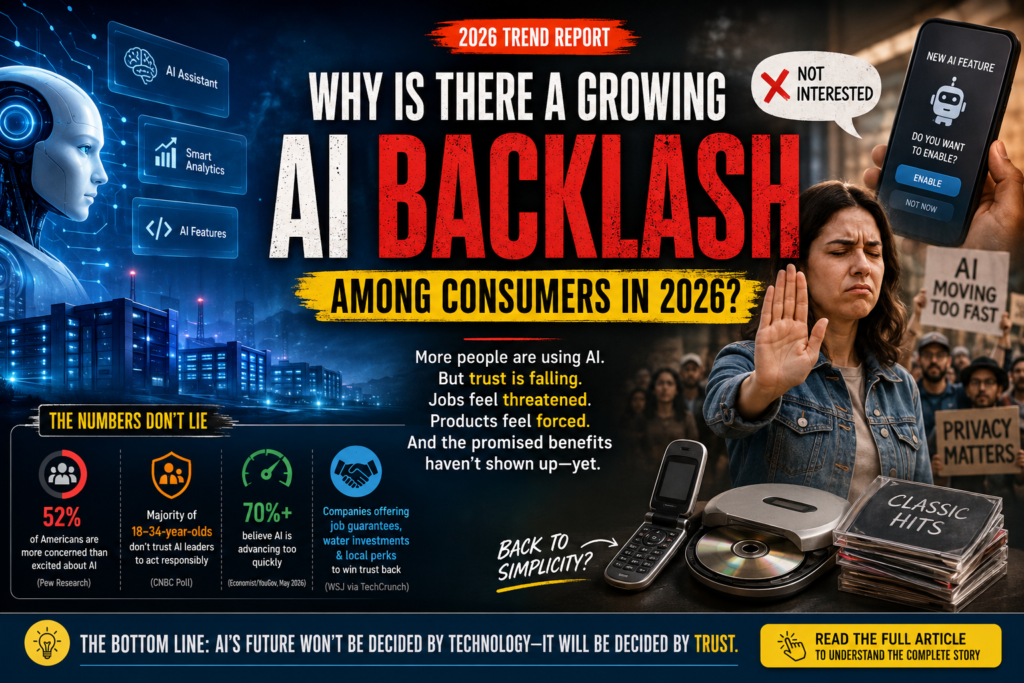
If you have noticed friends switching back to dumbphones, buying CD players, or rolling their eyes every time a new “AI feature” shows up uninvited in an app, you are watching a real-world backlash against AI happen in real time. The short answer: consumers understand AI well enough by now, they just do not believe the trade-offs are worth it, jobs feel threatened, products feel forced on them, and the benefits promised by AI companies have not shown up in their daily lives yet.
This is not a fringe reaction anymore. It is showing up in national surveys, in political memos, and even in blunt admissions from the CEOs building this technology. For an industry that raised hundreds of billions of dollars on the promise that AI adoption was inevitable, the growing public resistance to AI has stopped being just a public-relations headache, it is becoming a real business problem, one that is starting to reshape how companies build products, negotiate with local communities, and talk about their own roadmaps.
What Is the AI Backlash, and Why Is It Happening Now?
The AI backlash refers to the growing wave of public skepticism, distrust, and resistance toward artificial intelligence, even as the technology becomes more powerful and more widely deployed. Unlike early skepticism toward new technology, this reaction is happening at a stage when AI is already deeply embedded in everyday products, emails, TVs, search engines, and workplace tools.
The pattern is unusual. Historically, once a technology like the smartphone or the internet reached mass adoption, public acceptance tended to follow close behind. With AI, the opposite is happening: the more visible AI becomes, the more wary people are getting. That widening gap between how much people use a technology and how much they trust it is the core of what’s driving this reaction, and it is what makes this moment different from previous tech adoption cycles.
Why Does This Matter to Students and Young Professionals in India?
It matters because trust, not just capability, will decide which AI tools survive, which companies hire for AI-adjacent roles, and which skills stay valuable. If you are building a career around AI in India, understanding why this backlash is happening helps you separate genuine opportunity from hype, and helps you build tools and content people will actually trust rather than tune out.
The Data Behind the AI Backlash
The numbers behind this shift are hard to ignore. A study released by Pew Research found that 52% of Americans said they are “more concerned than excited” about the increased use of AI in daily life, a sharp jump from just 37% in 2021, as reported by TechCrunch. That is a 15-percentage-point swing in under five years, a fast erosion of goodwill for a technology still being pitched as inevitable.
The distrust runs deeper than general unease. A recent CNBC poll of 18- to 34-year-olds found that when respondents were shown the names of nine top leaders in the AI industry, a majority said they do not trust those individuals to “act responsibly” with AI, according to TechCrunch’s reporting. This is a notable data point because it is not distrust of the technology in the abstract, it is distrust of the specific people steering it.
An Economist/YouGov poll from May 2026 found that over 70% of Americans believe AI is advancing too quickly, TechCrunch reported, citing Axios’s coverage of the same polling. Put together, these three data points paint a consistent picture: concern is rising, trust in leadership is low, and a large majority feel the pace of AI development has outrun their comfort level.
- 52% of Americans are “more concerned than excited” about AI in daily life (Pew Research, up from 37% in 2021)
- A majority of 18- to 34-year-olds do not trust named AI industry leaders to act responsibly (CNBC poll)
- Over 70% of Americans think AI is advancing too quickly (Economist/YouGov poll, May 2026)
- Tech companies are now offering job guarantees, clean water investments, and local perks, including $50,000 teacher bonuses tied to a Meta data center in Louisiana, to offset community pushback, per The Wall Street Journal’s reporting cited by TechCrunch
What makes these numbers worth paying attention to is not any single data point on its own, but how consistently they point in the same direction across completely different sources. Pew Research tracks general public sentiment over time. CNBC’s polling narrows in on trust toward specific named leaders. The Economist/YouGov survey measures perceived pace rather than perceived value. Three different methodologies, three different framings of the question, and yet all three land on the same conclusion: people are not simply neutral bystanders watching AI unfold, they are actively uneasy about it, and that unease has been building for years rather than appearing overnight.
From Data Centers to Ballot Boxes: The AI Backlash Goes Political
This backlash is no longer confined to opinion polls, it has entered electoral politics. TechCrunch reported that Axios obtained a memo from the National Republican Senatorial Committee, warning top AI companies that U.S. data centers are hurting the party’s chances in a competitive Ohio election. When a political party is actively worried that AI infrastructure could cost it votes, that signals the backlash has moved from social sentiment into economic and political consequence.
This is part of why, according to The Wall Street Journal’s reporting referenced by TechCrunch, tech companies are now racing to “sweeten” data center deals with surrounding communities. These sweeteners include job guarantees, investments in clean water infrastructure, and direct financial incentives, a sign that companies recognize local resistance is now a real obstacle to their build-out plans, not just background noise.
Question: Is the AI Backlash Only About Data Centers and Infrastructure?
No, the backlash extends well beyond data centers into how people experience AI in their everyday digital lives. Consumers are reacting to AI chatbots and AI-transformed search experiences that changed products they already used, features embedded into email and even television sets whether they wanted them or not, and concerns about AI being used to help students cheat, from school-level assignments up through online college degrees. Each of these touchpoints is small on its own, but together they add up to a sense that AI is something being done to people rather than something built for them, a distinction that matters a great deal when you are trying to understand why sentiment has soured even as usage has climbed.
Why Consumers Feel Differently About AI Than Past Tech Shifts
Technology adoption typically refers to the process by which a new tool or platform becomes widely used across a population. With smartphones, the personal computer, and the early internet, wider adoption over time generally correlated with growing public trust and acceptance, people used the product more, got comfortable with it, and eventually stopped questioning whether they needed it at all. The current pushback against AI breaks that pattern, TechCrunch’s reporting notes that AI appears to be facing more consumer resistance than those earlier transformative technologies did at a similar stage of adoption, even though AI is arguably more capable, right now, than any of those technologies were at the equivalent point in their own rollout.
Part of the explanation lies in intellectual property. Consumers have heard, repeatedly, about AI systems being trained on large volumes of copyrighted material, art, video, music, and writing, much of it created by humans who were not compensated or consulted. TechCrunch pointed to real legal consequences here too, including a $1.5 billion copyright settlement Anthropic reached, approved by a U.S. judge in July 2026, tied to claims around AI training data.
Question: Are AI Companies Aware Their Messaging Isn’t Working?
Yes, and some leaders have started to say so publicly rather than treating it purely as a communications problem. Some in Silicon Valley initially assumed the growing skepticism was simply a messaging failure, that if executives explained AI’s benefits more clearly, public opinion would shift. But TechCrunch’s reporting suggests the more accurate explanation is that consumers understand AI reasonably well already; they just are not convinced the benefits outweigh the costs being asked of them. That is a much harder problem to fix with a better slogan, because it requires actually changing what gets built and who it visibly benefits.
What Tech Leaders Are Actually Saying About the AI Backlash
Two of the industry’s most visible executives addressed the backlash directly and publicly in August 2026, and their comments are worth examining side by side.
Airbnb CEO Brian Chesky, speaking on a podcast referenced by TechCrunch, acknowledged that the backlash is real and tied it to a product gap rather than a pure messaging problem. He said the industry is “not talking about AI correctly” but that the bigger issue is a lack of products that “regular people” actually want to use, citing the example of wanting AI to deliver something like an affordable on-demand doctor, rather than features people find far less compelling, like summarized web pages or chatty smart TVs.
Anthropic CEO Dario Amodei, in a post on X referenced by TechCrunch, went further, describing negative public perception as a “big problem” rooted in a “crisis of trust.” He said people do not trust companies, governments, or the tech industry broadly, suspecting that these institutions are “cooking up some new way to screw them over.” Amodei also stated that the most accurate criticism of AI companies, Anthropic included, is that they have not yet delivered on big promises made to the public, citing curing cancer as an example of the kind of tangible benefit still owed.
Key takeaway: Both executives agree this reaction is a trust and delivery problem, not just a communications problem. The fix they describe is the same, ship things people actually value, not just things that are technically impressive.
Comparison: How the AI Backlash Differs From Past Tech Adoption Cycles
| Factor | Smartphones / Internet Era | Current AI Backlash (2026) |
| Adoption vs. Trust | Trust generally rose alongside adoption | Trust is falling even as adoption rises |
| Perceived Benefit | Clear personal upside (connectivity, convenience) | Vague or invisible upside for many everyday users |
| Cost Consumers Notice | Mostly the price of the device or service | Job security fears, IP concerns, unwanted feature integration |
| Community-Level Impact | Limited local infrastructure disputes | Data center fights over land, water, and electricity in local communities |
| Leadership Trust | Founders were often seen as visionary and relatable | Majority of young adults distrust named AI leaders’ judgment, per CNBC polling |
| Political Involvement | Rarely became a campaign-level issue | Data centers already flagged as an electoral risk in the U.S. |
The Retro-Tech and “Grandma Hobbies” Response to AI Backlash
One of the more striking signs of this shift is where consumer attention is actually going instead. TechCrunch reported that young people are showing renewed interest in retro technology, dumbphones, point-and-shoot cameras, tape decks, and CD players, alongside AI-free, algorithm-free classic iPods, which are reportedly selling for a premium on eBay. So-called “grandma hobbies” like quilting, knitting, jigsaw puzzles, cards, and games such as Mahjong are also seeing renewed popularity, per the same reporting.
This extends to social behavior as well. TechCrunch noted that in-person meetups and activities, including run clubs, are winning out over online dating for some users, and Tinder itself has expanded in-person events to more cities partly in response to this shift. Taken together, this points to a broader cultural pull away from algorithm-mediated experiences, not just resistance to AI chatbots specifically.
The Gap Between What AI Companies Promise and What Consumers Actually Get
Expectation gap is a useful term here: it describes the distance between what a company says a product will deliver and what the average user actually experiences once they use it. In AI’s case, that gap has widened considerably. Companies have talked for years about AI curing diseases, transforming productivity, and freeing up workers’ time. What most consumers have actually received, based on TechCrunch’s reporting, is closer to summarized web pages, chatbots bolted onto products they already used, and AI features in TVs and inboxes that nobody specifically asked for.
Question: Why does this expectation gap fuel distrust more than a simple lack of features would?
Because it feels like a broken promise rather than a missing feature, and broken promises are remembered far longer than unmet wishes. When a company sets expectations that high and delivers something that modest, the shortfall reads less like “the technology isn’t ready yet” and more like “we were oversold.” Dario Amodei’s own comments, as reported by TechCrunch, acknowledge this directly, he described the industry’s failure to deliver on big promises as the most accurate criticism being leveled against AI companies today, Anthropic included.
This expectation gap also helps explain why the backlash is showing up unevenly. People who have experienced a genuinely useful AI application, faster customer support, a helpful coding assistant, a tool that saves real time at work, tend to be more forgiving. People whose primary exposure to AI has been an unwanted chatbot pop-up or an AI-generated summary replacing a page they wanted to read directly tend to be far more skeptical. The technology is the same; the experience of it is not, and that inconsistency is part of why public opinion looks so split.
What This Means for AI Content, Products, and Marketing Going Forward
For anyone working in AI-adjacent content, product design, or marketing, including the growing number of AI startups and training platforms in India, the backlash carries a clear signal: credibility now matters more than novelty. A feature that is technically impressive but does not solve a problem the user actually has is more likely to generate irritation than adoption. TechCrunch’s reporting on Chesky’s comments makes this point explicitly, the industry has largely built things that are technically interesting rather than things “regular people” say they love using.
This shift also changes what good AI communication looks like. Overstating what a tool can do, burying limitations in fine print, or launching AI features without a clear opt-out tends to reinforce the exact distrust driving the backlash in the first place. Conversely, being specific about what a tool actually does, being upfront about its limits, and giving users control over whether they use it at all are increasingly differentiators rather than just good practice. In a market where trust is scarce, transparency has become a competitive advantage rather than a compliance checkbox.
Practical Takeaways for Anyone Building an AI Career or Product in India
If you are a student, fresher, or young professional trying to build a future around AI skills, this backlash is not a reason to avoid the field, but it is a signal about what kind of AI work will actually matter.
- Build for a specific, felt need, not for the novelty of adding AI to something that worked fine before.
- Be transparent about training data and sourcing if you are building AI tools or content, IP concerns are one of the biggest drivers of public distrust.
- Don’t oversell AI’s capabilities. Both Chesky’s and Amodei’s comments point to overpromising as a core trust problem the industry still has to fix.
- Watch how companies communicate AI features, not just what the features do, tone-deaf rollouts (like AI added to products users did not ask for) fuel resentment even when the underlying technology is solid.
- Track policy and local-community reactions to AI infrastructure, since the Ohio data center example shows AI’s economic footprint is now a live political issue, not just a technical one.
FAQ: Understanding the AI Backlash
What is causing the AI backlash in 2026? This reaction is being driven by a mix of factors: rising public concern documented in Pew Research polling (52% “more concerned than excited,” up from 37% in 2021), distrust in AI industry leadership found in CNBC polling, worries about job displacement, unwanted AI features embedded into everyday products, and concerns over AI systems being trained on copyrighted work without consent.
Is the reaction against AI bigger than what earlier technologies faced, like smartphones? According to TechCrunch’s reporting, yes, AI appears to be facing more consumer resistance than transformative technologies like the iPhone, the personal computer, or the early internet did at a similar stage of adoption, largely because trust is falling even as usage rises, rather than rising alongside it.
Are AI company executives acknowledging the backlash publicly? Yes. Airbnb CEO Brian Chesky and Anthropic CEO Dario Amodei both addressed it directly in August 2026, with Amodei calling it a “crisis of trust” and acknowledging that AI companies, including Anthropic, have not yet delivered on major promises made to the public.
Has the AI backlash affected politics or elections? Yes. TechCrunch reported that the National Republican Senatorial Committee sent a memo warning AI companies that U.S. data centers were hurting the party’s standing in a competitive Ohio election, showing that AI infrastructure has become a live political liability in some regions.
How are tech companies responding to community pushback around data centers? Companies are reportedly offering local communities incentives such as job guarantees, clean water infrastructure investment, and direct financial perks, including a reported $50,000 teacher bonus tied to a Meta data center in Louisiana, as documented by The Wall Street Journal and cited by TechCrunch.
Does this backlash mean people are rejecting AI-related careers too? Not necessarily. It is largely about specific products, messaging, and trust, not a rejection of AI skills or careers. It does suggest that people entering AI-related fields should focus on building genuinely useful, transparent, and well-communicated tools rather than novelty AI features.
Keep Learning: Build AI Skills That Outlast the Hype Cycle
Understanding this backlash against AI is part of understanding how the AI industry actually works, not just the models, but the trust, policy, and public reaction shaping what gets built next. If you want to go deeper into how AI tools are actually built and deployed responsibly, explore Kalinga.ai’s upcoming workshops and training programs designed for students and young professionals across Odisha and India.