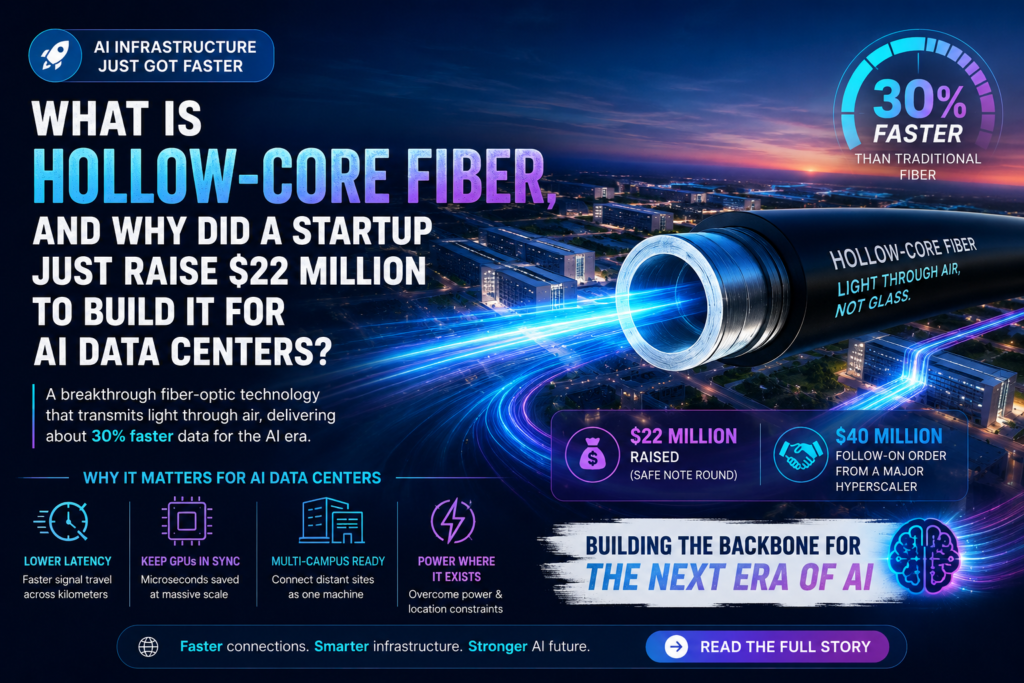
Imagine your AI prompt taking a fraction of a second longer to process simply because the data center answering it is spread across two buildings instead of one, that tiny delay is exactly the problem a new fiber-optic technology is trying to solve. Hollow-core fiber is a rare type of fiber-optic cable that sends light through a vacuum-like air channel instead of glass, letting data travel about 30% faster than it does on the fiber used in most networks today. A young company called Relativity Networks just raised $22 million to build this technology into the backbone connecting AI data centers, and the story tells us a lot about where the AI infrastructure race is headed next.
For readers in Odisha and across India tracking the AI and data center boom, this isn’t just a funding headline, it’s a preview of the next bottleneck in AI infrastructure, and the engineering fix for it.
What Happened: Relativity Networks’ $22 Million Raise
Relativity Networks announced $22 million in funding on Tuesday, August 18, 2026, through a SAFE note round drawn by investors including Rhapsody Venture Partners, Bell Ventures Inc., and Faster Than Glass LLC, among others, according to TechCrunch.
What is a SAFE note? A SAFE note (Simple Agreement for Future Equity) is an investment that converts into actual company shares once a startup completes its first priced funding round. It’s a standard tool for pre-seed and seed-stage startups because it lets founders raise money quickly without immediately negotiating a company valuation. Relativity Networks used this exact structure to close its round.
Beyond the $22 million raise, the company also landed something arguably more telling of real-world demand: a $40 million follow-on order from a major hyperscaler (a large-scale cloud and data center operator) that chose not to be named publicly. A single unnamed hyperscaler placing a $40 million order is a strong signal that this isn’t just an investor bet, it’s a company already selling into live infrastructure builds.
What Is Hollow-Core Fiber, and How Is It Different From Regular Fiber?
Hollow-core fiber is fiber-optic cable engineered so that light travels through a vacuum-like hollow channel at its core instead of through solid glass. Traditional fiber-optic cable, the kind that carries most of the world’s internet traffic, sends light pulses through strands of solid glass, which slows the light down compared to its theoretical top speed. Hollow-core fiber removes most of that glass from the light’s path, letting it travel closer to the actual speed of light.
Why does this matter for data centers? Because in large-scale AI computing, even microseconds of delay add up when thousands of GPUs (graphics processing units, the chips that power AI training and inference) need to talk to each other constantly.
According to Relativity Networks CEO Jason Eisenholz, conventional fiber takes roughly five microseconds to carry a signal one kilometer. Hollow-core fiber cuts that down to about three and a half microseconds per kilometer, a real but small-sounding difference that becomes significant at data-center scale, where signals travel across many kilometers of cabling every second.
Why Fiber Speed Suddenly Matters for AI Data Centers
Why does a 30% latency improvement matter now, when fiber has “just worked” for decades? Because AI compute has outgrown the single building. A few years ago, AI workloads ran across one rack of GPUs inside one room, so the time light took to travel between chips was negligible. Today, AI data center campuses often sprawl across hundreds of acres and dozens of buildings, and the physical distance between GPUs has become a real performance bottleneck.
This shift is happening because power availability, not floor space, is now the limiting factor for data center construction. Data center developers are projected to spend as much as $4 trillion by the end of the decade, and they’re already constrained by political approvals and the availability of electricity on local power grids. That forces companies to build compute capacity wherever power exists, even if that means splitting operations across multiple campuses that then need to function as one synchronized system.
Multi-campus deployment is the practice of linking two or more separate data center sites so they operate together as a single logical computing unit. Eisenholz sees this as hollow-core fiber’s biggest opportunity: knitting together pre-existing data centers that are geographically apart but need to behave like one machine for AI training and inference workloads.
As Eisenholz put it, the industry is moving to where usable power exists, but those separate sites “still need to operate as one synchronized machine.”
The Three Eras of AI Infrastructure, According to Relativity’s CEO
Eisenholz frames the evolution of AI infrastructure in three distinct phases, and it’s a useful mental model for understanding where hollow-core fiber fits in:
- Era one, Compute: The early focus was simply stacking GPUs. More chips meant more raw AI processing power, so companies competed on GPU count above all else.
- Era two, Networking: Once GPU supply scaled up, the bottleneck shifted to the networking inside a single data center, connecting chips efficiently enough to actually use all that compute power.
- Era three, Geography: The next constraint, per Eisenholz, is optimizing the physical distance and geographic layout between data center sites, which is exactly what faster fiber like hollow-core is built to address.
This progression matters because it reframes hollow-core fiber not as a niche cabling upgrade, but as infrastructure for a structural shift in how AI companies think about location and distance.
Hollow-Core Fiber vs. Conventional Fiber: A Quick Comparison
| Factor | Conventional (Solid-Core) Fiber | Hollow-Core Fiber |
| Light travels through | Solid glass strand | Vacuum-like hollow channel |
| Latency per kilometer | ~5 microseconds | ~3.5 microseconds |
| Speed advantage | Baseline | ~30% faster signal transmission |
| Deployment maturity | Widely deployed, industry standard | Rarely deployed, still emerging |
| Best-fit use case | General-purpose internet and enterprise networking | Long-distance, latency-sensitive AI data center links |
| Effective usable distance before latency hurts performance | Baseline | ~30% greater distance possible |
Why This Could Reshape Where AI Data Centers Get Built
Does faster fiber actually change where companies can build data centers? Yes, because latency, not just distance on a map, is the real constraint. Since hollow-core fiber cuts transmission time by roughly 30%, it effectively lets developers place data centers up to 30% farther apart before that added distance starts to hurt performance, according to Eisenholz’s framing in the TechCrunch report.
That’s a meaningful unlock in a world where power availability, not land, increasingly dictates data center location. A handful of practical implications follow from this:
- Data center operators can pursue sites with better power access, even if they’re geographically farther from an existing campus.
- Multi-campus AI clusters become more viable as a single “synchronized machine” rather than isolated compute islands.
- Regions previously considered too remote for tightly coupled AI clusters may become usable, provided fiber routes can be built.
- Infrastructure planning shifts from “how much compute can we fit in one building” to “how do we architect compute across a spread-out geography.”
What This Means for Students and Professionals in India
For students and early-career professionals following AI infrastructure out of Odisha, this story is a good real-world case study in how AI’s growth isn’t only a software story, it’s increasingly a hardware and physics story. The race to build AI isn’t just about better models; it’s also about power grids, real estate, and now, the literal speed of light through cable. Understanding this layer of the AI stack, compute, networking, and now geography, is genuinely useful context whether you’re studying networking, cloud infrastructure, or just trying to make sense of where the AI industry’s money is actually going.
It’s also a reminder that early-stage funding news, even a “small” $22 million raise, can be a leading indicator of where large infrastructure investment is headed months or years down the line.
FAQ: Hollow-Core Fiber and Relativity Networks
What is hollow-core fiber used for? Hollow-core fiber is primarily being positioned for latency-sensitive, high-distance networking, most notably connecting AI data center campuses so that GPUs spread across different buildings or sites can communicate almost as fast as if they were in the same room.
How much faster is hollow-core fiber than regular fiber? Based on Relativity Networks’ figures, hollow-core fiber transmits data about 30% faster than conventional glass fiber, cutting travel time from roughly five microseconds per kilometer down to about three and a half microseconds.
How much money has Relativity Networks raised? Relativity Networks raised $22 million through a SAFE note round in August 2026, backed by investors including Rhapsody Venture Partners, Bell Ventures Inc., and Faster Than Glass LLC, in addition to securing a separate $40 million order from an unnamed hyperscaler.
Why is fiber latency suddenly a bigger deal for AI companies? Because AI compute has scaled from single racks of GPUs to sprawling multi-building campuses covering hundreds of acres, meaning the physical distance data has to travel between chips has grown large enough to noticeably affect performance.
What is a multi-campus data center deployment? It’s an approach where multiple separate data center sites are networked together tightly enough to function as a single, synchronized computing system, rather than operating as isolated, independent facilities.
Is hollow-core fiber widely used today? No, the TechCrunch report describes hollow-core fiber as a rarely deployed technology, and Relativity Networks is among the companies working to bring it into more mainstream use for AI infrastructure.
Keep Exploring AI Infrastructure with Kalinga.ai
If stories like this, where AI’s next bottleneck turns out to be physics, not code, get you curious, explore more AI infrastructure breakdowns and beginner-friendly explainers on Kalinga.ai to build a sharper picture of how the AI industry is actually being built, one layer at a time.