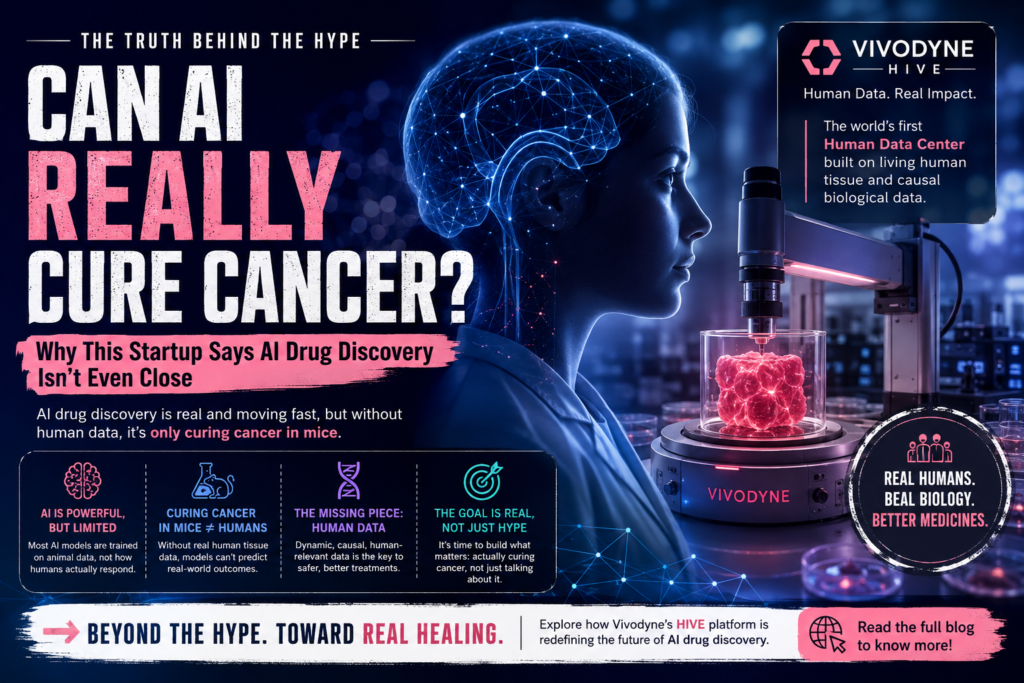
Every few months, a tech CEO promises that artificial intelligence is about to cure cancer, and every few months, that promise quietly fails to show up in a hospital near you. The honest answer is simpler and less exciting: AI drug discovery is real, useful, and moving fast, but it is nowhere close to “curing cancer” in the way the hype suggests. According to a Philadelphia-founded biotech startup called Vivodyne, the reason isn’t that AI models are too weak, it’s that they’ve never actually seen human biology behave in real time.
This piece breaks down what’s really happening in AI drug discovery right now: why the big promises keep missing their deadlines, what Vivodyne’s “human data center” is trying to fix, and what any of this means for students and professionals in India who are watching AI reshape healthcare from the outside in.
Why Hasn’t AI Cured Cancer Yet? The Data Problem Nobody Talks About
AI drug discovery refers to the use of machine learning models to predict how molecules behave in the human body, which compounds might bind to a disease target, which might be toxic, and which are worth testing further. It sounds like exactly the kind of pattern-recognition problem AI should be great at, and in narrow ways, it is. But predicting a molecule’s shape is very different from predicting how a living human body will respond to it over weeks or months.
Why hasn’t AI cured cancer despite years of hype? Because the AI models being used for drug discovery are trained mostly on data from animal testing, isolated cells, and individual proteins, not living human tissue. That means the models never learn how a real human body actually reacts to a drug candidate, which is precisely the information doctors need before a treatment can be approved.
Andrei Georgescu, CEO and co-founder of Vivodyne, put it bluntly to TechCrunch: absent human testing, these AI models “are going to cure cancer in mice.” It’s a pointed line, but it captures the core issue in AI drug discovery today, the models are only as good as the biological data they’re trained on, and that data doesn’t reflect how humans actually respond to treatment.
What Tech’s Biggest Names Have Said About AI Curing Cancer
The “AI will cure cancer” narrative hasn’t come from nowhere, it’s been repeated by some of the most influential people in the industry. Sam Altman has repeatedly cited curing cancer as a justification for OpenAI’s push toward more advanced AI and larger compute investments, while Google DeepMind’s Demis Hassabis said last year that AI could potentially cure all disease within a decade.
Even Anthropic’s own leadership has now pushed back on the framing. Anthropic CEO Dario Amodei wrote over the weekend that claims about AI curing cancer have become more cliché than credible, arguing instead that the real goal has to be actually curing cancer, not just talking about the possibility. Notably, Amodei himself has made similar claims about AI and cancer in earlier essays, which shows just how far the industry’s own thinking has shifted in a short time.
Question: Are any AI-designed drugs actually in human trials right now? Yes, but the numbers are small. A handful of AI-designed drugs have reached human trials, with one candidate advancing as far as Phase III, the stage of widespread human testing. That’s meaningful progress, but it’s a long way from the “AI cures disease” headlines that keep circulating.
It’s worth pausing on why so many respected leaders keep reaching for cancer as the example. Cancer is emotionally resonant, it affects nearly every family at some point, and it makes for a far more compelling pitch to investors and the public than saying “we’ve made molecule screening 20% faster.” The problem is that repeating the promise without the underlying data infrastructure to back it up sets expectations that the field simply can’t meet on the current timeline, which is exactly the gap Vivodyne is trying to point at.
AlphaFold, Isomorphic Labs, and the Limits of Prediction Alone
One of the most celebrated breakthroughs in this space is AlphaFold, the protein-structure prediction system that won a Nobel Prize for its creators. AlphaFold was a major advance for understanding the basic building blocks of life, but it has yet to actually produce a new approved drug.
Isomorphic Labs, the company built specifically to turn AlphaFold’s science into real medicines, is still finding this out the hard way. Isomorphic Labs is now expecting its first clinical trials by the end of this year, after originally planning for them in 2025. In its own words, the company wrote in February that true drug discovery will require “highly accurate predictive models, across an expansive range of biochemical properties and interactions”, a polite way of saying that predicting a protein’s shape isn’t the same as predicting how a drug will behave inside a human being.
That one-year slip might sound minor, but in an industry where a single Phase III trial can run into the hundreds of millions of dollars, delays of this kind ripple through investor expectations, hiring plans, and the broader narrative around how fast AI-driven biotech can actually move. It’s a useful reminder that software timelines and biology timelines rarely move at the same speed.
The pharma industry’s failure rate makes the challenge even clearer. Georgescu points out that this isn’t a new problem AI just discovered, it’s the industry’s oldest and most expensive one. About 90% of drugs that work in animal testing never receive regulatory approval for use in humans. That statistic alone explains why better human-relevant data, not just bigger AI models, is the real bottleneck in AI drug discovery.
Meet Vivodyne: Building the World’s Largest “Human Data Center”
Vivodyne is a biotech startup that believes it has identified the actual fix for this data gap. The company was spun out of the University of Pennsylvania in 2021, after Georgescu completed his PhD in bioengineering there. Its core technology is a system called HIVE, modular robotic labs that grow, dose, and monitor living human tissue automatically.
Definition + Expansion: HIVE is a robotic laboratory platform that can grow lab-created human tissue and then autonomously expose it to drugs or stimuli while recording how it reacts over time. Unlike a single experiment run by a human scientist, HIVE runs enormous numbers of these tests in parallel, around the clock, generating a continuous stream of biological cause-and-effect data. This is the exact type of “causal” information Georgescu argues today’s AI models are missing.
How closely does Vivodyne’s lab-grown tissue match real human biology? Fairly closely, according to the company’s own figures. Vivodyne says its liver cells show 94% predictive accuracy compared to human trials testing for toxicity, its airway tissue matches real human tissue behavior 96% of the time, and its bone marrow achieved 100% concordance across tests of 20 different chemotherapy drugs. Those numbers haven’t been independently peer-reviewed at the time of writing, but they represent the kind of validation pharma partners are watching closely.
Last week, Vivodyne opened what it calls the world’s largest “human data center” just outside San Francisco, a facility built entirely around this tissue-testing approach. The company has raised just under $80 million across two funding rounds led by Khosla Ventures, and Georgescu says his team is already achieving twice the throughput of all the animal trials currently being conducted in the US.
Why Vivodyne Compares Drug Testing to Car Crash Tests
Vivodyne’s pitch to pharmaceutical companies rests on a simple analogy that’s worth understanding if you’re trying to explain AI drug discovery to a friend who isn’t technical.
Question: Why does Vivodyne compare its process to automotive crash testing? Georgescu compares the problem to automotive crash tests: an automaker is typically confident its car will pass US safety requirements before it’s even tested, but drugmakers rarely have that same confidence walking into a clinical trial, where most drugs end up failing to win FDA approval. In other words, car companies can simulate crashes accurately enough to predict outcomes in advance, but drug companies still largely have to “wait and see” what happens once a treatment reaches human trials, which is a hugely expensive way to learn.
Clinical trials typically cost tens of millions of dollars, so being able to predict failure earlier, before a trial even begins, could save the industry enormous amounts of time and money. Vivodyne says it is already working with multiple major pharmaceutical companies, though it hasn’t named them publicly.
Static Snapshots vs. Causal Data: The Real Bottleneck in AI Drug Discovery
This is arguably the most important, and most technical, part of the story, so it’s worth slowing down here.
Definition + Expansion: In machine learning, a static snapshot is a single data point that captures what something looks like at one moment, without any information about how it got there or what happens next. Most existing cellular datasets used to train today’s drug-discovery models are exactly this, isolated pictures of “cell state A” or “cell state B” with no record of the process that connects them. It’s a bit like trying to understand a cricket match by looking at two random scoreboard photos instead of watching the actual overs unfold.
Georgescu explains why this matters so much for building better models. He points to a study published in Nature Methods last month, which found no clear data scaling laws when training generative AI models on existing cellular data, meaning simply adding more of this kind of static data doesn’t reliably make the models better, unlike what’s happened with large language models trained on text.
Georgescu told TechCrunch that all the current training is done on static snapshots of cells, and the models aren’t conditioned at all by how a cell actually got to that state. In his words, the model learns “this is cell state A” and “this is cell state B,” but never learns that cell state B is the effect of inflaming cell state A. Without that cause-and-effect link, an AI model can describe biology but can’t reliably predict what will happen if you intervene in it, which is exactly what drug discovery requires.
This is where Vivodyne’s approach differs. Vivodyne’s HIVE machines are tracking hundreds of thousands of ongoing experiments where diseased tissue is deliberately exposed to a stimulus, generating exactly the kind of before-and-after, cause-and-effect data that Georgescu believes will let future AI models understand human biology deeply enough to make real medical progress, something he sees as increasingly essential as the industry moves toward combination therapies that target multiple biological pathways at once.
AI Drug Discovery Approaches Compared
Different players in this space are attacking the same core problem, bad or incomplete data, from very different angles. Here’s how the major approaches stack up.
| Approach | Data Source | Key Strength | Current Limitation |
| Traditional animal testing | Live animal models | Established regulatory pathway | 90% of drugs that work in animals fail human approval |
| AlphaFold / protein prediction | Protein structure databases | Extremely accurate structure prediction | Hasn’t yet produced an approved drug |
| Isomorphic Labs | AlphaFold-derived models + biochemical data | Backed by DeepMind’s research depth | First trials delayed from 2025 to late 2026 |
| Standard cellular AI models | Static single-cell snapshots | Large existing datasets | No clear data scaling laws; lacks causal information |
| Vivodyne (HIVE) | Lab-grown living human tissue, dosed in real time | Causal, human-relevant biological data at scale | Still early-stage; independent validation still emerging |
What This Means for AI and Biotech Careers in India
For students and young professionals in Odisha and across India tracking where AI drug discovery is headed, the Vivodyne story is a useful reality check, and a genuine opportunity signal. India already has a large base of pharmaceutical manufacturing talent, a fast-growing IT and data-science workforce, and a government pushing hard on biotech investment; what’s missing in most training pipelines is exposure to where these two worlds are starting to overlap. The next wave of hiring in this field isn’t only going to be about training bigger language models; it’s going to be about people who can bridge AI, biology, and lab-scale data infrastructure.
A few takeaways worth keeping in mind if this space interests you:
- Pure AI/ML skills aren’t enough anymore. The most in-demand profiles increasingly combine machine learning fundamentals with basic biology, chemistry, or bioengineering literacy.
- “Causal AI” is becoming a real specialization. Understanding the difference between correlation-based models and cause-and-effect (causal) models is now a genuinely valuable skill, not just an academic distinction.
- Data engineering matters as much as model-building. Companies like Vivodyne succeed because of how they generate and structure data, not just the algorithms they run on top of it.
- Regulatory and clinical-trial literacy is an underrated edge. Understanding how drugs actually move from lab to approval (in India via CDSCO, or internationally via the FDA) makes AI talent far more valuable to health-tech employers.
- Watch adjacent fields, not just headline AI news. Robotics, lab automation, and bioinformatics are quietly becoming just as important to this story as large language models.
FAQ: AI Drug Discovery and Vivodyne
Is AI actually close to curing cancer? No. Despite years of statements from tech leaders, the AI models currently used in drug discovery lack the human-relevant biological data needed to reliably predict how treatments will work in people, which is why so few AI-designed drugs have reached late-stage human trials.
What is Vivodyne and what does it do? Vivodyne is a biotech startup, spun out of the University of Pennsylvania in 2021, that builds robotic lab systems called HIVE. These systems grow lab-created human tissue and generate real-time biological data intended to train more accurate models for drug discovery.
How accurate is Vivodyne’s lab-grown human tissue? According to the company, its liver tissue shows 94% predictive accuracy for toxicity compared to human trials, its airway tissue matches real human behavior 96% of the time, and its bone marrow reached 100% concordance across tests of 20 chemotherapy drugs.
Why do most drugs that work on animals fail in humans? Animal biology differs from human biology in ways that current models don’t fully capture, which is one reason about 90% of drugs effective in animal testing never receive human regulatory approval.
What is the difference between AlphaFold and Vivodyne’s approach? AlphaFold predicts the 3D structure of proteins from their genetic sequence, which is extremely useful for understanding biology but hasn’t yet produced an approved drug on its own. Vivodyne instead focuses on generating living, dynamic human tissue data that shows cause-and-effect biological responses over time.
Why does “causal data” matter so much for AI drug discovery? Most existing AI training data only shows static snapshots of cells, without recording how or why a cell changed state. Causal data, showing what stimulus caused what biological effect, is what lets a model actually predict outcomes of a new treatment, rather than just describe existing biology.
Keep Learning About AI’s Real-World Impact
The gap between AI hype and AI reality is exactly the kind of story Kalinga.ai was built to cover and explain in plain language. If you want to go deeper into how AI is actually being applied across industries, and build the practical skills employers in this space are hiring for, explore Kalinga.ai’s latest coverage and upcoming AI training workshops in Bhubaneswar.