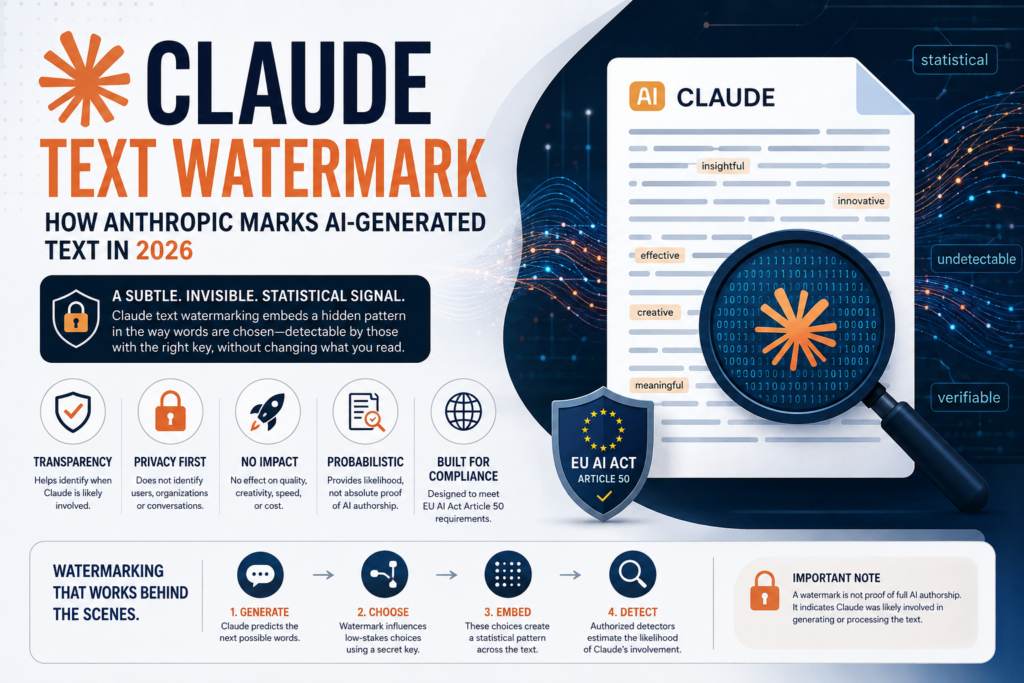
Claude text watermarking is Anthropic’s new method for identifying text that was generated or processed by Claude. Announced on August 14, 2026, the system uses a statistical watermark inspired by Google DeepMind’s SynthID-Text approach. Instead of inserting visible marks, extra characters, or metadata into ordinary text, it subtly changes how Claude resolves certain low-stakes word-selection choices. A detector with the appropriate cryptographic key can then estimate whether Claude was likely involved in producing the text.
Anthropic says the technique is designed to have no practical impact on the quality, readability, creativity, token count, or price of Claude responses. It also says the watermark does not identify the user, organization, conversation, or account behind the text.
The change matters beyond Claude. It arrives as transparency obligations under the European Union’s AI Act begin applying from August 2, 2026. Article 50 requires providers of generative AI systems to make AI-generated or manipulated content detectable in a machine-readable way, where technically feasible. The EU’s final Code of Practice provides a framework for meeting those obligations.
For writers, educators, developers, publishers, and businesses, however, one distinction is crucial: a watermark is not the same thing as an AI detector, and detecting Claude involvement is not proof that an entire document was written by AI.
What Is a Claude Text Watermark?
A Claude text watermark is a statistical pattern embedded in the way Claude selects words while generating text.
Large language models generate text sequentially. At each step, a model considers many possible next tokens and assigns probabilities to them. Sometimes one option is overwhelmingly likely because accuracy requires it. In other situations, several alternatives are similarly appropriate.
For example, after writing a sentence such as:
“The weather today was cold and…”
Claude could reasonably continue with words such as “overcast” or “grey.” Choosing one rather than another does not substantially change the meaning.
Claude’s watermarking system takes advantage of these lower-stakes choices.
Rather than allowing the source of randomness to be completely arbitrary, the watermarking process uses a secret key together with preceding words to influence how those choices are resolved. Across a sufficiently long passage, these individual decisions can form a statistical pattern.
A reader normally cannot see that pattern.
A detector that possesses the appropriate key can test whether the observed sequence is statistically consistent with Claude’s watermarking process. The result is therefore probabilistic rather than a simple binary statement that says “AI” or “human.”
What the watermark does not do
Claude’s watermark does not:
- Add visible symbols to generated text.
- Insert hidden characters into sentences.
- Add extra words solely for watermarking.
- Attach a user ID to the text.
- Reveal the user’s account.
- Reveal the conversation that produced the text.
- Prove that a person did not participate in writing.
- Prove that every word in a document came from Claude.
- Determine whether another AI model generated the content.
Anthropic explicitly says the watermark is associated with Claude’s output rather than the identity of the person using Claude.
How Does Claude Watermarking Work?
The easiest way to understand Claude text watermarking is to think of it as changing how randomness is generated, rather than changing the substance of the answer.
Step 1: Claude generates candidate tokens
Like other large language models, Claude predicts possible next tokens based on the context.
Some choices are highly constrained.
For example:
“2 + 2 =” → “4”
There is little useful freedom here. Selecting a different token would make the answer incorrect.
Other contexts provide multiple reasonable choices.
“The sky looked…” → “grey,” “gray,” “cloudy,” “overcast”
There may be several semantically acceptable continuations.
Step 2: The watermark operates on flexible choices
The watermarking mechanism can influence certain low-impact choices where several alternatives are acceptable.
This is important because the system is not supposed to force Claude to select bizarre, inaccurate, or unnatural vocabulary simply to create a detectable signal.
Anthropic says its method does not push Claude toward words it otherwise would not have considered appropriate.
Step 3: A secret key creates a statistical pattern
The system uses a key and contextual information from preceding words to determine the source of randomness used for particular choices.
Individual choices remain difficult for a reader to distinguish from normal generation.
But thousands of choices can provide enough statistical information for a detector to estimate whether the text is consistent with the watermark.
Step 4: Detection produces a likelihood, not absolute proof
This is one of the most important limitations.
A detector can estimate whether Claude was likely involved. It cannot establish with absolute certainty that Claude wrote the entire document.
Anthropic describes the question as essentially:
“What is the likelihood that Claude was involved in producing this text?”
That is fundamentally different from:
“Was this entire document written by AI?”
Claude Text Watermark vs. Traditional AI Detectors
The terms “watermark” and “AI detector” are often used interchangeably, but they describe different technologies.
Traditional AI detection systems generally analyze linguistic or statistical characteristics of text. They may look for patterns associated with machine-generated writing, sentence structures, token probabilities, repetitive phrasing, or other signals.
A watermark detector has a different advantage: the model provider knows the secret key used to create its watermark.
That creates a more direct provenance signal.
| Feature | Claude Text Watermark | Conventional AI Detector |
|---|---|---|
| Main purpose | Determine whether Claude was likely involved | Estimate whether text resembles AI-generated writing |
| Requires provider key | Yes | Usually no |
| Looks for statistical watermark | Yes | No |
| Can identify Claude specifically | Potentially, with the relevant key | Usually cannot reliably identify the model |
| Can prove human authorship | No | No |
| Can prove entire document was AI-written | No | No |
| Works best on long generated passages | Yes | Depends on detector |
| Vulnerable to substantial rewriting | Yes | Also potentially |
| Identifies the user | No | No |
| Changes visible text | No | No |
This distinction is particularly important for schools, publishers and employers. A positive watermark signal should not automatically be interpreted as “this person cheated” or “this entire article was generated by AI.”
It establishes something narrower: Claude was likely involved in producing or processing some of the text.
Why Is Anthropic Introducing Watermarking Now?
The immediate driver is regulatory transparency.
Anthropic says it is implementing Claude text watermarking to comply with the European Union’s AI Act. Anthropic and other major AI providers signed the EU Code of Practice on Transparency of AI-Generated Content in July 2026. The company says it is initially applying its watermarking approach globally because it does not yet have a durable mechanism for limiting the feature to particular regions.
The broader regulatory framework is Article 50 of the EU AI Act.
The European Commission says Article 50 transparency obligations apply from August 2, 2026. For generative AI providers, outputs such as synthetic text, images, audio and video must be marked in a machine-readable format and made detectable as artificially generated or manipulated, where technically feasible.
The European Commission’s Code of Practice is voluntary, but the underlying Article 50 transparency requirements are legal obligations. The code provides practical methods for providers and deployers seeking to demonstrate compliance.
Why does the EU want AI content marked?
The underlying policy objective is information integrity.
The EU AI Act recognizes that increasingly capable generative AI systems can produce large volumes of synthetic material that may be difficult for people to distinguish from human-created information. The regulation connects this challenge with risks including misinformation, manipulation, fraud, impersonation and consumer deception.
Watermarking is therefore part of a larger ecosystem of provenance and transparency technologies.
It is not intended to solve every problem associated with synthetic content.
Does Claude Watermark Every Word?
No.
This is a critical technical detail.
The watermark works best when Claude has meaningful freedom to select among multiple plausible tokens. It is less useful when the correct output is highly constrained.
Consider factual statements.
If the model needs to complete:
“Isaac Newton’s most famous work was called Principia…”
the correct continuation is constrained by factual accuracy. There is little benefit in artificially pushing the model toward alternative words.
The same principle applies to code.
If a program requires an exact function name, syntax element, variable, number, or operator, changing the selection could break the program. Anthropic therefore says code generally contains less watermarking than ordinary prose, although arbitrary choices in places such as comments can still provide opportunities for the signal.
This creates an important consequence
A short technical answer may contain too little watermark signal to detect reliably.
A long essay with thousands of flexible word choices provides substantially more statistical evidence.
Anthropic explicitly notes that detection is weaker on small samples and that confidence generally increases as the passage becomes longer.
What Happens When Claude Edits Human-Written Text?
This is another area where misunderstanding could lead to false conclusions.
Suppose a writer creates a 2,000-word article and asks Claude:
“Correct grammar and punctuation only.”
If Claude changes only a handful of words, most of the document remains human-written.
The watermark only applies to words Claude actually chooses.
As a result, there may be too few Claude-generated decisions for reliable detection.
Anthropic says that light proofreading may therefore produce little or no detectable watermark, depending on the amount of editing and the length of the material.
The opposite is also true.
If Claude substantially rewrites the article, replaces sentences, restructures paragraphs and generates large sections of new prose, there are many more opportunities for the watermark to appear.
The practical rule
The more text Claude generates, the more opportunity there is for its watermark to become statistically detectable.
This makes watermarking particularly different from an authorship label.
A document can contain:
- Human-written material.
- Claude-generated paragraphs.
- Human revisions.
- Claude proofreading.
- Another AI’s contribution.
- Human final editing.
The watermark does not reconstruct that entire history.
It only provides evidence of Claude’s involvement.
Can Claude Watermark Be Removed?
To some extent, yes.
Anthropic acknowledges that text watermarking is not impossible to circumvent.
Light editing may not completely eliminate the signal. But a sufficiently extensive rewrite that replaces essentially every word can remove the original statistical pattern.
This is not necessarily a flaw unique to Anthropic.
Text is inherently easier to transform than many other digital artifacts. A person can copy, edit, translate, summarize, restructure or rewrite prose without preserving the exact original token sequence.
This means watermarking should be understood as a provenance signal, not a permanent forensic fingerprint.
Why rewriting creates a philosophical problem
Imagine Claude generates 1,000 words.
A human rewrites 900 of them and keeps 100.
A detector may detect Claude involvement.
But what does that prove?
It does not tell us:
- How much Claude contributed.
- Whether Claude created the original idea.
- Whether the human supplied the research.
- Whether the human substantially edited the material.
- Whether another AI was involved later.
This is why watermark results should be interpreted within the context of an organization’s authorship policy rather than used as an automatic judgment mechanism.
Does Translation Carry a Claude Watermark?
Yes.
Anthropic says translated text generated by Claude can carry the watermark because Claude is making the word choices in the translated output.
This is different from simply copying an existing human-written document into Claude for reference.
The key factor is what Claude actually generates.
If Claude translates a paragraph from English into another language, essentially every word in the translated output is selected by the model. That gives the watermarking system many more decisions to work with.
Does Claude Watermark Code?
Only partially and usually less strongly than ordinary prose.
Software is often highly constrained. A function may need a specific syntax structure. A particular API may require an exact parameter name. A mathematical expression may have only one correct result.
Watermarking those choices aggressively could reduce reliability.
Claude’s approach therefore leaves exact, correctness-sensitive decisions alone and can operate in areas where there is genuine flexibility. Comments are one example where natural-language choices can provide some room for watermarking.
For developers, the practical implication is simple:
Claude watermarking should not be interpreted as a comprehensive code provenance system.
A repository containing AI-generated code could have weaker watermark evidence than a long natural-language explanation generated by the same model.
Does Claude Watermark Make Responses Slower or More Expensive?
Anthropic says no.
According to the company, the watermark has a negligible effect on model speed and does not require additional tokens. Therefore, Anthropic says it does not increase the serving price of Claude responses.
This is significant because one potential concern with content provenance is computational overhead.
The Claude approach is designed to operate inside the generation process rather than adding a second large generation stage after the response is created.
Can a Claude Watermark Identify the User?
No.
Anthropic explicitly says its watermark does not contain information that can identify an individual user, organization or conversation. The watermark is associated with Claude’s output rather than the identity of the person who requested it.
That means a detector could potentially conclude:
“Claude was likely involved.”
It cannot conclude from the watermark alone:
“This specific employee generated the text.”
or:
“This particular customer asked Claude to write it.”
That distinction matters for privacy and workplace governance.
What Does a Claude Watermark Actually Prove?
The most accurate interpretation is:
A valid watermark detection can provide evidence that Claude was likely involved in generating or processing the text.
It does not establish complete authorship.
It does not prove that the text was exclusively AI-generated.
It does not prove that a human had no role.
It does not prove that the content is factually correct.
It does not establish ownership.
Anthropic also states that watermarking does not change who owns an output or who is legally responsible for it.
For organizations, this is an important governance distinction.
A useful evidence hierarchy
When evaluating AI-generated content, organizations should ideally combine:
- Watermark or provenance evidence
- Generation logs, where legitimately available
- Human editorial records
- Version history
- Source citations and research records
- Human review
- Context about how the content was produced
No single signal should be treated as a complete authorship record.
Claude Watermark vs. C2PA for Images and Files
Anthropic is using a different approach for certain generated files.
When Claude creates supported file types such as PNG, JPG or SVG, Anthropic says it will attach a cryptographically signed content credential using C2PA, an open standard for recording digital provenance.
This is conceptually different from the statistical watermark used for text.
| Content | Anthropic approach | What it communicates |
| Text | Statistical watermark | Claude was likely involved in generating the text |
| PNG/JPG/SVG files | C2PA content credential | Claude was involved in creating or processing the file |
| Code | Limited statistical watermarking | Some flexible natural-language choices may carry a signal |
| Human text lightly proofread by Claude | Often weak signal | There may be insufficient Claude-generated choices |
| Claude translation | Watermarked | Claude generated the translated words |
C2PA is a provenance technology based on signed metadata rather than statistical word selection. Anthropic says the credential does not change the underlying file and does not contain identifying information about the user.
The distinction demonstrates a broader trend: different media require different provenance mechanisms.
There is unlikely to be one universal technical solution for text, images, video, audio and software.
What Happens to Older Claude Models?
Anthropic says the EU AI Act provides a transition period for models launched before August 2, 2026.
The company is working to add watermarking to older Claude models over the following months.
This matters because users should not assume that every historical Claude-generated document already carries the same watermark.
Content created before the relevant implementation is not necessarily retroactively identifiable.
The European Commission also says content generated before August 2, 2026 does not need to be retroactively labelled under Article 50, although it encourages labelling where possible.
What Does Claude Watermarking Mean for Students and Teachers?
Education is likely to be one of the areas where the technology receives the most attention.
A watermark could eventually provide an additional signal when investigating whether Claude was involved in an assignment.
But it should not become an automatic academic-integrity verdict.
Consider three examples.
Scenario 1: Claude writes the complete essay
The essay is long and contains many model-generated choices.
A watermark detector has more statistical information available, so Claude involvement may be easier to establish.
Scenario 2: Student writes the essay and uses Claude for grammar corrections
Only a small number of words may have been generated or changed by Claude.
The signal may be weak or undetectable.
Scenario 3: Student writes the research and asks Claude to substantially rewrite it
A watermark may indicate Claude involvement, but it cannot determine how much intellectual work came from the student.
For educators, the better policy is therefore to combine technical signals with:
- Draft history.
- Citations.
- Oral explanation.
- Version control.
- Assignment-specific AI rules.
- Student disclosure.
- Human judgment.
A watermark can be evidence of model involvement; it is not a complete academic-authorship detector.
What Does Claude Watermarking Mean for Businesses?
For businesses, the technology could become useful for content governance and provenance.
Companies increasingly use AI to create:
- Marketing copy.
- Internal reports.
- Customer-support responses.
- Software documentation.
- Research summaries.
- Translations.
- Presentations.
- Code comments.
- Product descriptions.
A provenance signal can help organizations answer questions about where content originated.
But businesses should avoid treating watermarking as a replacement for content governance.
A mature AI-content policy should distinguish between:
AI-assisted work
A human creates the core material and uses AI for limited support.
AI-edited work
A human draft is substantially revised by an AI system.
AI-generated work
The model creates most of the final material.
AI-transformed work
The model translates, summarizes, restructures or converts existing material.
The same watermark signal may appear across these categories even though their human contributions are very different.
Why Claude Text Watermarking Is Important for the Future of AI
The bigger story is not simply that Claude now has a watermark.
It is that AI provenance is becoming part of the infrastructure of generative AI.
For years, the central question was:
“Can AI generate convincing content?”
The industry is increasingly asking a second question:
“Can we determine where that content came from?”
That shift has major consequences.
1. AI content provenance becomes a platform feature
Watermarking is moving from experimental research toward production infrastructure.
2. Regulation is influencing model architecture
The EU AI Act is not merely creating documentation requirements. Its transparency rules are influencing how AI providers design generation systems and provenance mechanisms.
3. AI detection becomes more model-specific
Traditional detectors attempt to infer whether writing “looks like AI.”
Provider-controlled watermarks can instead test for a specific generation mechanism.
4. Provenance will become multi-layered
Text watermarks, C2PA credentials, metadata, cryptographic signatures, audit logs and application-level records may increasingly work together.
5. Detection will remain probabilistic
No watermark can solve the fundamental problem of transformed digital content.
Content can be copied, edited, translated, summarized or rewritten.
Therefore, provenance technologies will provide evidence rather than perfect historical reconstruction.
The Biggest Limitations of Claude Text Watermarking
Claude’s approach is significant, but it should not be misunderstood as a perfect AI detector.
The major limitations include:
Short text
Short samples contain fewer statistical decisions and therefore provide less evidence.
Exact factual content
When the correct answer is highly constrained, there may be little opportunity to insert a watermark.
Code
Programming languages often require exact tokens, reducing opportunities for watermarking.
Light editing
If Claude changes only a few words in an existing human document, the signal may be too weak.
Heavy rewriting
A sufficiently comprehensive rewrite can disrupt or remove the original statistical pattern.
Attribution ambiguity
A positive result indicates likely Claude involvement, not the precise amount of Claude involvement.
Model coverage
Older Claude models may not initially have the same watermarking implementation.
No universal AI attribution
A Claude watermark cannot tell you that another AI model was responsible for content that does not match Claude’s watermark.
These limitations mean that AI provenance should be treated as one layer of evidence rather than an all-purpose authorship test.
What Should Content Teams Do About Claude Watermarking?
Organizations publishing AI-assisted content should focus on transparency and process rather than trying to defeat provenance systems.
A practical workflow is:
1. Define acceptable AI use
Specify whether AI can be used for brainstorming, research, drafting, editing, translation or final publication.
2. Keep editorial records
Maintain version histories and source material for important publications.
3. Preserve human responsibility
Assign a human owner to published content, particularly for factual, financial, legal, medical or public-interest information.
4. Verify facts independently
A watermark says nothing about whether a statement is true.
5. Don’t treat AI detection as authorship proof
Use watermark results as one signal among multiple forms of evidence.
6. Understand regional requirements
Organizations operating in the European Union should assess their obligations under Article 50 and applicable guidance.
7. Build provenance into the workflow
AI disclosure is easier when generation, editing, approval and publication steps are documented from the beginning.
Claude Text Watermarking: What Changes for AI Users?
For everyday Claude users, the immediate experience should remain largely unchanged.
Anthropic says users should not notice a visible difference in the text. There are no hidden characters added to responses, no extra tokens required and no additional serving cost attributable to the watermark.
The larger change happens behind the scenes.
Text generated by future Claude models can carry a statistical signal that enables authorized detection.
That changes the expectations around AI-generated content.
Users should increasingly assume that AI-generated content may have provenance signals even when those signals are invisible to humans.
This is similar to the broader shift happening across digital media: authenticity is becoming something that can be evaluated through technical infrastructure rather than appearance alone.
Frequently Asked Questions About Claude Text Watermarking
Is Claude text watermarking visible?
No. Anthropic says the watermark does not create visible changes in the response and does not add hidden characters. The signal is statistical and can be detected using the relevant key.
Can Claude watermarking prove that a person used Claude?
It can provide evidence that Claude was likely involved in generating or processing text, but it does not identify the person, account, organization or conversation responsible for the content.
Can I remove a Claude watermark by editing the text?
Light editing may not completely remove the signal, while a comprehensive rewrite can disrupt it. Anthropic acknowledges that sufficiently extensive rewriting can eliminate the original watermark pattern.
Does Claude watermark every response?
The strength of the watermark depends on how much freedom Claude has when generating the text. Short passages, highly constrained factual answers, proofreading and exact code can contain relatively little watermark signal.
Does Claude watermarking make Claude slower?
Anthropic says the effect on speed is negligible and that the system does not require additional tokens, so it does not increase the model’s serving cost.
Why is Anthropic introducing text watermarking?
Anthropic says the immediate reason is compliance with the EU AI Act’s transparency requirements. Article 50 requires certain AI-generated content to be marked in a machine-readable and detectable way, with the relevant transparency obligations applying from August 2, 2026.
The Bottom Line
Claude text watermarking is a statistical provenance technology designed to identify likely Claude involvement without visibly changing the generated text.
Anthropic’s implementation uses a version of the SynthID-Text approach developed by Google DeepMind. It influences the source of randomness behind certain low-stakes word choices, creating a statistical pattern that can later be tested with the appropriate key.
The technology is deliberately subtle: Anthropic says it does not add hidden characters, extra tokens or identifying information, and that internal testing found no practical impact on quality.
But its limitations are equally important.
A watermark is not a universal AI detector. It cannot determine exactly who used Claude, how much AI contributed, whether another AI was involved, or whether the final content is accurate. Short passages, exact factual statements, code and lightly edited human writing may provide limited watermark evidence.
The arrival of Claude watermarking nevertheless marks an important development in AI governance.
As generative AI becomes embedded in publishing, education, software development, business communication and research, knowing how content was produced is becoming nearly as important as evaluating the content itself.
The future of trustworthy AI content will likely not depend on a single detector. Instead, it will combine watermarks, provenance credentials, metadata, cryptographic records, editorial controls and human accountability.
For users, the message is straightforward: AI-generated content is becoming more traceable, but traceability should be interpreted as evidence of provenance—not as a perfect answer to the much harder question of authorship.