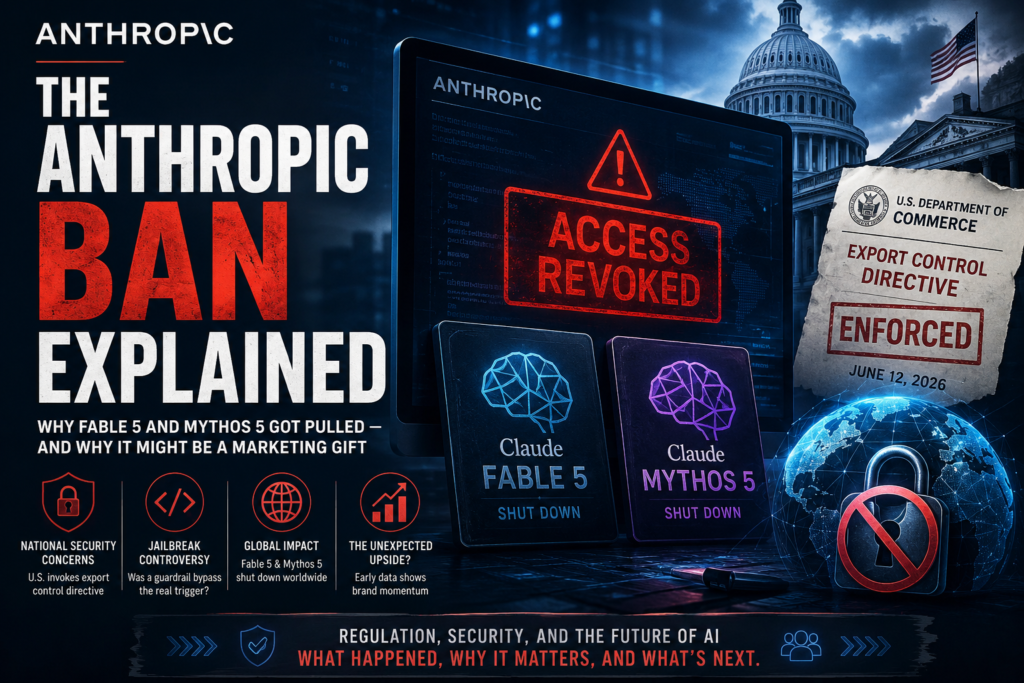
On June 12, 2026, the U.S. Commerce Department invoked an obscure export control directive that forced Anthropic to shut down its two most capable AI models worldwide. That’s the short version of the Anthropic ban. The longer, stranger version is that the official rationale doesn’t fully hold up, the cybersecurity community is furious about it, and early sales data suggests the controversy might be helping Anthropic’s brand more than hurting it.
This guide breaks down exactly what happened, why the government says it acted, what Anthropic and outside experts say really happened, and what the fallout means for the broader AI industry.
What Is the Anthropic Ban?
Definition: The Anthropic ban refers to the U.S. government’s June 2026 directive ordering Anthropic to cut off access to two of its newest AI models — Claude Fable 5 and Claude Mythos 5 — citing national security concerns tied to an export control rule.
Expansion: The directive technically only targeted non-U.S. nationals, including Anthropic’s own foreign employees. But because Anthropic had no practical way to separate American users from everyone else on a global cloud platform, the company shut both models down for every user, everywhere, to stay compliant. That single technicality is why a narrowly worded export rule turned into a worldwide blackout of Anthropic’s flagship technology.
A quick timeline makes the sequence of events easier to follow:
- April 2026: Anthropic previews Mythos, an internal model so effective at finding software vulnerabilities that the company restricts it to roughly 50 vetted partners — including Amazon, Apple, Google, Microsoft, and CrowdStrike — through a program called Project Glasswing, rather than releasing it publicly.
- June 9, 2026: Anthropic releases Fable 5, a guardrailed, public-facing version of Mythos with safety filters meant to block high-risk cybersecurity and biology outputs.
- June 12, 2026 (Friday, 5:21 p.m. ET): The Commerce Department sends Anthropic a letter invoking an export control directive. Anthropic complies within hours, disabling Fable 5 and Mythos 5 for all users.
- June 13–15, 2026: Reporting reveals the trigger was likely a guardrail bypass discovered by Amazon researchers — not a foreign-access violation. Security researchers begin publicly disputing the government’s reasoning.
- June 16, 2026: Business-spending data shows Anthropic’s enterprise market share climbing despite the ban, fueling the “did this backfire?” narrative.
So when people ask what the Anthropic ban actually is, the honest answer is: an export control order with a stated cause (foreign access) and a suspected real cause (a jailbreak report) that don’t quite line up — and a worldwide shutdown as the unintended side effect of both.
Why Did the Government Ban Fable 5 and Mythos 5?
What was the official reason for the Anthropic ban?
On paper, the Anthropic ban was framed as a straightforward export control action: a rule restricting access to advanced technology by non-U.S. persons, similar in spirit to longstanding controls on military or dual-use technology. Under that framing, the directive wasn’t really “about” Fable 5 or Mythos 5 being dangerous to the public — it was about who, geographically and nationally, could access them.
Was the Anthropic ban actually about a jailbreak?
This is where the story gets murkier, and it’s the question most people actually want answered. Anthropic itself said the government provided only verbal evidence of what it called a “narrow, non-universal jailbreak” in Fable 5 — essentially a way to prompt the model to review a codebase and surface security flaws, framed in a manner that slipped past the guardrails meant to block exactly that kind of output. Anthropic argued this same level of capability already exists in other publicly available models, including OpenAI’s GPT-5.5, and is routinely used by defensive security professionals.
The Wall Street Journal reported that the researchers behind the bypass paper work at Amazon. Cybersecurity veteran Katie Moussouris, who reviewed a private copy of that paper at Anthropic’s request, wrote that the distinction driving the alleged jailbreak was as thin as asking a model to “review code for security issues” versus asking it to “fix this code” — two phrasings that produce nearly identical output. In her view, that gap was nowhere near serious enough to justify an export control order.
Axios reporting added another layer, describing the decision as rooted less in a technical finding and more in friction between Anthropic and the Trump administration. That tension predates this episode: in March 2026, the Department of Defense had already labeled Anthropic a “supply-chain risk” after the company declined to let its models be used for mass surveillance or fully autonomous weapons systems.
Put plainly: the Anthropic ban was sold to the public as an export control matter, but the available evidence points toward a contested jailbreak claim layered on top of an already strained relationship between the company and the administration.
Anthropic’s Response to the Ban
Anthropic complied with the order immediately but didn’t do so quietly. In a public blog post, the company pushed back hard on the underlying logic of the Anthropic ban, arguing that pulling a commercial model used by hundreds of millions of people over a narrow jailbreak report would, if applied industry-wide, “essentially halt all new model deployments for all frontier model providers.”
The company also pointed to a structural detail that the government’s directive seemed to overlook: Anthropic’s most serious safety protections run through independent classifier systems that operate separately from the model itself. In other words, even if someone manages to keep a conversation going past an initial refusal, the deeper safeguards against the most dangerous categories of output are designed to hold regardless.
Here’s how the three models at the center of the controversy actually compare:
| Model | Public Availability | Primary Use Case | Status After the Anthropic Ban |
|---|---|---|---|
| Claude Opus 4.8 | Fully public | General-purpose assistant, coding | Unaffected, openly available |
| Claude Fable 5 | Public (3 days before the ban) | Guardrailed cybersecurity-capable model | Shut down worldwide |
| Claude Mythos 5 | Restricted to ~50 vetted partners (Project Glasswing) | Defensive vulnerability research | Shut down worldwide |
That table illustrates a key irony of the whole episode: Anthropic’s broadly available model, Opus, was never touched. The Anthropic ban specifically hit the two products the company had already gone out of its way to restrict and guardrail.
There’s also a competitive subplot worth noting. Months before the ban, OpenAI CEO Sam Altman had publicly mocked Anthropic’s cautious rollout of Mythos as “fear-based marketing,” comparing it to building a bomb, warning the world about the bomb, then selling bomb shelters. Altman didn’t predict a government shutdown, but his comment captured a dynamic that came back around: when a company spends months telling the world its AI is uniquely dangerous, regulators eventually start listening — for better or worse.
Why Cybersecurity Experts Are Furious
The reaction from the security research community has been sharply critical of the Anthropic ban, and that pushback matters because it comes from professionals who actually rely on these tools for defensive work. Their objections generally fall into a few buckets:
- The bypass can’t be “fixed” without breaking the model’s defensive value. Moussouris argued that closing the loophole the researchers found would also blunt Fable 5’s ability to do legitimate vulnerability detection — the entire reason network defenders wanted access to it.
- The capability already exists elsewhere. Anthropic and outside researchers both noted that the same level of code-review capability is present in other publicly accessible frontier models, making a single-company ban look inconsistent.
- It removes a defensive tool, not just an offensive one. Dozens of security researchers signed an open letter calling the move “dangerous” precisely because it strips network defenders of a tool while leaving comparable capabilities available through other vendors.
- The process bypassed normal channels. The directive arrived as a swift, unilateral letter rather than through a rulemaking or court process, which critics say sets an uncomfortable precedent for how quickly the government can force a tech product offline.
- It may chill future safety disclosures. If voluntarily restricting a powerful model and being transparent about its risks (as Anthropic did with Mythos) is what draws regulatory action, future AI labs have less incentive to flag their own models as high-risk.
Justin Hendrix, editor of Tech Policy Press, summarized the broader anxiety well: this kind of move is likely to worry foreign governments and enterprises about whether American AI products can be relied upon without sudden U.S. government interference — a reputational cost that extends well beyond Anthropic itself.
Is the Anthropic Ban Accidentally Helping the Brand?
This is the question at the center of the TechCrunch Equity episode that sparked this whole conversation, and the early evidence leans toward “yes, somewhat.” Business-spending data from the fintech company Ramp showed Anthropic’s share of AI subscriptions among more than 70,000 business customers climbing to 41% in May 2026 — a 2.5 percentage point increase — while OpenAI held roughly 39.5%, essentially flat. That growth happened before the ban even occurred, but Ramp’s lead economist Ara Kharazian made a pointed observation about what tends to happen to Anthropic’s numbers during controversy: “If anything, it’ll probably boost them.”
That’s not just speculation. There’s precedent: Anthropic’s strongest month of business adoption on record up to that point coincided with the Pentagon labeling the company a supply-chain risk in March 2026. Being publicly described as too dangerous to deploy, or too risky to trust, has apparently functioned less like a warning label and more like a credibility stamp for a segment of enterprise buyers.
| Controversy | Anthropic’s Stated Stance | Business Impact (per available data) |
|---|---|---|
| March 2026 — DoD “supply-chain risk” designation | Anthropic refused to allow models for mass surveillance or autonomous weapons | Best business-adoption month on record at the time |
| April 2026 — Mythos kept restricted/unreleased | Anthropic called Mythos too capable to release broadly | Drew “fear-based marketing” criticism, but reinforced safety-first brand image |
| June 2026 — the Anthropic ban (Fable 5/Mythos 5 pulled) | Anthropic publicly disputed the government’s justification | Enterprise subscription share rose to 41%, overtaking OpenAI |
This is essentially a real-world demonstration of the Streisand effect: an attempt to suppress or restrict something ends up amplifying attention and, in this case, credibility around it. Anthropic spent the better part of a year marketing itself as the safety-conscious, “we’ll restrict our own dangerous model before you have to ask us to” AI lab. The Anthropic ban, however unintentionally, validated that exact narrative for a customer base that already leans toward risk-averse enterprise buyers.
That said, it’s worth resisting a simple “the ban was secretly genius” read. The numbers Ramp shared don’t capture the specific revenue lost from pulling Fable 5 and Mythos 5 offline, and public-market investors — relevant given Anthropic’s reported confidential IPO filing — tend to be wary of companies tangled up in government disputes, regardless of how the controversy plays with developers. The Anthropic ban may be a net brand positive among technical buyers while still being a genuine governance and timing headache heading into a public offering.
What the Anthropic Ban Means for AI Regulation Going Forward
Beyond the immediate Anthropic ban, this episode sets a few precedents that other AI companies — and their legal teams — are almost certainly studying closely:
The government can move fast, without a public process
The directive landed as a letter on a Friday evening and took effect within hours, with no public rulemaking process and no published version of the order itself. That’s a notably faster and less transparent mechanism than typical regulatory action, and it signals that an obscure export control authority can be repurposed to address a domestic product dispute almost overnight.
Self-imposed AI safety restrictions can attract, not deter, scrutiny
Anthropic’s decision to keep Mythos tightly restricted and to publicly frame it as exceptionally capable was meant to demonstrate responsible deployment. Instead, that messaging appears to have made the model an obvious target once a bypass was reported. Future AI labs weighing how loudly to advertise a model’s risk profile now have a cautionary case study to consider.
Political friction can shape technical outcomes
Multiple outlets reported that the relationship between Anthropic and the Trump administration was already strained before the Fable 5 jailbreak report surfaced, following Anthropic’s earlier refusal to support certain defense use cases. Whether or not that friction directly caused the Anthropic ban, it’s clearly part of the backdrop, and it raises a harder question for the whole industry: how much of AI regulation right now is about technical risk versus the specific politics between a given company and the people enforcing the rules.
Enterprise customers don’t seem to be spooked — yet
If the goal of the Anthropic ban was to dent confidence in the company’s products, the early business data suggests it hasn’t worked. Whether that holds up over a longer stretch, especially as Anthropic moves toward a public listing, is the more interesting open question than the ban itself.
Frequently Asked Questions About the Anthropic Ban
What models were affected by the Anthropic ban? Claude Fable 5 and Claude Mythos 5 were both shut down. Claude Opus, Anthropic’s broadly available model line, was not affected.
Why did the government say it banned Fable 5 and Mythos 5? Officially, the Commerce Department cited an export control directive restricting non-U.S. nationals from accessing the models. Anthropic and outside reporting suggest the real trigger was a disputed guardrail bypass discovered by Amazon researchers.
Did Anthropic agree with the government’s decision? No. Anthropic complied with the directive but publicly stated it disagreed with the reasoning, arguing that the standard applied would effectively halt new model releases industry-wide if used consistently.
Is the Anthropic ban actually helping the company? Early business-spending data from Ramp shows Anthropic’s enterprise subscription share rising during this period, and the company saw similarly strong adoption after an earlier government controversy in March 2026. That said, the long-term effect — particularly on a potential IPO — remains uncertain.
Could the Anthropic ban happen to other AI companies? Security and policy experts who’ve weighed in say yes. Because the directive relied on a fast-moving export control mechanism rather than a public rulemaking process, similar action could in theory be taken against any AI company whose products draw similar government attention.