Autonomous robotics has moved out of the research lab and into everyday industrial operations. Robots now work around the clock in ports, warehouses and factories, and the next challenge is no longer whether they can do the job, but whether they can cope with messy, unpredictable environments. That is the central message from a World Economic Forum discussion at its 56th Annual Meeting in Davos, where experts on physical AI argued that the hardest advances in robotics are behind us.
If you work in technology, education, marketing, operations or policy, that claim deserves attention. It suggests the next five years will be less about dramatic technical breakthroughs and more about deployment, trust and skills. This guide explains what changed, where robots already operate, what comes next, and what it means for people building careers around this field. Every section is written to stand on its own, so you can jump straight to the question you care about.
Key Takeaways
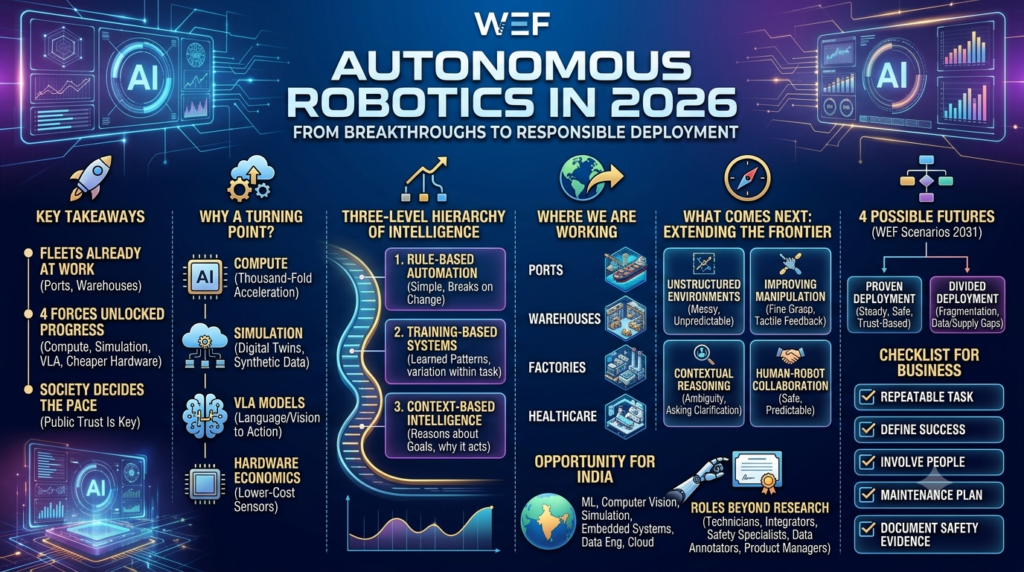
- Robots have left the lab. Fleets of machines already run continuously in structured settings such as ports and warehouses.
- Four forces unlocked progress: a roughly thousand-fold rise in computing power, simulation with synthetic data, Vision-Language-Action models, and cheaper hardware.
- Intelligence is climbing a ladder: from rule-based automation, to training-based systems, to context-based intelligence that understands why it acts.
- The next frontier is unstructured environments, where conditions change constantly and robots must reason, not just repeat.
- Society, not just technology, decides the pace. A WEF scenario analysis to 2031 treats public trust as being as important as technical capability.
What Is Autonomous Robotics?
Autonomous robotics is the field of building machines that sense their surroundings, decide what to do, and act in the physical world with little or no moment-to-moment human control. The key word is “autonomous”: the machine does not simply replay a fixed script. It perceives, plans and adapts.
Expanding on that definition, the field sits at the intersection of several disciplines. Sensors such as cameras and lidar give a robot a picture of its environment. Software interprets that picture, identifies objects and obstacles, and chooses an action. Actuators such as wheels, arms and grippers carry the action out. Increasingly, a learned AI model ties these steps together, which is why many experts now describe the whole area as physical AI: artificial intelligence that acts on the real world instead of only producing text or images.
How Is an Autonomous Robot Different From Automated Equipment?
An automated machine follows a fixed routine and fails when conditions change. An autonomous robot senses the change and adjusts. A traditional assembly-line arm that welds the same joint ten thousand times is automated. A mobile robot that reroutes around a blocked aisle, or an inspection robot that decides where to look next, is autonomous.
The distinction is a spectrum rather than a switch. Most real systems blend scripted behavior with learned decision-making, and the share of learned behavior is growing.
Why Did Robotics Reach a Turning Point?
Robotics reached a turning point because four enabling technologies matured at roughly the same time: far more computing power, realistic simulation, AI models that connect language and vision to action, and cheaper hardware. According to the World Economic Forum’s summary of the Davos discussion, these advances moved autonomous systems from experimental prototypes to large-scale use in manufacturing, logistics, ports and healthcare.
Here is how each driver contributes:
- Compute. The discussion pointed to roughly a thousand-fold acceleration in computing capability, which makes it practical to train and run the large models that robots need for perception and decision-making.
- Simulation. Digital twins and synthetic data allow robots to practice in virtual worlds before touching a real factory floor.
- Foundation models for action. New AI models translate what a robot sees and what a human says into physical movement.
- Hardware economics. Cheaper, more capable sensors, motors and processors lower the cost of building and deploying machines, which widens who can afford them.
What Is the Simulation-to-Reality Gap?
The simulation-to-reality gap is the difference between how a robot behaves in a virtual environment and how it behaves in the real world. A robot may handle a simulated box perfectly and then fumble a real one because of lighting, friction or sensor noise. Digital twins and synthetic data narrow this gap by making simulations more faithful and by generating varied training scenarios that expose the robot to many conditions. The practical result is that robots can be trained largely in software and then carry that learning into physical work.
What Are Vision-Language-Action Models?
Vision-Language-Action models, often shortened to VLA models, are AI systems that take in visual input and natural-language instructions and output physical actions. Think of them as the robotics counterpart to chat-style language models. Instead of answering a question with words, they decide how an arm should move or where a vehicle should go.
Their importance is generality. Older robots needed custom programming for each task. A VLA model can be trained on broad data and then guided by plain instructions, which makes it far easier to repurpose a robot for a new job. That flexibility is a major reason experts believe the hardest technical hurdles have been cleared.
The Three-Level Hierarchy of Robot Intelligence
Autonomous robotics is evolving along a hierarchy, moving from rule-based automation, to training-based systems, to context-based intelligence. Each level adds a capability the previous one lacked. The table below compares them.
| Level | How it works | Where AI fits | Typical strength | Typical limit |
| Rule-based automation | Humans write explicit instructions for every situation | Little or none | Fast, precise, predictable repetition | Breaks when conditions change |
| Training-based systems | Models learn patterns from data and simulation | Perception and decision-making are learned | Handles variation within a known task | Struggles with unfamiliar situations |
| Context-based intelligence | Language and vision combine so the robot understands the situation | Reasoning about goals, not just actions | Can grasp why it is acting, not only how | Still maturing; needs strong safety evidence |
The most important shift is the move to the third level. A context-aware robot can interpret an instruction such as “clear the damaged pallet but leave the fragile ones,” because it connects language to what it sees. That is a qualitative leap, and it is what opens the door to unstructured settings.
Where Is Autonomous Robotics Already Working?
Robots are already working at scale in structured environments, meaning places where layouts, tasks and risks are well understood. The WEF discussion highlighted ports, warehouses and factories, where fleets of robots operate continuously, along with healthcare and logistics more broadly.
Structured settings succeed first for a simple reason: predictability. A warehouse has marked aisles, standard containers and known workflows. A port has defined lanes and repeatable tasks. In these places, robots can be tested thoroughly, errors are easier to contain, and the return on investment is easy to measure.
The Davos session on living autonomously brought together voices from academia and industry, including Daniela Rus of MIT’s Computer Science and Artificial Intelligence Laboratory, Jake Loosararian of Gecko Robotics and Shao Tianlan of Mech-Mind. The mix reflects where the field now sits: research ideas and commercial deployment are converging.
Why Do Structured Settings Come First?
Structured settings come first because they reduce the number of surprises. When the environment is stable, a robot’s perception and planning can be validated against a narrow set of conditions. That lowers risk, simplifies regulation and builds a track record. Each successful deployment produces data and operating experience that make the next, harder deployment more realistic.
Will 70% of Manufacturing Be Autonomous by 2050?
Some experts forecast that by 2050 around 70% of global manufacturing operations could be largely autonomous. That figure comes from the perspective summarized in the WEF’s coverage, and it is best treated as an informed projection rather than a guarantee.
Several factors will determine whether the forecast holds. Cost curves matter, since cheaper hardware speeds adoption. Safety validation matters, since factories will only hand over control when evidence supports it. Workforce transition matters, since the people who run and maintain these systems need new skills. And policy matters, since rules on safety, data and liability differ across regions.
The sensible reading is directional. Manufacturing is on a path toward much higher autonomy, and the timeline will vary by industry, country and company size.
What Comes Next for Autonomous Robotics?
What comes next is a shift from proving the technology to extending it. The WEF discussion emphasized deployment in unstructured environments, better manipulation, contextual reasoning, and responsible collaboration between humans and machines. Each of these is a distinct challenge.
Moving Into Unstructured Environments
Unstructured environments are places where layouts change, objects vary and people move unpredictably: homes, hospitals, construction sites, farms and city streets. They are harder because a robot cannot rely on a fixed map or a narrow set of tasks. Progress here depends on models that generalize, and on enough safety evidence that people will accept machines working beside them.
Improving Manipulation
Manipulation means handling physical objects with skill: grasping a soft item, threading a cable, folding fabric. Humans do this effortlessly, but it remains one of the harder problems in robotics because it demands fine touch, accurate vision and rapid adjustment. Better manipulation is what lets robots move beyond moving boxes and into assembly, care and repair work.
Adding Contextual Reasoning
Contextual reasoning is the ability to understand the situation behind an instruction. This is where the language side of VLA models matters. A robot that grasps context can handle ambiguity, ask for clarification and explain its choices, which is essential for working with non-experts.
Building Human-Robot Collaboration
Collaboration is the human side of the equation. Robots that share space with people need predictable behavior, clear signals and reliable fail-safes. Just as important, the people working alongside them need training and a voice in how the systems are introduced. Responsible collaboration is as much an organizational design problem as a technical one.
Four Possible Futures Through 2031
A WEF report on physical autonomous systems argues that the next five years will shape how robotics evolves globally by 2031. According to coverage of the report, the outcome depends on two factors, technological innovation and societal acceptance, which combine into four possible scenarios.
Two of those scenarios illustrate the range:
- Proven deployment. Robotics grows steadily in controlled settings such as logistics, ports and mining, where outcomes are predictable and public trust remains stable. Shared oversight and transparent safety evidence help extend robots into areas like healthcare and construction.
- Divided deployment. Robots reach high levels of autonomy, but deployment fragments across global power blocs and large private players. A small number of actors control most of the data and supply chains, which could widen economic gaps and strain public accountability.
The lesson for leaders is that autonomous robotics is not on a single predetermined track. Coordinated choices on standards, data access and safety evidence made now can push the outcome toward broader, safer benefits.
How Can Businesses Start With Robotics Safely?
Businesses should start with a narrow, structured use case, measure it carefully, and expand only when safety and return on investment are proven. The WEF discussion’s emphasis on structured settings points to the same sequence, and it keeps risk manageable while a team builds experience.
A practical starting checklist looks like this:
- Pick a repeatable task. Choose work with clear boundaries, such as moving materials between fixed points or inspecting standard equipment.
- Define success in numbers. Track throughput, error rates, downtime and safety incidents before and after the pilot.
- Involve the people who will work alongside the robots. Early training and feedback reduce resistance and surface practical problems quickly.
- Plan for maintenance. Robots need spare parts, software updates and skilled technicians, and those costs belong in the business case.
- Document safety evidence. Keep test records and incident logs, because regulators, insurers and customers will ask for them.
Teams that follow this sequence build a track record that makes each later deployment easier to approve. Teams that skip it often discover that a robot which works in a demo can struggle with real shift patterns, dust, lighting and human unpredictability.
What Are the Main Risks and Open Challenges?
The main risks are safety in shared spaces, concentration of power, workforce disruption and unclear accountability. None of them are reasons to stop; they are reasons to plan.
- Safety and trust. Robots working near people need rigorous testing and transparent evidence. Public acceptance can vanish quickly after a visible failure.
- Concentration of data and supply chains. If a few organizations control the data, chips and hardware, smaller firms and many countries may be left behind.
- Workforce transition. Some tasks will disappear while new roles in supervision, maintenance, data and integration appear. Training programs need to move faster than deployment.
- Accountability. When an autonomous system causes harm, responsibility must be clear among the maker, the operator and the owner.
- Uneven access. Without deliberate effort, the benefits of autonomous systems may cluster in a few regions and industries.
What This Means for Students and Early-Career Professionals in India
For students, freshers and young professionals in India, this field is a career-relevant field rather than a distant curiosity. The technology stack behind it overlaps heavily with skills already in demand: machine learning, computer vision, simulation, embedded systems, data engineering and cloud infrastructure.
Three practical moves help:
- Build a foundation in applied AI. Learn how perception models, reinforcement learning and language models work, since VLA models combine all three ideas.
- Get hands-on with simulation. Because training increasingly happens in virtual environments, comfort with simulators and synthetic data is a differentiator.
- Think in systems. Deployment depends on safety, integration and operations, so people who connect technology to real workflows are valuable.
Roles will extend beyond research. Companies will need technicians, integrators, safety specialists, data annotators, product managers and trainers. This field will reward people who combine technical depth with domain knowledge in logistics, manufacturing, healthcare or agriculture.
Frequently Asked Questions
What is the difference between autonomous robotics and artificial intelligence?
Artificial intelligence is the broad field of machines performing tasks that normally need human intelligence. Autonomous robotics applies AI to physical machines that sense and act in the real world. Put simply, AI is the brain, and a robot is the body that lets that brain work on physical tasks.
Are autonomous robots already used in real businesses?
Yes. Autonomous robots already operate at scale in ports, warehouses and factories, and are expanding into healthcare and logistics. Most successful deployments today are in structured environments where conditions are predictable.
What does “physical AI” mean?
Physical AI means artificial intelligence that perceives and acts in the physical world, usually through robots, vehicles or drones. It contrasts with software-only AI that works with text, images or code.
Will robots take over most jobs?
No credible source supports that claim. Evidence suggests tasks will change, some roles will shrink, and new roles will emerge. The outcome depends heavily on training, policy and how thoughtfully companies introduce the technology.
What are Vision-Language-Action models used for?
They help robots turn what they see and what they are told into physical actions. This lets a single robot be redirected to new tasks with plain instructions rather than custom programming, which makes deployment faster and cheaper.
What is the biggest barrier to the next phase?
Trust and safety evidence in unstructured environments. The technology can increasingly perform the tasks; the harder question is proving it is safe enough for homes, hospitals and public spaces.
Conclusion: From Breakthroughs to Responsible Deployment
The core story is simple. Autonomous robotics has already cleared its toughest technical hurdles, and the work now shifts to scale, reliability and trust. Cheaper hardware, vast compute, simulation and Vision-Language-Action models have made robots capable. What remains is bringing them into messier settings, improving manipulation and reasoning, and ensuring that humans and machines collaborate responsibly.
For businesses, the move is to start with structured use cases and build safety evidence. For policymakers, it is to shape standards and data access before the field fragments. For learners, it is to build skills that sit where AI meets the physical world. The next five years will shape which of the possible futures we get, and the people who prepare now will be best placed to influence it.