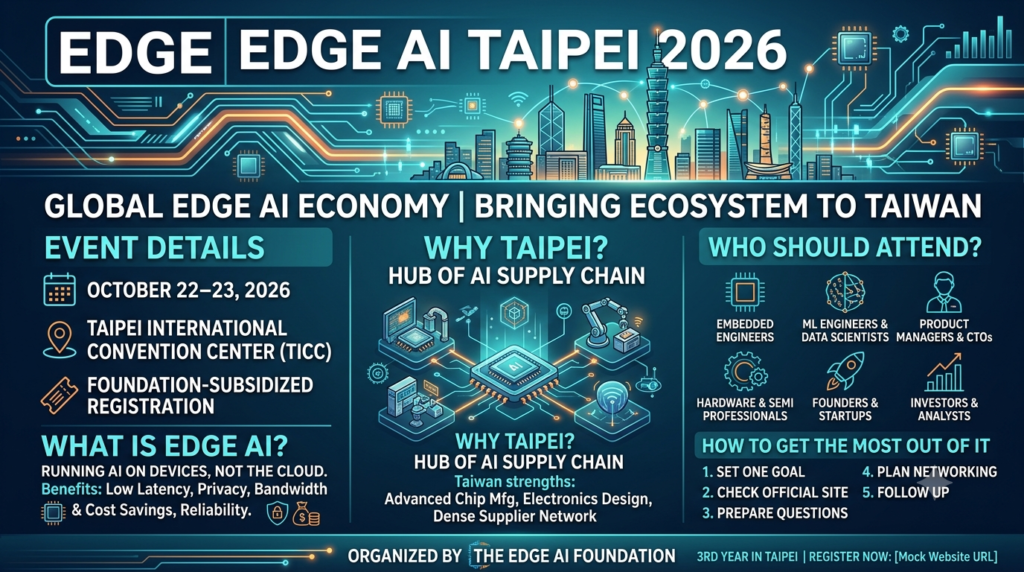
EDGE AI Taipei 2026 is a two-day edge AI conference held on October 22–23, 2026, at the Taipei International Convention Center (TICC) in Taipei, Taiwan. It is organized by the Edge AI Foundation for engineers, founders, executives, students and investors who want practical knowledge of how AI runs on devices instead of in the cloud. Registration is subsidized by the Foundation, which lowers the cost of attending.
Most AI headlines are about giant models in distant data centers. The other half of the story is happening on cameras, factory lines, vehicles, wearables and sensors, where AI has to be fast, private and frugal with power. This guide explains what the event is, why Taipei is the right host city, who should go, and how to make the trip worth it.
Quick Facts at a Glance
- Event: EDGE AI Taipei 2026
- Dates: October 22–23, 2026
- Venue: Taipei International Convention Center (TICC), No. 1, Section 5, Xinyi Road, Xinyi District, Taipei City, Taiwan
- Organizer: Edge AI Foundation
- Edition: Third year in Taipei
- Theme: Bringing the worldwide edge AI ecosystem to Taiwan
- Registration: Foundation-subsidized, through the official event website
- Contact: events@edgeaifoundation.org
What Is EDGE AI Taipei 2026?
Definition: EDGE AI Taipei 2026 is an in-person community gathering focused on edge AI, meaning artificial intelligence that runs on or near the device where data is created. The organizers describe its mission as educating, connecting and accelerating the edge AI economy in Taiwan.
Expansion: The event is not positioned as a typical trade show. The organizers frame attendance as a strategic investment in learning, innovation and future-ready thinking. The promise is practical insights, real-world case studies and industry intelligence that attendees can take back and apply across their organizations.
Attendees are meant to meet leaders in edge AI from outside Taiwan as well as from inside it. That mix matters because edge AI is a global value chain. Chip designers, software teams, device makers, integrators and end customers sit in different countries, and the ideas that move products forward often come from conversations between them.
Who Organizes It?
The Edge AI Foundation is the community organization behind the event. It runs a series of gatherings in different regions, and its London 2026 edition was a two-day program of presentations, demos and talks. The Taipei edition applies the same community-first approach to Taiwan’s manufacturing and technology ecosystem.
What Is Edge AI, and Why Does It Matter?
Definition: Edge AI is the practice of running machine learning models directly on local hardware, such as phones, cameras, industrial controllers, vehicles and microcontrollers, rather than sending data to a remote cloud server for processing. You will also see it called on-device AI.
Expansion: Four practical pressures push teams toward the edge:
- Latency. A robot arm or a vehicle cannot wait for a round trip to a data center. Local inference responds in milliseconds.
- Privacy. Keeping raw audio, video or health data on the device reduces exposure and can simplify compliance.
- Bandwidth and cost. Streaming every sensor reading to the cloud is expensive. Processing locally and sending only results saves money.
- Reliability. Devices keep working when connectivity is poor or absent, which is common in factories, farms and moving vehicles.
Making this work requires a different engineering toolbox than cloud AI. Teams compress models through quantization, pruning and distillation. They choose hardware such as neural processing units, low-power accelerators and microcontrollers. They also build software stacks that squeeze performance out of tight memory and power budgets. These are the topics that make an edge AI conference valuable. The problems are concrete, and the solutions are rarely obvious from a vendor datasheet.
Edge AI vs. Cloud AI: A Quick Comparison
| Factor | Edge AI (on-device) | Cloud AI |
|---|---|---|
| Where inference runs | On the device or a nearby gateway | In remote data centers |
| Latency | Very low, often milliseconds | Higher, depends on the network |
| Data privacy | Raw data can stay local | Data must be transmitted |
| Connectivity needed | Works offline or with weak links | Requires a stable connection |
| Ongoing cost | Hardware upfront, low per-inference cost | Pay per use, grows with volume |
| Model size | Constrained by memory and power | Can be very large |
| Best for | Real-time vision, sensors, wearables, robotics | Large-scale training, heavy reasoning |
Most real products use both. The cloud trains and updates models, and the edge runs them close to the action. That hybrid reality is why the ecosystem needs events where hardware and software people meet.
Why Taipei? The Hub of the World’s AI Supply Chain
Direct answer: Taipei is a natural home for an edge AI event because the organizers describe it as the hub of the world’s AI supply chain, and Taiwan’s strengths in semiconductors and electronics manufacturing sit right at the point where edge AI turns from research into shipped hardware.
Taiwan’s Role in the Taipei AI Supply Chain
Taiwan is widely recognized for advanced chip manufacturing, electronics design and manufacturing, and a dense network of suppliers for boards, modules, sensors, cameras and industrial computers. Edge AI products depend on all of these. A smart camera, a factory inspection system or an in-car assistant needs a chip, a module, firmware, a model and a manufacturer who can build it at scale. Much of that chain is within reach of Taipei.
For a software engineer, that proximity means a chance to understand hardware constraints directly. For a hardware company, it means meeting the people who write the models that will run on its silicon. The Taipei AI supply chain is both a manufacturing story and a collaboration story, and the conference is designed to connect the two.
A Third Year in Taipei
The organizers call this their third year in Taipei. A third edition suggests a maturing local community rather than a one-off visit. Returning communities tend to produce deeper conversations because attendees already know the players, the open problems and the follow-ups from earlier years.
The Venue: Taipei International Convention Center
The TICC is in the Xinyi District, the city’s central business and convention area. The official address is No. 1, Section 5, Xinyi Road, Xinyi District, Taipei City. The district is well connected by Taipei’s public transport network, which makes it convenient for attendees arriving from abroad. Confirm hall assignments and session locations on the official website closer to the date.
What to Expect at the Conference
Direct answer: Expect education, networking and business-development opportunities centered on edge AI. The organizers promise practical insights, real-world case studies and industry intelligence delivered by leaders from inside and outside Taiwan.
The official page does not publish a full agenda or speaker list at the time of writing, so check the registration site for current details. Based on how the organizers describe the event and on the format of their London 2026 gathering, which featured presentations, demos and talks, attendees can reasonably look forward to:
- Talks and case studies showing how edge AI is deployed in real products
- Demonstrations that let you see hardware and software running, not just described
- Networking with engineers, product leaders, founders and potential partners
- Career and knowledge opportunities from meeting people at the global frontier of the field
Treat this list as a guide to the format, not a confirmed schedule.
A Different Kind of Conference
Many AI events are dominated by model announcements. Edge AI conversations are usually more grounded: What accuracy did you get after quantization? How much power does it draw? How did you handle updates in the field? Those questions make for a practical, builder-friendly atmosphere where attendees leave with specifics they can test the following week.
Who Should Attend EDGE AI Taipei 2026?
Direct answer: Anyone whose work or career touches AI on devices will find value, from hands-on engineers to business leaders evaluating edge AI investments. Here are the groups that benefit most:
- Embedded and firmware engineers moving from classic control code to machine learning on microcontrollers and low-power chips
- ML engineers and data scientists who need to compress, optimize and deploy models to constrained hardware
- Product managers and CTOs deciding what to build on-device versus in the cloud
- Hardware and semiconductor professionals looking for software partners, ecosystem relationships and customer insight
- Founders and startup teams seeking partners, early customers and a read on where the market is heading
- Investors and analysts tracking how AI value is shifting toward devices and manufacturing
- Students and early-career engineers who want to see where the field is headed and meet people hiring for edge AI skills
- Journalists and creators covering the ecosystem, who can use the organizers’ media credentials request form
Subsidized registration lowers the cost barrier, which makes the event more accessible to smaller teams, researchers and individuals than many industry conferences.
How to Get the Most Out of the Event
Attending is easy. Getting value takes preparation. Use this sequence.
1. Decide Your One Goal
Pick a single priority before you book travel: learn a technique, find a hardware partner, meet potential customers, or scout career options. A clear goal makes every scheduling decision easier.
2. Check the Official Site Regularly
The agenda, speakers and registration details can change. Bookmark the official event website and look again a week before you travel. Questions about registration or support go to events@edgeaifoundation.org.
3. Prepare Your Questions
Edge AI problems are specific. Arrive with two or three real questions, such as “Which accelerator suits a battery-powered vision sensor?” or “How do teams manage model updates across thousands of deployed devices?” Concrete questions get concrete answers.
4. Plan Your Networking
Make a short list of the kinds of people you want to meet, such as chip vendors, integrators or fellow founders. Use the event’s networking tools and your professional networks to arrange conversations in advance. Informal chats between sessions are often where the best opportunities appear.
5. Follow Up Within a Week
Send a short, specific message to each person you meet, referencing your conversation and proposing a next step. Notes taken the same day make this much easier.
Frequently Asked Questions
When is EDGE AI Taipei 2026?
The event takes place on October 22–23, 2026, over two days.
Where is the event held?
It is held at the Taipei International Convention Center (TICC), No. 1, Section 5, Xinyi Road, Xinyi District, Taipei City, Taiwan.
Who organizes it?
The Edge AI Foundation organizes the event, as part of its global community of edge AI gatherings.
Is registration expensive?
Registration is subsidized by the Foundation, which the organizers say delivers more value at a lower cost. Exact ticket prices are not listed on the main page I reviewed, so check the registration page for current pricing.
Is the event only for people in Taiwan?
No. The organizers say attendees will meet edge AI leaders from outside Taiwan as well as inside it, and the event aims to bring the worldwide edge AI ecosystem to Taipei.
Can journalists and media attend?
The official site links to a media credentials request form for press access. Check the site for the most recent version of that form.
How do I contact the organizers?
Email events@edgeaifoundation.org for questions or support about the event.
What is the difference between edge AI and on-device AI?
The terms are close and often used interchangeably. Edge AI is the broader idea of running AI near where data is produced, which can include gateways and local servers. On-device AI usually means running models directly on the end device itself, such as a phone, camera or sensor.
Final Takeaway
EDGE AI Taipei 2026 offers a focused, two-day look at the part of AI that is quietly reshaping products and factories: models that run locally, quickly and privately. Its location in Taipei puts attendees close to the hardware and manufacturing ecosystem that turns edge AI ideas into real devices. If your work involves chips, sensors, embedded software or product strategy for connected devices, mark October 22–23 in your calendar, decide your one goal, and confirm the latest details on the official website.