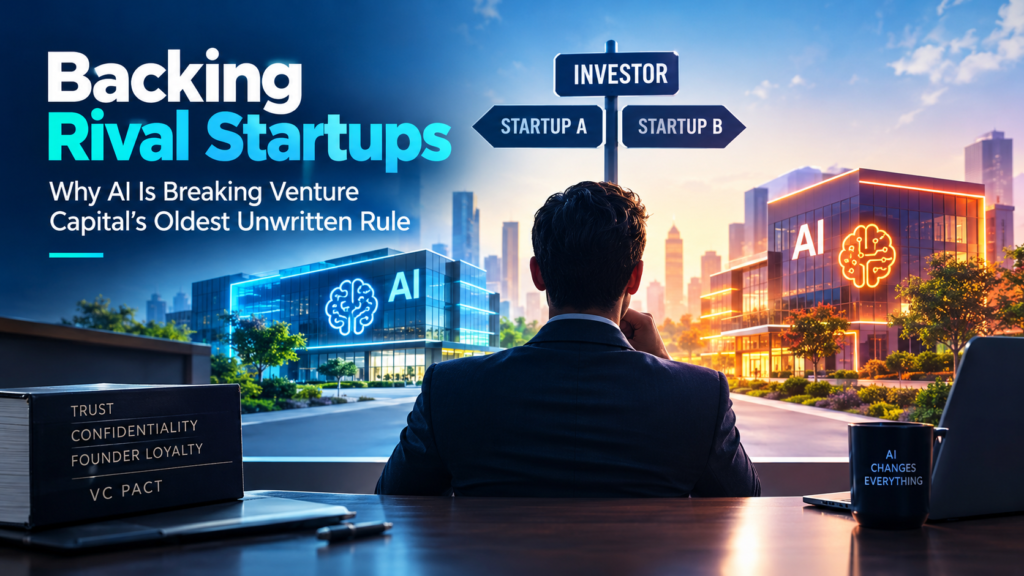
Is backing rival startups still taboo in venture capital? Officially yes, but the AI boom is wearing the rule down faster than most firms expected. Even Benchmark’s partners acknowledged at TechCrunch Disrupt that the AI boom is straining the unwritten rule that a firm doesn’t back two companies that compete head-on. TechCrunch
That admission matters because Benchmark is the firm most associated with doing venture the old-fashioned way. When the most disciplined partnership in Silicon Valley says the pact is getting harder to keep, founders, limited partners, and other investors should pay attention.
This guide explains what the pact is, what Benchmark actually said, why AI is forcing the issue, and what it means for anyone raising or deploying capital. Each section stands on its own, so you can jump to the part you need.
Quick Answer: Where the Venture Pact Stands Today
The pact against backing rival startups is bent, not broken. Firms still prefer exclusivity at the earliest stages, and they still promise founders confidentiality. But in AI, companies grow into each other’s territory so quickly that overlapping portfolios have become close to unavoidable.
Three facts frame the current state of play:
- Benchmark isn’t declaring the rule dead. It stopped short of calling the pact over, even as it admitted the strain. TechCrunch
- The biggest AI labs already share backers. At least 95 investors reportedly hold stakes in both Anthropic and OpenAI, according to New York Times reporting that cites PitchBook. shopifreaks
- Stage matters. The earlier the investment, the more founders expect a firm to stay exclusive in its category.
What Is the Venture Pact Against Backing Rival Startups?
The venture pact against backing rival startups is an informal norm, never a written contract. It holds that a venture firm should not fund two companies that compete directly for the same customers, because doing so creates divided loyalty. The norm lives in reputation and handshake understandings between investors and founders.
Why Did the Pact Exist?
The pact exists to protect trust. A founder shares unreleased product plans, pricing experiments, hiring pipelines, and financial weaknesses with investors. If the same investor also funds a direct competitor, the founder has to wonder whether any of that information will leak, even by accident.
This is the core of venture capital conflicts of interest, and the pact is the industry’s self-policing answer to it. Firms that followed the norm could tell founders, “You are our only bet in this category,” and that promise was a real recruiting advantage.
How Did the Pact Work in Practice?
In practice the pact worked through category discipline. A firm that backed one payments company would pass on the next payments company, no matter how good the pitch was. A partner who broke the norm risked losing deal flow, because founders talk to each other and remember who stayed loyal.
The norm also had a financial logic. Venture returns come from a handful of outsized winners, and a firm that owns a meaningful stake in one category leader doesn’t need to hedge. That logic is exactly what the AI era has disrupted.
What Did Benchmark Say About Backing Rival Startups at Disrupt?
Benchmark’s partners described the conflicts as a matter of necessity rather than preference. According to TechCrunch’s reporting, they said the pressure comes as portfolio companies expand into each other’s territory. Each partner came at the issue from a different angle. TechCrunch
Eric Vishria: Confidentiality and Limits on What Investors Know
Vishria said Benchmark stays committed to each founder and keeps what it learns confidential. He also downplayed how much a venture capitalist could pass along even if tempted. His words: “We are not product or technology experts.” TechCrunch
He also said Benchmark has been fortunate to avoid the kind of direct conflict seen in the dispute between Factory and Cognition, two AI companies that Khosla Ventures backs. In other words, Benchmark can still stay out of the worst collisions, but it wouldn’t rule them out. hyper
Chetan Puttagunta: AI Is Accelerating the Problem
Puttagunta’s point was about speed. He said AI is accelerating the problem. In earlier software eras, two startups could share an investor for years before their products overlapped. In AI, a coding assistant can become an agent platform, and an agent platform can become an enterprise suite, all within a few quarters. TechCrunch
Peter Fenton: The “Kryptonite” Problem
Fenton framed the issue as Benchmark’s toughest challenge, calling it “kryptonite” for the firm. His reasoning rests on a spectrum. At one end is the co-founder-style investor who works inside the company. At the other is the public-market stock picker, who can own several rivals because he is merely allocating capital. mezhaTechCrunch
Fenton said Benchmark sits nearer the co-founder end and treats transparency as a golden rule. The closer an investor is to the founders, the more damaging overlap becomes. TechCrunch
Why Is AI Eroding the Pact? Direct Answers
AI is eroding the pact because it makes companies larger, faster-moving, and more overlapping than any prior technology wave. Three forces do most of the work.
Question: Why does AI create so many overlapping companies?
Direct answer: AI products are built on general-purpose models, so a startup that starts in one niche can expand into adjacent ones with little extra engineering. Two companies that began in separate categories can end up selling to the same buyer within a year. That makes category discipline hard to maintain, even for a firm that tried to invest carefully.
Question: Why do the largest AI labs share investors?
Direct answer: They need more capital than any single group of investors can supply. Anthropic has raised more than $130 billion from roughly 300 backers, while OpenAI has raised more than $180 billion from about 230. Few large funds can afford to sit out either company, so the list of OpenAI and Anthropic investors overlaps heavily. shopifreaks
The pattern has been building for years. Sequoia Capital, already an investor in OpenAI and xAI, also added Anthropic, which commentators saw as a break from the “one winner” model. analyticsindiamag
Question: Do smaller stakes change the calculus?
Direct answer: Yes. Large funds such as Menlo Ventures, Lightspeed, and Iconiq reportedly hold only 1% to 2% of Anthropic, compared with the 11% Benchmark held in Uber at its IPO. A small stake gives an investor less influence and less access to sensitive information. Many investors argue that this reduces the conflict, because they are closer to financial holders than to co-founders. shopifreaks
That is the same distinction Fenton drew. The further a firm sits from the operating company, the easier it is to justify backing rival startups at the same time.
Old Model vs. AI-Era Model: A Comparison
The table below contrasts the traditional approach to VC exclusivity with the one emerging in AI. It is a simplified generalization, and individual firms vary.
| Dimension | Traditional venture model | AI-era venture model |
|---|---|---|
| Rule on competitors | Avoid direct rivals in the same category | Overlap tolerated, especially at scale |
| Typical check size | Small to mid-sized, concentrated | Very large, often shared across many funds |
| Investor ownership | Often 10% or more | Often low single digits at the frontier |
| Founder expectation | “You are our only bet here” | “We manage conflicts openly” |
| Information risk | Mitigated by exclusivity | Mitigated by confidentiality policies and limited access |
| Product overlap | Slow, over many years | Fast, sometimes within quarters |
| Board role | Frequent, hands-on seat | Rarer for frontier-lab investors |
| Main defense | Reputation and loyalty | Disclosure, firewalls, stage discipline |
The takeaway is that the old model relied on avoiding conflicts, while the new one relies on managing them. Managing conflicts demands more transparency, and that is where firms will be judged.
What Are the Risks of Backing Rival Startups?
The risks of backing rival startups are real, even if investors now accept them more readily. Here are the main ones founders and limited partners should weigh:
- Information leakage. Startups fear that backers of competing companies may share proprietary information or compromise one investment in favor of another. texxr
- Divided attention. A partner who sits on two competing boards can’t give either company full focus during a crisis.
- Introductions and hiring conflicts. A recommendation of a candidate or customer to one company may come at the other’s expense.
- Trust erosion. Once founders believe loyalty is negotiable, they ask harder questions, which slows deals.
- Dispute escalation. If two portfolio companies end up in a legal or commercial fight, the shared investor is stuck in the middle.
- Signaling problems. Some founders read a competing investment as a lack of conviction.
None of these risks is new. What is new is how often they now occur, and how many of them involve companies worth tens of billions of dollars.
Frequently Asked Questions
Is backing rival startups illegal?
No. Backing rival startups is a norm, not a law. Investors owe duties to their own limited partners and must follow their fund documents, but nothing forbids funding competing companies. Disputes tend to arise from confidentiality agreements and information-sharing, not from the investment itself.
Did Benchmark say the pact is dead?
No. Benchmark acknowledged the strain but did not declare the rule over. It described the conflicts as a matter of necessity, not preference. It still treats exclusivity as important at the very early stage it favors. TechCrunch
Why do investors back both OpenAI and Anthropic?
Because the capital demands are enormous and the outcome uncertain. With funding rounds measured in the tens of billions, a fund that wants exposure to frontier AI has few ways to avoid overlap. Passive-style stakes also feel less conflicted than board-level involvement.
Has any investor tried to prevent this?
Yes, at least informally. Sam Altman was reportedly said to have asked investors not to back certain rivals, especially those founded by former OpenAI employees. The sheer number of shared backers suggests that such requests have limited force. hyper
What should a founder ask an investor about conflicts?
Ask three things: which competitors the firm already backs, who would see your information internally, and what the firm would do if two portfolio companies began competing directly. Clear, specific answers are a good sign. Vague reassurance is not.
A Practical Playbook for Founders
If you are raising money in a crowded AI category, treat conflicts as a diligence item, not an awkward topic.
- Map the investor’s portfolio. Look for companies that touch your customers, your data, or your roadmap, now or within two years.
- Ask for written confidentiality terms. A verbal “we keep everything confidential” is a start, but written policies are better.
- Limit what you share. Give board members what they need to govern, and keep competitive details out of broad investor updates.
- Negotiate information rights carefully. Large investors may want broad access. Consider carve-outs for sensitive product and customer data.
- Plan for the future conflict. Ask what happens if a portfolio company pivots into your market.
A Practical Playbook for Investors
For investors, the lesson of Benchmark venture capital is that the stage and the role you play determine how much conflict you can defend.
- Match your posture to your role. The closer you work with founders, the stricter your exclusivity should be.
- Disclose early. Telling a founder about an adjacent investment before the term sheet is far better than having them discover it later.
- Build real firewalls. Separate deal teams, restrict data access, and document the policy.
- Be honest about expertise. Vishria’s point that investors are not product or technology experts is a limit on leakage, but it should not become an excuse for carelessness.
- Protect your reputation. In a small ecosystem, the cost of one broken trust is higher than the benefit of one extra bet.
What to Watch Next
Several developments will show whether the pact stabilizes at a new, looser level or erodes further.
Disputes between portfolio companies. The Factory-Cognition situation shows how a shared investor can end up near a fight. If more disputes surface, expect louder demands for disclosure.
Fund structures. Large firms that run venture, growth, and other strategies under one roof may argue that different funds are separate. Benchmark’s own growth is part of this story, since the firm has broken with its tradition of small funds, with its first growth fund as part of a larger capital raise. Partners elsewhere have openly argued that bigger platforms are a different kind of business from classic venture. TechCrunch
Founder behavior. If founders start demanding exclusivity clauses or side letters, the informal pact may become formal. If they stop caring, the norm will fade.
The next wave of AI categories. Coding tools, agents, legal software, and sales automation are all crowded. These categories will be the real test of whether backing rival startups becomes routine.
Key Takeaways
- Backing rival startups was once a near-universal taboo, and it still carries reputational cost.
- Benchmark’s partners said the AI boom is straining the pact, but they didn’t declare it dead.
- Shared investors across the largest AI labs show how common overlap has become.
- The traditional defense, exclusivity, is being replaced by disclosure, confidentiality, and role discipline.
- Founders should treat investor conflicts as a diligence topic, and investors should disclose early.
Conclusion
The pact against backing rival startups was always a convenient fiction in some corners of venture capital, but it was a useful one. It gave founders confidence that their investors were on their side alone. AI has made that promise harder to keep, because companies expand quickly, capital needs are enormous, and categories collide.
What Benchmark’s partners offered at Disrupt was not a eulogy but a more honest description of the rule: it still matters most when investors are closest to the company, and it matters least when investors are passive allocators. For founders, the sensible response is to ask direct questions and document the answers. For investors, it is to decide which end of the spectrum they occupy, and behave accordingly.