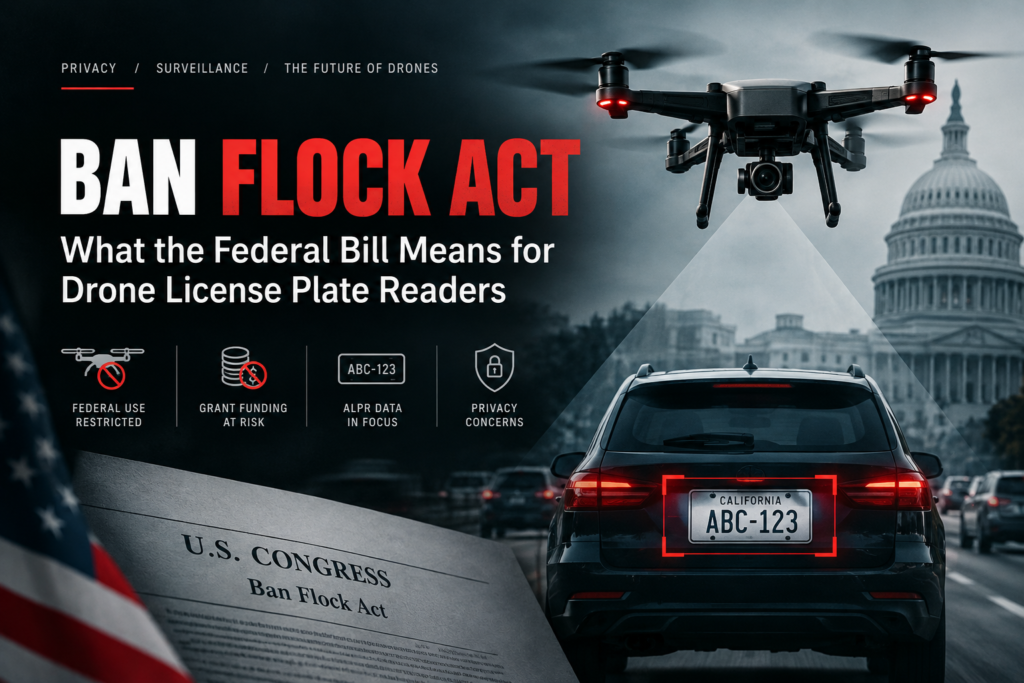
Congress now has a bill that would pull the federal government out of the license plate reader business, drones included. The Ban Flock Act would prohibit federal agencies from using the cameras and cut off grant funding for state and local contracts that rely on the technology. upi
The legislation arrived in early October 2026. DroneLife reports that it would restrict government use of automatic license plate readers, including systems that collect data using drones, while not proposing a general ban on drones, aerial surveillance, or Drone as First Responder (DFR) programs. For public safety agencies, drone operators and privacy advocates, the Ban Flock Act is a signal about where surveillance policy may be heading. dronelifedronelife
This guide covers what the bill says, how it treats drone license plate readers, how it compares with rival proposals, and what happens next.
Key Takeaways
- Announced: Sens. Bernie Sanders (I-Vt.) and Jeff Merkley (D-Ore.) and Rep. Alexandria Ocasio-Cortez (D-N.Y.) announced the Ban Flock Act on a Friday, which was October 2, 2026. DroneLife lists the House bill as H.R. 10691, introduced October 1. 404media
- Scope: Despite the name, the text doesn’t call out Flock but covers any and all ALPR systems. TechCrunch
- Federal funding lever: Under the bill, state and local governments would lose grants from five federal departments, including Justice and Homeland Security, unless they ban the tech. TechCrunch
- Drones: Drone-collected plate data is covered, but drones themselves are not banned.
- Odds: Like most bills, this one faces long odds. TechCrunch
What Is the Ban Flock Act?
Definition: The Ban Flock Act is a federal bill that would bar U.S. agencies from using automatic license plate readers (ALPRs) without explicit statutory authorization. slashdot
Expansion: The bill’s reach goes beyond the cameras themselves. It would bar federal agencies from using ALPRs or tapping data collected by readers run by local police and private companies. That matters because most plate-reading data is collected by local departments and private firms, then shared. The bill targets the federal government’s access to that data, not just its own hardware. TechCrunch
Think of it as two levers. The first is a direct prohibition on federal use. The second is a funding condition that pressures states and cities to follow suit.
Who Introduced the Ban Flock Act?
The Senate side is led by Sanders and Merkley, with Ocasio-Cortez carrying it in the House. Their pitch is blunt. Sanders said America cannot become a surveillance state, and Ocasio-Cortez argued that Big Tech companies like Flock Safety built a mass surveillance system to harvest Americans’ data without consent. techradardenvergazette
Advocacy groups quickly lined up. Demand Progress’s senior policy advisor called the Ban Flock Act the gold standard for federal legislation against invasive Flock cameras. DroneLife notes the House version was referred to multiple House committees. 404mediadronelife
What Would the Bill Prohibit?
In practical terms, the proposal would:
- Block federal agencies from acquiring, possessing, accessing or otherwise using ALPR devices
- Cut federal agencies off from plate data collected by local police and private companies
- Pause or withhold grants from state and local governments that run ALPR contracts
- Let people sue the federal government over its use of the technology hoodline
- Require an act of Congress to carve out exceptions
Under the Ban Flock Act, an agency like Homeland Security could no longer query a nationwide plate database. Local police would face a choice: keep the cameras and risk federal grant money, or drop them.
How the Ban Flock Act Treats Drones
Drones were not the headline of the legislation, but they are a significant part of the story. Flock Safety has pushed aggressively into aerial hardware, and the bill’s definitions appear written to catch that shift.
Does the Ban Flock Act Ban Police Drones?
No. DroneLife reports the bill does not propose a general ban on drones, aerial surveillance or DFR programs. What it targets is plate data. A department could keep flying drones for search and rescue, scene documentation or 911 response. The restriction applies when a drone-based system captures license plate data and federal agencies want to use it.
What Is “Captured Plate Data”?
Definition: “Captured plate data” is the bill’s term for information produced by or derived from automated plate readers.
Expansion: DroneLife’s summary says Section 2 defines the term broadly enough to include data gathered through drone-mounted systems. That closes a loophole. Without it, an agency could argue that a plate read from the air is a different thing from a plate read by a roadside camera. Readers should confirm the exact definitional language in the bill text, since the excerpt available here is truncated.
Why Drones Sit at the Center of the Debate
Drone license plate readers are not a side project for Flock. DroneLife points to a Fast Company report that Flock’s drone sector is the company’s most profitable. One report says Flock acquired drone startup Aerodome in 2024 in a deal reported at more than $300 million. The same report says it now offers an NDAA-compliant “Alpha” drone that can read plates from as far as 2,000 feet. That claim comes from a single outlet with a pro-gun-owner perspective, so treat the specifics with care. Proposed “Ban Flock Act” Targets License Plate Readers, Including Drone-Based Systems +2
The concern for privacy advocates is mobility. A fixed camera watches one road. A drone can follow a vehicle across a city. For the DFR industry, which has worked to build public trust around fast 911 response, the question is whether plate-reading capability puts that goodwill at risk.
Ban Flock Act vs. Other Federal Flock Bills
The Ban Flock Act is not the only proposal in play. Members of both parties have introduced competing approaches, and they differ sharply on how far to go.
| Bill | Lead sponsor(s) | Core approach | Who it targets |
|---|---|---|---|
| Ban Flock Act | Sanders, Merkley, Ocasio-Cortez | Ban federal ALPR use; withhold grants from governments that keep ALPRs | Federal agencies, plus state and local grant recipients |
| Stop Flock Abuse Act | Sen. Josh Hawley (R-Mo.) | Regulate rather than ban: written approval for each search, deletion of driver data after ten days with exceptions, no facial recognition in ALPR networks | ALPR networks and their users |
| Flock-Off Act | Rep. Thomas Massie (R-Ky.) | Block localities from buying, installing, operating or upgrading ALPRs and biometric cameras | Municipalities and local governments |
| Protection Against Mass Surveillance Act | Rep. Tim Burchett (R-Tenn.) | Bar federal agencies from buying, operating or accessing Flock-style ALPR systems | Federal agencies |
The Hawley bill’s provisions are drawn from 404 Media’s summary of the Stop Flock Abuse Act. The Massie bill would block any attempt to purchase, install, maintain, operate or upgrade ALPRs and biometric surveillance cameras for municipalities and localities. The Burchett proposal, per one report, would ban federal agencies from purchasing, deploying, operating, accessing, or contracting for Flock’s ALPR cameras and similar technologies. lawmakers introduce multiple laws to curb flock after 404 media coverage +2
The key distinction: the Ban Flock Act is a prohibition paired with a funding lever, while the Hawley bill is a regulate-and-audit model. Denver Gazette coverage framed it the same way, noting the Ban Flock Act goes further by targeting federal use and funding and conditioning grants on a local ban. denvergazette
Why Lawmakers Are Moving Now
Documented Misuse
Supporters point to specific abuses. A former Milwaukee officer pleaded guilty to misconduct after searching for his then-partner and her ex 179 times, listing the reason as “investigation”. A Kentucky police officer was arrested after reportedly using Flock systems to stalk an ex-girlfriend. TechCrunchslashgear
404 Media’s reporting added a civil liberties angle. It revealed that California police investigated an “immigration protest” using Flock lookups, and that police used Flock to monitor “No Kings” protests nationwide. Lawmakers cited that reporting when introducing the new bills. 404media
A Court Weighs In
A federal judge recently wrote that Flock’s cameras offer “indiscriminate mass surveillance”. A Flock spokesperson told The Washington Post they expect the ruling to be appealed and ultimately overturned. Flock also says the decision does not set controlling precedent. The ruling gives bill supporters a legal talking point, even though the case itself is likely headed for appeal. slashdotslashdot
Pressure From States and Cities
Local governments are not waiting for Congress. Florida’s transportation department formally revoked Flock’s permits for license plate readers on state highways. That move was narrower than a blanket ban, since private citizens may still use Flock devices on their own property. slashgearslashgear
In Richmond, California, the city council on October 6 approved new police drones and cameras but sent license plate readers back for a future vote. A city official said a replacement system would swap out the city’s 110 Flock readers camera for camera, with the city owning the equipment instead of leasing it. grandviewindependentgrandviewindependent
The pattern is clear. Communities are accepting some surveillance tools while scrutinizing plate readers specifically.
A Hearing Nobody Attended
Hawley invited the CEOs of Flock Safety, Axon, Motorola Solutions and Verkada to testify at a September hearing. Hawley said none of them attended. That non-appearance added fuel to the push for legislation. The Hill
Flock Safety’s Response
Flock Safety says it is not opposed to rules. A company spokesperson, Andrew Smith, told The Hill that Flock strongly supports legislation establishing guardrails governing license plate reader use. Flock’s chief legal officer, Dan Haley, said Americans’ privacy should not hinge on a single vendor’s judgment, leadership or commercial incentives. The Hill
The company has also changed its product. It said it introduced a new tool that blocks impermissible searches in real time. And CEO-level commentary reported by TechCrunch described a “double-key” search approval idea, where two people must approve a search, as “on the whiteboard”. 404mediaTechCrunch
On facial recognition, Flock’s position is that its readers do not include facial recognition. The company says users cannot search specifically for people in its image database, though the presence of humans can be searched through Flock’s non-plate-reader cameras. The Hill
Will the Ban Flock Act Pass?
Short answer: unlikely in the near term. TechCrunch put it plainly: this one faces long odds. TechRadar described it as more a statement of intent and opinion than anything likely to become law in the near future. Commentators also note that surveillance industry lobbying remains powerful and state and local law enforcement rely on ALPR data for investigations. techcrunch.com +2
Still, passage is not the only measure of impact. Even a bill that stalls can:
- Shape the vocabulary of the debate (for example, “captured plate data”)
- Push vendors toward voluntary safeguards
- Give state legislators and city councils a model to copy
- Force committee members to take positions on record
There’s also a structural point. Because the proposal is federal, states and local areas could still invest in ALPR systems with their own money. But the grant conditions would make that expensive in practice, and the Ban Flock Act would hit hardest where departments depend on federal funding. techradar
What the Ban Flock Act Means for Different Audiences
For drone operators and DFR programs:
- A drone program is not banned, but any plate-reading payload could draw scrutiny
- Agencies may want to separate plate-reading features from routine DFR operations
- Documenting data retention and search policies now is a sensible precaution
For law enforcement agencies:
- Federal grant exposure could become a budgeting issue
- Auditable, written search justification is where the broader policy conversation is heading
- Competing bills like Hawley’s suggest some form of regulation is more likely than an outright ban
For privacy advocates:
- The Ban Flock Act is the strongest federal ask on the table
- Local campaigns, such as Richmond’s, may matter more in the short term than Capitol Hill
For residents:
- Check whether your city or county has an ALPR contract and what its retention policy says
- Watch your city council’s agenda, since many decisions are made there rather than in Congress
Frequently Asked Questions
What is the Ban Flock Act?
The Ban Flock Act is a 2026 federal bill that would prohibit U.S. federal agencies from using automatic license plate readers or their data and would withhold certain federal grants from state and local governments that keep using them.
Does the Ban Flock Act name Flock Safety?
No. The text covers every ALPR vendor. TechCrunch noted that the bill doesn’t call out Flock in the text but covers any and all ALPR systems, even though the title references the company. TechCrunch
Does the Ban Flock Act cover drones?
Partly. It reaches plate data collected by drone-based systems, but it does not ban drones or DFR programs, according to DroneLife.
Can individuals sue under the Ban Flock Act?
One report says the bill would let Americans sue the federal government over its use of plate readers. Confirm the exact mechanism in the bill text. hoodline
Is the Ban Flock Act bipartisan?
The bill’s sponsors are progressive Democrats and an independent. However, other anti-Flock bills come from Republicans, including Hawley, Massie and Burchett, which suggests a wider coalition of concern even if they disagree on remedies.
Bottom Line
The Ban Flock Act may never become law in its current form. But it marks a turning point: plate reader policy is now a federal fight, and drone-based collection is part of it. For the drone industry, the takeaway is not that aerial programs are under attack. It is that plate-reading capability is becoming the pressure point, and agencies that can show clear limits, audits and retention rules will be best positioned however Congress moves.