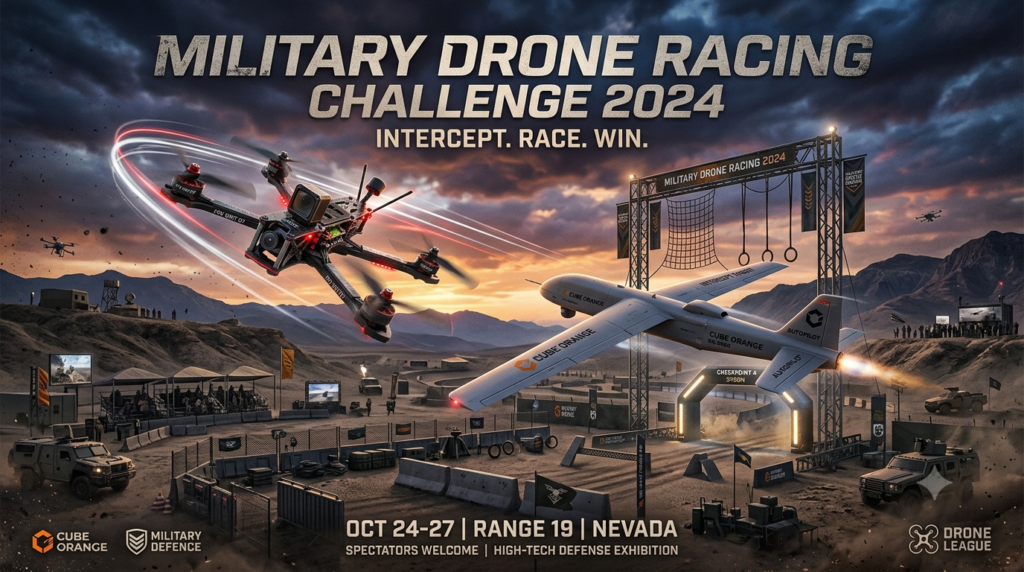
Military drone racing now includes live tactical intercepts, not just lap times. At the 2026 Military International Drone Racing Tournament (MIDRT) at the Royal Military Academy Sandhurst, teams of four pilots from 12 nations raced against the clock and had to intercept fixed-wing aircraft powered by CubePilot’s Cube Orange flight controller. The Australian Defence Force (ADF) team won the champion nation title for the eighth consecutive tournament. suasnewssuasnews
If you only know drone racing as glowing gates and screaming quadcopters, this tournament shows how far military drone racing has travelled. Pilots had to predict a moving aircraft’s path, close on it and strike under time pressure, then fly a complex assault course and deliver simulated munitions against multiple targets. suasnews
This guide explains what happened at Sandhurst, how the format works, why the Cube Orange autopilot matters, and what the event signals for defence training. Every section opens with a direct answer, so you can jump to whatever you need.
Quick Answer: What Happened at MIDRT UK 2026?
The 2026 MIDRT at Sandhurst combined speed, precision and tactical judgement, and Australia dominated both the team and individual titles. The key facts:
- Event: The Military International Drone Racing Tournament, held at the Royal Military Academy Sandhurst, England.
- Participants: Teams of four pilots from 12 nations.
- Challenges: Intercepting fixed-wing aircraft, navigating a complex assault course, and delivering simulated munitions against multiple targets.
- Team result: The ADF Drone Racing Team won for the eighth consecutive tournament, with Ukraine second on its debut. suasnews
- Individual result: Hamish Glover, a CubePilot test engineer and Australian Army Reservist, won the overall competition and was crowned the fastest military drone pilot in the world. suasnews
- Technology: CubePilot supplied several fixed-wing tactical aircraft, each powered by its Cube Orange flight controller. suasnews
Taken together, those facts show that military drone racing has become a test of decision-making as much as raw speed.
What Is Military Drone Racing?
Definition
Military drone racing is a competition in which armed forces personnel fly first-person-view (FPV) drones through timed courses and, increasingly, tactical challenges. Pilots wear goggles that stream live video from a camera on the aircraft, which gives them the feel of sitting on board. The drones are typically custom-built multicopters, most weighing less than 2 kg, flown through courses with multiple obstacles. contactairlandandsea
Expansion: Sport, Training and Capability
The sport began as a way to engage service members with technology. Australia’s Army Forces Commander described drone racing in 2018 as an emerging sport that encouraged interest in science, technology, engineering and mathematics among soldiers. It also works as an inclusive activity: drone racing is an authorised and encouraged adaptive sport in the Australian Army. defencecontactairlandandsea
That mix of recreation, skill-building and capability development explains why militaries keep investing in it. A pilot who can hold a precise line at speed, read a course and stay calm under pressure has learned skills that transfer to real uncrewed aircraft operations.
Why Do Armed Forces Take Part in Military Drone Racing?
Because racing builds the same reflexes, line choice and split-second decisions that tactical flying demands. Glover made this point directly: racing and tactical flying draw on the same core skills, and the track is where pilots build them. Wing Commander Keirin Joyce, President of the ADF Drone Racing Team, has said consistent results reflect the maturity of FPV drone racing in the ADF and show how the sport is growing in importance as both competition and a platform for developing FPV and drone capability. eos-aus
Competition also creates a shared space for allies. Between heats at the 2025 Sandhurst tournament, pilots shared techniques, exchanged lessons learned and strengthened bonds with international counterparts. The racing grabs the headlines, but the exchange between nations is a large part of the value. eos-aus
A Short History of Military Drone Racing Tournaments
2018: The First MIDRT in Sydney
The first Military International Drone Racing Tournament took place at Victoria Barracks in Sydney, from 18 to 21 October 2018. Teams came from Australia, Malaysia, New Zealand, Thailand, the United Arab Emirates, the UK and the US. The event ran in the lead-up to the Invictus Games, which gave it a natural link to adaptive sport. The Australian Army team won the inaugural team cup. defenceconnectcontactairlandandsea
At that stage the format was recognisably a racing event: obstacle courses, freestyle flying and team competition. The tactical element came later.
2025 and 2026: Sandhurst and Sydney
The tournament became a travelling series hosted by different nations. The 2025 edition was hosted by UK Forces at the Royal Military Academy Sandhurst, and the ADF team won the championship. In 2026, a post by a participant described the Sydney edition as the first time the ADF had hosted MIDRT with both racing and tactical activities. The tactical side now sits alongside the racing side as a permanent feature. eos-aus
2026: Sandhurst Returns With Twelve Nations
The 2026 Sandhurst event is the clearest sign of how far military drone racing has developed. With 12 nations competing, a debut from Ukraine, and a tactical range built around fixed-wing aircraft, the tournament has outgrown its origins as a novelty sport.
Inside the Tactical Range
What Is the Tactical Range?
The tactical range is the part of MIDRT where pilots move from lap times to mission-style tasks. In practice, military drone racing at this level asks pilots to do three things in one run: intercept a fixed-wing aircraft, navigate an assault course, and deliver simulated munitions against several targets. The scoring rewards speed, but it also rewards accuracy and judgement.
Why Is Intercepting a Fixed-Wing Aircraft Harder Than a Gate Course?
Because the target moves and thinks for itself, so the pilot cannot memorise the route. Intercepting a fixed-wing aircraft with a 5-inch FPV drone is far harder than flying a gate course: pilots must predict the target’s path, close on it and strike under time pressure. suasnews
A gate course is static. Once a pilot has flown it a few times, muscle memory takes over. FPV drone interception removes that comfort. The pilot has to:
- Read the target’s speed and heading from a small, fast-moving video feed.
- Choose an intercept line rather than follow a fixed one.
- Correct continuously as the target changes position.
- Commit to the strike at the right moment, with the clock running.
That is why many pilots describe interception as the point where racing stops being a sport and starts looking like a mission. FPV drone interception rewards anticipation more than raw stick speed.
How the Format Evolved: Sydney vs Sandhurst
The Sandhurst tactical range built on a format first seen in Sydney earlier in 2026. At MIDRT Australia 2026 in Sydney, pilots jousted with 7-inch FPV drones against Cube Orange-powered fixed-wing targets, and Sandhurst used 5-inch FPV drones. The table summarises the differences. suasnews
| Feature | MIDRT Australia 2026 (Sydney) | MIDRT UK 2026 (Sandhurst) |
|---|---|---|
| Location | Sydney, Australia | Royal Military Academy Sandhurst, England |
| Pilot drone class | 7-inch FPV drones | 5-inch FPV drones |
| Targets | Cube Orange-powered fixed-wing aircraft | Cube Orange-powered fixed-wing aircraft |
| Core task | Jousting against the fixed-wing targets | Intercept, assault course, simulated munitions |
| Competitors | International military teams | Teams of four from 12 nations |
| Technology partner | CubePilot | CubePilot (founding sponsor of the series) |
Moving from larger 7-inch drones to smaller 5-inch drones for the interception work suggests organisers are steadily raising the difficulty. Every change to the format pushes pilots toward the kind of precision real operations demand, which is a pattern military drone racing organisers appear to be following deliberately.
The Cube Orange: The Flight Controller Behind the Targets
Definition and Expansion
The Cube Orange is a flight controller, the “brain” that keeps an aircraft stable and on its programmed path. It has triple-redundant IMUs (inertial measurement units) and runs the open-source ArduPilot software. CubePilot, the Australian company that makes it, supplied the fixed-wing tactical aircraft that served as targets. suasnews
An IMU measures motion and orientation. Having three of them means the system can cross-check readings and keep flying sensibly if one sensor misbehaves. For a target aircraft, that is a practical advantage.
Why Redundancy Matters in a Tournament
A tournament needs targets that behave the same way every heat. The source article notes that the Cube Orange’s design supports reliability when flying target runs heat after heat. That consistency matters in military drone racing because fairness depends on it: if one target flew erratically, one team would face an easier or harder challenge than another. Reliable autopilots make the contest about the pilots, not about equipment luck.
What ArduPilot Adds
ArduPilot is open-source autopilot software used across many types of uncrewed vehicles. Because its code is open, it has a large community of developers and users, and it can be adapted to different aircraft and missions. In this case it flew fixed-wing targets around a tactical range. Pairing open-source software with well-engineered hardware like the Cube Orange flight controller is a common route to dependable, adaptable autonomy.
Hamish Glover: A Pilot Who Also Builds the Targets
Hamish Glover won the overall competition and was crowned the fastest military drone pilot in the world. He is a CubePilot test engineer and an Australian Army Reservist, so he sits on both sides of the event: he helps test the hardware that flew the targets, and he flies against it.
His result is a good illustration of how military drone racing rewards combined skill. Glover argues that the reflexes, line choice and split-second decisions built on a track are exactly what interception demands, and that the aim is to “race hard, learn fast” and keep building skills for a rapidly changing environment. A pilot with an engineer’s understanding of the aircraft may also read the targets’ behaviour better, though that is an inference rather than something the organisers have stated.
Sovereign Capability: The Strategic Story
Sovereign capability means a nation can design, build and operate critical technology with its own people. CubePilot CEO Philip Rowse frames it this way: Australia has world-class engineers and pilots, and the country has to keep investing in them. CubePilot is the founding sponsor of the MIDRT series, and Rowse says the company backed it from the start because the tournament develops exactly those people.
At Sandhurst, both halves of that idea were visible. Australian-made Cube Orange autopilots flew the targets, and an Australian engineer took the top individual prize. Seen through this lens, military drone racing is a talent pipeline as much as a spectator event: it identifies skilled pilots, tests domestic hardware in front of international peers, and keeps both visible to allies.
What Military Drone Racing Means for Training and Talent
Military drone racing offers a low-cost, repeatable way to train and select uncrewed-aircraft pilots. That is an analysis rather than an official statement, but the evidence points in that direction. Organisers have described career paths that run from cadets and veterans through to defence and industry roles for young FPV pilots. The practical benefits include:
- Skill development: Pilots practise precise control, fast decisions and situational awareness.
- Selection: Competition shows which pilots perform under pressure.
- Technology feedback: Engineers see how hardware holds up in demanding conditions.
- Alliance building: Teams from different countries swap techniques and lessons.
- Inclusion: The sport is open to a wide range of participants, including as an adaptive sport.
- Industry links: Manufacturers like CubePilot connect directly with the people who use the technology.
Ukraine’s second-place finish on its debut is also telling. A nation with intense practical experience of FPV drones chose to enter and performed strongly, which shows that the competition attracts serious operators rather than only enthusiasts.
Gate Racing vs Tactical Flying: A Comparison
Gate racing and tactical flying share core skills but differ in what they demand from the pilot. The comparison below draws on the tournament format and the pilots’ own descriptions of the two disciplines. It is the clearest way to understand how military drone racing is evolving.
| Aspect | Gate racing | Tactical flying (intercept and assault) |
|---|---|---|
| Course | Fixed, repeatable | Moving target plus assault course |
| Main challenge | Speed and line precision | Prediction, interception and accuracy |
| Memorisation helps? | Yes, heavily | Much less |
| Target behaviour | None (static gates) | Autopilot-flown fixed-wing aircraft |
| Time pressure | Lap time | Time to intercept and strike |
| Shared skills | Reflexes, line choice, split-second decisions | Reflexes, line choice, split-second decisions |
| Training value | Fundamental control | Mission-style decision-making |
Frequently Asked Questions
What Is the Military International Drone Racing Tournament?
The Military International Drone Racing Tournament (MIDRT) is an international competition in which military teams race and fly FPV drones. It began in Sydney in 2018, and it has since moved between host nations, including Sandhurst in England. The 2026 edition added tactical challenges built around fixed-wing aircraft.
Who Won MIDRT UK 2026?
The Australian Defence Force Drone Racing Team won the champion nation title, and Hamish Glover won the individual title. Ukraine finished second in the team standings on its debut.
What Is the Cube Orange?
The Cube Orange is a flight controller made by CubePilot. It has triple-redundant IMUs and runs ArduPilot, and it powered the fixed-wing aircraft used as targets at Sandhurst.
How Is Military Drone Racing Different From Civilian Drone Racing?
The key difference is the purpose and the format. Civilian leagues focus on pure speed around a course. The military version links the sport to training and capability development, and at MIDRT 2026 it added intercepts, an assault course and simulated munitions delivery. The competitors also come from armed forces rather than the general public.
What Size Were the FPV Drones at Sandhurst?
Pilots flew 5-inch FPV drones at Sandhurst. In Sydney earlier in 2026, they flew 7-inch FPV drones against the same type of fixed-wing targets.
Is Military Drone Racing Only About Speed?
No. Military drone racing also tests accuracy, prediction and tactical judgement. The Sandhurst format asked pilots to intercept a moving aircraft, handle an assault course and strike multiple targets. Speed helps, but a fast pilot who cannot predict the target’s path will lose time.
Key Takeaways
- MIDRT UK 2026 brought teams of four from 12 nations to Sandhurst for racing and tactical challenges.
- The ADF won the champion nation title for the eighth consecutive tournament, and Ukraine finished second on debut.
- Hamish Glover, a CubePilot engineer and Army Reservist, was crowned the fastest military drone pilot in the world.
- Cube Orange flight controllers flew the fixed-wing targets, using triple-redundant IMUs and ArduPilot for reliability.
- FPV drone interception is harder than gate racing because pilots must predict a moving target’s path and strike under time pressure.
- Sovereign capability is the strategic theme: Australian hardware, Australian engineers and Australian-trained pilots on one stage.
- Military drone racing now works as a training tool, a talent pipeline and a way for allies to exchange techniques.
Conclusion
The 2026 Sandhurst tournament shows how quickly the sport is changing. What began in 2018 as a racing event at Victoria Barracks has become a multi-nation competition where pilots intercept moving aircraft and deliver simulated munitions. Military drone racing is no longer only about who is fastest around a course; it is about who can think, predict and act fastest.
The Cube Orange flight controller sits at the centre of that shift, flying reliable targets so that the contest stays fair and repeatable. Together, the hardware, the pilots and the sovereign-capability argument make the case that these tournaments are worth watching, for sport fans and defence observers alike.