A biohybrid drone is a drone that uses a living insect antenna as its nose. A new water-retaining hydrogel electrode from Japanese researchers keeps that antenna’s odor responses usable for up to seven hours under tested indoor conditions. That result from Shinshu University and Chiba University targets the main reason a biohybrid drone has struggled to leave the laboratory: a detached antenna dries out, its signal degrades, and the electrical connection becomes unstable. shinshu-ushinshu-u
Picture a drone searching a collapsed building after an earthquake. Smoke, dust, and darkness can blind its cameras, but a silkworm moth’s antenna can still register faint chemical cues in the air. The catch is that antenna tissue is perishable, and an odor sensor that fades in an hour is not much use in a real rescue. This guide explains what the team built, what the data show, what the drone test did and did not prove, and where the technology could realistically go next.
Key Takeaways
- What it is: A biohybrid drone pairs a standard flying platform with a living silkworm moth antenna that acts as an odor sensor.
- The innovation: A hydrogel electrode keeps the antenna-to-electrode contact moist, which slows signal loss.
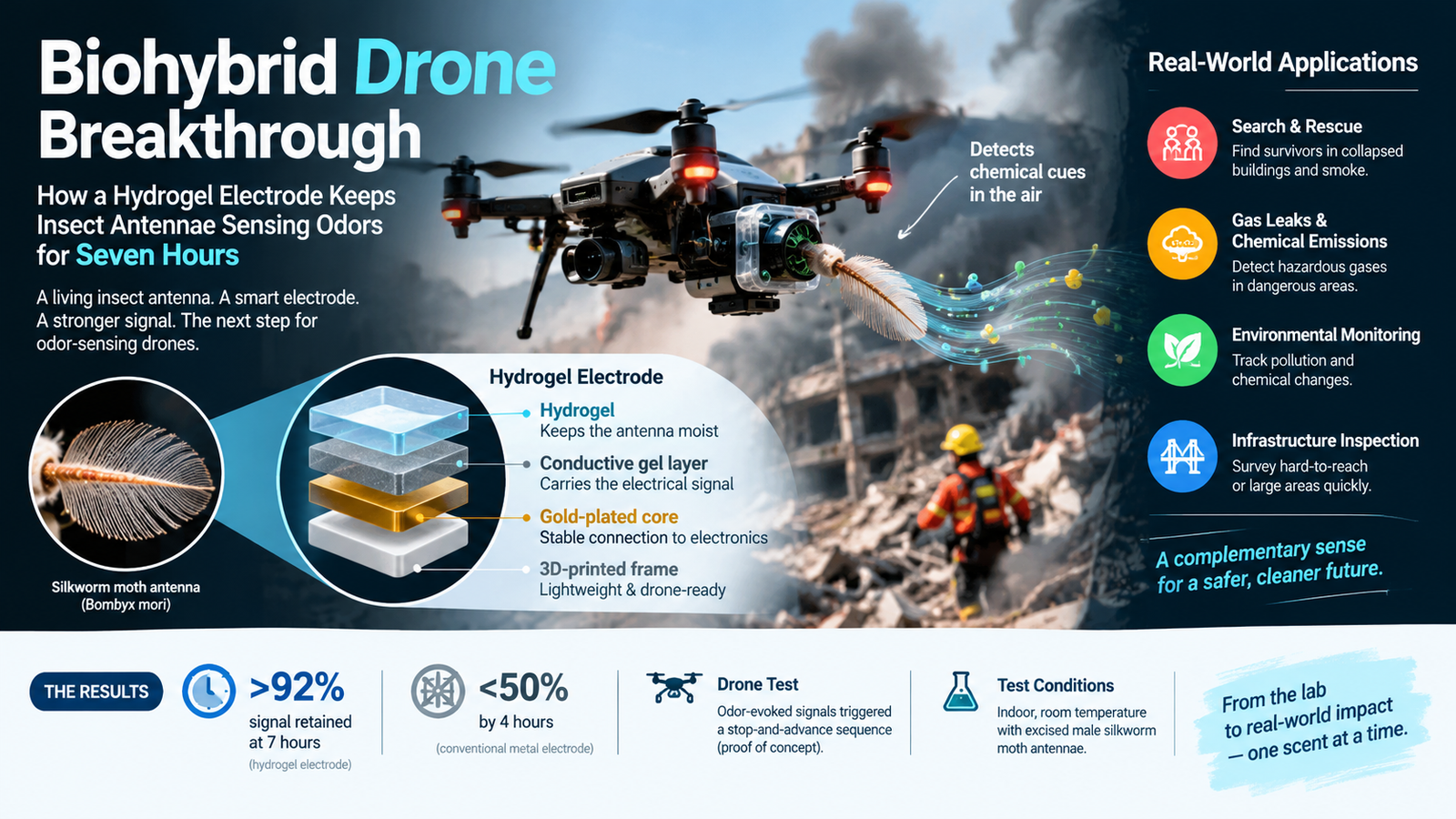
- The headline number: The hydrogel design retained more than 92% of its initial response after seven hours, while a conventional metal electrode fell below the study’s 50% usability threshold by hour four. shinshu-ushinshu-u
- The drone test: A proof-of-concept flight showed that odor-evoked signals could trigger a programmed stop-and-advance sequence. It did not demonstrate optimized odor-source localization. shinshu-u
- Why it matters: Longer sensor life is a prerequisite for any biohybrid drone that has to work outside a lab.
- Publication: The paper appears in Sensors and Actuators B: Chemical, available online since July 2, 2026, with print publication in Volume 467 on November 15, 2026. shinshu-u
What Is a Biohybrid Drone?
A biohybrid drone is a flying robot that combines conventional hardware, such as rotors, a flight controller, and onboard electronics, with a living biological component that serves as a sensor. The biological part does something engineered sensors still find difficult: it detects specific airborne chemicals with high sensitivity.
In this research line, the biological component is an excised antenna from a male silkworm moth (Bombyx mori). The antenna is attached to an electroantennogram (EAG) sensor, a system that measures the electrical responses of the antenna to odor stimuli. When odor molecules reach the antenna, its cells generate a small voltage change. The EAG sensor records that voltage, and the drone’s electronics can then act on it. thedebrief
How a Biohybrid Drone Differs from a Conventional Drone
A conventional drone navigates mostly by sight. Cameras, LiDAR, and similar sensors dominate. A biohybrid drone keeps all of that and adds chemical awareness. The difference is not that one flies better. The difference is what each can perceive.
| Feature | Conventional Drone | Biohybrid Drone |
|---|---|---|
| Primary sensing | Cameras, LiDAR, thermal imaging | Visual hardware plus a living insect antenna |
| Strength | Mature, durable, widely available | Detects airborne chemical signals |
| Weakness | Struggles in smoke, dust, and darkness | Biological sensor degrades over time |
| Maintenance | Standard hardware upkeep | Requires keeping the antenna hydrated and stable |
| Maturity | Commercial | Laboratory and proof-of-concept stage |
Why Do Drones Need a Sense of Smell?
Why add smell to a drone? Because visual sensors lose effectiveness in exactly the places where drones are most needed. The Shinshu University release notes that most drone systems rely primarily on cameras and visual sensors, which can fail in smoke, dust, darkness, or collapsed structures. Odor sensing offers a complementary channel. It can detect gas leaks and chemical emissions that cameras cannot see at all. shinshu-u
Insects are natural candidates for this job. Evolution has tuned their antennae to pick out specific chemical signatures from a noisy environment. The researchers behind this work have long argued that borrowing that biological hardware could give robots a head start over building artificial sensors from scratch. Their earlier studies, covered widely when published in npj Robotics, described a drone that could locate an odor source from about five meters away. thedebrief
An odor-sensing drone built on this principle does not replace vision. It adds a second sense, much as a search dog adds scent to a human rescuer’s eyes.
What Problem Did the Hydrogel Solve?
What was the bottleneck? The antenna’s lifespan on the electrode. Researchers described the core obstacle plainly: excised insect antennae gradually lose signal quality as they dry out and the electrical interface becomes unstable. The sensing tissue was never the only issue. The connection between tissue and electronics was equally fragile. shinshu-u
For a biohybrid drone, that fragility is a practical dealbreaker. A drone may need to fly a search pattern for an extended period. If the sensor’s signal drops sharply partway through a mission, the operator cannot trust a “no odor detected” reading. Stability matters as much as sensitivity.
The lead researcher, Associate Professor Daigo Terutsuki of Shinshu University, framed the team’s thinking this way: extending how far an odor-tracking drone can search is only part of the challenge, because the biological sensor also has to stay stable long enough to work on a moving platform. The team therefore targeted the antenna-electrode interface directly.
How the Hydrogel Electrode Works
The Layered Design
The new electrode is a composite. According to the release, it combines a hydrogel, a conductive gel layer, a gold-plated core, and a 3D-printed frame. Each part has a role: shinshu-u
- Hydrogel: Holds water and keeps the antenna’s contact point moist.
- Conductive gel layer: Carries the electrical signal between tissue and metal.
- Gold-plated core: Provides a stable, conductive path to the recording electronics.
- 3D-printed frame: Holds everything in a lightweight, reproducible structure suited to mounting on a drone.
The published paper’s title also specifies agar-based hydrogels, which are gels made from a plant-derived polysaccharide. That choice points toward a low-cost, easily prepared material rather than an exotic one.
Why Moisture Is the Key Variable
Think of the hydrogel as a tiny humidifier built into the contact point. An excised antenna is living tissue, and living tissue works through wet chemistry. As the tissue dries, ions can’t move as readily, and the antenna’s electrical response weakens. A dry contact also raises electrical resistance and introduces noise.
By holding water near the interface, the hydrogel electrode aims to preserve both the biology and the electronics at once. The researchers also took electrochemical impedance measurements, which supported more stable electrical coupling in the hydrogel assembly during the first hour. Impedance is a measure of how much a connection resists signal flow, so a steadier reading suggests a steadier link. shinshu-u
This is the central idea: you do not need a more sensitive antenna if you can stop losing the signal you already have.
The Results: Seven Hours Versus Four
How much better is the hydrogel electrode? In the team’s tests on excised male silkworm moth antennae, the difference was substantial. Under indoor, room-temperature conditions, the hydrogel electrode kept more than 92% of its initial EAG response amplitude after seven hours. The conventional grooved gold-plated metal electrode dropped below the study’s 50% practical-usability threshold by four hours. shinshu-ushinshu-u
| Metric | Conventional Grooved Gold-Plated Electrode | Hydrogel Electrode |
|---|---|---|
| Material approach | Metal contact | Water-retaining hydrogel with conductive gel layer |
| Signal at 4 hours | Below 50% of initial response | Still strongly responsive |
| Signal at 7 hours | Not usable by the study’s threshold | More than 92% of initial response |
| Test conditions | Indoor, room temperature | Indoor, room temperature |
| Antenna source | Excised male Bombyx mori antenna | Excised male Bombyx mori antenna |
Note the careful framing of the 50% figure. It is a threshold the researchers defined in advance for what counts as practically usable. That is good scientific practice, because it prevents the goalposts from moving after the data arrive.
For any team evaluating a biohybrid drone for field work, the practical translation is straightforward. A sensor window of roughly seven hours is long enough to plan meaningful missions. A window of under four hours is not.
From Bench to Flight: What the Drone Test Showed
What the Team Demonstrated
A stable sensor on a lab bench is only half the story. The team also asked whether the stabilized sensor could operate on a moving platform, so they mounted it on a lightweight drone. In proof-of-concept experiments, the sensor detected odor-evoked EAG signals. In separate free-flight tests, EAG threshold crossings triggered a programmed stop-and-advance sequence. water retaining hydr +2
In plain terms: when the antenna sensed an odor strongly enough, the drone responded by moving forward. That shows the biological signal can feed directly into flight behavior.
What the Team Did Not Claim
Precision matters here, and the researchers were careful about it. The release states that these experiments showed the stabilized interface can support drone-mounted odor sensing, rather than demonstrating optimized odor-source localization. shinshu-u
That means the experiment did not show a fully autonomous biohybrid drone tracking an odor plume to its source. It showed that the sensing link survives mounting, vibration, and flight long enough to be useful. Readers who see this work summarized as “drone finds odor sources with moth antennae” should know that the specific result here is narrower, and more defensible.
How This Fits the Earlier Biohybrid Drone Research
This hydrogel study is one step in a multi-year program. Understanding the sequence explains why the hydrogel matters.
An earlier version of the system was limited. Coverage of the follow-up work noted that the first version’s odor-detection range was about two meters. The team then redesigned the electrodes and the EAG sensor to better match silkworm moth antenna structure. They also added a “stepped rotation algorithm” that mimics the way insects pause while tracking odors. Those changes extended the effective range to about five meters. hacksterinterestingengineering
| Stage | Main Focus | Reported Outcome |
|---|---|---|
| Early prototype | Proving antenna-based odor detection on a drone | Odor-detection range of roughly 2 meters |
| Behavior-inspired redesign | Insect-like stepped rotation, better electrodes and EAG sensor | Effective range up to about 5 meters |
| Hydrogel electrode study (2026) | Long-term sensor stability on the interface | More than 92% signal retained at 7 hours; proof-of-concept flight |
Each generation of the biohybrid drone solved a different bottleneck. First came range, then behavior, then durability. The hydrogel result is arguably the most important for deployment, because a sensor with excellent range is still useless if it expires before the mission ends.
Real-World Applications
Search and Rescue After Earthquakes
The most frequently cited use case is disaster response. Dr. Terutsuki noted that in disaster-prone regions such as Japan, longer-lasting biological odor sensors could become a key component of future search-and-rescue systems after earthquakes. Earlier coverage of the research line likewise described the goal of helping responders locate survivors by tracking odors when every second counts. shinshu-utechspot
The logic is that human scent and other chemical traces persist in air even when line of sight is blocked. A drone that can follow those cues into rubble-filled or smoke-filled spaces could extend rescuers’ reach.
Gas Leaks and Chemical Emissions
In industrial settings, the researchers suggest that these sensors could enable mobile detection of gas leaks or chemical emissions in areas that are difficult or dangerous for humans to access. A flying odor-sensing drone could survey a facility’s perimeter or a hazardous site without putting a technician at risk. shinshu-u
Infrastructure Inspection and Environmental Monitoring
The release also lists infrastructure inspection and environmental monitoring among future directions. Here the value is repeated, mobile coverage. A drone can sample air across a wide area far faster than a person with a handheld device.
A biohybrid drone is not meant to replace cameras or engineered gas sensors. It is meant to complement them. The strongest near-term pitch is a specialized sensing layer for situations where vision fails and chemical cues matter.
Limitations and Open Questions
Honest reporting on a promising technology includes the caveats. Several remain open:
- Controlled conditions: The seven-hour result was measured under indoor, room-temperature conditions. Heat, wind, humidity swings, and dust in real disaster zones could change performance.
- Biological lifespan: Reporting on the earlier system noted the relatively short lifespan of the biological components, with researchers exploring ways to preserve or artificially replicate antennae. hackster
- Maintenance and housing: Coverage of the earlier work emphasized that maintenance protocols and protective housings will be crucial for real-world deployment. thedebrief
- Localization performance: The flight test demonstrated signal-triggered movement, not optimized source-finding.
- Scalability: Preparing, mounting, and replacing living antennae on demand is a logistics question the field has yet to answer at scale. This is a practical consideration rather than a finding from the study.
A biohybrid drone depends on a living part, and that dependency is both its advantage and its constraint. Seven hours is a meaningful step forward, but it is not an unlimited operating window.
Frequently Asked Questions
Is a biohybrid drone a real, flying drone?
Yes. The research team mounted the stabilized sensor on a lightweight drone and ran proof-of-concept flight tests. It remains a research prototype rather than a commercial product.
How long does the hydrogel electrode keep the antenna working?
Up to seven hours in the team’s indoor, room-temperature tests, with more than 92% of the initial EAG response amplitude retained.
Which insect provides the antenna?
The tests used excised antennae from male silkworm moths (Bombyx mori).
What does an EAG sensor do?
An electroantennogram sensor records the electrical response of an insect antenna when it is exposed to an odor. It converts a biological reaction into a signal that electronics can read.
Can the drone find an odor source on its own?
Not in this study. The flight tests showed that EAG threshold crossings could trigger a stop-and-advance sequence. The researchers explicitly did not present this as optimized odor-source localization.
Who conducted the research?
Associate Professor Daigo Terutsuki led the work at Shinshu University, with graduate student Reina Omori, undergraduate student Kie Kondo, and Associate Professor Yosuke Kageshima of Shinshu, plus Associate Professor Toshiyuki Nakata of Chiba University.
Where was it published?
In Sensors and Actuators B: Chemical, under the title “Engineering electroantennogram interfaces through agar-based hydrogels for multi-hour recording and drone-mounted biohybrid odor sensing.”
Will a biohybrid drone replace electronic gas sensors?
There is no evidence of that yet. The more realistic role is complementary: adding biological sensitivity where conventional sensing struggles.
What to Watch Next
The next milestone for the biohybrid drone is likely a combination of the team’s earlier and later advances: insect-inspired search behavior plus a stable, long-lived interface, tested in less controlled environments. Watch for outdoor trials, protective housings, and any progress on preserving or replacing antennae. Those developments would show whether the idea can move from proof of concept toward fieldable tools.
Conclusion
The hydrogel electrode does not make an insect antenna more sensitive. It keeps the connection stable, and for a biohybrid drone, stability is what separates a clever demonstration from a usable sensor. By holding moisture at the antenna-electrode contact, the Shinshu and Chiba teams extended usable recording to seven hours, well beyond the four hours at which a conventional metal electrode fell below the usability threshold.
The honest summary is this: the research clears a major hurdle and supports drone-mounted odor sensing, but outdoor performance and full odor-source localization remain to be shown. If those pieces follow, a biohybrid drone could become a specialized tool for search and rescue, hazardous gas detection, and environmental monitoring.